St. Lydia of Thyatira, Seller of Purple
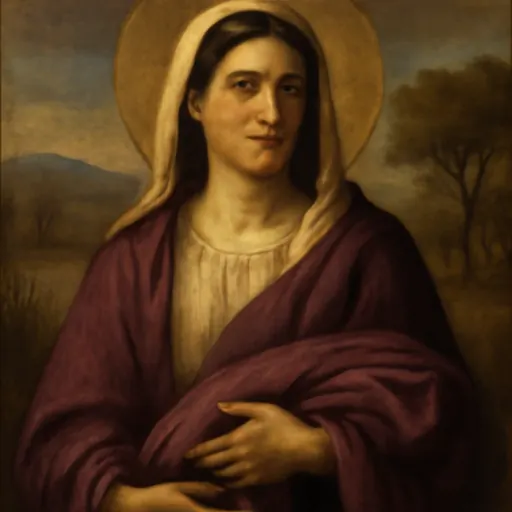
St. Lydia of Thyatira was a seller of purple cloth and the first person in Europe recorded as baptized. St. Paul met her by the river outside Philippi; she believed, was baptized with her household, and opened her home to the apostles. Her feast is August 3 in the Roman Martyrology and May 20 in the Greek Orthodox Church.
Who was St. Lydia of Thyatira?
St. Lydia of Thyatira was a merchant of purple cloth living at Philippi in Macedonia, and the first person in Europe whom Scripture names as believing in Christ and being baptized. St. Paul met her by a river on a Sabbath morning around the year 50. In a few verses of Acts we see her listen, believe, bring her whole household to baptism, and throw open her home to the apostles. Her house became the first church of Philippi.
The Roman Martyrology remembers her simply: "At Philippi, in Macedonia, holy Lydia, a seller of purple, who was the first of all to believe the Gospel there at the preaching of the holy Apostle Paul." The Orthodox Church honors her with the title Equal of the Apostles.
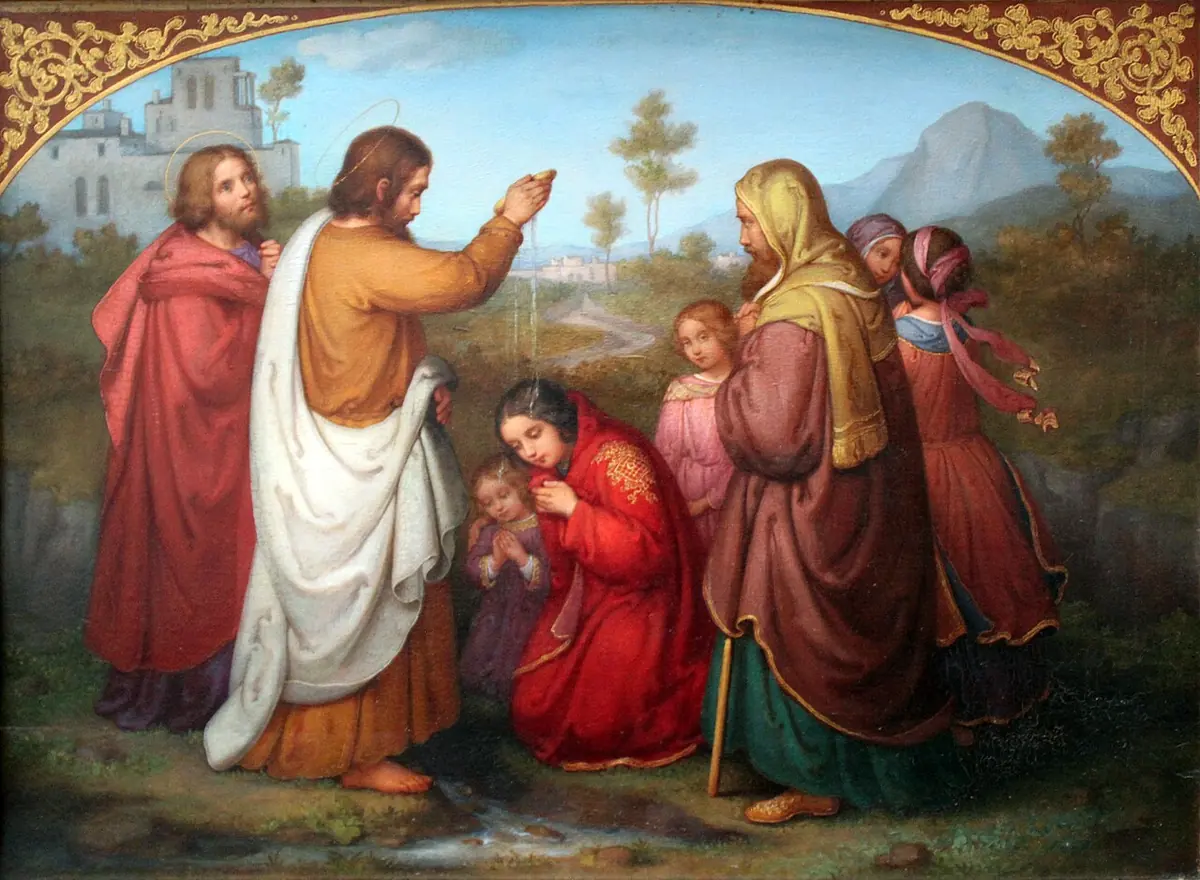
The story of Lydia in Acts
Paul crosses into Europe
On his second missionary journey Paul was at Troas, on the coast of Asia Minor, when he saw in a night vision a man of Macedonia pleading, "Pass over into Macedonia, and help us." He sailed at once with Silas, Timothy and Luke, who from here tells the story as an eyewitness, writing "we." They landed at Neapolis and went inland to Philippi, a Roman colony on the Via Egnatia.
By the river on the Sabbath
Philippi seems to have had no synagogue, so on the Sabbath the missionaries went looking for the Jews and God-fearers at prayer:
And upon the sabbath day, we went forth without the gate by a river side, where it seemed that there was prayer; and sitting down, we spoke to the women that were assembled.
Among the women was Lydia. Luke gives her a careful introduction: "a seller of purple, of the city of Thyatira, one that worshipped God." Thyatira, today Akhisar in western Turkey, was known for its dyers. Purple cloth was costly, so Lydia was very likely a woman of some means. "One that worshipped God" means she was a Gentile who already prayed to the God of Israel.
Then comes the line that makes her story so tender: she "did hear: whose heart the Lord opened to attend to those things which were said by Paul." Her faith was a gift from God before it was her own choice.

Baptism and an open door
Lydia was baptized "and her household," which probably included family members, servants and workers. Straight away she put her home at the apostles' service:
If you have judged me to be faithful to the Lord, come into my house, and abide there. And she constrained us.
"She constrained us," Luke adds. She would not take no for an answer.
The church in her house
Paul's stay in Philippi ended in trouble. After he freed a slave girl from a spirit of divination, her owners had Paul and Silas beaten and jailed. That night an earthquake opened the prison, and the jailer and his family were baptized. When the magistrates released them the next day, the apostles went straight back to Lydia:
And they went out of the prison, and entered into the house of Lydia; and having seen the brethren, they comforted them, and departed.
By then there were "brethren" meeting in her house. The beaten missionaries were comforted, and the new Christians were comforted too. Paul's later Letter to the Philippians is the warmest he wrote, full of thanks for a church that supported him "from the first day." Lydia is not named in it, and we do not know what became of her.
Miracles and legends
No miracles are told of Lydia herself, and no early legend adds to her story. What Scripture gives is the quiet miracle of grace: the Lord opened her heart. A traditional belief, not found in Acts, locates the place of her baptism on the stream near ancient Philippi, and today the village there is named Lydia.
Why St. Lydia is honored as a patron
Because she dealt in purple, dyers and textile workers have long counted her as one of their own. Women in business see in her a capable merchant who brought her work and her household to Christ. Her pressing invitation, "come into my house," makes her a natural patron of Christian hospitality. These are patronages of popular devotion; see more on our patron saints page.
Symbols of St. Lydia in art
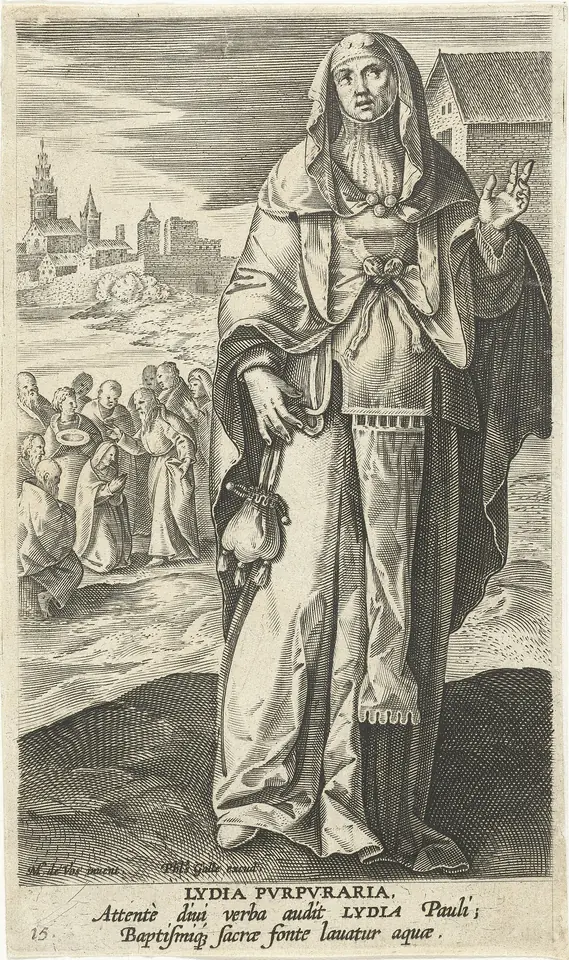
- Purple cloth: her trade, and the surest sign of who she is. In the engraving on this page she holds her goods in her arms.
- River and baptism: Western artists, like Marie Ellenrieder, show her kneeling at the water's edge as Paul baptizes her.
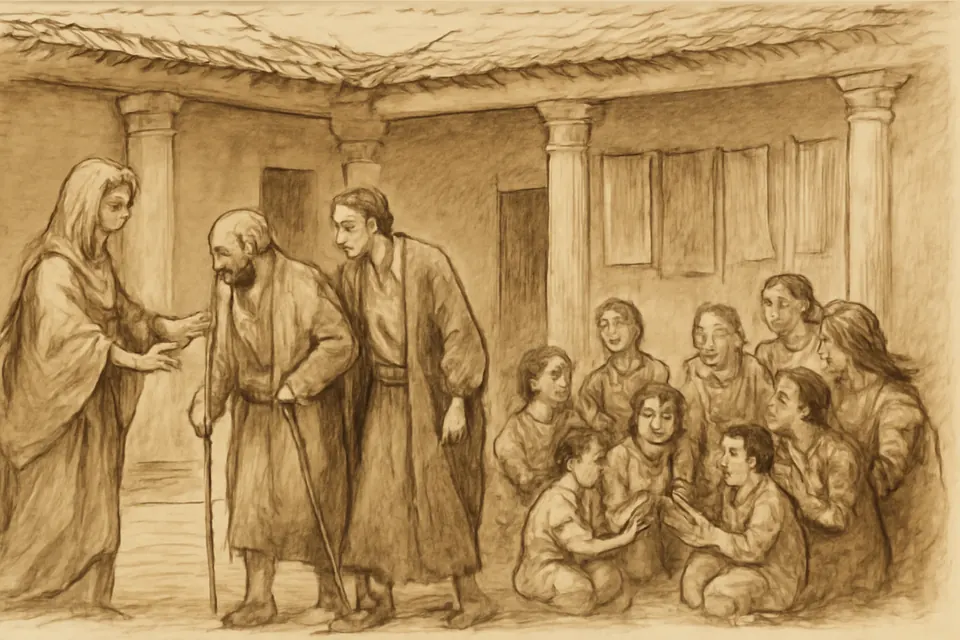
- Doorway or house: her hospitality, sometimes shown as Paul and Silas arriving at her door.
- Eastern icons: she appears as a holy woman in a veil and mantle, often purple or red, holding a cross or a scroll.

Feast day and the shrine at Philippi
We keep her memory on August 3 in the Roman Martyrology. The Greek Orthodox Church keeps May 20, and the Slavic churches March 23. According to the Orthodox Church in America, the Church of Constantinople glorified her formally on May 23, 1972.
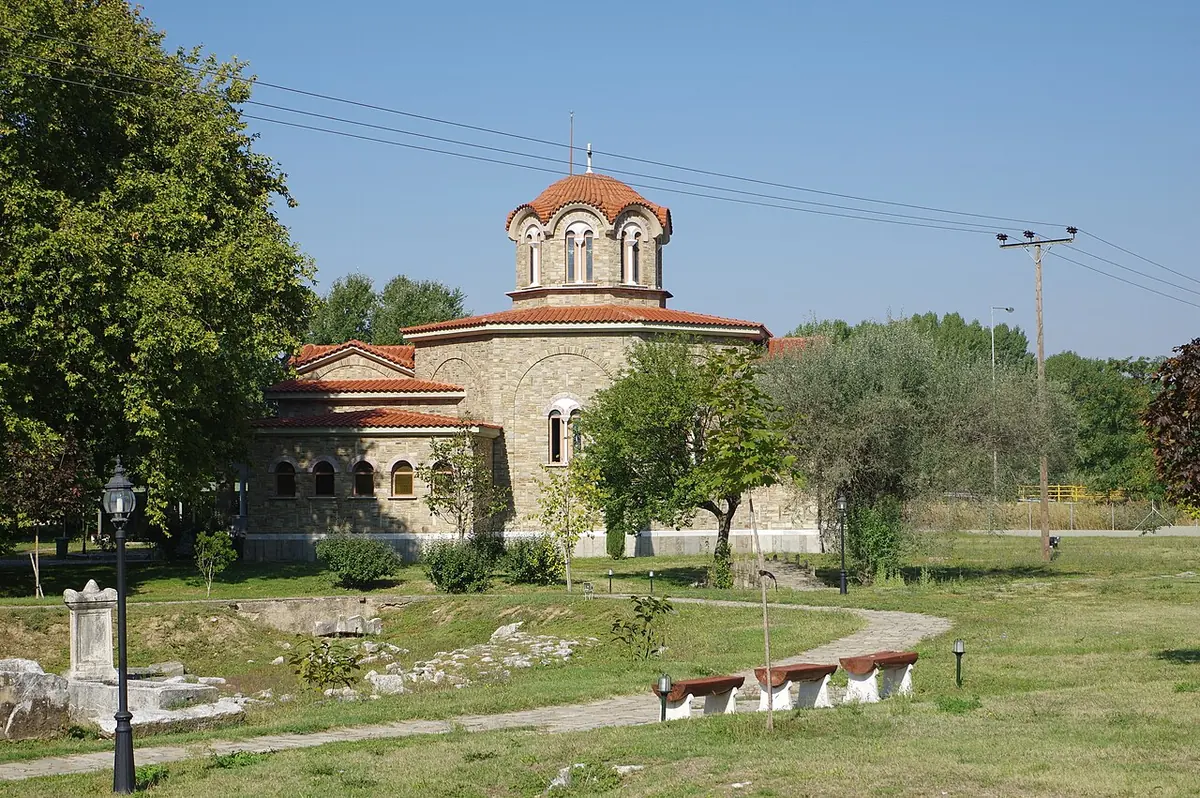
Pilgrims to Philippi visit the Baptistery of St. Lydia in the village of Lydia, a modern church built in the style of the early Christian basilicas of Philippi, and the stone steps where baptisms are still celebrated in the stream. Browse other saints of these days on our feast days page.
Prayer to St. Lydia
There is no traditional Western prayer to St. Lydia. We can pray with the words of her own story, asking that the Lord open our hearts as he opened hers, and that our homes be as open to Christ and his servants as hers was.
Let us ask St. Lydia to pray for women in business and all who work with their hands, for families who share the faith in their homes, and for every heart that is beginning to listen.
Frequently asked questions
Who was Lydia in the Bible?
A woman from Thyatira in Asia Minor who lived at Philippi and dealt in purple cloth. Acts 16:14 calls her 'a seller of purple, of the city of Thyatira, one that worshipped God,' and says 'the Lord opened' her heart to Paul's preaching. She was baptized with her household and hosted Paul, Silas, Timothy and Luke.
Why is Lydia called the first convert in Europe?
Philippi lay in Macedonia, and Paul crossed there from Troas after a vision of a Macedonian calling for help. Lydia is the first person Acts names as believing and being baptized on European soil.
What is St. Lydia the patron saint of?
Popular devotion takes her as patron of dyers and cloth workers, because of her trade in purple, and of businesswomen and hospitality. These patronages grow from her story in Acts, not from an official decree.
When is the feast of St. Lydia?
August 3 in the Roman Martyrology. The Orthodox Church keeps May 20 in Greek usage and March 23 in Slavic usage, and honors her with the title Equal of the Apostles.
Keep exploring
Sources
- Acts of the Apostles, chapter 16 (Douay-Rheims), Bible Gateway. Scripture quoted on this page
- Saint Lydia of Philippi, Orthodox Church in America. Her Eastern feasts, the title Equal of the Apostles, the baptistery, and her glorification by Constantinople in 1972
- Roman Martyrology (1916 English translation), August 3, Divinum Officium project. Her Martyrology entry, quoted on this page