Blessed Mark of Aviano, Capuchin Preacher and the Siege of Vienna
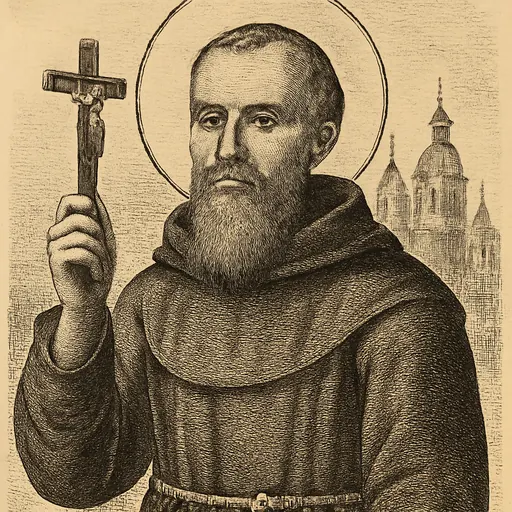
Blessed Mark of Aviano (1631–1699) was a Capuchin preacher whose blessing was followed by so many healings that rulers across Europe begged for his visits. Friend and spiritual guide of Emperor Leopold I, he served as papal legate at the relief of Vienna in 1683. John Paul II beatified him in 2003, and his feast is August 13.
Who was Blessed Mark of Aviano?
Blessed Mark of Aviano was a Capuchin friar from Friuli who became, almost against his will, one of the best-known men in seventeenth-century Europe. He preached repentance, led great crowds in an act of perfect contrition, and blessed the sick, and so many healings followed his blessing that kings, princes and the emperor himself asked for him. He became the friend and conscience of Emperor Leopold I and was with the Christian armies when Vienna was saved from the Ottoman siege in 1683. He called himself the "spiritual physician of Europe." We keep his feast on August 13.
The life of Blessed Mark of Aviano
A runaway to the war
He was born Carlo Domenico Cristofori at Aviano on November 17, 1631, one of eleven children in a well-off family, and baptized the same day. From 1643 to 1647 he studied with the Jesuits at Gorizia.
Venice was then fighting the Ottoman Empire for Crete in the long War of Candia. Young Carlo, eager to give his life for the faith, ran away from school to reach the war. He got as far as Capodistria, starving and exhausted, and knocked at the door of the Capuchin friary. The superior fed him and wisely sent him home. But those few days with the friars changed his direction. In September 1648 he entered the Capuchin novitiate at Conegliano, and on November 21, 1649, he made his vows and took the name Mark of Aviano. He was ordained a priest at Chioggia on September 18, 1655.
A hidden friar
For years he lived the ordinary Capuchin life of prayer and community. From 1664 he preached Lent and Advent missions across Italy, and he served as superior at Belluno in 1672 and at Oderzo in 1674.
Everything changed on September 8, 1676. Preaching at the convent of San Prosdocimo in Padua, he blessed Sister Vincenza Francesconi, who had been bedridden for about thirteen years, and she was healed at once. Similar events followed in Venice a month later, and crowds began to follow him.

His preaching stayed short and plain. He called his hearers to faith, to sorrow for sin and to penance, had them all recite the act of perfect contrition together, and then gave his blessing.
The friar Europe asked for
For the last twenty years of his life he traveled, always under obedience to his superiors or on orders from the Holy See, through Germany, France, Belgium, Holland, Switzerland, Bohemia and Austria. Rulers competed for his visits, among them Charles of Lorraine, the Elector of Bavaria, King Charles II of Spain and King John Sobieski of Poland.
In 1681 he passed through the Low Countries. A Rijksmuseum print from that year shows thirteen healings reported in Antwerp, Brussels, Aachen and other towns. In Ghent, in June 1681, according to the record of the painting now in the city museum (STAM), a family healed at his blessing paid Pieter Le Plat to paint the scene on the Friday Market.

Leopold I and the siege of Vienna
He first met Emperor Leopold I at Linz in September 1680. From then until his death he was the hesitant emperor's friend, adviser and spiritual father, in family, political and religious matters alike. At the insistence of the emperor and on orders from Rome he went to the imperial court fourteen times.
In 1683 an Ottoman army besieged Vienna. Father Mark joined the relieving forces as papal legate and missionary apostolic. His work was to hold the quarreling allied commanders together, call the soldiers to a Christian life and care for their souls. On September 12, 1683, the city was freed. Tradition holds that he said Mass for the army on the heights above the city that morning. From 1683 to 1689 he stayed with the campaigns, through the recapture of Buda on September 2, 1686, and of Belgrade on September 6, 1688, and afterward he worked for peace between France and the Empire.

His death
In May 1699 he made his last journey to Vienna, already sick. The imperial family visited him in the friary on August 2. On August 12 the nuncio brought him the blessing of Pope Innocent XII, and he received the last sacraments and renewed his vows. He died on August 13, 1699, holding a crucifix, with Emperor Leopold and Empress Eleonora at his side. The emperor buried him near the imperial tombs and, hoping for his beatification, had his remains moved four years later to a chapel of the Capuchin Church, where they rest today. Pope John Paul II beatified him on April 27, 2003.
The miracles of Blessed Mark of Aviano
- Reported: the healing of Sister Vincenza Francesconi at Padua in 1676, the event that made him famous.
- Reported: many healings during his journeys, recorded in prints and paintings of the 1680s, among them the Heynderycx family of Ghent in 1681.
- Approved: a miracle recognized by the Church for his beatification in 2003.

Symbols of Blessed Mark of Aviano in art
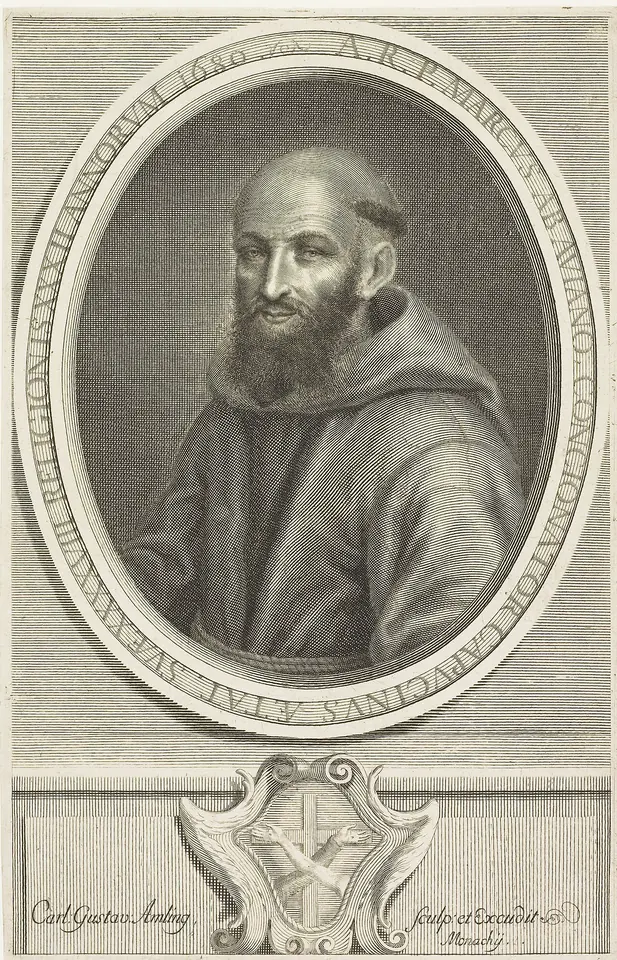
Portraits made in his lifetime agree on his look:
- The Capuchin habit with its pointed hood and cord, and a long beard, the mark of the Capuchin reform;
- A crucifix raised high, for his preaching and his blessing of the armies;
- A hand lifted in blessing over kneeling crowds and the sick, as in Le Plat's painting.
Feast day and prayer
We keep the feast of Blessed Mark of Aviano on August 13. His tomb is in the Capuchin Church in Vienna, and his birthplace, Aviano, honors him too. See the feast day calendar.
We know of no traditional prayer to him that we can quote. We can pray the way he taught the crowds to pray: with an act of perfect contrition, sorry for our sins because they offend God, who is all good. Let us ask Blessed Mark to pray for peace among nations, for the sick, and for a Europe that remembers its Christian roots. Blessed Mark of Aviano, pray for us.
Frequently asked questions
Who was Blessed Mark of Aviano?
A Capuchin friar born Carlo Domenico Cristofori at Aviano in Friuli in 1631. A preacher of repentance, he traveled through Italy, Germany, France, Flanders, Switzerland, Bohemia and Austria, led crowds in the act of perfect contrition, and blessed the sick. He was adviser to Emperor Leopold I and died in Vienna on August 13, 1699.
What did Mark of Aviano do at the Battle of Vienna?
He was with the relieving armies in 1683 as papal legate and missionary apostolic. His task was to keep the allied commanders united, call the soldiers to a Christian life and care for them spiritually. The Dicastery for the Causes of Saints credits him with a decisive personal part in the liberation of Vienna on September 12, 1683. He went on with the armies to the recapture of Buda in 1686 and Belgrade in 1688.
Did Mark of Aviano invent the cappuccino?
No. A popular modern story connects him with coffee after the siege of Vienna, but there is no record of it from his time. The drink's name recalls the brown habit of the Capuchin friars.
Where is Mark of Aviano buried?
In the Capuchin Church in Vienna. Emperor Leopold I had him buried near the imperial tombs and, four years later, had his remains moved to a chapel of the church, where they still rest.
Keep exploring
Sources
- Dicastery for the Causes of Saints: Marco d'Aviano. His birth, schooling in Gorizia, Capuchin vows and ordination, the 1676 healing in Padua, his journeys and friendship with Leopold I, the campaigns of 1683–1689, his death and burial
- John Paul II, Homily for the beatification of six Servants of God, April 27, 2003. The beatification, and the pope's words on him as an "unarmed prophet of divine mercy"