St. Susanna of Rome, Virgin and Martyr
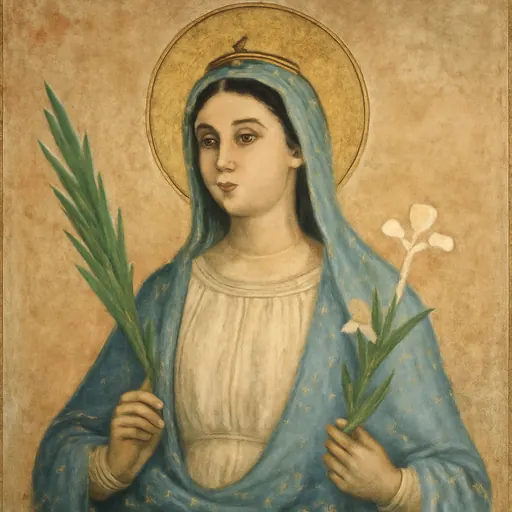
St. Susanna of Rome was a young Christian woman martyred in Rome around 295, in the persecution of the Emperor Diocletian. Tradition says she was the daughter of the priest St. Gabinus and the niece of Pope St. Caius, and that she was beheaded in her own home after refusing to marry the emperor's son. Her feast day is August 11, and she is honored as a virgin martyr and co-patron of Santiago de Compostela. She is not the Susanna of the Book of Daniel.
Who was St. Susanna?
St. Susanna of Rome was a young Christian woman who gave her life for Christ in Rome around the year 295, in the last great persecution of the Church under the Emperor Diocletian. The Roman Martyrology remembers her on August 11 as "the holy virgin Susanna, a woman of noble race, and niece of the blessed Pontiff Caius," who "merited the palm of martyrdom by being beheaded in the time of Diocletian."
Her name is shared with several other holy women, so it helps to be clear from the start. This St. Susanna is not the Susanna of the Book of Daniel, the Old Testament wife rescued from false witnesses by the prophet Daniel. She is a Roman martyr of the 3rd century, and the church that bears her name stands near the Baths of Diocletian in the center of Rome.

What we know of her life comes from two kinds of witness. The first is very old and very sober: her name in the earliest lists of Roman martyrs, her feast on August 11, and a church in Rome that has carried her name for more than fourteen centuries. The second is her Passio, the story of her martyrdom written down between about 450 and 500, which tells a vivid tale of a family of saints, an imperial marriage refused and a death in her own home. The Church has kept both. We honor the martyr the old lists remember, and we read the Passio for what it is, a devout story built around her memory.
Which St. Susanna? Telling the Susannas apart
Many people searching for "St. Susanna" are looking for one of several women. Here is how to tell them apart.
- St. Susanna of Rome (this page): virgin and martyr, died about 295, feast August 11. Her church is Santa Susanna in Rome.
- Susanna in the Book of Daniel: the heroine of Daniel 13, a married woman of Babylon, falsely accused of adultery by two elders after she refused them, and saved when the young Daniel questioned the elders separately and caught them in their lie. Her story is in Catholic and Orthodox Bibles.
- Susanna the disciple: one of the women who followed Jesus and "provided for them out of their means" (Luke 8:3).
- St. Susanna U Sur-im: one of the Korean martyrs, killed in 1846 and canonized in 1984, honored with St. Andrew Kim Taegon and companions on September 20.
- St. Shushanik (Susanna) of Georgia: a 5th-century Armenian princess and queen, martyred by her husband, honored in the Georgian and Armenian churches.
The story of St. Susanna
The account below is the one told in her Passio and repeated by later writers. It is legend built on a real martyrdom, and we tell it as tradition.
A family of saints
Tradition gives Susanna a remarkable family. Her father was Gabinus, a priest, and her uncle was Caius, bishop of Rome from 283 to 296. The Roman Martyrology honors St. Gabinus on February 19 as a "priest and martyr, brother of the blessed pope Caius," who died after long imprisonment under Diocletian, and Pope St. Caius on April 22. The two brothers, the Passio says, owned neighboring houses near the place called "the two laurel trees" on the Quirinal Hill, and Christians gathered there to pray.
The family was said to be well born and related to the emperor himself. This detail sets up the drama of the story: Susanna was a young woman whose marriage mattered to the most powerful man in the Roman world.
The emperor's proposal
Diocletian, according to the Passio, wanted Susanna to marry his adopted son and co-ruler, Maximian. Messengers came to the house with the proposal and every pressure that rank and family could bring. Susanna answered that she had already given herself to Christ and would have no other bridegroom.
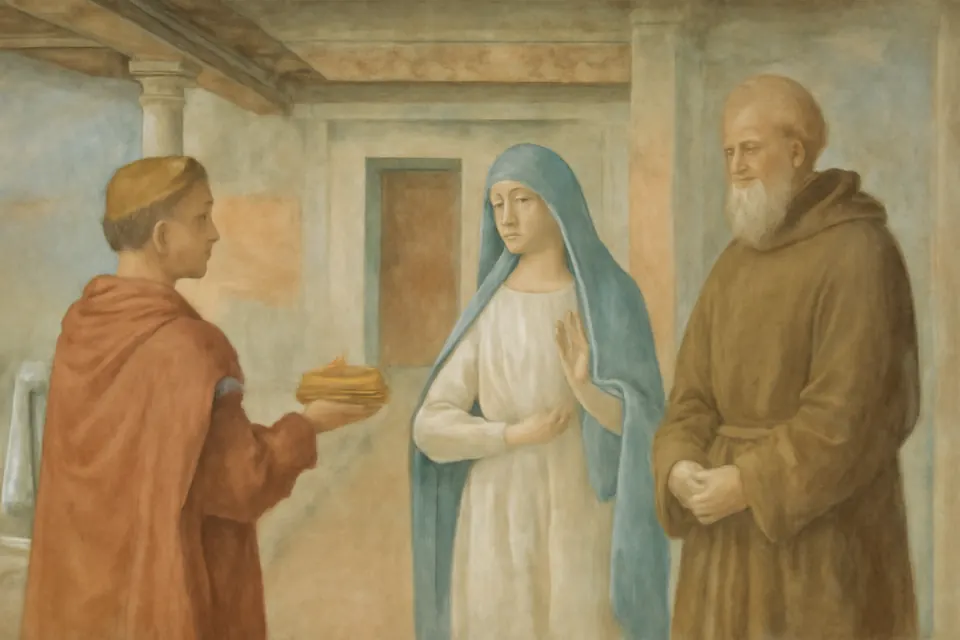
Her refusal was not only a matter of marriage. To accept would have meant entering a pagan court and honoring its gods. Later artists show the next step in the story: Susanna brought before a statue of Jupiter and ordered to offer incense, and refusing again. Cesare Nebbia, who painted the apse of her church in the 1590s, chose that scene of a refused sacrifice for one of his frescoes.
Martyrdom in her own home
Diocletian, the story goes, gave the order that she should die. Soldiers came to the house of Gabinus, and Susanna was beheaded there, in her father's home, around the year 295. The Catholic Encyclopedia sums up the tradition: "She was beheaded about the year 295, at the command of Diocletian, in her father's house."
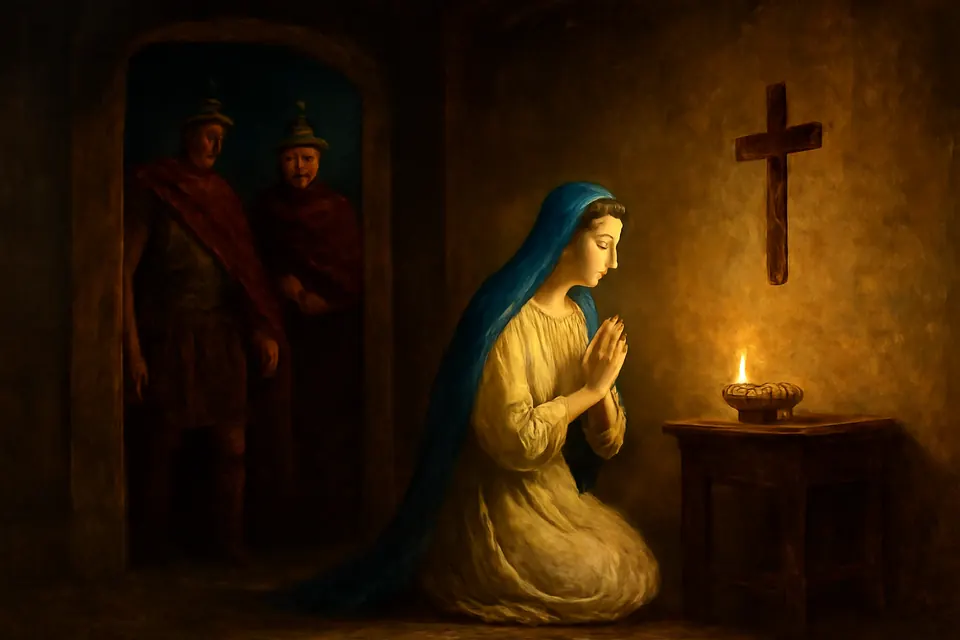
The house of Gabinus and the house of Caius next to it were afterward joined and turned into a church. In the Middle Ages it was known as Santa Susanna ad duas domos, "St. Susanna at the two houses."
What history can tell us about St. Susanna
It would be easy to dismiss the whole story because the Passio is late. The Church has never done that, and neither should we.
The Catholic Encyclopedia of 1912 states the matter plainly: "The authenticity of the Acts of Sts. Sebastian and Susanna has been rightly questioned; however, the martyrdoms and the day of death (11 August) are established by the witness of the oldest Martyrologies and the earliest places of worship." In other words, the details of the story may be literary, but a real woman named Susanna died for Christ in Rome and was honored on August 11 from early times.
The New Catholic Encyclopedia adds that the earliest possible mention of her name may be in the poet Claudian in 401, though that reference is uncertain. More solid is the history of her church. Roman records of a synod held in 499 list a titulus Gai, the "title of Gaius," a parish church named for the owner of the house where it stood. By the synod of 595 the same church appears as the titulus Susannae. Her name had taken the place of the founder's, a sign of how strongly the Roman faithful loved her.
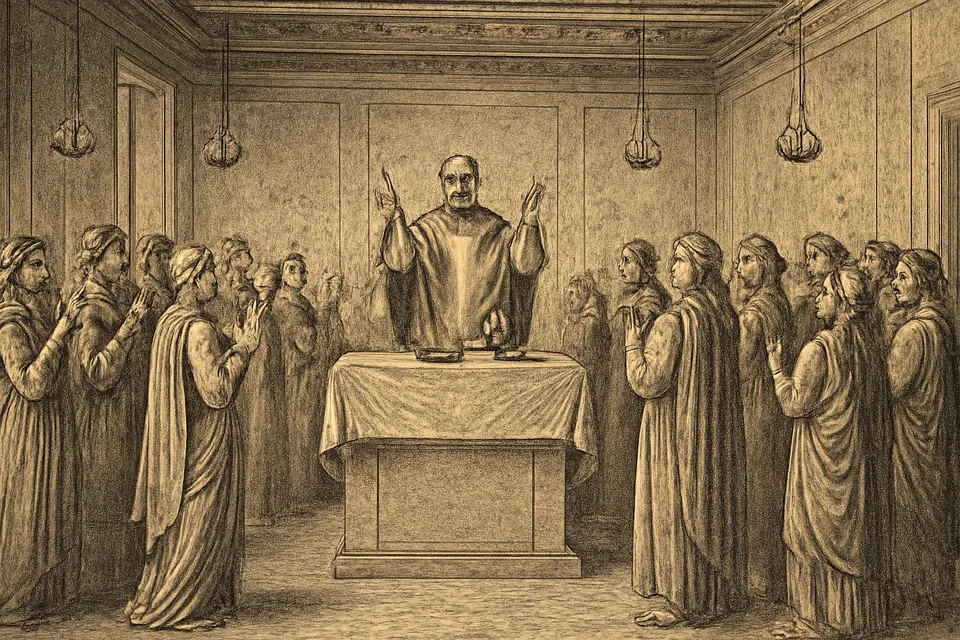
The 1969 revision of the Roman calendar removed her commemoration from the universal calendar because her Passio is legendary, and left her feast to her own church. She remains in the Roman Martyrology. That is a judgment about a document, not about a saint. We keep her memory as the early Roman Christians did, with her name, her day and her altar.
Miracles and legends of St. Susanna
St. Susanna lived long before the Church began formally investigating miracles, so no miracle attributed to her has been approved in the modern sense.
- Traditional: her refusal of the imperial marriage and of the sacrifice to Jupiter, and her death in her father's house, all come from the Passio of the late 5th century.
- Reported: favors granted through her intercession at her shrines in Rome and Santiago de Compostela, where devotion to her has continued for centuries. These are personal testimonies, not cases examined by the Church.
Her real miracle, for the early Church, was the martyrdom itself: a young woman who would not trade Christ for a crown.
St. Susanna and Susanna of the Bible
The two Susannas were brought together long ago by the Roman liturgy. In the old Roman Missal, the Mass for the Saturday of the third week of Lent was celebrated as a "station" at the church of St. Susanna, and its first reading was the whole story of Susanna from Daniel 13, the longest reading of the entire year. Gregory DiPippo of the New Liturgical Movement observes that the station "was clearly chosen for the coincidence of names." In the current lectionary, the Susanna reading falls on Monday of the fifth week of Lent.
The pairing is fitting. The early Church read the story of Susanna to catechumens preparing for baptism, to ready them for persecution. In the catacomb of Praetextatus, a 4th-century painting shows the biblical Susanna as a lamb between two wolves labeled "the elders." Both Susannas were chaste women threatened by powerful men, and both trusted God rather than yield.
Her church in Rome keeps both stories on its walls. The six large frescoes of the nave, by Baldassare Croce, tell the Old Testament story of Susanna and the elders, painted to look like hanging tapestries. The apse, painted by Tommaso Laureti and Cesare Nebbia, shows scenes from the life of the Roman martyr.

Why St. Susanna is a patron saint
St. Susanna has few formal patronages. Two are worth knowing.
- Young women and chastity. Like St. Agnes, St. Agatha and St. Lucy, she belongs to the company of Roman virgin martyrs who refused marriage to pagan men of power because they had given themselves to Christ. Young women preparing for marriage or religious life, and those who suffer pressure to give up their faith or their purity, can ask her prayers.
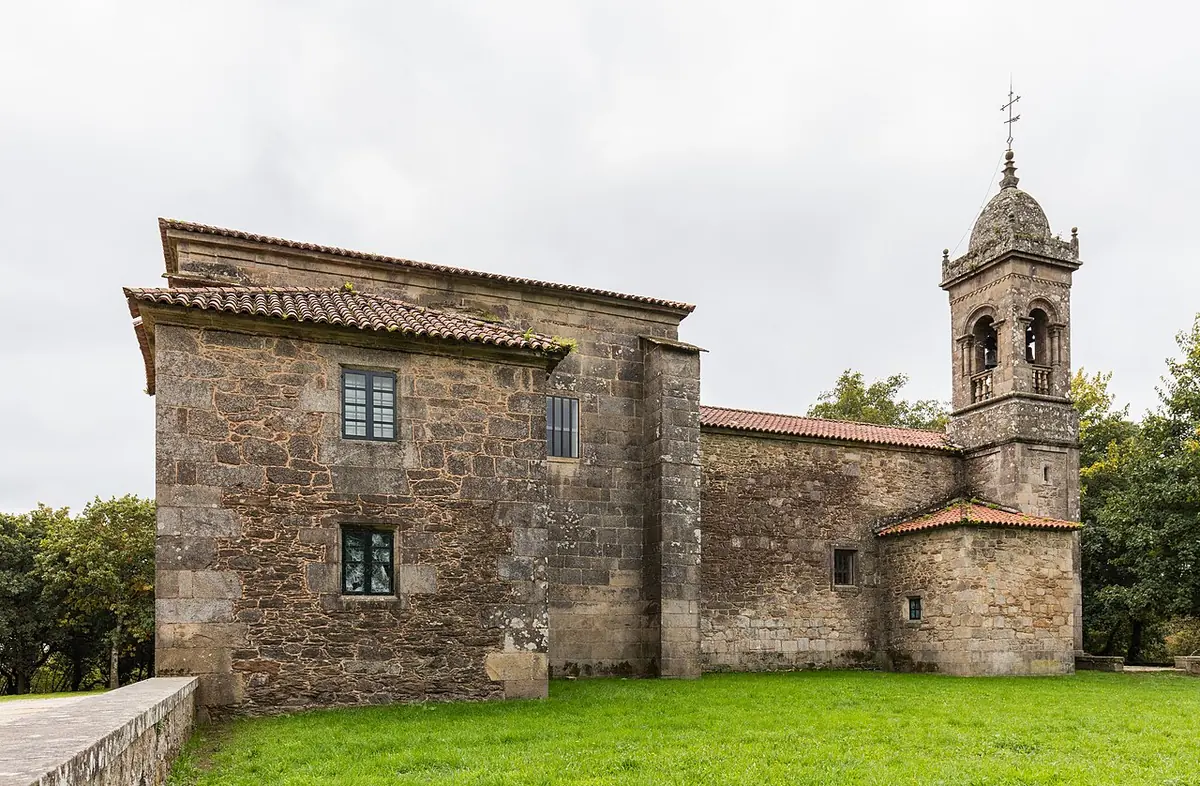
- Santiago de Compostela. The city of St. James in Galicia counts Susanna as its co-patron with St. James the Greater. Santiago Turismo records that Archbishop Diego Gelmírez consecrated the church of Santa Susana in 1102 to hold relics of St. Susanna brought from Portugal. The church stands on a rocky rise in the Alameda park, among the oak grove that carries her name.
See all the patron saints by cause.
Symbols of St. Susanna in art
St. Susanna can be hard to pick out among the many virgin martyrs, because painters gave them similar attributes. These are the clues.
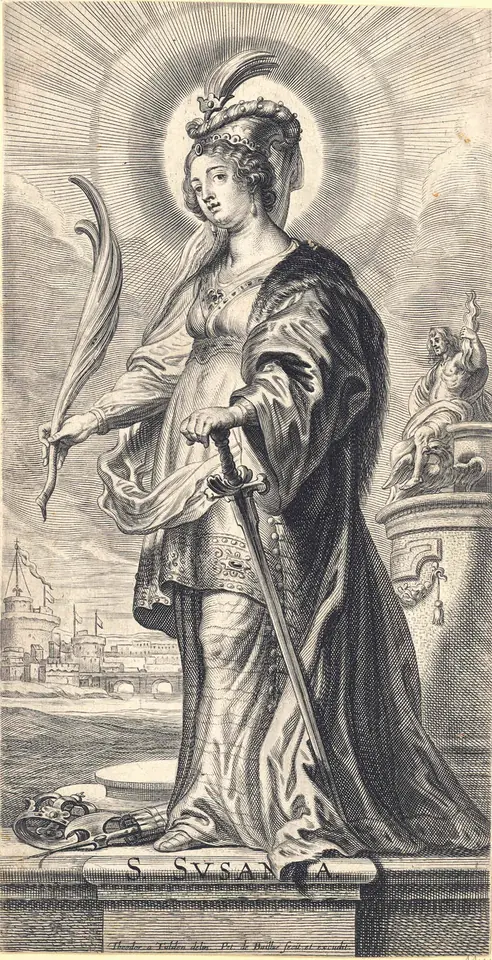
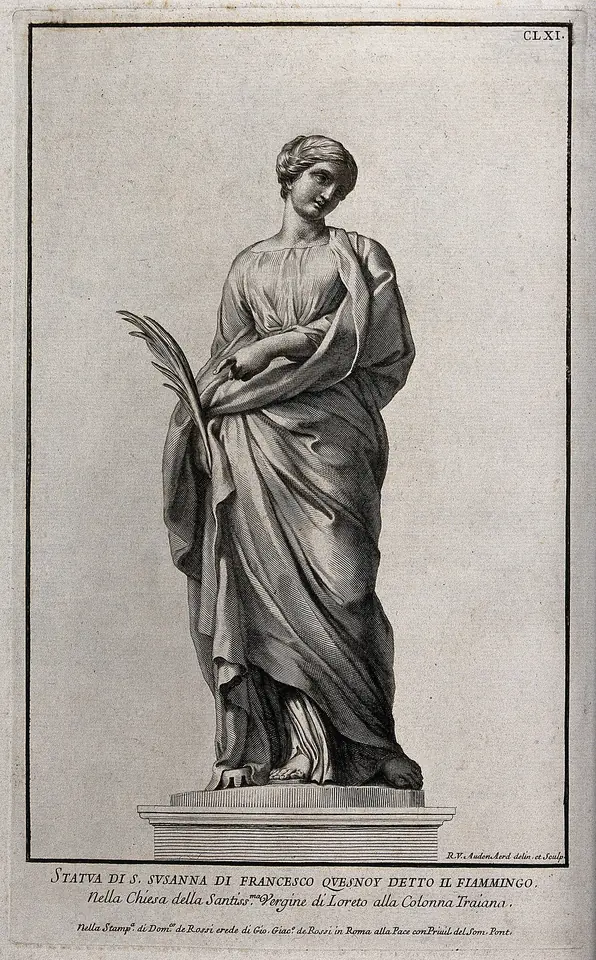
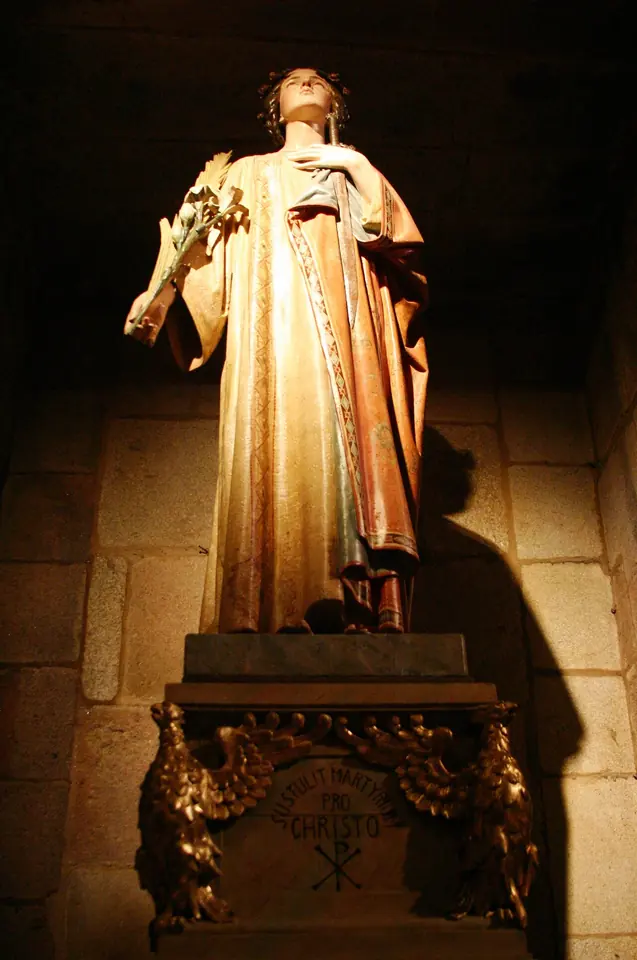
- The martyr's palm: the sign of victory through martyrdom, carried by nearly every martyr. Duquesnoy's statue and the Santiago figure both hold one.
- A sword: the instrument of her beheading. Bailliu's engraving puts her hand on the hilt of a sword resting point-down.
- A statue of Jupiter: her most distinctive sign. When a young saint with a palm stands near a statue of a bearded god with a thunderbolt or a pagan altar, she is very likely Susanna, who refused to offer incense to Jupiter.
- A crown: for her noble birth or for the crown of martyrdom, and for the imperial marriage she turned down.
- A lily: the sign of virginity, common on holy cards.
- Roman dress and a veil: Baroque artists dressed her as a noble Roman matron, as in Duquesnoy's statue.
The most famous image of her is François Duquesnoy's marble statue in the church of Santa Maria di Loreto near Trajan's Column in Rome, begun in 1629. The Flemish sculptor gave her the calm face and deep folds of an ancient Greek statue. It became one of the most admired modern statues in Rome, and engravers copied it, as Robert van Audenaerd did in the print below.
Eastern icons rarely show the Roman Susanna. When an icon of a "righteous Susanna" appears, it is usually the Old Testament heroine shown with the Prophet Daniel.
Feast day and where St. Susanna is honored
We keep the feast of St. Susanna on August 11, the day the oldest Roman calendars give for her martyrdom. Before 1969 she was commemorated that day on the General Roman Calendar with St. Tiburtius, another Roman martyr of Diocletian's persecution whose story comes from the legend of St. Sebastian. The two had no connection beyond the date. Today August 11 is the memorial of St. Clare of Assisi in the universal calendar, but St. Susanna's feast is still kept at her church in Rome and at Santiago. See the feast day calendar.
Santa Susanna, Rome
The church of Santa Susanna alle Terme di Diocleziano stands on the Quirinal Hill, on the corner of Via XX Settembre and Largo Santa Susanna, next to the larger church of Santa Maria della Vittoria. Tradition places Susanna's tomb in its confessio, below the high altar, with the relics of other martyrs, including her father St. Gabinus. The Catholic Encyclopedia notes that apart from the Passio, no early source describes her tomb.

The church was rebuilt in the late 16th century, and its travertine facade by Carlo Maderno, finished in 1603, is counted among the first great Baroque facades of Rome. A community of Cistercian nuns lives in the adjoining monastery; during the Second World War they hid Jewish women and children there at great risk.

For American Catholics the church has a special history. At the end of 1921 Pope Benedict XV allowed the Paulist Fathers to use Santa Susanna, next door to the American embassy, as a church for Americans in Rome. Fr. Thomas Lantry O'Neill became its first rector on February 19, 1922, and Cardinal O'Connell of Boston celebrated the first Mass for the American community on February 26. For about nine decades it was where American pilgrims, students and diplomats heard Mass in English. The church closed to the public in 2013, and the American parish now gathers at the church of St. Patrick in Rome, hosted by the Irish Augustinians.
Santiago de Compostela
In Santiago, where pilgrims come to the tomb of St. James, Susanna has her own church in the Alameda park and a statue in the cathedral. The present church of Santa Susana is a 17th- and 18th-century rebuilding of the Romanesque church of 1102; the main door and a window survive from the original. It opens only on special occasions.
Praying with St. Susanna
No traditional prayer composed especially for St. Susanna is in common use today, and we do not invent one and put it in her mouth. The Church gives us simpler ways to ask her intercession.
- Her name in prayer. "St. Susanna, pray for us" is enough. Her name can be added to the Litany of the Saints among the holy virgins and martyrs.
- The prayers of the Mass for a virgin martyr. Where her feast is kept, the Mass is drawn from the Commons of Martyrs and of Virgins in the Roman Missal, whose prayers ask for a share in the martyr's steadfast faith and purity of heart.
- The story of Susanna in Daniel 13. Reading it on her feast, as Rome once did on her Lenten station day, is a fine way to honor her. It is a story about trusting God when the powerful lie about us.
- The Martyrology. Many religious houses still read the day's entry from the Roman Martyrology. On August 11 it names her, and hearing it is a short act of remembrance.
Let us ask St. Susanna to pray for young people who are pressured to give up their faith or their purity, for Christians who suffer for their faith today, and for all who are falsely accused. She chose Christ over a crown, and she is a sure friend to anyone who must make a hard choice for God.
Frequently asked questions
When is the feast day of St. Susanna?
August 11. The Roman Martyrology lists her on that day, and until 1969 she was commemorated on the General Roman Calendar together with St. Tiburtius, a different martyr. Today her feast is kept above all at her church in Rome and in Santiago de Compostela.
Is St. Susanna the same as Susanna in the Bible?
No. Susanna in Daniel 13 is an Old Testament heroine, a married Jewish woman in Babylon falsely accused by two elders and saved by the young prophet Daniel. St. Susanna of Rome was a Christian virgin martyred around 295. The two are linked only by their name and by the Lenten liturgy, which read the Daniel story on the day of the station Mass at St. Susanna's church.
What is St. Susanna the patron saint of?
She has no long official list of patronages. As a virgin martyr she is invoked by young women and for the virtue of chastity, and the city of Santiago de Compostela in Spain counts her as its co-patron with St. James.
How did St. Susanna die?
According to her Passio, written about two centuries after her death, she refused to marry the emperor's son and would not offer incense to Jupiter. She was beheaded in her father's house around 295. The Catholic Encyclopedia notes that the details of the Passio are doubtful, but her martyrdom and her day of death are attested by the oldest martyrologies.
Where are St. Susanna's relics?
Tradition places her tomb in the confessio of the church of Santa Susanna near the Baths of Diocletian in Rome, built over her family's house. The church of Santa Susana in Santiago de Compostela was consecrated in 1102 to hold relics of a St. Susanna brought from Portugal.
What does St. Susanna hold in art?
Usually a martyr's palm, often a sword (the instrument of her death) and sometimes a crown or a lily. Baroque prints add a statue of Jupiter, the idol she refused to honor.
Is there a prayer to St. Susanna?
No well-known traditional prayer to St. Susanna is in common use. The faithful ask her intercession simply, "St. Susanna, pray for us," or in the Litany of the Saints and the prayers of the virgin martyrs. On her feast the Church reads the prayers of the Mass for a virgin martyr.
Sources
- Catholic Encyclopedia (1912): Sts. Tiburtius and Susanna
- Roman Martyrology (pre-1962 English translation), August 11
- Roman Martyrology (pre-1962 English translation), February 19: St. Gabinus
- New Catholic Encyclopedia: Susanna, St.
- Gregory DiPippo, The Story of Susanna in the Liturgy of Lent, New Liturgical Movement (2011)
- Churches of Rome: Santa Susanna, frescoes of the nave and apse
- St. Patrick's Catholic American Parish in Rome: History and Centennial
- Santiago Turismo: Igrexa de Santa Susana