St. Irene of Athens, the Byzantine Empress Who Restored the Icons

St. Irene of Athens (about 752–803) was the Byzantine empress who, as regent for her young son, called the Second Council of Nicaea in 787, which ended the first iconoclast persecution and restored the veneration of holy icons. She later had her son Constantine VI deposed and blinded, ruled alone from 797 to 802, and died in exile on Lesbos. Some Greek and Byzantine Catholic calendars honor her on August 7; her cult has always been local.
Who was St. Irene of Athens?
St. Irene of Athens was a Byzantine empress of the eighth century, the woman who brought the holy icons back into the churches of the East. As regent for her young son she called the Second Council of Nicaea in 787, the seventh ecumenical council, which taught that icons of Christ, the Mother of God and the saints may be honored and venerated. Every icon we kiss in an Eastern church, and every image of a saint we pray before, owes something to that council.
Her life was also stained by a grave sin. In 797 she had her own son, the emperor Constantine VI, deposed and blinded so that she could rule alone. The Church does not hide this, and neither will we. Irene is honored as a saint only in a local and modest way, in some Greek and Byzantine Catholic calendars, and only for what she did for the icons.
She is not the same woman as St. Irene Chrysovalantou, the ninth-century abbess, or the early martyrs St. Irene of Thessalonica and St. Irene of Rome.
The life of St. Irene of Athens
A bride from Athens
Irene was born in Athens around 752 into the Sarantapechos family, which was prominent in central Greece. In 769 the emperor Constantine V chose her as a bride for his son Leo. She arrived in Constantinople that November and was crowned and married in December. Her son Constantine was born in January 771.
An empress who kept her icons
The emperors of her husband's family were iconoclasts. They had ordered the holy images taken down and persecuted the monks who defended them. The Catholic Encyclopedia records that Irene "was a steadfast image-worshipper," and that "even during her husband's life she concealed holy icons in her rooms." Near the end of his reign Leo IV punished courtiers who had put images back in their apartments, and he was about to banish the empress when he died, on September 8, 780.

The Second Council of Nicaea
Irene became regent for her nine-year-old son and at once began to undo the iconoclast policy. Relics and pictures went back into the churches, and monasteries reopened. A first attempt at a council in Constantinople in 786 was broken up by iconoclast soldiers, so she replaced the mutinous troops with officers she trusted and summoned the bishops to Nicaea in 787. Pope Adrian I sent legates and approved the council.
The council restored the veneration of images and ended the first iconoclast persecution. At its last session, held in Constantinople on October 23, 787, Irene and her son signed the acts, and the bishops acclaimed her as a "New Helena," after St. Helena, the mother of Constantine the Great.

Her son blinded
What came next is the dark part of her story. Irene would not give up power when Constantine came of age. In 790 the army backed him and he ruled briefly on his own, but she returned as co-ruler in 792. In 797 she had him seized and blinded in the Porphyra, the purple chamber of the palace where he had been born. Lynda Garland, the historian of the Byzantine empresses, calls it "the most indefensible action of Irene's reign." The chronicler Theophanes, who admired Irene for the icons, still wrote that the sun was darkened afterward, and that everyone knew why.
Ruling alone, and exile
From 797 to 802 Irene ruled alone, and she was the first Byzantine empress to strike gold coins bearing her own portrait. Pope Leo III crowned Charlemagne emperor in the West on Christmas Day 800, partly on the argument that a woman's rule left the imperial throne vacant.
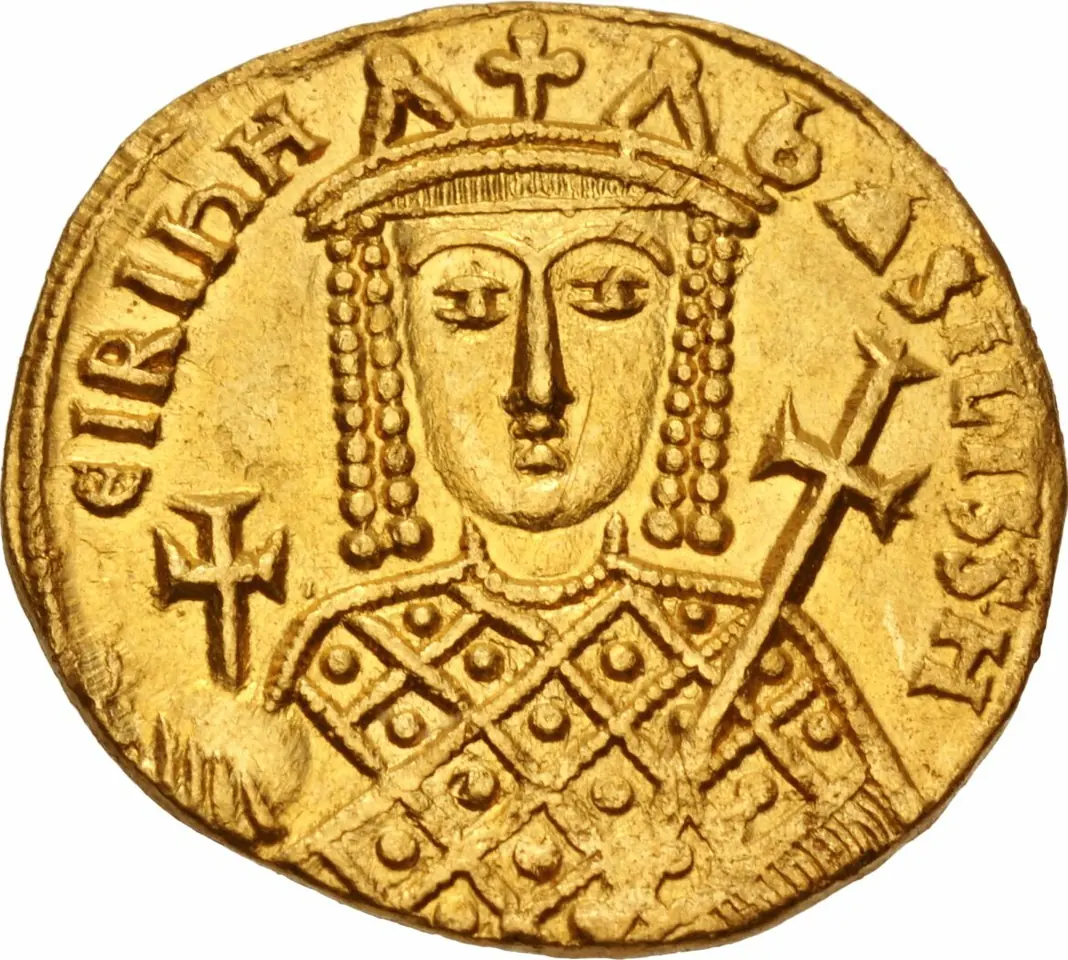
On October 31, 802, her finance minister Nikephoros seized the throne. She was sent first to a convent she had founded on the island of Prinkipo and then to Lesbos, where tradition says she supported herself by spinning wool. She died there on August 9, 803.

Why St. Irene is honored
Irene's cult rests on one thing: she gave the Church back its icons. St. Theodore the Studite, a fearless defender of images who did not flatter emperors, praised her zeal for icons and for monasteries. Garland notes that a later Life of Irene presents her as pious and virtuous. Her feast never spread far, and her name does not appear in the standard printed Menaion. No miracles are recorded through her intercession, and we make no claims for any.
There is something here for us all the same. God used a deeply flawed ruler to restore something good and true to His Church. When we honor her, we honor the council she called, and we pray for the mercy that every sinner needs.
Symbols of St. Irene of Athens in art
Irene appears mostly as an empress rather than as a saint. Look for:
- A tall imperial crown with hanging strings of pearls (pendilia): the crown of a Byzantine sovereign.
- The loros: the stiff, jeweled band worn crosswise over the imperial robe.
- An orb and a scepter topped with a cross: symbols of rule under Christ, as on her coins.
- An icon in her hands, in modern devotional images: the sign of the council she called.
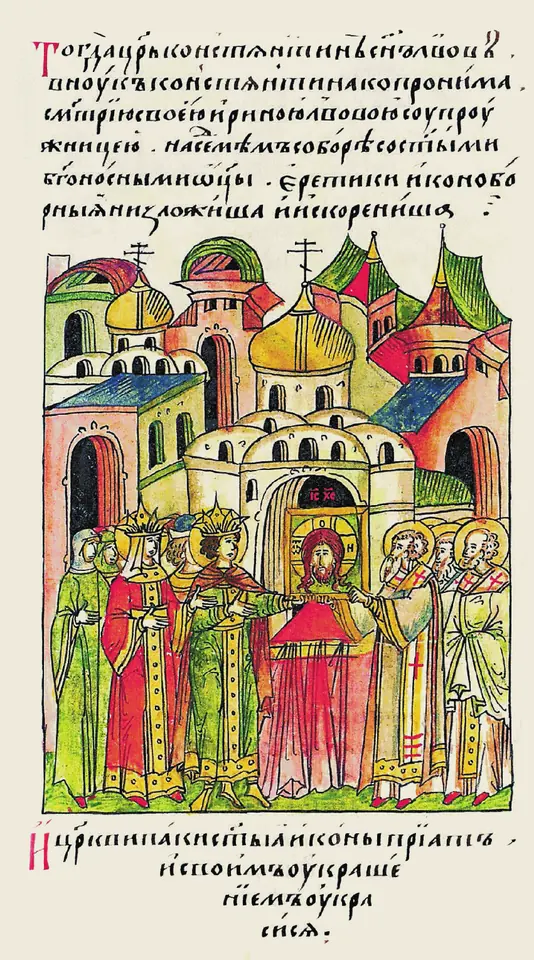
The Russian Illustrated Chronicle made for Ivan the Terrible in the 1560s shows Irene and her son with the bishops of the Seventh Council as an icon of Christ is lifted up. Watch for confusion: a famous mosaic portrait of an "Empress Irene" in the Pala d'Oro in Venice and in Hagia Sophia shows a different woman, Irene of Hungary, the wife of John II Komnenos.
Feast day
Some Greek and Byzantine Catholic calendars keep St. Irene of Athens on August 7, two days before the anniversary of her death on August 9, 803. Her body was later moved to the Church of the Holy Apostles in Constantinople, which was torn down after the Ottoman conquest; her tomb is lost. You can find the saints of nearby days on our feast days page.
Prayer to St. Irene of Athens
There is no traditional prayer to St. Irene of Athens in the standard prayer books. Let us pray instead in the words the Church has always used for the saints: St. Irene, pray for us. We can ask her prayers for the honor of holy images in our churches and homes, for rulers tempted to cling to power, and for broken families where a parent and a child have wounded each other.
St. Irene of Athens, pray for us.
Frequently asked questions
Why is Irene of Athens considered a saint?
Because she brought back the holy icons. As regent she called the Second Council of Nicaea (787), which defined that icons may be venerated, and she reopened monasteries the iconoclast emperors had closed. St. Theodore the Studite praised her zeal for images and monks. Her cult grew from that service to the Church, and it has stayed local; the Roman calendar does not list her.
Did Empress Irene blind her son?
Yes. In 797 her supporters seized Constantine VI, then about twenty-six, and blinded him in the Porphyra, the purple chamber of the palace where he had been born. Historian Lynda Garland calls it 'the most indefensible action of Irene's reign.' Her holiness is honored for what she did for the icons, not for this.
When is the feast of St. Irene of Athens?
Some Greek and Byzantine Catholic calendars list her on August 7. She died on August 9, 803. Her name does not appear in the standard printed Menaion.
Is Irene of Athens the same as St. Irene Chrysovalantou?
No. St. Irene Chrysovalantou was a ninth-century abbess from Cappadocia, honored on July 28. Irene of Athens was the eighth-century empress. The Church honors several other saints named Irene too, including the martyrs of Thessalonica and Rome.