St. Pontian, Pope and Martyr
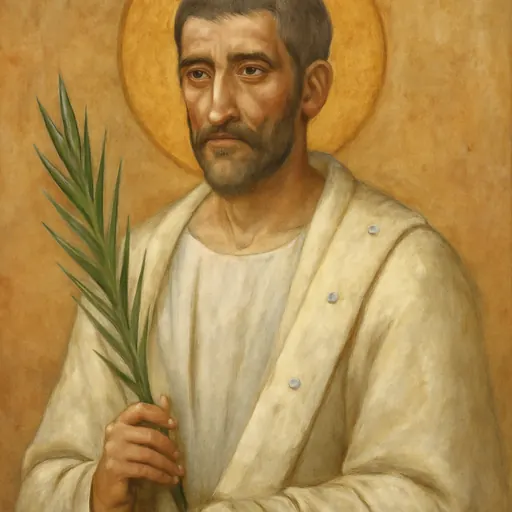
Pope St. Pontian led the Church of Rome from 230 to 235. When the emperor Maximinus Thrax sent him to the mines of Sardinia, he resigned the papacy so Rome could elect a new bishop, the first pope known to have done so. He died there in exile around 235, reconciled with St. Hippolytus, and we keep both as martyrs on August 13.
Who was St. Pontian?
St. Pontian (Pontianus in Latin) was bishop of Rome, the pope, from 230 to 235. We know only a little about him, but the little we know is moving. He governed the Church in a quiet spell between persecutions, saw the end of a long and bitter schism, and when the storm broke he gave up his office rather than leave the Church in Rome without a shepherd. He died a convict in the mines of Sardinia.
The name is easy to confuse. There is a city called Pontian in Malaysia, and there is another saint, St. Pontian of Spoleto, a young martyr honored on January 19. This page is about Pope St. Pontian, the 3rd-century martyr whose feast we keep with St. Hippolytus on August 13.
His life
Pope in a quiet time
The Liber Pontificalis, the old collection of papal lives, says Pontian was a Roman, the son of a man named Calpurnius. The Catholic Encyclopedia notes that with him the papal record becomes more reliable, because the author of the Liberian Catalog of 354 had a good chronicle of the 3rd-century bishops to draw on. It dates his election to July 21, 230, after the death of Pope Urban I.
Two things mark his years in office. First, the schism of Hippolytus went on. Hippolytus, a learned Roman priest, had broken with Pope Callistus in 217 and let himself be set up as a rival bishop of Rome. Second, a synod in Rome under Pontian accepted the condemnation of Origen pronounced at Alexandria in 231 and 232. St. Jerome and Rufinus mention that Roman synod, and the Catholic Encyclopedia says it was "without doubt" held by Pontian.
Exile to Sardinia
In 235 the soldier-emperor Maximinus Thrax came to power and turned on the leaders of the Church. Pontian was one of his first victims. He and Hippolytus, the two rival heads of the Roman Christians, were sent together to Sardinia, which the Catholic Encyclopedia calls the "unhealthy island." Convicts there worked the mines until they died.
Pontian knew he would not come back. So on September 28, 235, he resigned. The Liberian Catalog uses the Latin word discinctus est, "he was unbelted," the old Roman phrase for laying down an office. The Church in Rome then elected Anteros in his place. Eusebius, writing in the early 300s, notes the change briefly: Anteros succeeded Pontianus.

Reconciliation and death
Somewhere in that exile, before or soon after the resignation, Hippolytus made his peace with the Church, and the schism he had led for nearly twenty years came to an end. It is a quiet grace hidden in a hard story: two old opponents, both condemned to the same mine, became brothers again in Christ.
How long Pontian lived in Sardinia we do not know. The Liber Pontificalis, drawing on older acts of the martyrs that no longer survive, says he died from the hardship and inhuman treatment he suffered. The Church honors him as a martyr for that death in exile.

The tomb of St. Pontian
Some years later Pope St. Fabian, who led the Church from 236 to 250, brought the bodies of Pontian and Hippolytus back to Rome. Pontian was laid in the papal crypt of the Catacomb of St. Callixtus on the Via Appia on August 13, and Hippolytus was buried on the Via Tiburtina. That shared day is why the two are honored together.
In 1909, archaeologists found Pontian's original epitaph in the crypt of St. Cecilia, beside the papal crypt. It reads in Greek letters PONTIANOS EPISK. MARTUR, "Pontian, Bishop, Martyr." The Catholic Encyclopedia notes that the word martyr was added later, in a ligature, which tells us the Roman Church came to honor him as a martyr after his burial. The Chronography of 354 also lists him under August 13 in its Depositiones martyrum, the Roman list of martyrs' burials.

Miracles and legends
No miracles are recorded for St. Pontian, and no legend of any weight grew up around him. His holiness is plain, not wondrous: he served faithfully, chose the good of the Church over his own office, and died in chains.
Why there is no special patronage
We know of no traditional patronage of Pope St. Pontian, and we will not invent one. Many Catholics, though, find a natural reason to ask his prayers: for the pope, for any leader who must step aside for the good of others, for prisoners and forced laborers, and for reconciliation between people divided inside the Church.
Symbols of St. Pontian in art
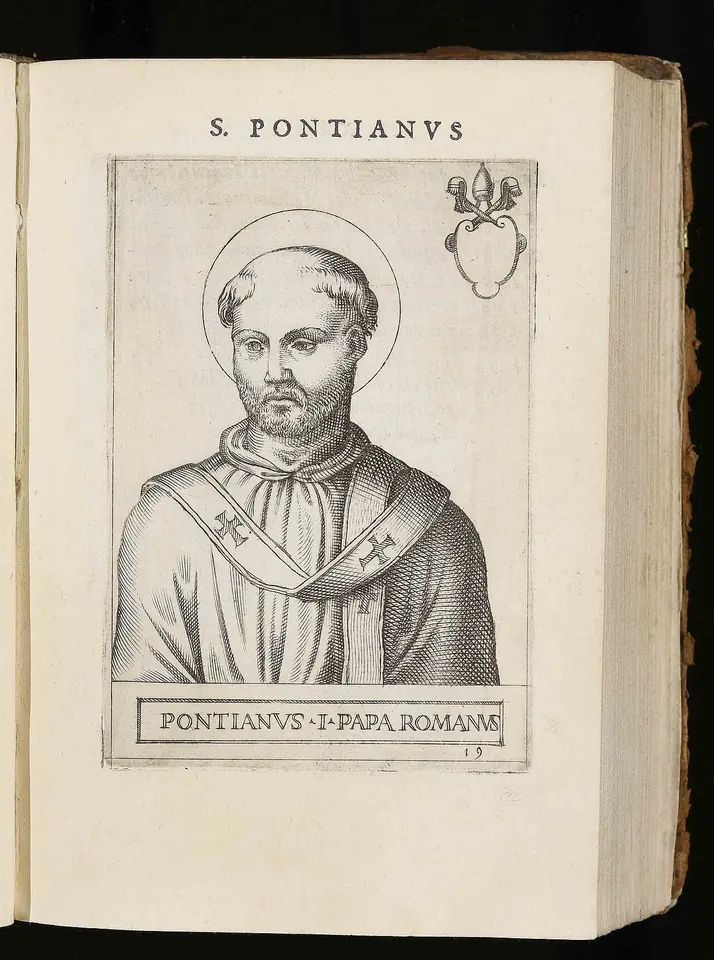
Pontian is seldom painted on his own. You will usually meet him in series of papal portraits, like Cavalieri's 1580 engravings or the mosaic medallions of all the popes that run around the nave of St. Paul Outside the Walls in Rome. Look for:
- The pallium, the white woolen band with black crosses, which marks him as bishop of Rome.
- Papal dress, sometimes even a tiara, in later Western art. That is an anachronism, since 3rd-century bishops wore nothing of the kind.
- The martyr's palm, for his death in exile.
- Hippolytus beside him, in images made for their shared feast.
Prayer to St. Pontian
There is no traditional prayer to St. Pontian in the standard prayer books. The Church prays for us on August 13 in the collect of the shared memorial, asking that the long-suffering of these two just men may bring us "a great increase of love" for God and constancy in the holy faith.
Let us ask Pope St. Pontian to pray for the Holy Father, for all who are exiled or imprisoned for their faith, and for every quarrel among Christians that needs healing. St. Pontian, pray for us.

Frequently asked questions
Why is St. Pontian important?
He is the first pope known to have resigned. Exiled to Sardinia in 235, he gave up his office on September 28 of that year so the Church in Rome would not be left without a shepherd. His reign also saw the end of the schism of Hippolytus, the earliest antipope, who was reconciled to the Church in exile alongside him.
When is St. Pontian's feast day?
August 13, together with St. Hippolytus, as an optional memorial in the General Roman Calendar. That is the date the two martyrs were buried in Rome after Pope Fabian brought their bodies back from Sardinia. Older editions of the Roman Martyrology kept him on November 19.
How did Pope Pontian die?
He died of hardship and cruel treatment as a convict laborer in the mines of Sardinia, around 235 or 236. The Liber Pontificalis, drawing on older lost acts of the martyrs, says he died from the privations he endured. No executioner killed him; the Church honors him as a martyr because he died in exile for the faith.
Where is St. Pontian buried?
In the Crypt of the Popes in the Catacomb of St. Callixtus on the Via Appia, Rome. In 1909 archaeologists found his original epitaph there, which reads in Greek "Pontianos, Episk. Martur" (Pontian, Bishop, Martyr).
Keep exploring
Sources
- Catholic Encyclopedia (1911): Pope St. Pontian. The resignation date, the 1909 epitaph and the old November 19 feast
- Catholic Encyclopedia (1910): St. Hippolytus of Rome
- Catholic Culture, Liturgical Year: Saints Pontian and Hippolytus, August 13
- Eusebius, Church History, Book VI (Pontianus succeeds Urban; Anteros succeeds Pontianus)