St. Clare of Montefalco

St. Clare of Montefalco (about 1268–1308), also called Clare of the Cross, was an Augustinian abbess in Montefalco, Umbria, known for her love of Christ's Passion. When her sisters examined her heart after her death, they reported finding a small cross and the instruments of the Passion formed in it. Pope Leo XIII canonized her in 1881, and her feast day is August 17.
Who was St. Clare of Montefalco?
St. Clare of Montefalco was an Augustinian abbess in the small hill town of Montefalco, in Umbria, who lived from about 1268 to 1308. She spent nearly her whole life in one community of women, which she joined at six and led from her early twenties. Her prayer centered on the suffering of Christ, and she told her sisters that she carried his cross in her heart. After she died they opened her heart and reported that they found a cross there. That is why she is called St. Clare of the Cross, the name she took at her profession.

The Roman Martyrology remembers her on August 17: "At Montefalco in Umbria, St Clare, a nun of the Order of Hermits of St. Augustine, virgin. In her flesh were renewed the mysteries of the Lord's passion, which the faithful honour with great devotion."
She is not St. Clare of Assisi, the friend of St. Francis, who died some fifteen years before she was born.
The life of St. Clare of Montefalco
A child among hermits
Clare's much older sister, Joanna (Giovanna), gathered a small group of women around 1270 to live as hermits at a place outside Montefalco now called Sant'Illuminata. Clare joined them in 1274, at the age of six. In 1281 the group moved to a new house that became the convent of Santa Croce, the Holy Cross. Not everyone welcomed them. Local Franciscan friars and townspeople objected that Montefalco could not support another community that lived by begging.

Franciscan or Augustinian?
The women first lived in the manner of the Franciscan Third Order. When they wanted to take formal vows, they asked the Bishop of Spoleto for an approved rule. Since no approved rule then existed for Third Order Franciscan women living in community, the bishop gave them the Rule of St. Augustine in 1290. This later led to a long dispute between Franciscan and Augustinian writers over whom she belonged to. The Catholic Encyclopedia concludes, kindly, that both are right in a sense: she began as a Franciscan tertiary and became an Augustinian nun.
Abbess at twenty-three
Joanna died in 1291 (the Catholic Encyclopedia says 1295), and the sisters chose Clare to succeed her. She accepted only when the Bishop of Spoleto ordered her to. The Catholic Encyclopedia describes her as "kind and indulgent towards others" but harsh with herself, so much that her fasting once put her life in danger. The Augustinian liturgy remembers her as demanding about the common life, "as stated in the Rule of Saint Augustine."
In 1303 she was finally able to build a church for the sisters. She is said to have foretold that the Bishop of Spoleto, Nicolò Alberti da Prato, would become a cardinal; when he was raised to that rank in December 1303, he authorized the foundation stone of the new oratory of the Holy Cross and St. Catherine.
The heretic who came to Santa Croce
Around 1307 a Franciscan named Bentivenga da Gubbio, who taught a heresy of the "free spirit" that excused sin, went looking for followers among the nuns of Umbria and tried to win Clare over. She recognized the error and reported him to Cardinal Napoleone Orsini, the papal legate. The cardinal's chaplain, the Franciscan Ubertino da Casale, gathered the evidence, and Bentivenga was imprisoned for life. Clare, who never left her convent, helped protect the Church in central Italy from a dangerous teaching.

The cross planted in her heart
Clare's prayer returned again and again to the Passion. Her best-known vision, painted on the walls of her own church, is traditional: Christ appeared to her as a poor traveler bent under his cross and told her he was looking for a place to plant it. Recognizing her vocation, he planted it in her heart. She felt the pain of it for the rest of her life.
She died at Santa Croce in August 1308, still a young woman of about forty. As she lay dying she told her sisters that she bore the cross of Christ in her heart.

The miracles of St. Clare of Montefalco
- The cross in her heart: reported. Her sisters opened her heart to preserve it, as was sometimes done then, and reported finding a small cross formed in the tissue, with other figures they took for the instruments of the Passion. The vicar of the Bishop of Spoleto, Berengar of Saint-Affrique, arrived "burning with indignation," suspecting the nuns of fraud. He appointed a panel of physicians, jurists and theologians, who ruled out fabrication. He went on to lead the first inquiry into her holiness.
- The three stones: reported. In her gallbladder the sisters found three small round stones, which they took as a sign of the Holy Trinity. A later devotional tradition adds that each stone weighs the same as the other two together, or as all three; that detail is traditional.
- Her incorrupt body: reported. Her body has been kept in Montefalco since 1308, and pilgrims long described it as incorrupt.
- Miracles for her canonization: approved. Her cause opened within a few years of her death, with testimony taken in 1318, but it stalled in 1333 and again in the 18th century. Pope Leo XIII finally canonized her in 1881, after the Church accepted the miracles required.
Why St. Clare of Montefalco is honored
She has no formal patronage beyond her hometown. People carrying heavy crosses ask her prayers, and the Augustinian family celebrates her as one of its great mystics. The Augustinian Mass for her feast asks God that "we too draw strength from this passion." In the Philippines, where the Augustinians have worked for centuries, several parishes are dedicated to her. See more on our patron saints page.
Symbols of St. Clare of Montefalco in art
Clare is painted as a young nun, and her attributes come straight from her story:
- A heart with a cross in it: her chief emblem. She often holds her own heart, with a small cross rising from it.
- A crucifix: her lifelong meditation on the Passion. In engravings she presses it to her shoulder or heart.
- Scales with three balls: the three stones found after her death, weighed to show their mystery.
- The black Augustinian habit with white wimple and black veil, sometimes with a leather belt.
- A lily: her virginity, as in Francesco Longhi's altarpiece of 1600.
- Christ carrying his cross toward her: the vision of the cross planted in her heart, a favorite scene in Montefalco.
You can tell her from Clare of Assisi by the black Augustinian habit (Clare of Assisi wears brown or gray with a cord) and by the heart. Clare of Assisi usually holds a monstrance.

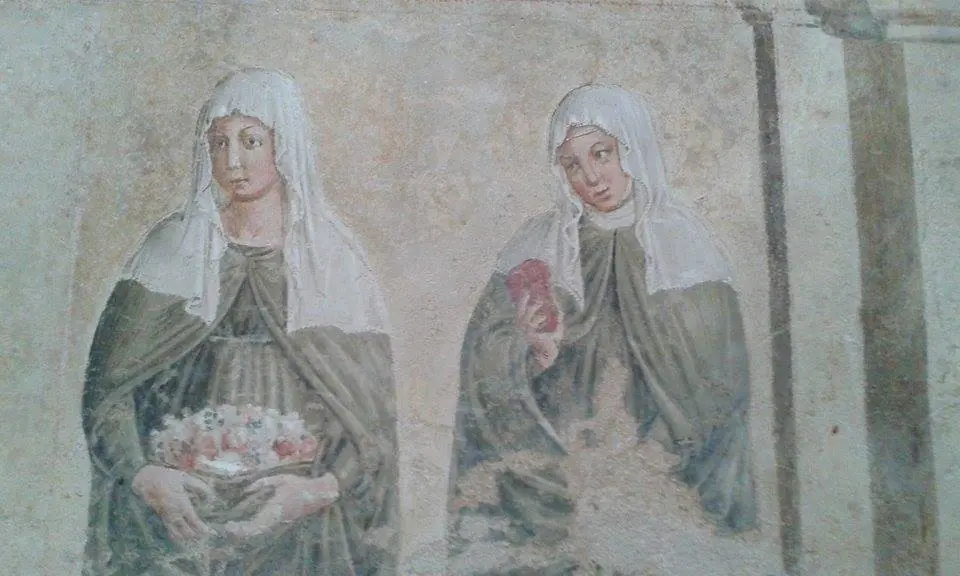
In Montefalco's church of San Francesco, a predella fresco pairs her with St. Elizabeth of Hungary, who carries roses in her apron while Clare holds her heart.
Feast day and the shrine in Montefalco
The feast of St. Clare of Montefalco is August 17. Find other saints of the season on our feast days page.
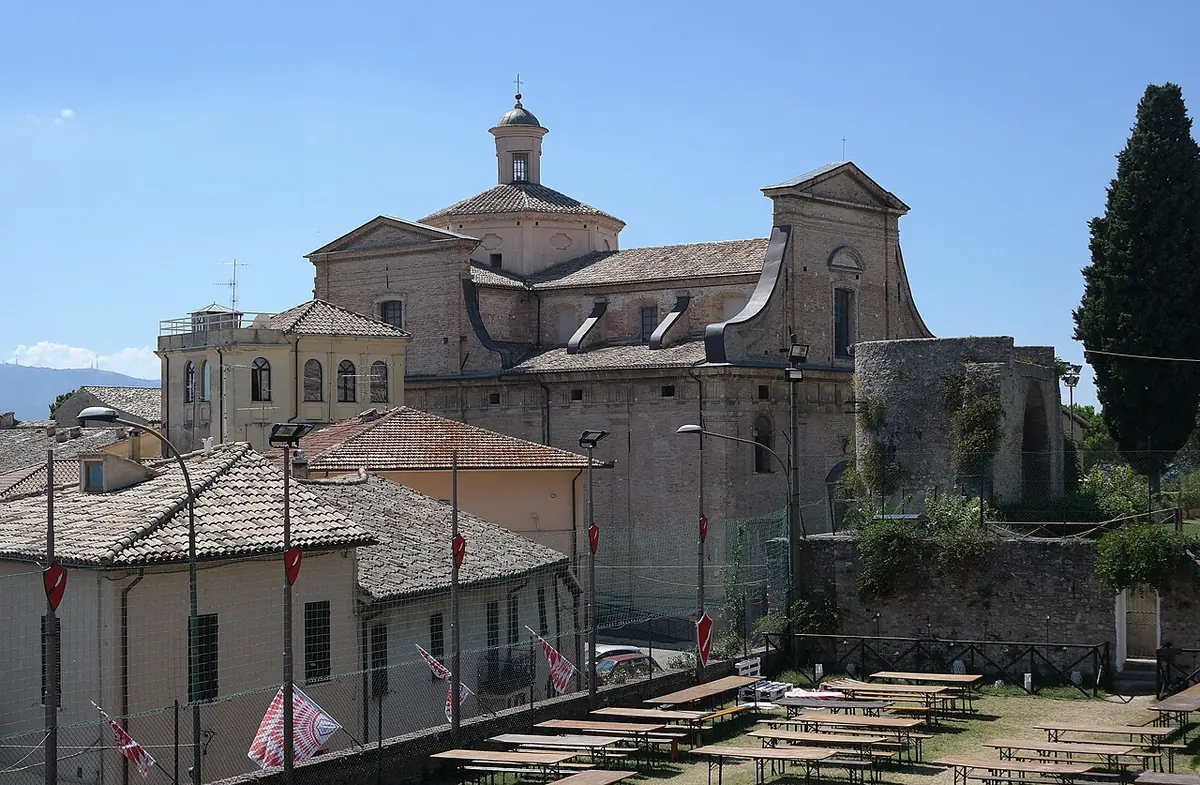
Her relics were moved in 1430 into a larger church built on the site of Santa Croce, and the present Church of Santa Chiara was built in the 17th century. Her body lies in a silver urn under the altar of her chapel, given in 1612 by an anonymous donor through the Jesuits. Grated niches beside the altar, opened in 1718, keep a pectoral cross given to her by Cardinal Giacomo Colonna, a silver bust containing her heart, a silver reliquary holding the little cross found in it, and the three stones. Behind the apse, the Chapel of the Holy Cross keeps frescoes painted in 1333 with scenes of her life and death.
Prayer to St. Clare of Montefalco
On August 17 the Augustinian family prays at Mass in thanks that God deepened Clare's holiness as she contemplated the suffering and death of his Son, and asks that we, too, may draw strength from the Passion and be renewed in his likeness. The official English text is in the Augustinian proper for the day, found in any Augustinian missal.
Let us ask St. Clare of the Cross to teach us to keep the Passion of Jesus close to our hearts, and to pray for us when our own crosses feel heaviest.
Frequently asked questions
Is St. Clare of Montefalco the same as St. Clare of Assisi?
No. St. Clare of Assisi (1194–1253) was St. Francis's companion and founded the Poor Clares. St. Clare of Montefalco was born about fifteen years after her death, in another Umbrian town, and became an Augustinian nun and abbess. Clare of Assisi's feast is August 11; Clare of Montefalco's is August 17.
What was found in St. Clare of Montefalco's heart?
According to the accounts from 1308, her sisters found a small cross formed of tissue in her heart, and other figures they took for the instruments of the Passion, such as the scourge and the crown of thorns. In her gallbladder they found three small stones, which they took as a sign of the Holy Trinity. A commission of physicians, lawyers and theologians found no evidence of fraud. These are reported wonders, not miracles approved for her canonization.
When is the feast of St. Clare of Montefalco?
August 17. The Roman Martyrology lists her on that day, and the Augustinian family celebrates it with a proper Mass.
Where is St. Clare of Montefalco buried?
In the Church of Santa Chiara in Montefalco, built on the site of her convent of Santa Croce. Her body rests in a silver urn under the altar of her chapel, and her heart, the cross found in it and the three stones are kept in niches beside it.
Was St. Clare of Montefalco a Franciscan or an Augustinian?
Both, at different times. As a girl she followed the Franciscan Third Order way of life with her sister's community. In 1290 the Bishop of Spoleto gave the community the Rule of St. Augustine, and she lived and died an Augustinian nun. The Catholic Encyclopedia explains the old dispute between the two orders.