St. Oswald of Northumbria, King and Martyr
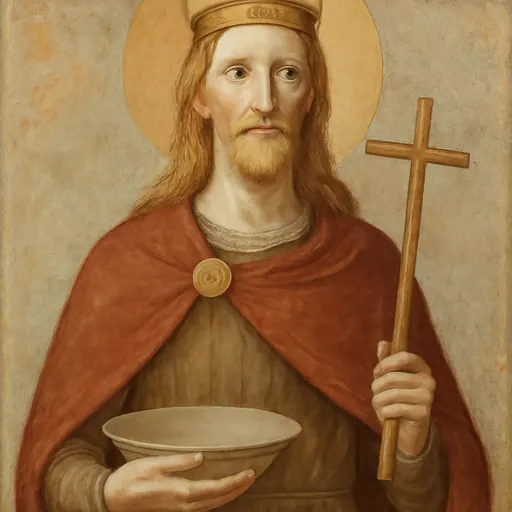
St. Oswald of Northumbria (about 604–642) was an English king who became a Christian in exile at Iona, raised a wooden cross before his victory at Heavenfield, and brought St. Aidan from Iona to convert his people. He died in battle against the pagan King Penda praying for his soldiers' souls. We honor him as a king and martyr on August 5.
Who was St. Oswald of Northumbria?
St. Oswald was a 7th-century king of Northumbria, in the north of England, who reigned for only eight years, from 634 to 642, and in that time opened his kingdom to the Gospel. He learned the faith as a boy in exile among Irish monks, won his throne under the sign of the cross, brought St. Aidan to Lindisfarne, and died in battle against a pagan king. The English honored him at once as a king and martyr.
There are other Oswalds, and other places called St. Oswald. This page is about the king, Oswald of Northumbria, not the 10th-century archbishop St. Oswald of Worcester. We keep his feast on August 5, the day he died.
Almost everything we know comes from St. Bede, who wrote his Ecclesiastical History at Jarrow about ninety years later, from people who still remembered.

His life
Exile at Iona
Oswald was born about 604, a son of King Æthelfrith of Bernicia, the northern half of Northumbria. When his father was killed in 617, his uncle Edwin took the kingdom, and Oswald and his brothers fled north to the Irish kingdom of Dál Riata. The Catholic Encyclopedia says they were cared for at St. Columba's monastery on Iona. There Oswald was baptized and learned the Irish language.
The cross at Heavenfield
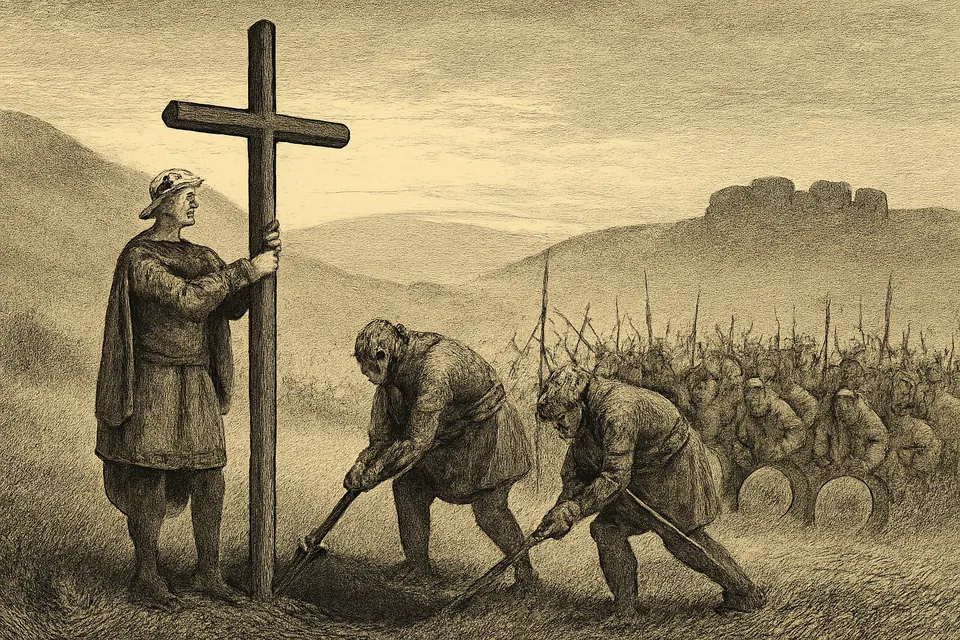
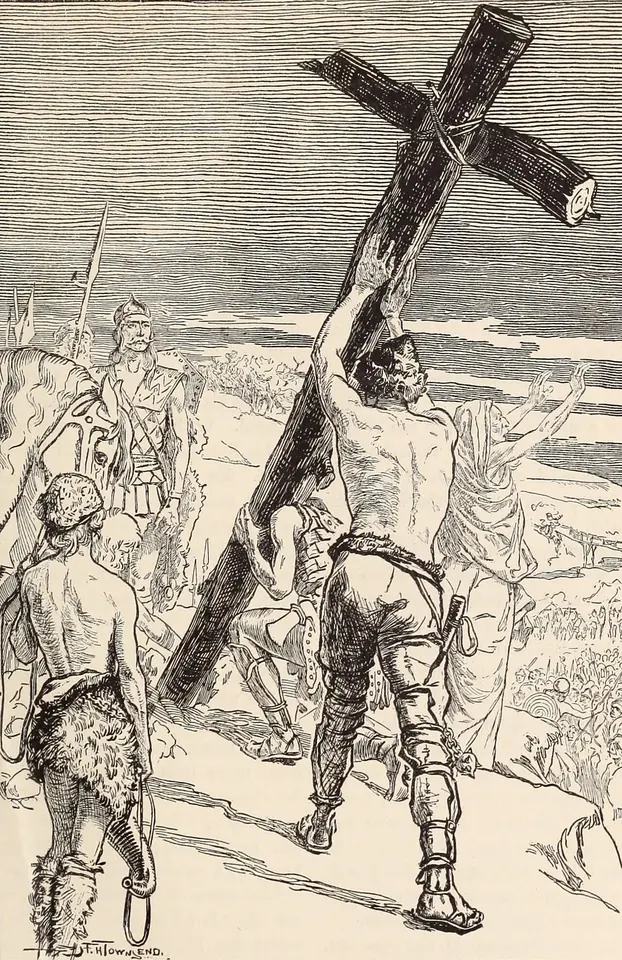
In 633 Edwin was killed by the British king Cadwallon and the pagan Penda of Mercia, and Northumbria fell back into paganism. Oswald came south with a small army. Before the battle, near the old Roman wall a few miles from Hexham, he set up a wooden cross. Bede tells it this way:
The cross being made in haste, and the hole dug in which it was to be fixed, the king himself, full of faith, laid hold of it and held it with both his hands, till it was set fast.
Then he had his army kneel and pray, saying "He knows that we have undertaken a just war for the safety of our nation." They won the battle, and the place was called Heavenfield. Bede says it was the first cross, church or altar raised among the people of Bernicia.
A king who served the poor
Oswald sent to Iona for a bishop, and Aidan came, setting up his see on Lindisfarne in 635. Because Aidan spoke little English at first, the king translated his sermons for his nobles. Bede says that Oswald ruled more of Britain than any king before him, yet stayed "humble, affable, and generous to the poor and strangers." He married the daughter of King Cynegils of Wessex and stood as Cynegils's godfather at his baptism.
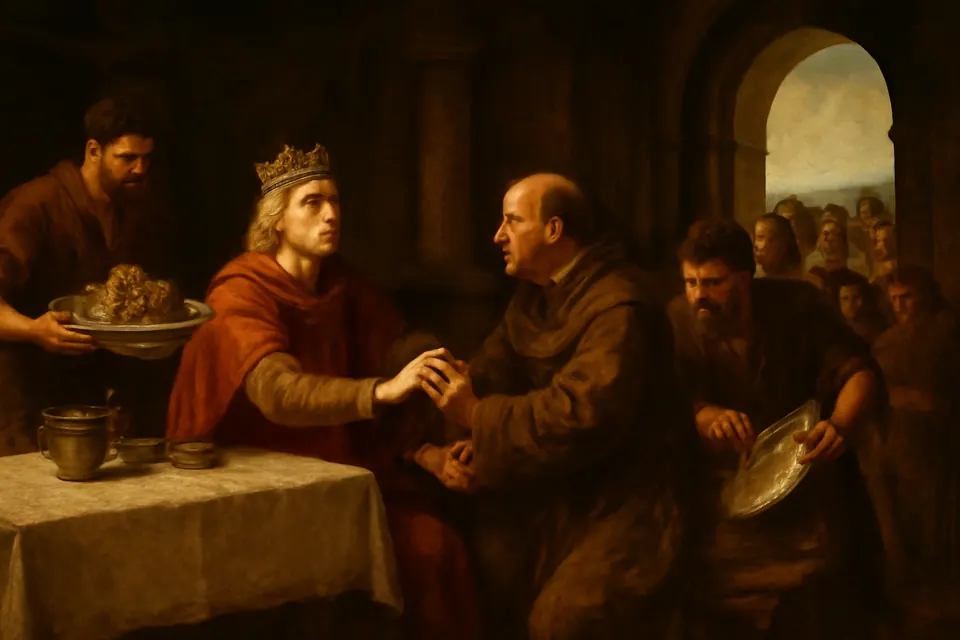
The best-known story is from an Easter dinner. A servant came in to say that a crowd of poor people was waiting outside. Oswald sent out the food on his table and ordered his silver dish to be cut up and shared among them. Aidan, sitting beside him, took his right hand and said, "May this hand never perish."
Death at Maserfield
On August 5, 642, Oswald was killed fighting Penda at a place Bede calls Maserfield, traditionally Oswestry in Shropshire. He was about thirty-eight. Bede records his last prayer as a proverb: "Lord, have mercy on their souls, said Oswald, as he fell to the ground." Penda had his head and arms cut off and set on stakes. A year later Oswald's brother Oswy took them down.

Miracles of St. Oswald
Bede gives several stories, which he heard from older people and which we should call reported: his own account is careful to say where he heard each one.
- The Heavenfield cross. Chips of its wood, dipped in water, healed sick people and cattle, and the monks of Hexham came every year to keep vigil there.
- The incorrupt arm. Aidan's blessing came true: Bede says the king's arm and hand were "entire and uncorrupted to this day" in a silver case at Bamburgh.
- The earth of Maserfield. So many people carried away dust from the place where he fell that a hole as deep as a man was left. Bede tells of a horse and a paralyzed girl healed there.
- The pillar of light. When his niece Queen Osthryth brought his bones to Bardney Abbey, the monks at first refused them, and a column of light stood over the cart all night until they repented.
Why St. Oswald is a patron of Northumbria and of kings
He is the first great Christian king of Northumbria, and the north of England has always claimed him. He is also a model for Christian rulers: a king who prayed long into the morning, Bede says, often with his hands turned upward on his knees, and who gave away his own silver to the hungry.

Symbols of St. Oswald in art
You will find Oswald in English churches and, surprisingly often, in Germany, Austria and Switzerland, where his cult spread in the Middle Ages. Look for:
- Crown and scepter, often with a palm, as king and martyr.
- A wooden cross, for Heavenfield.
- A silver dish or covered cup, for the Easter alms.
- An orb, in late medieval and Renaissance portraits like Jacopo de' Barbari's, simply as a sign of royal power.

Relics and places of pilgrimage
His head went to Lindisfarne, then into St. Cuthbert's coffin in 875 for fear of the Danes, and with St. Cuthbert to Durham, where it rests today. Some of his bones went from Bardney to Gloucester in the 10th century. Pilgrims still walk to the little church at Heavenfield, and the town of Oswestry, traditionally the place where he fell, is held to be named for him. On the Continent, the cathedral of Hildesheim keeps a 12th-century reliquary made for a relic of his head.

Prayer to St. Oswald
We know of no traditional prayer to St. Oswald in the standard prayer books. His own prayer is the best one we have: "Lord, have mercy on their souls." Let us pray it for soldiers, for all who die in war, and for those who govern. St. Oswald, king and martyr, pray for us.
Frequently asked questions
Why is St. Oswald a saint?
For his faith as a king and his death. Bede says he stayed "humble, affable, and generous to the poor" at the height of his power, prayed for hours each morning, and worked with St. Aidan to bring the Gospel to Northumbria. He was killed in battle by the pagan King Penda of Mercia in 642, praying for his men, and the English honored him as a martyr from that time.
What happened at Heavenfield?
Before fighting the British king Cadwallon near Hadrian's Wall in 634 or 635, Oswald set up a wooden cross, held it himself while it was planted, and had his small army kneel and pray. They won. Bede says it was the first sign of the Christian faith raised among the Bernicians, and that chips from the cross healed the sick. A church now stands at the site.
What were St. Oswald's last words?
Bede reports a proverb: "Lord, have mercy on their souls, said Oswald, as he fell to the ground." Seeing that he would be killed, he prayed for the souls of his army.
Where are St. Oswald's relics?
His head was buried at Lindisfarne, placed in St. Cuthbert's coffin in 875 and carried with it to Durham Cathedral, where it is believed to lie still. Most of his bones went to Bardney Abbey in Lincolnshire and some later to Gloucester. Bede says his arm and hand stayed incorrupt at Bamburgh in his own day; several churches on the Continent also claim relics.
Keep exploring
Sources
- Catholic Encyclopedia (1911): St. Oswald. Relics at Durham, Gloucester and Bamburgh; Reginald's description of his appearance
- Bede, Ecclesiastical History of the English People, Book III (Medieval Sourcebook, Fordham University). Heavenfield (III.2), the silver dish (III.6), his death and the miracles at Maserfield (III.9–13)