St. Albert of Trapani
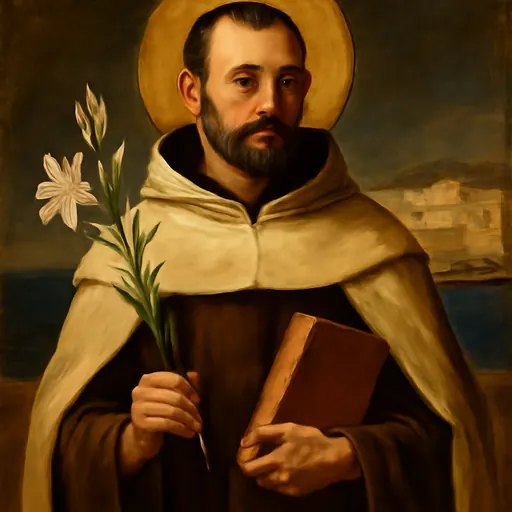
St. Albert of Trapani (about 1250–1307) was a Carmelite priest who preached across Sicily, won many Jews to Christ, and according to tradition saved Messina from famine through his prayer. He was the first saint venerated by the whole Carmelite Order. His feast day is August 7, and he is the patron of Trapani and invoked against fever.
Who was St. Albert of Trapani?
St. Albert of Trapani, also known as St. Albert of Sicily, was a Carmelite priest who lived in the second half of the 13th century and spent his life preaching on the island where he was born. He was the first saint to be honored by the whole Carmelite Order, which still calls him one of its fathers. Sicilians remember him as the friar who fed a starving city, and as a man of deep prayer who brought many of his Jewish neighbors to faith in Christ.
The Roman Martyrology sums him up in a single sentence. On August 7 it remembers "Saint Alberto degli Abati, priest of the Order of Carmelites, who with his preaching converted many Jews to Christ and provided food for the besieged city" of Messina.
His life
A child promised to Our Lady
Our main account of Albert's life is a Life written in the second half of the 14th century, which survives in many copies and reworkings from the 15th. It tells that he was born in Trapani around 1250 to Benedetto degli Abati and Giovanna Palizi, a noble couple who had been childless for twenty-six years. They promised that if God gave them a son, they would consecrate him to the Lord in honor of Our Lady of Mount Carmel. When the boy was still young his father began to arrange a good marriage for him, but his mother held her husband to their vow.
The Life says Albert entered the young Carmelite Order as a boy. In his humility he did not want to be ordained, but his brothers and superiors persuaded him, and he became a priest.
The documents
Not everything about Albert depends on the old Life. Parchments from the Carmelite convent of Trapani, now in the city's Biblioteca Fardelliana, show him present there on August 8, 1280, and on April 4 and October 8, 1289. Another, dated May 10, 1296, names him provincial superior of the Carmelites in Sicily. Those few lines of ink are the firm frame around the stories.
The siege of Messina
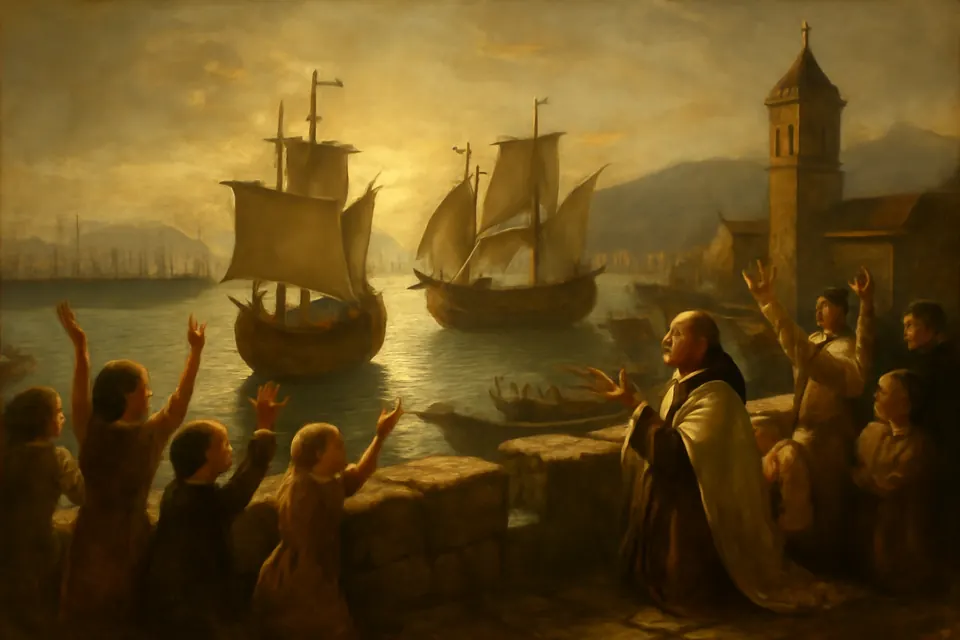
His superiors later sent him to the convent at Messina, on the far side of the island. There, in 1301, the city was under siege by the Duke of Calabria, and its people were starving. Tradition holds that Albert offered Mass for the city's deliverance, and that while he prayed three ships loaded with grain slipped through the enemy blockade and reached the harbor. The besiegers gave up. For Messina, he was ever afterward the friar who fed them.
Preacher to his neighbors
Albert's preaching, his charity and his reputation for miracles spread his name across Sicily. The Martyrology singles out his conversion of many Jews. The old accounts also speak of his love of purity and of prayer, and of a hard, penitential life.
He died in Messina on August 7, probably in 1307. The Life tells that at his funeral the clergy and the people disagreed about which Mass to sing: the people wanted the Mass of a saint, the clergy the ordinary Mass for the dead. Two angels appeared and began the Os iusti, the opening chant of the Mass of a holy confessor, and the question was settled.
The miracles of St. Albert of Trapani
- The grain ships at Messina (1301), traditional: told in his 14th-century Life and kept in the Martyrology's words that he "provided food for the besieged city."
- The angels at his funeral, traditional.
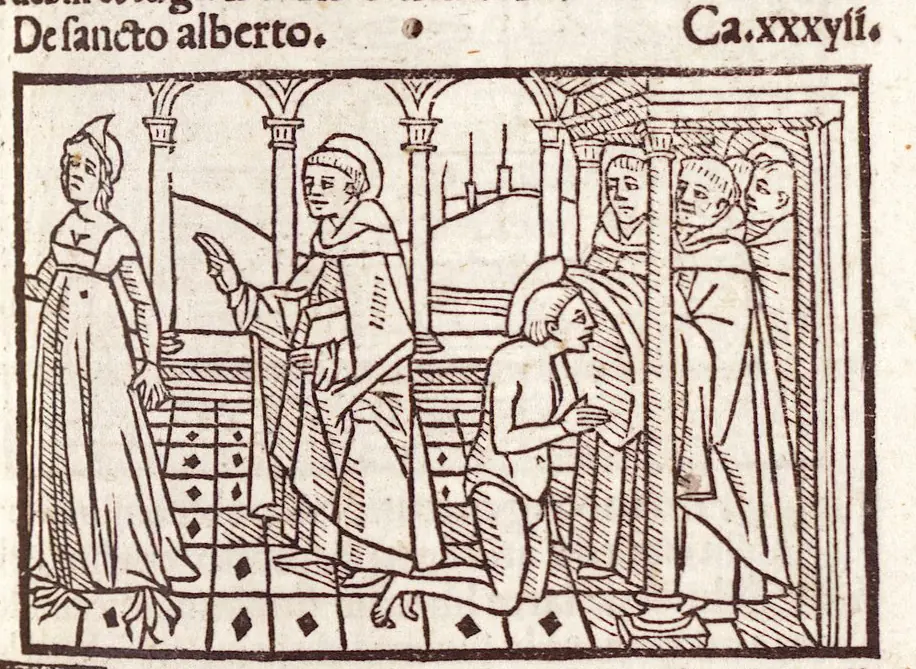
- Healings, especially of fever, reported: the Carmelite devotion of seven centuries, in which the sick ask his prayers and receive St. Albert water.
Pietro Liberi's altarpiece in the Carmelite church of Venice shows Albert at his most familiar work, bending over the sick.

St. Albert water
St. Albert's relics are scattered across Europe, and they are still used for a sacramental found nowhere else: St. Albert water. A priest dips a relic of the saint into water with a special blessing, and the water is given to the sick, especially those with fever. We do not treat it as a medicine or a charm. It is a prayer made visible, asking God to heal through the intercession of a saint who loved the sick.

Why St. Albert is a patron saint
He is the patron of his native Trapani, and also of Erice, Palermo and Messina, where a city gate was named for him in 1623. He is invoked against fever, because of St. Albert water, and for the possessed and against earthquakes. Above all he is a patron of the Carmelites. The Order's general chapter of 1420 ordered his image in every convent; in 1524 it put his image on the chapter's seal, and the prior general Nicholas Audet wanted an altar to him in every Carmelite church. St. Teresa of Avila and St. Mary Magdalene de' Pazzi were both devoted to him.
Symbols of St. Albert of Trapani in art
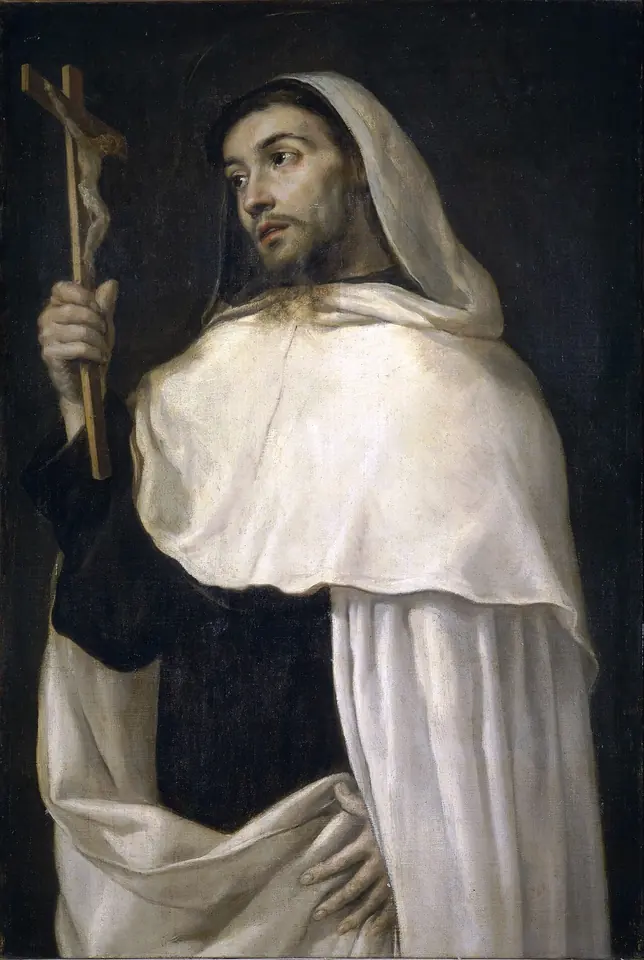
Look for a Carmelite friar in a brown habit with a white mantle. His oldest attribute is the lily, the sign of the chastity he chose as a young religious, often with a book for his preaching. Later images show him trampling a devil, and from the 17th century painters liked to show his miracles: the sick he healed and the grain ships at Messina. Some show him holding the Christ Child, and many put the walls and harbor of Trapani in the background. Spanish painters such as Antonio de Pereda gave him a crucifix to hold up.
His statue stands in the great Carmelite church of his hometown, where his head is kept.

Feast day and prayer
We keep the feast of St. Albert of Trapani on August 7. The Carmelites celebrate it as a feast, the Discalced Carmelites as a memorial. Pope Callixtus III permitted his cult by word of mouth in 1457, and Pope Sixtus IV confirmed it in a bull of May 31, 1476. Find his neighbors on our feast days page and other patrons of the sick on our patron saints page.
We have no traditional prayer to St. Albert in English that we can trace to a source, so let us simply ask him: St. Albert, you fed the hungry and healed the sick, pray for all who suffer from fever and illness, and for the Carmelite family you loved.
Frequently asked questions
Who was St. Albert of Trapani?
A Sicilian Carmelite friar of the 13th century, born Alberto degli Abati in Trapani. He became a priest, preached throughout Sicily, served as provincial superior of the Carmelites on the island, and died in Messina, probably on August 7, 1307. He is the Carmelites' first saint and often called their "father."
When is the feast of St. Albert of Trapani?
August 7, the day of his death, as the Roman Martyrology records. The Carmelites celebrate it as a feast and the Discalced Carmelites as a memorial.
What is St. Albert water?
Water blessed by dipping a relic of St. Albert into it, with a special blessing. Carmelites have given it for centuries to the sick, especially those suffering from fever. Like every sacramental, it is not a charm; we use it with faith, asking God for healing through the saint's prayers.
Is St. Albert of Trapani the same as St. Albert the Great?
No. St. Albert the Great was a German Dominican bishop and scholar, the teacher of St. Thomas Aquinas, whose feast is November 15. St. Albert of Trapani was a Sicilian Carmelite preacher. There is also St. Albert of Jerusalem, the patriarch who wrote the Carmelite Rule.
Keep exploring
Sources
- Santi e Beati: Sant'Alberto degli Abati (da Trapani), Sacerdote carmelitano. The parchments of 1280, 1289 and 1296 in the Biblioteca Fardelliana; the 14th-century Life; Callixtus III in 1457 and Sixtus IV's bull of May 31, 1476; iconography, patronages, St. Albert water and his head at Trapani
- Roman Martyrology 2004, August (GCatholic). August 7 entry