St. Jeanne Delanoue, Servant of the Poor of Saumur
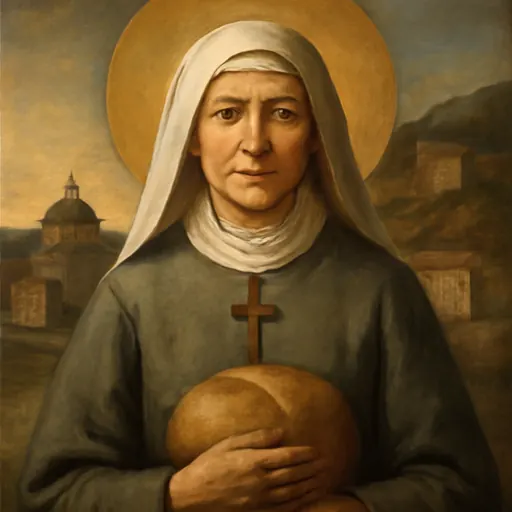
St. Jeanne Delanoue (1666-1736) was a shopkeeper of Saumur, France, who at twenty-seven gave her life to the poor. She took orphans, the sick and the elderly into her home, founded the Sisters of St. Anne of Providence, and opened the town's first hospice. Pope John Paul II canonized her in 1982, and we keep her feast on August 17.
Who was St. Jeanne Delanoue?
St. Jeanne Delanoue was a shopkeeper in Saumur, a town on the Loire in western France, who became one of the great servants of the poor in the age of Louis XIV. Born on June 18, 1666, the last of twelve children, she spent her first twenty-seven years minding the family's small dry-goods shop and minding its profits even more closely. Then, at Pentecost in 1693, she turned around completely. She spent the rest of her life feeding, clothing, housing and nursing the poorest people of her town, founded the Sisters of St. Anne of Providence, and died on August 17, 1736, with the whole town saying, "The saint is dead."
Pope John Paul II canonized her on October 31, 1982, and we keep her feast on August 17.
A shrewd young shopkeeper
Her parents kept a modest shop selling thread, ribbons and small goods near the shrine of Notre-Dame-des-Ardilliers, where pilgrims came to pray to the Virgin. Her father died when she was six, and the girl helped her mother run the business to keep the family fed. The Vatican biography published for her canonization describes her as clever, active and tireless, so devoted to trade that she kept the shop open on Sundays and feast days.
In his canonization homily John Paul II did not soften this part of the story. People knew her, he said, as "a prudent and self-interested merchant." When her mother died in 1692, Jeanne took over the shop, and by every sign she meant to make it prosper.

The call at Pentecost, 1693
The 1690s were terrible years in France: failed harvests, famine and bitter winters. Saumur filled with hungry people. In the season of Pentecost in 1693, a poor old pilgrim to the Ardilliers shrine named Françoise Souchet began coming to the shop and urging Jeanne to give herself to the poor. Something in the old woman's words reached her. The Pope saw the Holy Spirit at work here: the Spirit, he said, put out "the fire of her avarice" and lit in its place "the fire of charity," so that the careful trader became "a very great spendthrift in charity."

It did not happen all at once. At first she cared for the poor a little each day, alongside her customers. Then more each day than her customers. Soon, the Vatican biography says, the poor stopped waiting for her to come and came to her door instead.
The caves of the hillside
Saumur sits against a hillside of soft white tufa stone, and the poorest families lived in holes dug into the rock, in stables and caves. John Paul II described what Jeanne did there: she visited people who lived "like beasts" in those caves, brought them food and clothes, washed their laundry, gave them her own clothes when she had to, and tried to keep their shelters warm.
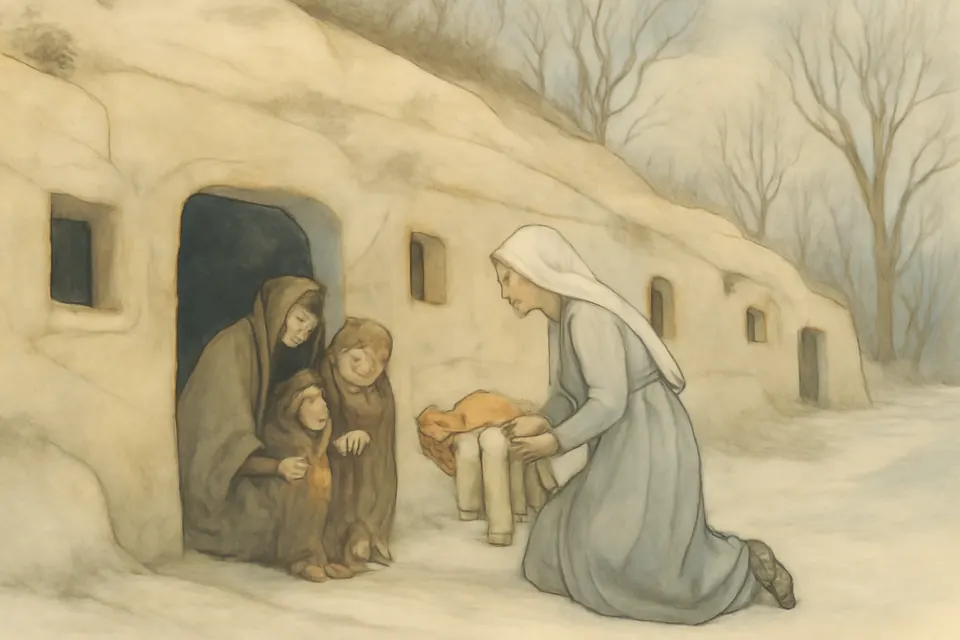
In 1700 she took a child into her own home, and the sick, the old and the destitute soon followed. There was no room for so many, so she fitted out the tufa caves themselves as shelters. In turn she set up three borrowed houses, which she called "Providences," for orphans, girls left on their own, women in trouble, old people and anyone caught by hunger and cold. She made no distinction between the deserving and the undeserving poor. She helped them all, and she wanted the children and young women to learn a trade.
The Sisters of St. Anne of Providence
By 1704 a few young women had joined her and were ready to take the religious habit. So began the Congregation of St. Anne of Providence, whose rule the Bishop of Angers approved in 1709. Jeanne wanted her sisters to live in the same house as the poor, eat what they ate, be nursed as they were nursed when ill, and wear a plain gray habit. The poor were to be greeted with respect and served first.
She herself begged in the streets at times, ate worse food than the people she fed, fasted often and slept little. In 1715 she opened the first hospice in Saumur, a work that, as the Vatican biography notes, the king had asked for as far back as 1672.
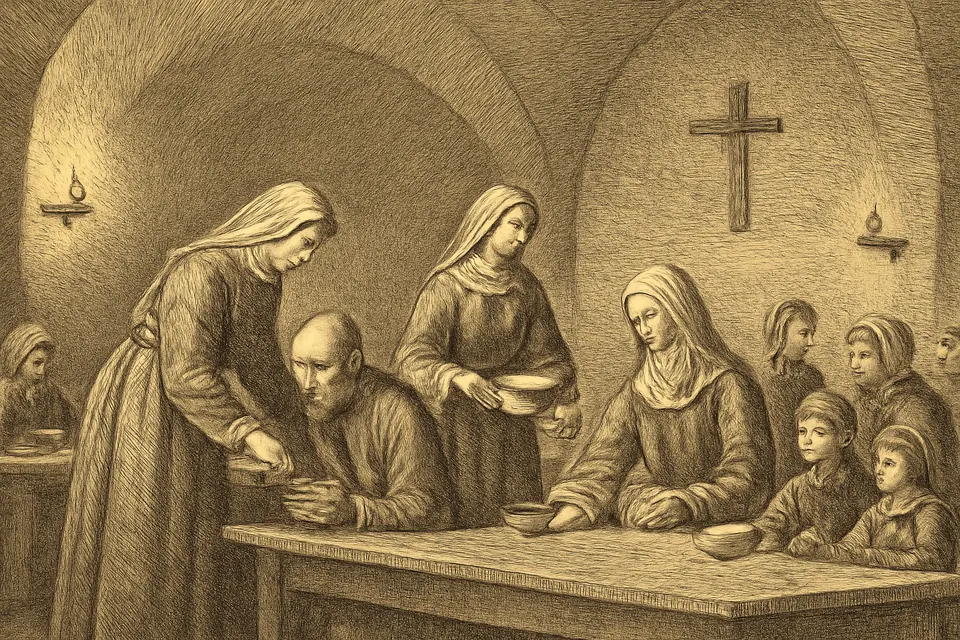
When she died on August 17, 1736, she left about a dozen communities, hospices and small schools. "The saint is dead," people said in Saumur. Her sisters, now called the Servants of the Poor of Jeanne Delanoue, still serve in France, Madagascar, Indonesia and Mali.
The secret of her charity
John Paul II insisted that her love for the poor did not come from sentiment. The Holy Spirit let her see Christ in them: the Christ Child in their children, Christ the friend of the poor, Christ humiliated and crucified. She trusted God's providence with the boldness of a child, and her houses were named for it. The Pope also spoke of her deep prayer, her devotion to Mary and the Eucharist, and her obedience to her confessors and her bishop. The Church does not ask us to take her on her word alone: as in every cause of her time, her beatification and canonization rested on approved miracles worked through her prayers, though the Vatican texts quoted here do not describe them.
The Pope named the example of the young Fr. Grignion de Montfort, St. Louis de Montfort, as an encouragement on her Marian path.
At her canonization the first reading was from Isaiah, and it reads like her life:
Is it not to share your bread with the hungry, and bring the homeless poor into your house; when you see the naked, to cover him, and not to hide yourself from your own flesh? (Isaiah 58:7, RSV-CE)
Symbols of St. Jeanne Delanoue in art
Images of St. Jeanne Delanoue are mostly devotional pictures made for her congregation and the people of Saumur, and they share a few signs:
- The plain gray habit and white headdress she chose for her sisters, the dress of the poor.
- Bread, a basket or a bowl, for the hungry she fed every day.
- Children and old people at her side, the orphans and the aged of her "Providences."
- The tufa caves of Saumur, the hillside homes of the poor where her work began.
- Our Lady of Ardilliers, the shrine beside her shop, for the Marian call that changed her life.
If you see a French nun in gray with bread in her hands and a domed church on the Loire behind her, it is very likely St. Jeanne.

Feast day and prayer
We keep her feast on August 17. In Saumur, pilgrims visit the Ardilliers shrine, where her calling began, and the motherhouse of her sisters at Saint-Hilaire-Saint-Florent. See the feast day calendar.
We know of no traditional prayer to St. Jeanne Delanoue in wide use. Let us simply ask her, in our own words, to pray for the hungry and the homeless, for those who live in want close to our own doors, and for us, that God may turn our own carefulness with money into generosity, as He did hers.
Frequently asked questions
Who was St. Jeanne Delanoue?
A French laywoman, later the foundress of a religious congregation, born in Saumur in 1666. She ran her family's small dry-goods shop until a call to serve the poor changed her life in 1693. She spent the next forty years feeding, housing and nursing the poorest people of the town, and died there on August 17, 1736.
When is St. Jeanne Delanoue's feast day?
August 17, the anniversary of her death in Saumur in 1736.
When was Jeanne Delanoue canonized?
Pope Pius XII beatified her on November 5, 1947, and Pope John Paul II canonized her in Rome on October 31, 1982, together with St. Marguerite Bourgeoys.
What congregation did St. Jeanne Delanoue found?
The Congregation of St. Anne of Providence, begun in 1704 and approved in 1709. Today the sisters are called the Servants of the Poor of Jeanne Delanoue, with communities in France, Madagascar, Indonesia and Mali.
Keep exploring
Sources
- Pope John Paul II, Homily for the canonization of Marguerite Bourgeoys and Jeanne Delanoue, October 31, 1982 (vatican.va). Her conversion at Notre-Dame-des-Ardilliers, Françoise Souchet, the cave dwellings, the "Providences," the gray habit and the Pope's words on her charity (our translation)
- Jeanne Delanoue (1666-1736), biography published by the Vatican for her canonization. Her family and the shop, the tufa caves, the 1704 foundation, the 1715 hospice, her death, beatification on November 5, 1947
- Diocese of Angers: Servantes des Pauvres de Jeanne Delanoue. The congregation's communities today
- Isaiah 58, Revised Standard Version Catholic Edition (Bible Gateway)