Blessed Martín Martínez Pascual, Young Priest and Martyr of Valdealgorfa
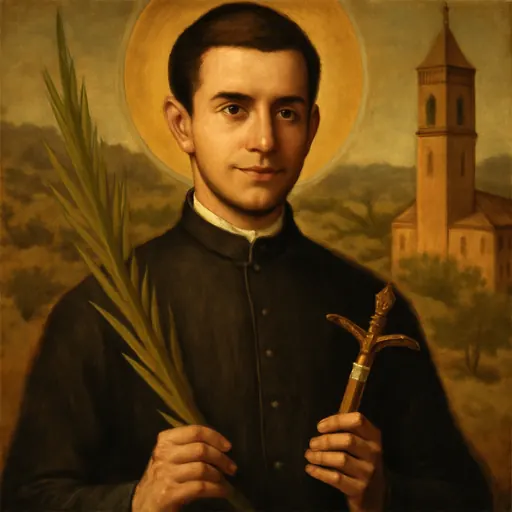
Blessed Martín Martínez Pascual (1910–1936) was a Spanish priest of the Brotherhood of Diocesan Worker Priests. Hiding near Valdealgorfa during the Spanish Civil War, he learned that militiamen had arrested his father to force him out. He walked back, was shot the same afternoon, and died forgiving his killers. He was beatified in 1995. His feast is August 18.
Who was Blessed Martín Martínez Pascual?
Blessed Martín Martínez Pascual was a Spanish priest who had been a priest for barely a year when the Spanish Civil War broke out. Hidden in a cave outside his home village of Valdealgorfa, he heard that militiamen had arrested his father to make him give up his son. He walked straight back to the village to take his father's place. That same afternoon, August 18, 1936, he was shot with other priests and laymen of the village, facing his killers and forgiving them. He was twenty-five. We keep his feast on August 18.
The life of Blessed Martín Martínez Pascual
A carpenter's son
Martín was born at Valdealgorfa, in the province of Teruel in Lower Aragon, on November 11, 1910, and baptized the next day. His father, also named Martín, was a carpenter, and his mother was Francisca Pascual Amposta. The family lived across from the convent of the Poor Clares, and the boy spent a great deal of time in their church, where the sisters prayed before the tabernacle.
His parents hoped he would join the Civil Guard. Martín wanted to be a priest. Encouraged by Mariano Portles, a village priest who looked after vocations (and who would die with him), he went to the minor seminary of Belchite and then to the major seminary of Zaragoza.

"The best of us all"
Classmates remembered him as a mischievous boy who changed completely in his philosophy years. They traced the change to his reading of Story of a Soul by St. Thérèse of Lisieux. From then on he aimed at holiness, but in her "little way," cheerful and natural, with no oddities. One classmate wrote in 1948 that he was "without any doubt, the best of us all." He spent long hours before the Blessed Sacrament, sometimes with his arms stretched out in the form of a cross.
He longed to be a missionary. When that door stayed closed, he joined the Brotherhood of Diocesan Worker Priests of the Sacred Heart, founded by Blessed Manuel Domingo y Sol to form future priests, thinking he could stir up missionary vocations among seminarians. He was ordained a priest at Tortosa on June 15, 1935, and sent to the order's vocations college in Murcia, where boys remembered him as recollected in chapel and great fun at recreation.
Summer of 1936
From June 26 to July 5, 1936, he made a retreat at Tortosa with other Worker Priests. Of the thirty priests there, twenty-two were martyred within weeks. Afterward he went home to Valdealgorfa for the summer.
On July 26 militiamen from outside arrived, the church was locked, and the priests went into hiding. Martín hid in a neighbor's house. A village woman managed to get the consecrated hosts out of the convent church, and at his request the nuns consumed them, keeping six or seven for him. With those he gave Communion in secret, led holy hours and the Rosary, and prayed an Our Father every day for the persecutors.

When the house was no longer safe, he moved to a cave on a farm about three kilometers outside the village.
The martyrdom of Martín Martínez Pascual
On August 18, 1936, after a proclamation ordering every priest to surrender, the militiamen arrested his father and threatened to shoot him if his son did not appear. The farmer who hid Martín brought him the news, with his father's message not to come back. Martín answered, "Yes, I'm going," and set off so fast that he reached the village long before the farmer did.
A militiaman who was a friend of the family met him on the road and told him the threat was only a bluff. According to that man's own testimony, Martín replied: "If I don't present myself, they will kill my father. I don't want anyone to suffer for me. I want to die a martyr with my companions." He embraced him and asked him to tell his parents to forgive their enemies.

The village committee, who liked him, tried to save him by telling the outside militiamen he was only a student. Asked, "Are you Martín Martínez, the student?", he said he was Martín Martínez, and a priest like the others. Locked for a few minutes in the town hall cell with the other priests, he gave them Communion from the hosts he had kept.
The priests were taken by truck toward the cemetery. Witnesses said he refused to be shot from behind because he had done nothing wrong, forgave his killers, asked them to aim well so no one would suffer, and cried "¡Viva Cristo Rey!" He was killed about six in the evening. Manuel Fuster Pellicer, a priest ordained just six weeks before, was found dead in his arms.

- Approved: his martyrdom. Pope John Paul II beatified him on October 1, 1995. As a martyr he needed no miracle for beatification.
A note on the famous photograph
A well-known photograph of a smiling young bearded man about to be shot has been captioned for decades as Martín Martínez Pascual and printed on many holy cards. It is not him. It was taken at Siétamo, in Huesca, far from Valdealgorfa, and in 2016 another picture surfaced showing the same man weeks later dressed as a militiaman. We honor Blessed Martín for what he did, not for a picture.
Symbols of Blessed Martín Martínez Pascual in art
No artwork of his own time exists. Devotional images show him in a priest's cassock, with the martyr's palm, and sometimes with a pyx or host, for the Eucharist he carried to his fellow prisoners.
Feast day and prayer
We keep his feast on August 18, among the Diocesan Worker Priests and in Spain. See the feast day calendar and what a martyr is.
We know of no traditional prayer to him that we can quote. Let us ask Blessed Martín to pray for priests and seminarians, for sons and daughters who carry their parents' burdens, and for the grace to forgive. Blessed Martín Martínez Pascual, pray for us.
Frequently asked questions
Who was Martín Martínez Pascual?
A young priest from Valdealgorfa in the province of Teruel, born on November 11, 1910. He studied at the seminaries of Belchite and Zaragoza, joined the Diocesan Worker Priests in 1934, was ordained at Tortosa on June 15, 1935, and taught at the order's vocations college in Murcia. He was killed in his home village on August 18, 1936.
Is the famous photo of a smiling priest before execution Martín Martínez Pascual?
No. A widely shared 1936 photograph of a young bearded man smiling before a firing squad was long captioned as him and printed on many holy cards. It was taken at Siétamo, in Huesca, far from Valdealgorfa, and in 2016 another photograph showed the same man weeks later as a militiaman. Blessed Martín was killed at Valdealgorfa, in Teruel.
What did Martín Martínez Pascual say before he died?
Witnesses in his cause said he refused to turn his back to the firing squad because he had done nothing wrong, that he forgave his killers and asked them to aim well so the others would not suffer, and that he cried "¡Viva Cristo Rey!" (Long live Christ the King!).
When was he beatified?
On October 1, 1995, in Rome, by Pope John Paul II, together with the founder of the Disciples of Jesus, Pedro Ruiz de los Paños, and seven other Diocesan Worker Priests.
Keep exploring
Sources
- Juan de Andrés Hernansanz, Testigos de su sacerdocio (Madrid–Salamanca, 1990), chapters on Valdealgorfa and on Martín Martínez Pascual. The witness testimony from his cause, quoted throughout (our translations)
- John Paul II, Homily for the beatification of October 1, 1995 (Italian). The beatification of the nine Diocesan Worker Priests led by Pedro Ruiz de los Paños
- El Confidencial: Ni cura ni mártir de la Guerra Civil, era un miliciano comunista (September 6, 2016). The misidentified Siétamo photograph