St. Irmina of Oeren, Abbess of Trier and Benefactor of Echternach
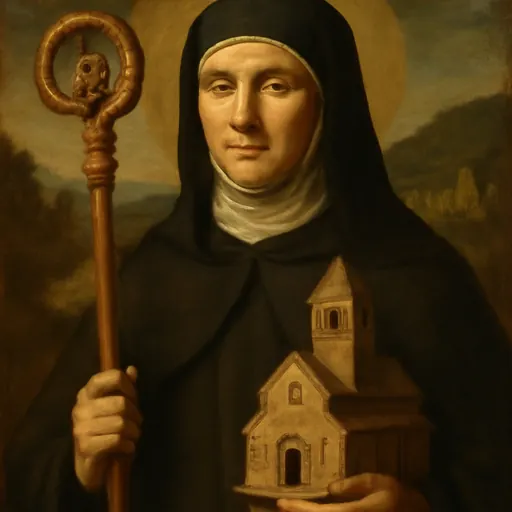
St. Irmina of Oeren (died about 710) was a Frankish noblewoman and abbess of the convent of Oeren in Trier, in present-day Germany. Charters of 698, 699 and 704 record her gifts to St. Willibrord, the apostle of the Frisians, including the estate where he founded the Abbey of Echternach in present-day Luxembourg. Her feast is December 24 in the older Trier calendars.
Who was St. Irmina of Oeren?
St. Irmina of Oeren was a Frankish noblewoman who lived around the year 700 and governed the convent of Oeren at Trier, the old Roman city on the Moselle. She is remembered as the woman who gave St. Willibrord, the English missionary to the Frisians, the land for his monastery at Echternach, in what is now Luxembourg. We know she was real because the charters of her gifts survive, dated 698, 699 and 704. Much of the rest of her story is legend, and we will say which parts are which.
The life of St. Irmina of Oeren
A noble family
Irmina belonged to the Frankish nobility of the Moselle country. An eleventh-century fragment from Trier calls her a sister of Regintrudis and of Adela, the abbess of Pfalzel. A twelfth-century source from Echternach went further and made her a daughter of King Dagobert. The 1881 Allgemeine Deutsche Biographie (ADB), by the church historian Franz Xaver Kraus, rejects the royal claim and calls the charter of 633 that supported it a forgery. The crown that often lies at her feet in art comes from that legend.
Kraus also passes on a romantic tale told by the abbot Trithemius around 1500, about a betrothal that ended before the wedding, and judges it a likely invention. We leave it there.
The convent at Oeren
The convent of Oeren stood near the Moselle in Trier. Its name is usually traced to the Roman granaries (horrea) on whose ruins it was built. Kraus doubts that Irmina founded it, since it already existed, and thinks it took her name because she gave it most of its property. In later centuries the house was known simply as St. Irminen.
The plague and the gift of Echternach
Alcuin's Life of St. Willibrord, written about a century later, tells of a convent of nuns in Trier struck by "a terrible plague." Many sisters died, others lay sick, and the rest waited in terror. They begged Willibrord to come, and he did at once. "On arriving at the convent, he immediately celebrated Mass for the sick and then blessed water and ordered it to be sprinkled about the buildings and given to the nuns to drink." The sisters recovered, and no one else in that house died of the plague.
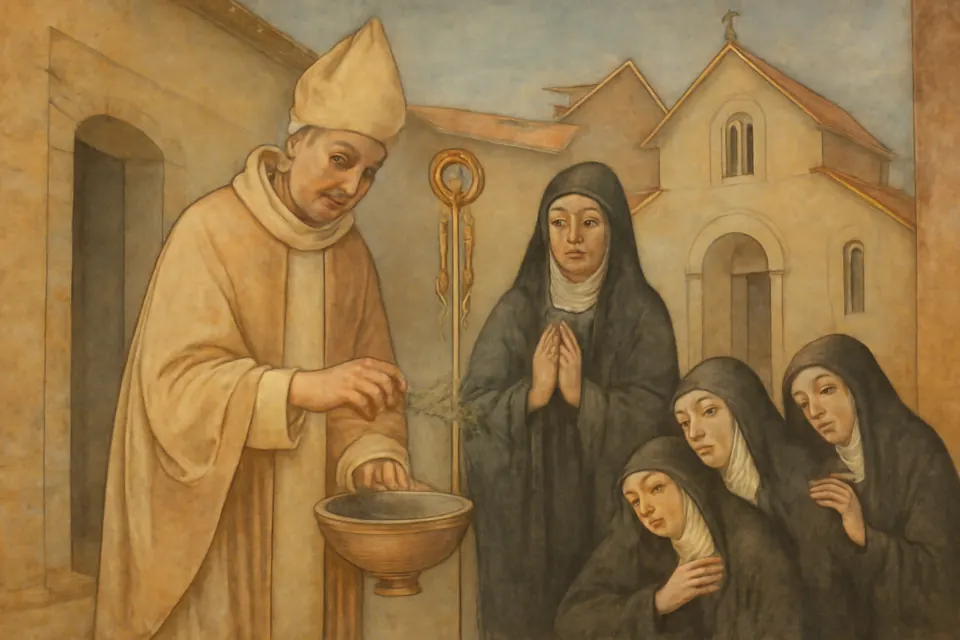
Alcuin does not name the convent or its abbess. Tradition at Echternach and Trier has long connected this story with Irmina's house at Oeren, and with her gift to Willibrord, though the English translator of Alcuin thought another Trier convent, St. Mary ad Martyres, more likely. We can call this miracle traditional: it is recorded by Alcuin, but its link to Irmina rests on later tradition.
What is certain is the gift. In 698 Irmina handed over to Willibrord part of her estate at Echternach on the Sauer River, and further charters followed in 699 and 704. Willibrord built his monastery there, and it became one of the great abbeys of northern Europe. He was buried at Echternach in 739, and his tomb is still the heart of the town's famous dancing procession every Whit Tuesday.
Her death
The ADB gives no firm date for her death; most references place it between 704 and about 710. Wissembourg in Alsace later honored her as its founder and claimed her whole body, and her head was said to be at Sponheim. Kraus notes that an epitaph recorded at Wissembourg had already disappeared by the eighteenth century.
Symbols of St. Irmina in art
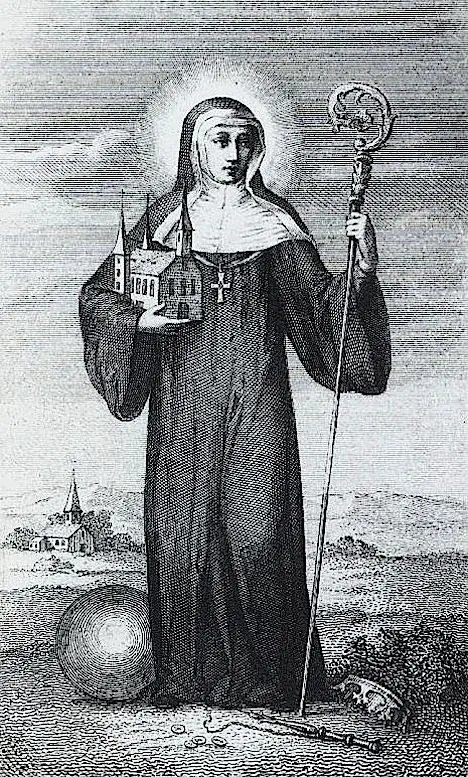
St. Irmina appears as an abbess. Look for:
- A black habit and white veil: the dress of a Benedictine abbess.
- A crosier: the staff of her office.
- A model of a church: her gift of Echternach to Willibrord.
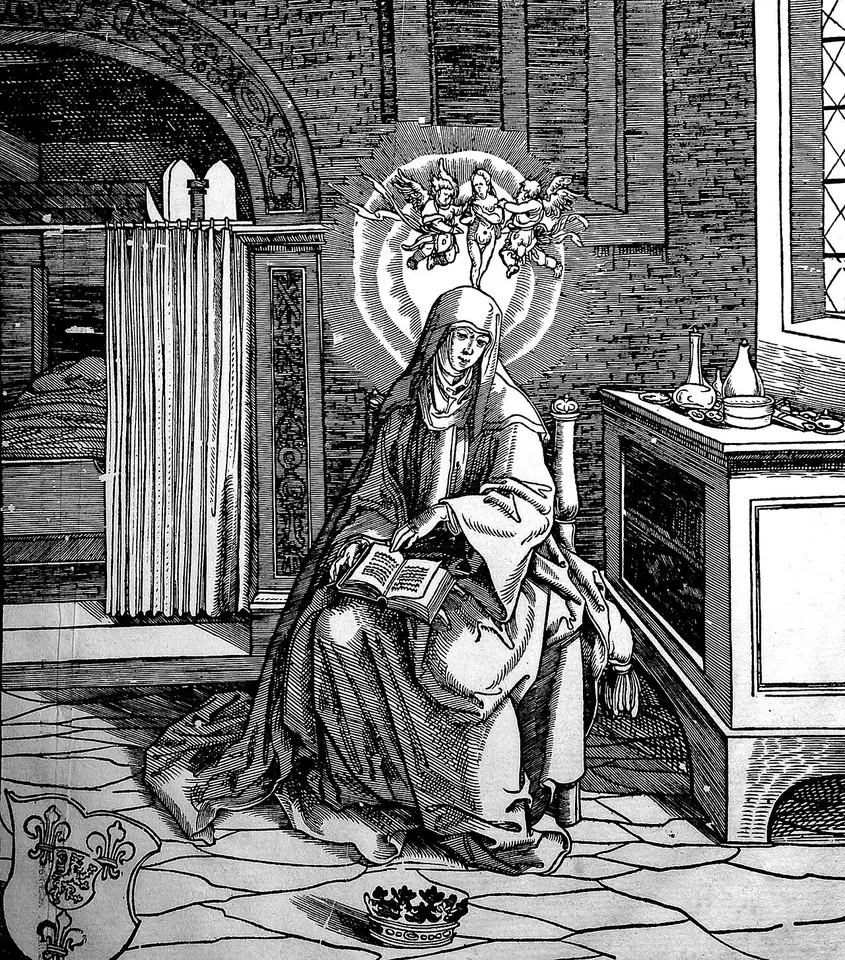
- A book: the prayer and reading of the convent.
- A crown at her feet or in her hand: the legend of her royal birth, and the earthly rank she set aside.
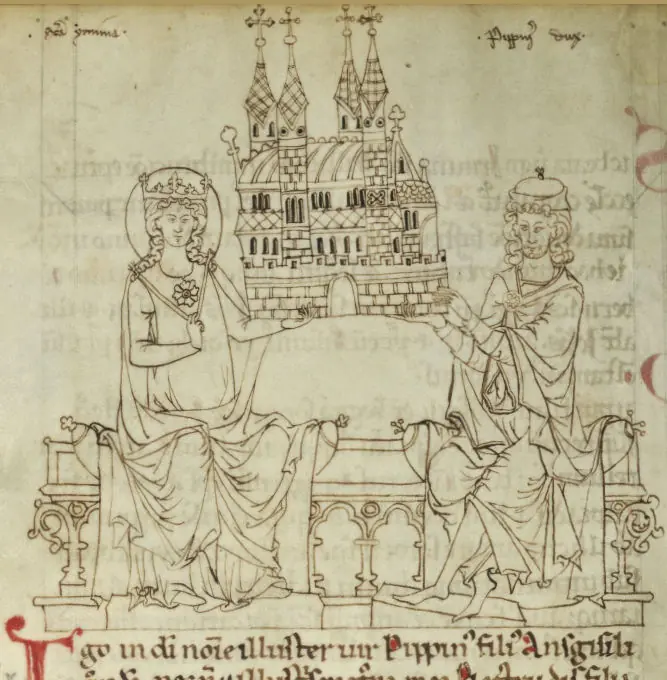
The Golden Book of Echternach (Liber aureus Epternacensis), copied in the 1190s and now in Gotha, shows her crowned and holding the church with Pepin of Herstal, the Frankish ruler who also supported Willibrord. Leonhard Beck's woodcut of 1516–1518 belongs to a series of saints claimed by the House of Habsburg as ancestors.
Feast day and places
The older calendars of Trier, such as the breviary of Trier printed at Basel in 1502, keep St. Irmina on December 24, Christmas Eve. The later Trier breviary moved her to December 18. You can see the saints of nearby days on our feast days page.
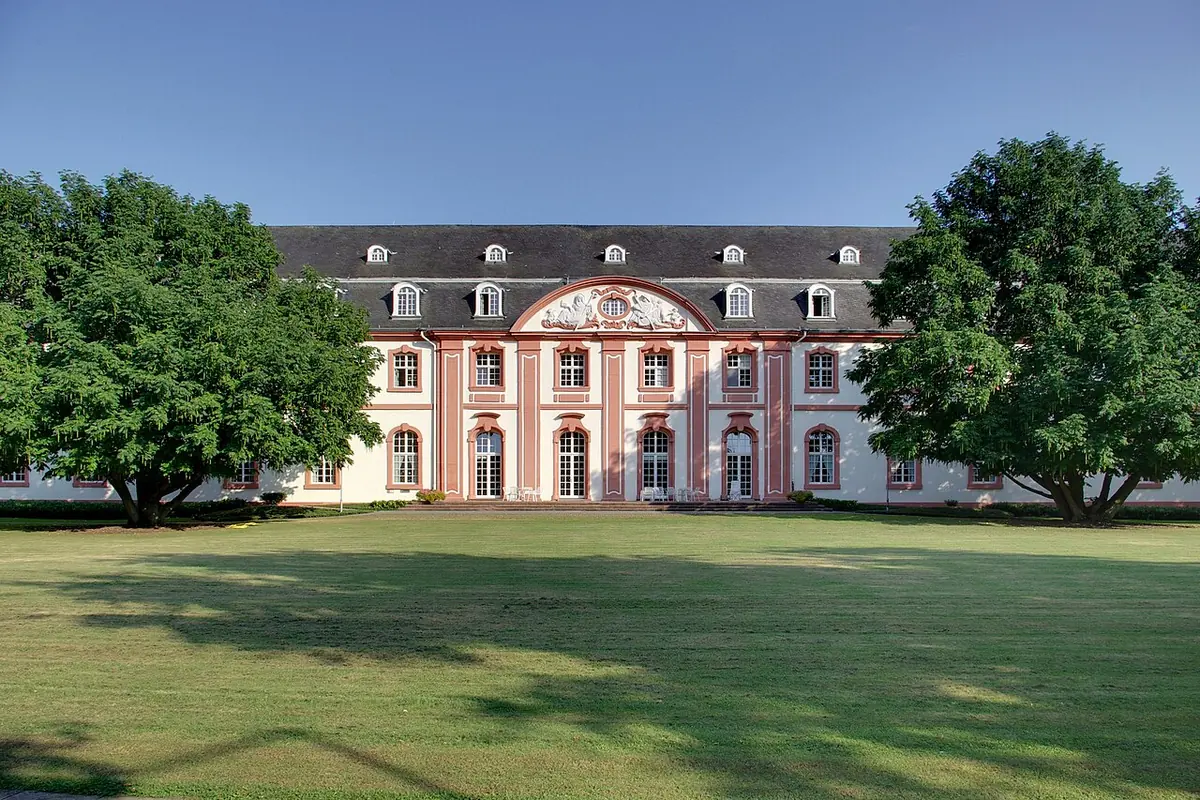
The convent of St. Irminen in Trier was rebuilt in the Baroque style around 1740. Its west wing still stands and today belongs to the Vereinigte Hospitien, the city's historic charitable foundation.
Prayer to St. Irmina
There is no widely known traditional prayer to St. Irmina in the standard prayer books. We can ask her intercession simply: St. Irmina, pray for us. Let us ask her prayers for communities struck by sickness, for benefactors who give generously to the Church, and for the monks and missionaries their gifts make possible.
Frequently asked questions
Who was St. Irmina of Oeren?
A Frankish abbess of the convent of Oeren in Trier around the year 700, who gave St. Willibrord the land for his abbey at Echternach. Charters of her gifts from 698, 699 and 704 still exist. The Trier convent was later named St. Irminen after her.
Was St. Irmina the daughter of King Dagobert?
That is a later legend. A 12th-century source from Echternach calls her a daughter of King Dagobert, but the 1881 Allgemeine Deutsche Biographie rejects the charter of 633 that supported the claim as a forgery. An 11th-century Trier fragment names her as a sister of Regintrudis and of Adela, abbess of Pfalzel.
When is the feast of St. Irmina?
December 24 in the older Trier calendars, such as the Trier breviary printed at Basel in 1502. The later Trier breviary moved her feast to December 18.
Where are St. Irmina's relics?
Wissembourg in Alsace claimed her whole body, and tradition there named her its founder. Her head was said to have gone to Sponheim. Neither claim can be checked today; her epitaph at Wissembourg was already lost by the 18th century.