St. Modestos of Jerusalem, Patriarch and Protector of Animals

St. Modestos of Jerusalem (died 634) was the abbot who held the Church of Jerusalem together after the Persians sacked the city in 614, rebuilt the Church of the Holy Sepulchre and later became patriarch. In the Orthodox Church he is loved above all as the protector of animals, especially farm animals, and his feast is December 18, when priests bless stables and flocks.
Who was St. Modestos of Jerusalem?
St. Modestos of Jerusalem was a monk, abbot and finally patriarch of the Holy City in the dark years of the seventh century. When a Persian army took Jerusalem in 614, burned its churches and carried away its patriarch and the relic of the True Cross, Modestos stayed, buried the dead and rebuilt. In the Orthodox world, though, most people know him for something else. Greek Christians call him the protector of animals, and on his feast priests go from stable to stable blessing the flocks.
We keep his feast on December 18.
Two lives of St. Modestos
The Orthodox tradition remembers him in two ways, and it helps to keep them apart.
The patriarch of history
The historical Modestos was born at Sebasteia in Cappadocia, became a monk and rose to be abbot of the great monastery of St. Theodosius the Cenobiarch in the Judean desert. In 614 the armies of the Persian king Chosroes overran Syria and Palestine. The Orthodox Church in America's life says that 90,000 Christians were killed, many churches were destroyed, and Patriarch Zacharias was led into captivity together with the Cross of the Lord.
Modestos was chosen to govern the Church of Jerusalem in the patriarch's absence. He buried the murdered monks of the monastery of St. Sabbas, and with money and help sent by St. John the Merciful, patriarch of Alexandria, he restored the ruined holy places, among them the Church of the Holy Sepulchre that St. Helena and Constantine had built. He governed in Zacharias's place for about fourteen years. Then the old patriarch came home from captivity, and with him came the Cross of the Lord, recovered from the Persians. After Zacharias died, Modestos became patriarch himself, though only for a short time. He died in 634, at about 97, and was succeeded by St. Sophronius.

The Modestos of the synaxarion
A second, more legendary life is read in Greek churches and retold by Ancient Faith Radio's Saint of the Day. In it Modestos is the orphan of martyred parents from Sebasteia, raised by pagans, baptized in secret at thirteen, sold into slavery in Egypt by jealous foster brothers, and freed after converting his master. On pilgrimage to Jerusalem, the doors of the Holy Sepulchre open at his prayer and the people choose him as their archbishop. One version says he died in peace; another that he was beheaded in old age. These stories are traditional, and the Church of Greece itself admits that "little is known about his life."
The miracles of St. Modestos
- Healing people and animals: traditional. His lives say he healed the sick and their livestock by his prayers.
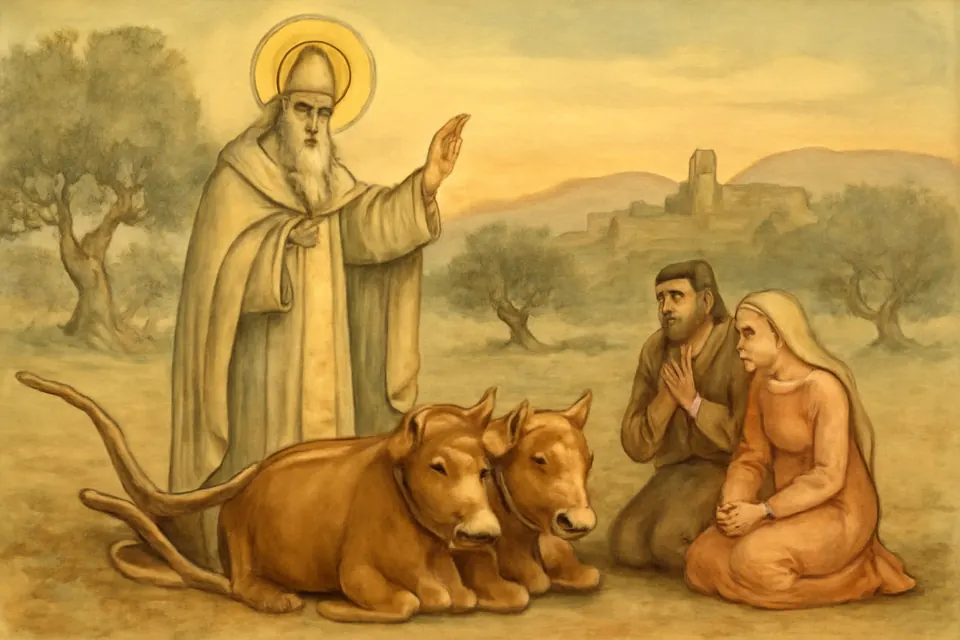
- The farmer's oxen: traditional. Greek tradition tells of a poor farmer whose plow oxen fell dead, and of Modestos raising them to life so the man could feed his family.
Why St. Modestos is the protector of animals
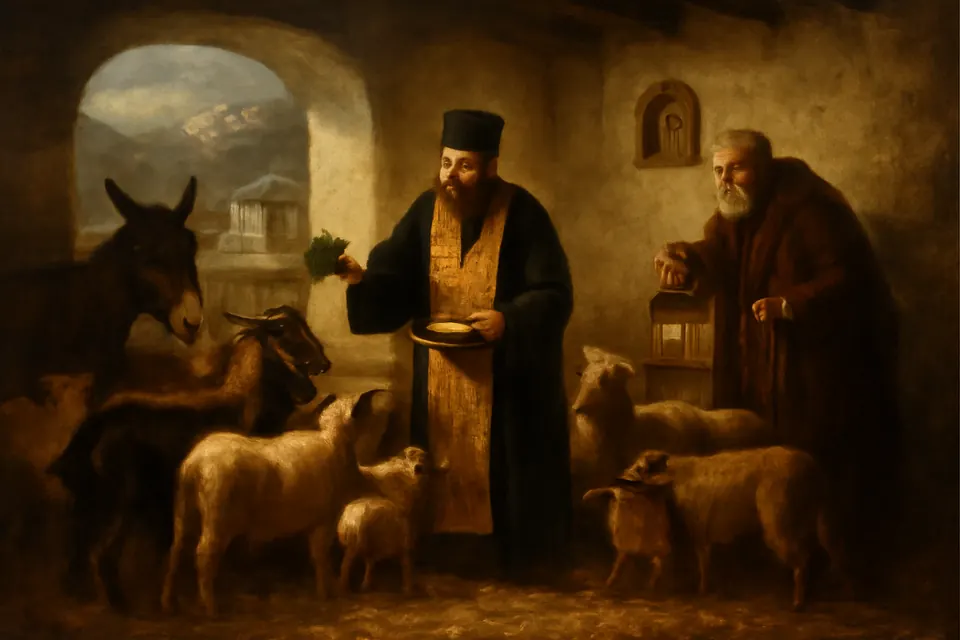
Because of these stories, the Church of Greece calls him "the Protector Saint especially of domesticated animals," and he is honored too as the protector of the plowing oxen that farm families once depended on. Farmers, shepherds and pet owners pray to him when an animal is sick or in danger. On his feast it is still the custom to sprinkle stables, sheepfolds and the homes of pets with holy water and ask his protection. See more causes on our patron saints page.

Symbols of St. Modestos in art
Icons show St. Modestos as an aged patriarch with a long white beard, in bishop's vestments with the omophorion, the long stole marked with crosses that Eastern bishops wear. He holds a Gospel book and raises his hand in blessing. Some icons add oxen, sheep or other farm animals at his feet, and where they appear they are the surest way to tell him apart from other bishop saints. The 1851 icon from the Bulgarian village of Zidarovo on this page is a good example: a small shepherd and his flock stand at the patriarch's feet.
Where St. Modestos is honored
The Orthodox Church in America records that his head is kept at Simonopetra Monastery on Mount Athos. In Jerusalem the Patriarchate keeps his feast at a chapel dedicated to him in the Abu Tor neighborhood, across the valley from Mount Zion; in 2015 Patriarch Theophilos came there to venerate him during the feast-day Liturgy.
Prayer to St. Modestos
Orthodox parishes honor him on his feast with the blessing of animals and their stables, and the faithful ask his help in their own words. We have not found a standard English prayer to quote. Let us ask St. Modestos, who rebuilt the house of God after war and cared for the poor farmer's oxen, to pray for every creature in our care and for all who suffer in war. Find other saints of December on our feast days page.
Frequently asked questions
Why is St. Modestos the protector of animals?
Greek tradition says that by his prayers he healed people and their animals, and raised a farmer's oxen from death. The Church of Greece calls him "the Protector Saint especially of domesticated animals," and the faithful pray to him when an animal is sick or in danger.
When is the feast of St. Modestos?
December 18 in the Orthodox Church, though some Greek calendars give December 16. On his feast it is the custom to bless stables, sheepfolds and the homes of pets with holy water.
What did St. Modestos do in Jerusalem?
After the Persians captured Jerusalem in 614 and carried off Patriarch Zacharias and the relic of the True Cross, Modestos, abbot of the monastery of St. Theodosius, governed the Church in his place. With help from St. John the Merciful of Alexandria he rebuilt the holy places, including the Church of the Holy Sepulchre.
Where are the relics of St. Modestos?
His head is kept at Simonopetra Monastery on Mount Athos.
Keep exploring
- Patron saint pages
- Dogs
- Feast-day calendar
- Saints remembered in DecemberSaint of the day
- More
- Saints A to ZPatron saints A to ZExplore every section
Sources
- Orthodox Church in America: Saint Modestos, Archbishop of Jerusalem. The Persian sack of 614, the help of John the Merciful, his death in 634 at 97, his head at Simonopetra
- Church of Greece (Ecclesia), Orthodox Outlet for Dogmatic Enquiries: Saint Modestos of Jerusalem. "The Protector Saint especially of domesticated animals"; the December 16 date
- Patriarchate of Jerusalem: The feast of St. Modestos, Archbishop of Jerusalem. His chapel in Abu Tor and the Patriarchate's celebration on December 18
- Ancient Faith Radio, Saint of the Day: Holy Hieromartyr Modestus I, Archbishop of Jerusalem. The legendary life (Sebasteia, slavery in Egypt) and the custom of blessing animal pens