St. Kuriakose Elias Chavara
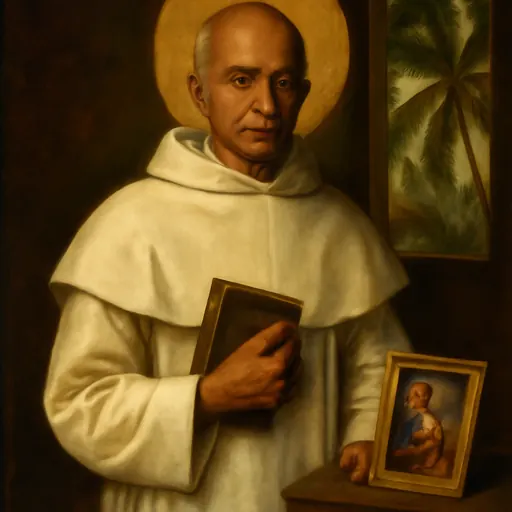
St. Kuriakose Elias Chavara (1805–1871) was a priest of the Syro-Malabar Church in Kerala, India, who co-founded the Carmelites of Mary Immaculate, the first Indian religious congregation for men, and later the Congregation of the Mother of Carmel for women. He renewed the Church in Kerala through seminaries, retreats, schools and a printing press. Pope Francis canonized him in 2014, and we keep his feast on January 3.
Who was St. Kuriakose Elias Chavara?
St. Kuriakose Elias Chavara was a nineteenth-century priest of the Syro-Malabar Church, the ancient Eastern Catholic Church of the St. Thomas Christians in Kerala, India. He co-founded the first Indian religious congregation for men, now the Carmelites of Mary Immaculate (CMI), and started the Congregation of the Mother of Carmel (CMC) for women. In Kerala he is known simply as Chavara Achan, Father Chavara.
We keep his feast on January 3. Pope John Paul II beatified him at Kottayam in 1986, alongside St. Alphonsa, and Pope Francis canonized him in 2014, together with St. Euphrasia Eluvathingal, a sister of his own congregation.
The life of St. Kuriakose Elias Chavara
A boy from the backwaters
He was born on February 10, 1805, at Kainakary, a village in the backwaters of Kuttanad. After his first schooling there he studied for the priesthood under Fr. Thomas Palackal, a malpan or teacher of the old Syriac tradition, at the seminary of Pallippuram. He was ordained a priest in 1829.
The first Indian congregation
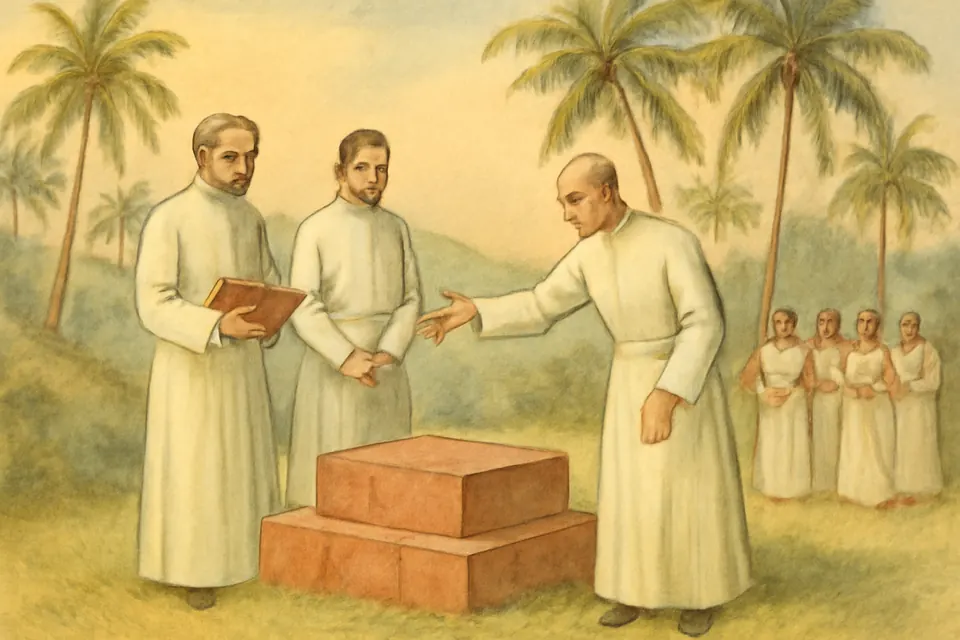
In 1831, with Fr. Palackal and Fr. Thomas Porukara, he founded a religious community at Mannanam, near Kottayam. The two older priests died before the community was formally erected, and in 1855 Chavara and the first members made their religious profession. He took the name Kuriakose Elias of the Holy Family and led the congregation as prior until his death. It grew to seven houses in his lifetime.
A reformer of the Church in Kerala
Under his leadership, John Paul II said in 1986, came "the establishment of seminaries for the education and formation of the clergy, the introduction of annual retreats, a publishing house for Catholic works, a house to care for the destitute and dying, schools for general education and programmes for the training of catechumens." He worked on the Syro-Malabar liturgy and spread devotion to the Holy Eucharist and the Holy Family.
In 1866, with the Italian Carmelite Fr. Leopold Beccaro, he began the Congregation of the Mother of Carmel for women, the community in which St. Euphrasia later lived.
Defender of unity
In 1861 a bishop from Mesopotamia, Thomas Rokos, arrived in Kerala without authority from Rome and drew many parishes after him. Chavara, newly named vicar general of the Syro-Malabar Catholics, led the resistance, and the threat of schism passed. John Paul II recalled "all his efforts to resist threats of disunity and to encourage the clergy and faithful to maintain unity with the See of Peter."
He died at Koonammavu on January 3, 1871, after a short, painful illness. His congregation's account says he kept his baptismal innocence to the end. In 1889 his remains were brought to the monastery church at Mannanam.

The road to canonization
The cause took more than half a century. At the request of the CMI prior general, the Archbishop of Changanacherry opened the diocesan process on January 3, 1958, the anniversary of Chavara's death. Rome formally introduced the cause on March 15, 1980, and on April 7, 1984, John Paul II declared him Venerable. Two years later, on his visit to India, the Pope beatified him in Kottayam's Nehru Stadium on February 8, 1986, together with Sister Alphonsa, who, he noted, "possessed a personal devotion to Father Kuriakose from early in her religious life." Pope Francis canonized him in St. Peter's Square on November 23, 2014, the solemnity of Christ the King.
Miracles of St. Kuriakose Elias Chavara
- The boy with club feet: approved for his beatification. Joseph Mathew Pennaparambil was born with both feet turned inward; in April 1960 his feet became normal.
- The girl with crossed eyes: approved for his canonization. Maria Jose Kottarathil of Pala, nine years old, was cured of a squint in both eyes on October 16, 2007, days after a visit to his tomb. The Vatican published the decree on the miracle in April 2014.
Why families and schools turn to St. Kuriakose Elias Chavara
He wrote a letter of counsel for the families of his home parish, known as the Testament of a Loving Father, which is still read in Kerala and which his congregation calls "applicable and relevant to this day." John Paul II said he dedicated himself to "encouraging and counselling Christian families." His congregations built schools across Kerala, and the press he started at Mannanam printed Catholic books in Malayalam. Pope Francis summed up his life in the motto he lived by: "sanctification of oneself and the salvation of others."
Symbols of St. Kuriakose Elias Chavara in art
Pictures of him follow a photograph taken near the end of his life: a bald, clean-shaven priest with a broad forehead and large eyes. Look for:
- The white Carmelite habit: the habit of the congregation he founded.
- The Holy Family: often in a picture beside him, for his religious name and his love of family life.
- A book: for his writings, his press and his schools.
Feast day and tomb
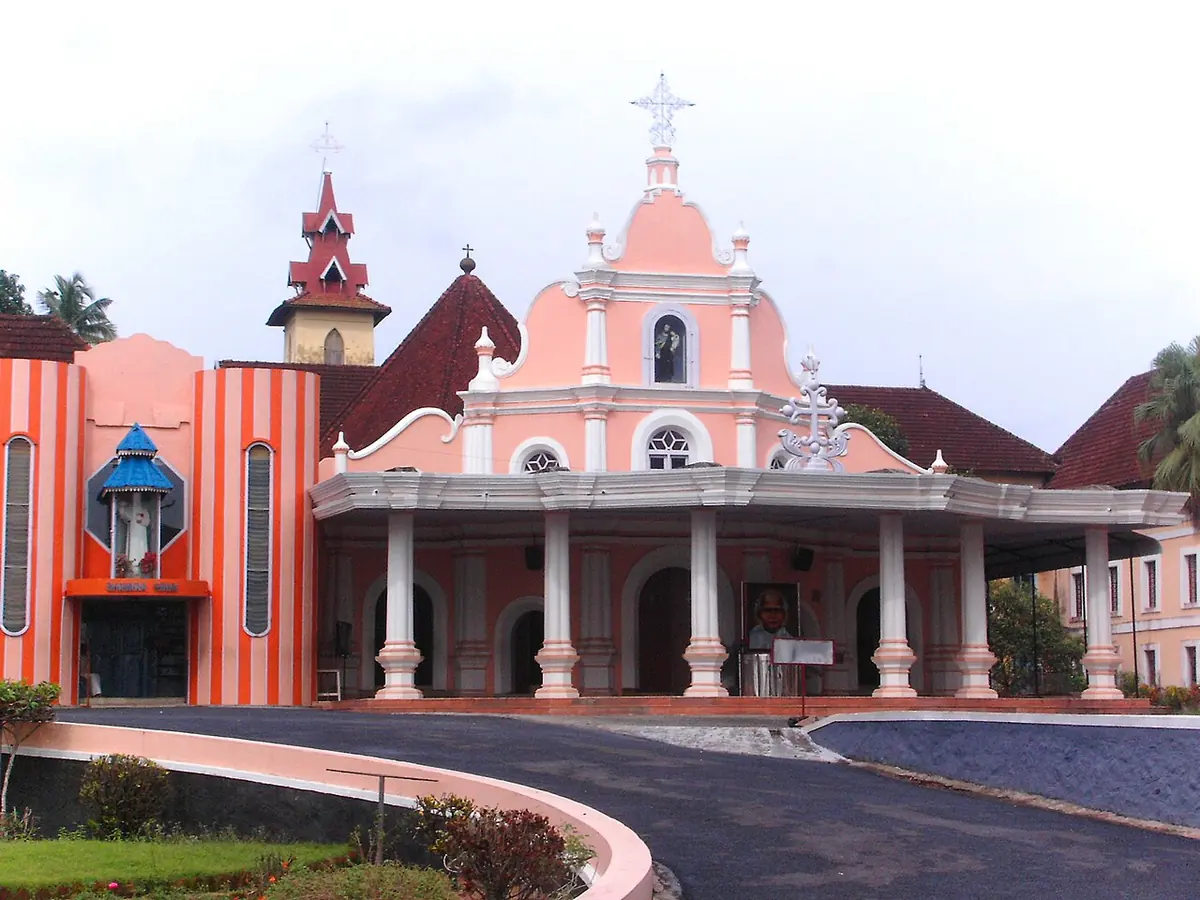
His feast is January 3, celebrated with great crowds at Mannanam, near Kottayam. Pilgrims pray at his tomb in St. Joseph's Monastery Church all year. See our feast days page for other saints of January.
Prayer to St. Kuriakose Elias Chavara
His congregations publish prayers for his intercession, but we haven't found a standard text we can cite, so we don't print one here.
Let us ask St. Kuriakose Elias Chavara to pray for our families, for priests and religious, for teachers and children in Catholic schools, for those who print and publish the faith, and for the unity of the Church. St. Kuriakose Elias Chavara, pray for us.
Frequently asked questions
When is the feast day of St. Kuriakose Elias Chavara?
January 3, the day he died in 1871. It is kept above all in the Syro-Malabar Church and at his tomb in Mannanam, Kerala.
What miracles were approved for St. Kuriakose Elias Chavara?
Two healings. For his beatification, the cure of a boy, Joseph Mathew Pennaparambil, born with club feet, in 1960. For his canonization, the instant cure of the squint in both eyes of a nine-year-old girl from Pala, Maria Jose Kottarathil, in 2007; the decree approving it was published in 2014.
What congregations did St. Kuriakose Elias Chavara found?
With Fathers Thomas Palackal and Thomas Porukara he founded the Carmelites of Mary Immaculate (CMI) in 1831, and with the Italian Carmelite Fr. Leopold Beccaro he started the Congregation of the Mother of Carmel (CMC) for women in 1866.
Where is St. Kuriakose Elias Chavara buried?
In St. Joseph's Monastery Church at Mannanam, near Kottayam. He died at Koonammavu, and his remains were moved to Mannanam in 1889.
Keep exploring
Sources
- Pope John Paul II, homily for the beatification of Kuriakose Elias Chavara and Alphonsa Muttathupandathu, Kottayam, February 8, 1986. His foundations, his works for the Syro-Malabar Church and Alphonsa's devotion to him
- Carmelites of Mary Immaculate: Our Founder (archived 2014). His profession in 1855, the 1861 schism, his death, the transfer of his remains in 1889 and the stages of his cause
- Pope Francis, address to the Syro-Malabar faithful after the canonization, November 24, 2014. The maxim "sanctification of oneself and the salvation of others"
- Vatican Information Service: Decrees for causes of saints (April 2014). Approval of the miracle for his canonization
- Wikipedia: Kuriakose Elias Chavara. Only source found for the names, dates and details of the two approved healings