St. John Cantius (John of Kanty)

St. John Cantius (John of Kanty, 1390–1473) was a Polish priest who taught philosophy and theology at the University of Kraków for more than forty years and became famous for giving everything he had to the poor. His feast day is December 23 (October 20 in Poland), and he is a patron of Poland and Lithuania, students, teachers and universities.
Who was St. John Cantius?
St. John Cantius was a Polish priest and university professor who lived almost his whole adult life between a lecture hall and a church in Kraków. He was born in 1390 in Kęty, a small town about 30 kilometers from Oświęcim, and he died on Christmas Eve 1473 at the age of 83. For more than forty years he taught philosophy and then theology at the University of Kraków, today's Jagiellonian University. The people of the city remembered him less for his lectures than for what he did on the way home from them: he gave away his money, his meals, his cloak and, more than once, his shoes.
His name causes some confusion. "Cantius" is not a surname. He signed the manuscripts he copied "Joannes de Kanthi," "de Kanty" or "de Canthy," which means John from Kęty. Latin writers made it Cantius, the Poles say Jan Kanty or Jan z Kęt, and the Roman Missal in English calls him St. John of Kanty.
Nothing dramatic happened to him. He was not martyred, he founded no order, and he left no famous book. He was a scholar who prayed, a priest who heard confessions, and a man who could not walk past a poor person. The Church has held him up for five centuries as proof that a teacher's ordinary days can be the road to holiness. We keep his feast on December 23, and in Poland on October 20.
The life of St. John Cantius
A late student from Kęty
Almost nothing is known of his childhood. His parents were townspeople of Kęty, and the old lives describe them as devout. In 1413, when he was already 23, he was entered in the register of the University of Kraków as "Johannes de Canti." The university had been refounded in 1400 through the efforts of St. Jadwiga, the young queen of Poland, and it was entering its golden century.
He studied the liberal arts, built mostly on Aristotle. According to the Polish Liturgy of the Hours biography, he became a bachelor in 1415 and a master of arts in January 1418, which allowed him to lecture. Those lectures were unpaid, so he supported himself with private lessons and pastoral help as a priest. He was ordained some time between 1418 and 1421; neither the date nor the place is certain.
Teacher at Miechów
In 1421 the Canons Regular of the Holy Sepulchre at Miechów, north of Kraków, asked the university for a head for their monastery school, and John was sent. He spent eight years there training young canons. He preached in the monastery church, and in his free time he copied books by hand: works of St. Augustine, whose rule the canons followed, of St. Thomas Aquinas and of Aristotle. Small scraps of two-part songs in his handwriting survive from these years, and later he was chosen cantor of a Kraków chapter, so he evidently knew music too.
Professor in Kraków
In 1429 a place opened in one of the university's colleges, where professors lived together under something like a religious rule, and his friends called him back. For the rest of his life he lived in the Collegium Maius on St. Anne Street. He lectured on Aristotle's logic, physics and economics, served several terms as dean of the arts faculty (1432–1433 and 1437–1438) and from 1434 directed the Collegium Maius.
At about forty he began the study of theology under the respected master Benedict Hesse. Because he was teaching and running a college at the same time, the degree took him thirteen years. He became a bachelor of theology in 1439 and a master, the equivalent of a doctorate, in 1443. After that he taught theology and Scripture until his death.
The parish he gave back
In 1439 he was made a canon and cantor of St. Florian's in Kraków and also pastor of the parish of Olkusz, a mining town some 40 kilometers away. The Catholic Encyclopedia says he was afraid of the responsibility for souls. The Polish sources add that he could not serve the parish and the university at once, and he would not take an income for work he could not do. After a few months he resigned the parish and its considerable revenue and went back to his books.
Eighteen thousand pages
Printing had not yet reached Kraków, and a scholar's library was what he copied himself. John copied for some forty years: Scripture commentaries, the Fathers of the Church, the medieval theologians and the philosophers, often adding a note on how to read them. By the count of the Polish Liturgy of the Hours biography, the surviving codices in his hand run to more than 18,000 pages. Most are in the Jagiellonian Library. Others were sent to Rome as evidence for his canonization and disappeared into the Vatican archives, where, according to the rector of St. Anne's, they were found again only in the early 1970s. No original treatise of his survives.

Pilgrim to Rome
The old lives say he walked to Rome four times and went once to Jerusalem, hoping to die a martyr among the Turks. Modern Polish historians are more cautious. It is certain that he went to Rome for the Holy Year of 1450 to gain the jubilee indulgence, and he may have gone more than once. The Holy Land pilgrimage has no documentary support. Some suggest it grew out of his visits to the copy of Christ's tomb in the Holy Sepulchre church at Miechów, which held earth brought from Jerusalem.
The professor of the poor
His first biographer, the Kraków historian Miechowita, writing in the next century, stressed two things: humility and charity. John gave the poor all the money and clothing he had beyond what he needed to live. He slept little and on the floor, ate sparingly and after becoming a doctor gave up meat entirely. Tradition credits him with a custom at the Collegium Maius of setting aside part of the professors' meal every day for a poor man. He looked after needy students out of his own small means, encouraged frequent Communion and spent long hours in the confessional. Opoka records one of his answers to a confessor's question: money won by gambling should go to the poor, not back to the losers, who had also done wrong by playing.
The Catholic Encyclopedia preserves the motto he kept before his eyes, which tradition says he wrote on the wall of his room:
Conturbare cave: non est placare suave,
Infamare cave; nam revocare grave.
In English: beware of upsetting others, for it is hard to make peace again; beware of slander, for it is hard to take it back.
Christmas Eve, 1473
He died in Kraków on December 24, 1473. The city was so convinced of his holiness that he was buried at once inside the university church of St. Anne, under the pulpit. Cures were reported at his grave almost immediately, and pilgrims came to it from across Poland.
The miracles of St. John Cantius
Much of what Poles love about St. John Cantius comes in the form of stories. Here is how they stand.
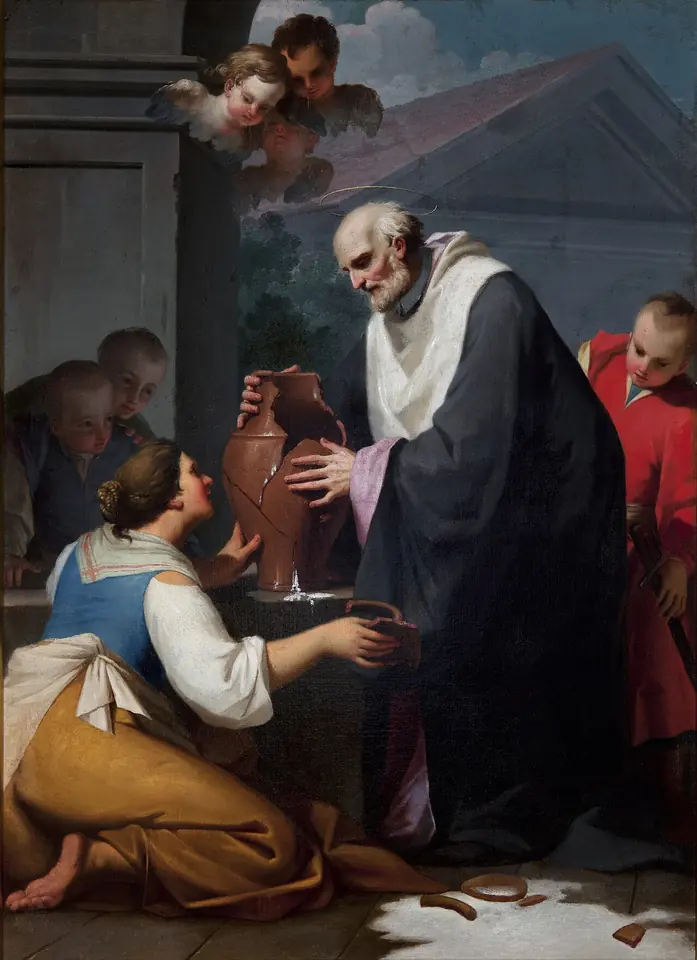
- The broken milk jug (traditional). A servant girl on her way to market dropped her master's jug of milk and sat weeping in the street, afraid of what would happen to her at home. The professor picked up the pieces, joined them and handed back the jug whole and full. It is the scene Tadeusz Kuntze painted, and Polish religious art has returned to it again and again.
- The robbers (traditional). In the life written by the Jesuit Piotr Skarga, John is set upon by robbers on a pilgrimage. They ask whether he has anything more, and he says no. After they leave he finds gold coins sewn into his clothing, runs after them and hands them over, because he had said they had everything. Struck by his honesty, the robbers give back all they took.
- The cloak and the shoes (traditional). Many stories show him giving his own cloak and shoes to a beggar in the cold and walking home barefoot.
- The food that renewed itself (traditional). The Polish Liturgy of the Hours biography records the legend that food he gave to a hungry neighbor was miraculously replaced on his own plate.
- Cures at his tomb (reported). The Catholic Encyclopedia says miracles were "multiplied after his death at his tomb." Petitions and thanks have been brought to St. Anne's ever since.
- Miracles for his beatification and canonization (approved). The Church examined miracles in the causes that led to his beatification in 1680 and his canonization in 1767. The sources consulted here do not describe them.

Beatification and canonization
The cause moved slowly. In 1621 a synod of the Polish bishops at Piotrków asked Rome to open the process, and the preparatory work began in 1628. Pope Innocent XI beatified John of Kęty on September 27, 1680. Pope Clement XIII canonized him on July 16, 1767, in the same ceremony as St. Joseph of Cupertino, St. Jane Frances de Chantal and St. Joseph Calasanz. For the occasion the professors of the Kraków Academy gave a wax figure of him in academic dress to the church in Kęty.
The Catholic Encyclopedia notes a rare honor in the old Roman Breviary: three proper hymns for his feast. He was, it says, the only confessor not a bishop to receive them.

Why St. John Cantius is the patron saint of Poland, students and teachers
Poland and Lithuania. He is counted among the patrons of the Polish nation and of Lithuania, its partner in the old Commonwealth, and he is a patron of the city and Archdiocese of Kraków and of the Diocese of Bielsko-Żywiec, which includes Kęty. In Kraków his feast is a solemnity.
Students, teachers and universities. He spent some 55 years studying and teaching. He is the patron of the Jagiellonian University, of professors and teachers, of Catholic schools, and of the young people who study in them. On his holy cards he often stands with an arm around a student, guiding the young man's gaze toward heaven. See all the patron saints of students and of teachers.
The poor. Caritas Polska, the Church's charity in Poland, also has him as its patron.
When John Paul II came back to Kraków in 1997 for the 600th anniversary of the university's faculty of theology, he called the 15th century "the century of saints" in Kraków and named John of Kęty first among them. He ended his address to the university rectors by "invoking the intercession of our Holy Patrons, Saint Stanislaus, Bishop and Martyr, Saint John of Kety and Saint Hedwig."

Symbols of St. John Cantius in art
St. John Cantius is not hard to recognize once you know what to look for. Painters and sculptors almost always show him as what he was, a late-medieval Kraków professor, and then add one of the stories of his charity.
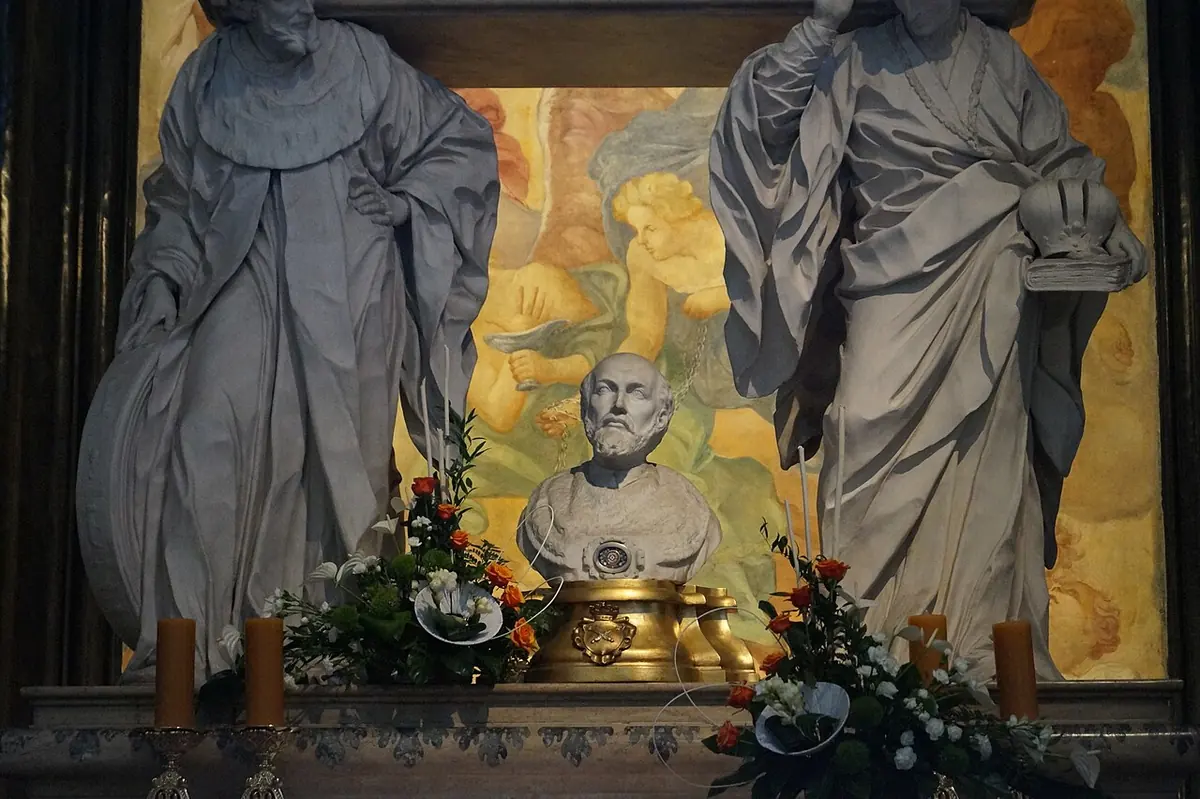
- Academic gown and biretta: the black or dark gown of a doctor of the university and the square cap of a cleric and scholar. Older images often put a white surplice under the gown. The figures in the Collegium Maius and the statue in Kęty on this page are dressed this way.
- A book: his life of study and teaching. In Porębski's painting of the five Kraków saints, he holds a book and a wreath of laurel and roses, and he steps on symbols of wealth.
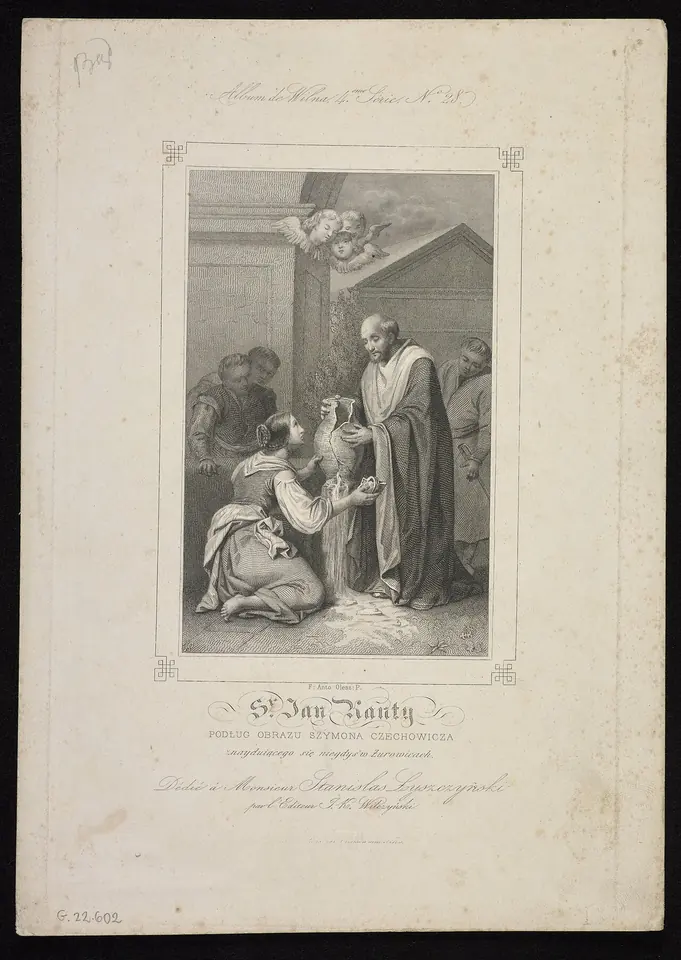
- A mended milk jug or pot: the legend of the servant girl, as in Kuntze's painting and the Czechowicz composition. When you see a priest in a gown handing a vessel to a kneeling woman, it is almost certainly John Cantius.
- A cloak or shoes given to a beggar: his habit of giving away his own clothing. Some images show him barefoot.
- Coins held out to robbers: the story of his honesty on the road.
- A student under his cloak: the teacher who guided his students toward God.
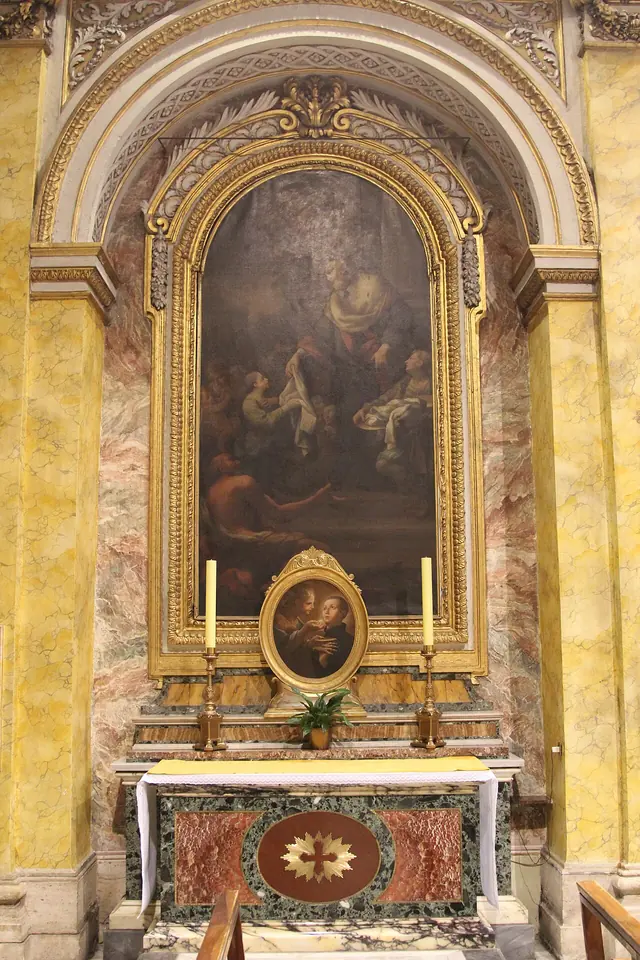
- A crucifix or a rosary: his devotion to the Passion. His tomb at St. Anne's faces the altar of the Descent from the Cross.
There is no Eastern icon tradition for him; he is a saint of the Latin Church. Modern Polish stained glass, like the window in Wrocław Cathedral, keeps the gown and biretta and often writes his name, "Św. Jan Kanty," in the glass.

Feast day and where St. John Cantius is honored
His feast was October 20 in the Roman calendar until 1969, when it moved to December 23, close to the day of his death on Christmas Eve. It is an optional memorial, and it falls among the last days of Advent, the day of the antiphon "O Emmanuel." Poland kept October 20, where it is an obligatory memorial and, in the Archdiocese of Kraków, a solemnity. The 1962 Missal also keeps October 20. See the feast day calendar.
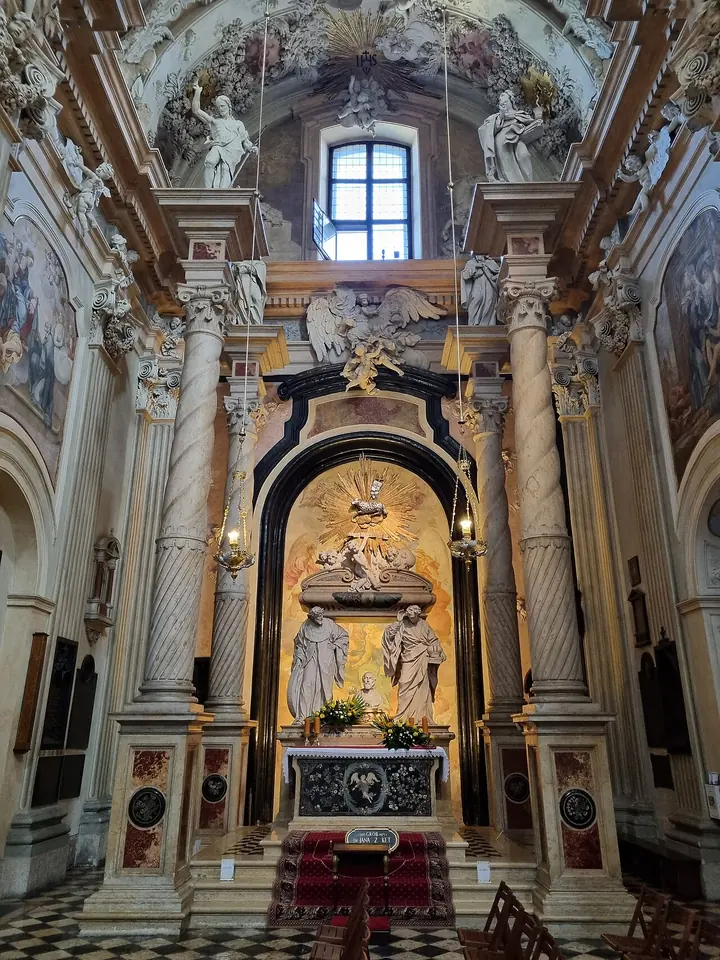
The tomb in St. Anne's, Kraków
His relics rest in the Collegiate Church of St. Anne, the Baroque university church that stands across St. Anne Street from the Collegium Maius. The tomb, a marble confessio in the right transept, shows his sarcophagus carried on the shoulders of four figures. John Paul II explained them in 1997: they stand for the four traditional faculties of the university, medicine, law, philosophy and theology, all serving the truth. A silver reliquary bust of the saint stands before it.
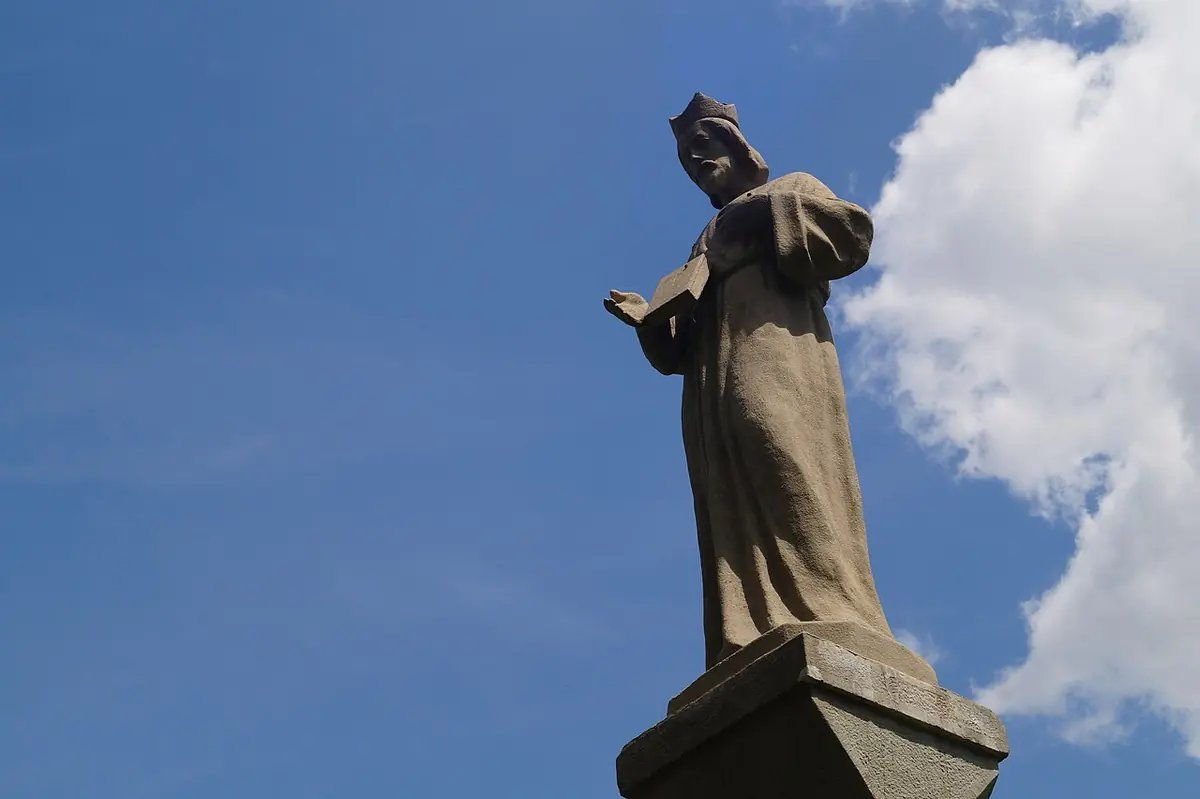
Kęty, his birthplace
In Kęty a chapel was built in 1648 on the spot where tradition places his family's house, and in 1715 it was enlarged into a small Baroque church. On October 20, 2024, at the close of a jubilee year for the 550th anniversary of his death, Bishop Roman Pindel declared it the Sanctuary of St. John Cantius, which its rector called the first in Poland and in the world. During that year 117 pilgrim groups came to the town. After the Mass that day, the clergy and faithful carried his relics in the town's traditional procession to his monument on the market square.
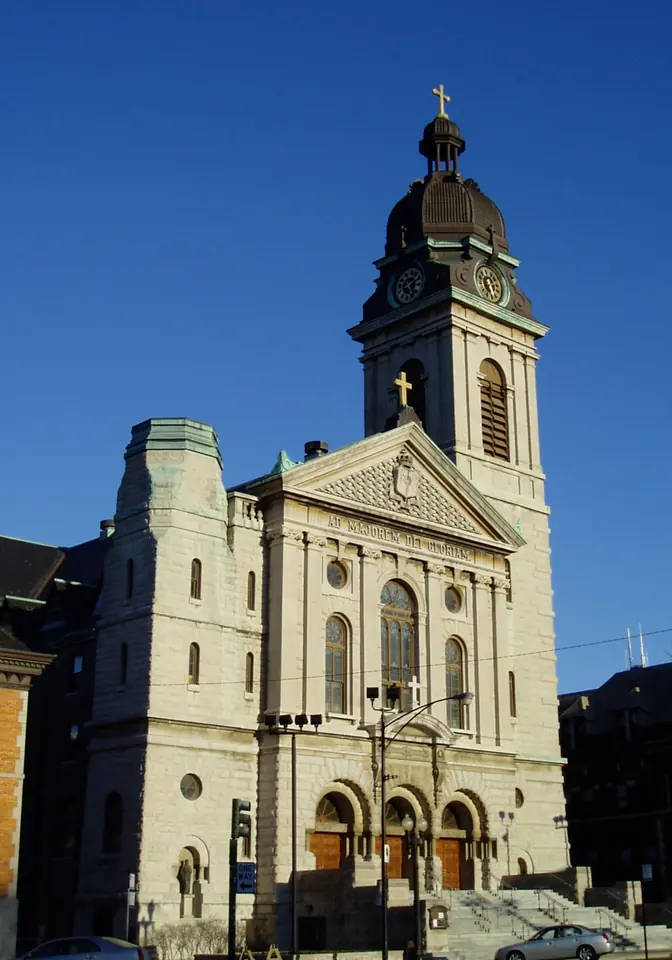
St. John Cantius Church, Chicago
For many Americans the name means a church. Polish immigrants on Chicago's Near West Side asked for a new parish in 1892, and St. John Cantius Church was built from 1893 to 1898. At its peak in 1918 it counted about 23,000 parishioners. In 1998 the Canons Regular of St. John Cantius were founded there, a religious community devoted to restoring sacred liturgy and music, and the parish is known today for its Latin liturgies and its collection of sacred art.
Prayer to St. John Cantius
We ask St. John Cantius to pray for students and teachers, for anyone who studies or writes for a living, for priests, and for the poor he loved. The prayers below have a clear origin.
The collect of his Mass
The Roman Missal gives this prayer for his memorial on December 23:
Grant, we pray, almighty God, that by the example of the Priest Saint John of Kanty we may advance in knowledge of holy things and by showing compassion to all, may gain forgiveness in your sight. Through our Lord Jesus Christ, your Son, who lives and reigns with you in the unity of the Holy Spirit, God, for ever and ever.
The prayer joins the two halves of his life, study and mercy, in one petition. In the Polish Missal, the prayer after Communion asks that through his merits we may imitate his mercy and share his eternal happiness.
A student's prayer
No longer prayer is attributed to St. John Cantius himself. Students and teachers can turn to him in their own words before an exam, a thesis defense or the first day of a school year, and ask him for honest work and a patient heart. A short invocation is always fitting: "St. John Cantius, pray for us."

Let us ask St. John Cantius to teach us his motto: to guard our tongues, to make peace, and to give to Christ in the poor whatever we have to spare, and a little more.
Find more patron saints and the other saints of Kraków, including St. Faustina and St. John Paul II.
Frequently asked questions
When is the feast day of St. John Cantius?
December 23 in the General Roman Calendar, where it has been since the calendar reform of 1969. Before that his feast was October 20, and the Church in Poland still celebrates him on October 20. Parishes that use the 1962 Missal also keep October 20.
What is St. John Cantius the patron saint of?
Poland and Lithuania, the city and Archdiocese of Kraków, and the Jagiellonian University, where he taught. Because he spent his life in the classroom he is honored as a patron of students, teachers, professors and Catholic schools, and Polish Caritas claims him for his love of the poor.
Why is he called "Cantius" or "Kanty"?
It isn't a family name. He signed his manuscripts "Joannes de Kanthi" or "de Canthy," meaning John from Kęty, his hometown near Oświęcim. Latin turned it into Cantius, and Polish into Kanty.
What miracles are told about St. John Cantius?
The best known is a legend that he mended a servant girl's broken milk jug and filled it again. Others tell of food renewed on his plate after he gave it away, and of the robbers who returned everything after he ran after them with coins he had forgotten. Cures were reported at his tomb from the time of his death, and the Church examined miracles before his beatification in 1680 and canonization in 1767.
Where is St. John Cantius buried?
In the Collegiate Church of St. Anne in Kraków, the university church, across the street from the Collegium Maius where he lived. His Baroque tomb shows his sarcophagus carried by four figures standing for the old faculties of the university. His birthplace church in Kęty also keeps relics and became a sanctuary in 2024.
Is there a prayer to St. John Cantius?
The Church's own prayer is the collect of his Mass, which asks that by his example we may advance in the knowledge of holy things and show compassion to all. Students and teachers ask his help in their own words. A simple invocation such as "St. John Cantius, pray for us" is always enough.
Did St. John Cantius really go to Jerusalem?
His old biographies say he walked to Rome several times and once to the Holy Land. Polish historians accept the Roman pilgrimage of the Holy Year 1450, but no document confirms the Jerusalem journey. Some think the story grew from his visits to the replica of the Holy Sepulchre in Miechów, where he had taught.
Why is there a St. John Cantius Church in Chicago?
Polish immigrants on Chicago's Near West Side asked for a new parish in 1892 and named it for the patron of their homeland. The church was built from 1893 to 1898. In 1998 the Canons Regular of St. John Cantius, a religious community devoted to sacred liturgy and music, were founded there.
Keep exploring
- Patron saint pages
- StudentsTeachers
- Feast-day calendar
- Saints remembered in DecemberSaint of the day
- More
- Saints A to ZPatron saints A to ZExplore every section
Sources
- Catholic Encyclopedia (1910): St. John Cantius
- John Paul II, Address to the rectors of Polish universities, Kraków, June 8, 1997
- Internetowa Liturgia Godzin (brewiarz.katolik.pl): Święty Jan Kanty, prezbiter (October 20). degrees and dates, manuscripts, the 1450 pilgrimage, beatification and canonization dates
- Opoka: Po prostu święty... (on St. John Cantius, with Fr. Władysław Gasidło of St. Anne's). the robbers story in Piotr Skarga's life; manuscripts rediscovered in the Vatican archives
- Opoka: Pierwsze w Polsce i na świecie sanktuarium św. Jana Kantego erygowane w Kętach (2024)
- Catholic Culture: Optional Memorial of St. John of Kanty, December 23 (collect and Pius Parsch excerpt)
- St. John Cantius Church, Chicago: Concise parish history