St. Anysia of Salonika (Thessalonica), Virgin and Martyr

St. Anysia of Salonika was a young woman of Thessalonica who gave her wealth to the poor and lived in prayer and fasting. Under Maximian, about 304, a soldier stopped her on her way to church and tried to drag her to a pagan sacrifice; when she resisted, he ran her through. We keep her feast on December 30.
Who was St. Anysia of Salonika?
St. Anysia of Salonika was a young Christian woman of Thessalonica, the great port city of northern Greece that English writers long called Salonika. She lived at the end of the third century, gave everything she had to the poor, and was killed by a Roman soldier on her way to church. She is one of the city's own martyrs, honored alongside St. Demetrius and the young St. Irene of Thessalonica.
We keep her feast on December 30, in the days of Christmas. The traditional Roman Martyrology gives her one line that day: "At Thessalonica, St. Anysia, martyr." The Orthodox Church preserves the fuller story of her life and death.
The story is simple, and it rings true to the time. It is the kind of death that came to many ordinary Christians in the last and fiercest persecution, when the law offered them no protection at all.
A young woman who gave everything away
The Orthodox life, as the Orthodox Church in America tells it, says Anysia was the daughter of well-to-do Christian parents who "raised her in Christian piety." When they died, she was left a rich young woman. She sold all she owned, gave the money to the poor, and began a strict life of fasting, vigil and prayer.
She did not leave the city or enter a convent. She stayed in Thessalonica, living as a consecrated virgin in her own home, and walked to church with the other faithful.

Killed on the road to church
During the persecution under the co-emperor Maximian (286–305), the life says, an edict declared that anyone could kill Christians without fear of punishment. Bodies began to appear in the towns and along the roads.
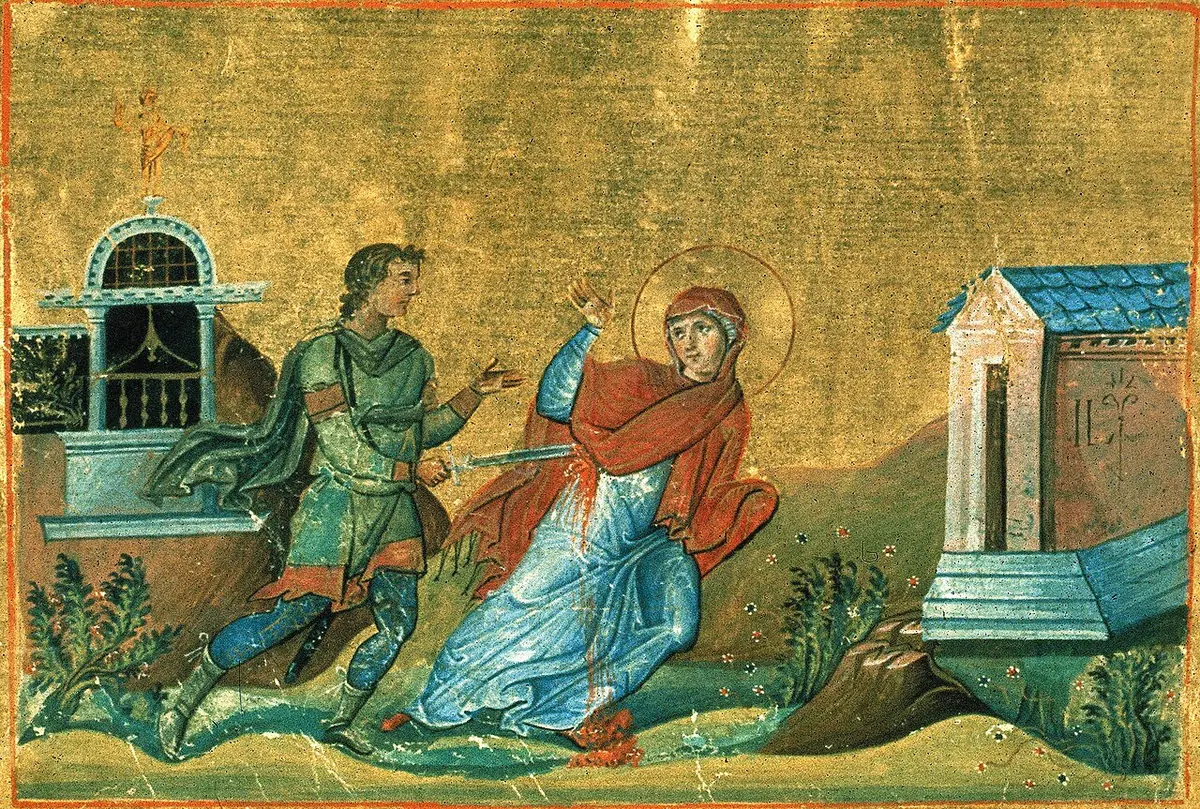
One day, as Anysia was walking to church, a pagan soldier stopped her and ordered her to come with him to the festival of the sun and offer sacrifice. She quietly pulled away. He grabbed her again and tried to tear the veil from her head, the sign of her consecration to Christ. Anysia pushed him back, spat in his face, and said, "My Lord Jesus Christ forbids you!" In a rage, the soldier ran her through with his sword.
People gathered around her body and wept, and they cried out against the emperor whose edict had led to the deaths of so many innocent people. The Christians buried her near the city gates, and a chapel was later built over her grave.
Her relics today
Her grave by the gates of Thessalonica became a place of prayer. Today her relics rest in a silver shrine in the great Basilica of St. Demetrius, the church built over the tomb of the city's patron, where pilgrims venerate them beside her icon. We have found no record of miracles formally investigated in her name, and her life does not report any; her witness is her death.
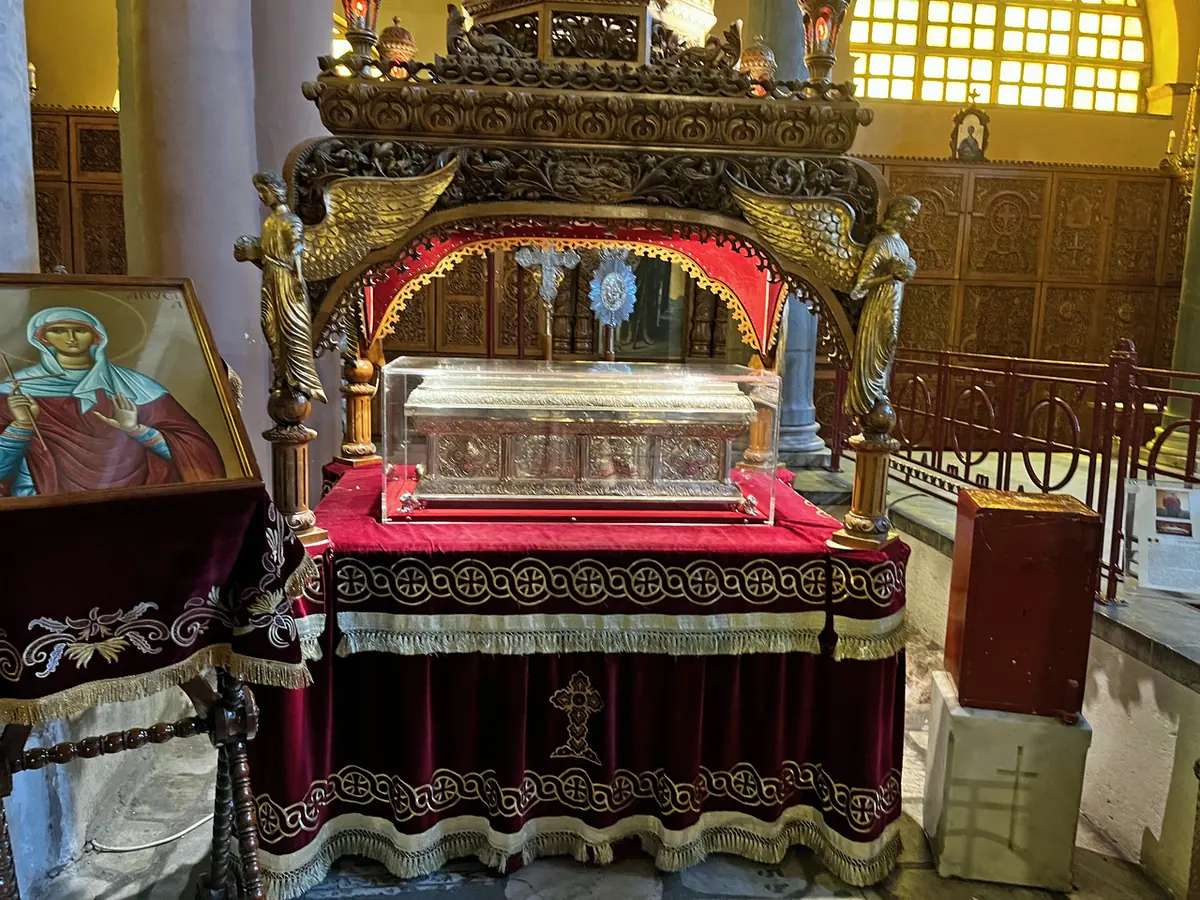
Where the relics of St. Anysia of Salonika are kept: see them on the relics map →
Symbols of St. Anysia in art
Anysia appears in Byzantine and Russian icons and in illustrated calendars of the saints:
- A veil and long mantle, often deep red over blue, the dress of a consecrated virgin, and a reminder that the soldier tried to tear her veil away.
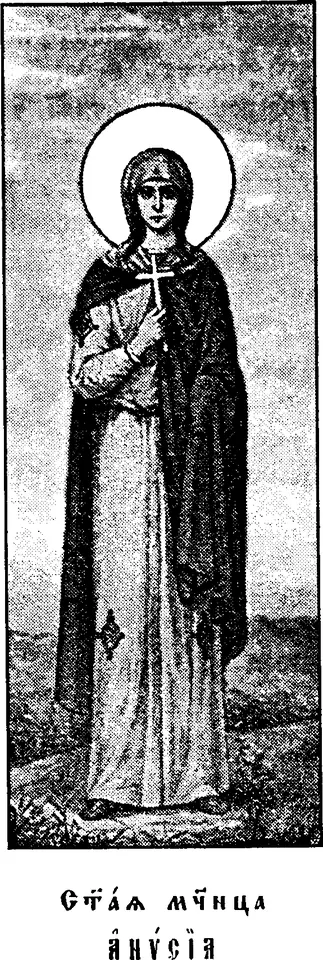
- A small cross held before her breast, the sign of a martyr.
- A palm in some Western images, for her victory.
- A soldier with a sword, in scenes of her death such as the eleventh-century Menologion of Basil II shown above.
In single icons she looks much like other virgin martyrs, so read the inscription. In Russian she is Anisia; in Greek, Agia Anysia.
Not to be confused with St. Anysius
On the same day, right after her, the Roman Martyrology names "St. Anysius, bishop of that city." He was a bishop of Thessalonica in the late fourth century, a friend of St. Ambrose, and has nothing to do with Anysia except the name and the city.
Prayer to St. Anysia
The Orthodox Church honors her with a troparion and kontakion on her feast. We know of no traditional prayer to her in wide use in English, and we will not invent one in her name. Let us ask St. Anysia to pray for us: for Christians who are threatened or harassed on their way to worship, for women who suffer violence, for young people who give away what they have to the poor, and for every believer who must choose between faith and safety; and let us ask her for the courage to say, as she did, "My Lord Jesus Christ forbids you." See the feast day calendar for the other saints of December.
Frequently asked questions
Who was St. Anysia of Salonika?
A virgin martyr of Thessalonica (Salonika, today Thessaloniki) in northern Greece, killed by a soldier about 304 during the persecution of Maximian after she refused to go with him to a pagan festival.
When is the feast of St. Anysia?
December 30, in both the Orthodox calendar and the traditional Roman Martyrology.
Where are the relics of St. Anysia?
Her relics are kept in a silver shrine in the Basilica of St. Demetrius in Thessaloniki.
Is St. Anysia the same as St. Anysius?
No. St. Anysius was a bishop of Thessalonica about a century later. The Roman Martyrology lists them one after the other on December 30, which causes confusion.
Keep exploring
Sources
- Orthodox Church in America: Virgin Martyr Anysia at Thessalonica. The Orthodox life, her charity, Maximian's edict, the soldier, her words and her burial
- The Roman Martyrology in English, December (Boston Catholic Journal). December 30: "At Thessalonica, St. Anysia, martyr," followed by St. Anysius, bishop