St. Valerian of Abbenza: Bishop Who Would Not Hand Over the Sacred Vessels
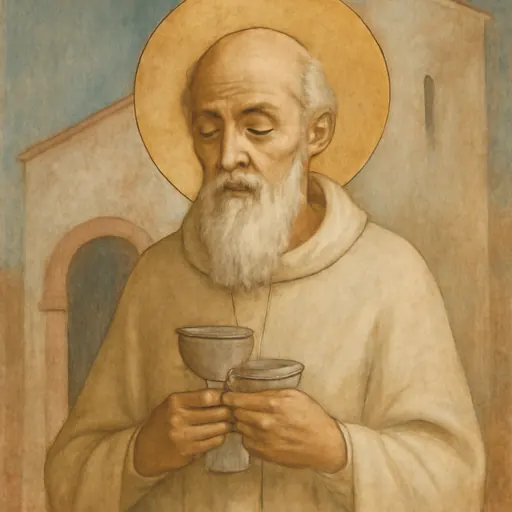
St. Valerian of Abbenza was a bishop in Roman Africa who, at over eighty years of age, refused to hand over his church's sacred vessels to the Arian Vandal king Genseric. He was driven out of his city, no one was allowed to shelter him, and he died by the roadside about 457. We keep his feast on December 15.
Who was St. Valerian of Abbenza?
St. Valerian of Abbenza was a Catholic bishop in Roman North Africa during the Vandal persecution of the fifth century. He was more than eighty years old when King Genseric's officers demanded the sacred vessels of his church. He refused. For that he was driven out of his city, alone, and the king forbade anyone to give him shelter. He lay for a long time on the public road under the open sky and died there, about the year 457. We keep his feast on December 15.
His story is short, and we tell it as the old sources tell it, chiefly the Roman Martyrology. Ancient African records of the Vandal persecution lie behind its account, but we have not been able to check them ourselves.
Africa under the Vandals
The Vandals, a Germanic people, crossed from Spain into North Africa in 429 under their king Genseric. In 439 they took Carthage and made it their capital. The Vandals were Arian Christians, who denied that the Son is equal to the Father, and the Catholic Encyclopedia notes that they "treated the Catholics more harshly than other German peoples." Genseric punished Catholic bishops with deposition, exile or death, shut them out of their churches and took their property.
Africa had been one of the great Catholic lands, the Church of St. Cyprian and St. Augustine, with hundreds of bishops, many of them in small country towns. Abbenza was one of these. Its exact site is not known.
The sacred vessels
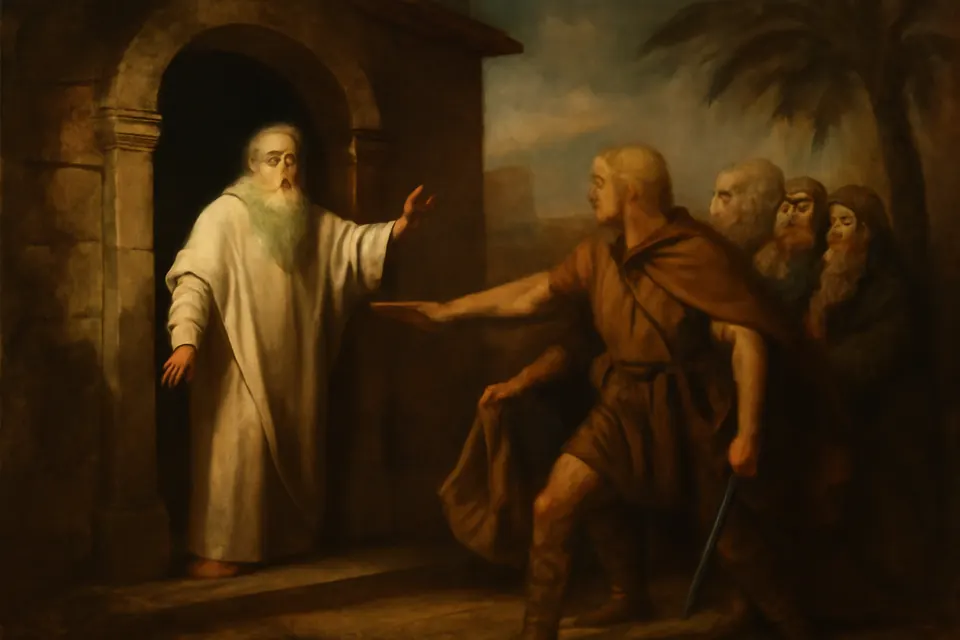
The Vandals wanted the gold and silver of the Catholic churches. For a bishop, the chalice and paten were not treasure to be traded for his life. They held the Body and Blood of Christ at every Mass, and to hand them over to be melted down or put to profane use was to betray the altar.
The Roman Martyrology tells what happened in one sentence: Valerian, "being upwards of eighty years old, in the persecution of the Vandals, under the Arian king Genseric, was asked to deliver the vessels of the church, and as he constantly refused, an order was issued to drive him all alone out of the city, and all were forbidden to allow him to stay either in their houses or on their land."
The word "constantly" matters. He was asked more than once, and he refused every time. Like St. Lawrence in Rome two centuries earlier, he knew that the treasures of the Church belonged to God and to the poor.

Death on the open road
The order meant slow death for an old man. No Christian in the town could open a door to him or let him rest in a field without risking the king's punishment. The Martyrology says: "For a long time he remained lying on the public road, in the open air, and thus, in the confession and defence of the Catholic verity, closed his blessed life." The Book of Saints adds that "he perished of want in the open country near the African city which had been his Episcopal See," and gives the year as 456. Other reckonings place it in 457.
He was not beheaded or burned, yet the Church counts him among the martyrs, because he died of the sentence laid on him for his faithfulness. His death is a quiet one: an old bishop alone on a dusty road, praying, with his people unable to help him.

Miracles and legends
No miracles are told of St. Valerian, and no relics or shrine of his are known. His witness is simply his steadfastness. What we know of him is traditional in the sense that it rests on one short ancient account, but it is a sober one, with no wonders added.
Symbols of St. Valerian in art
Old images of St. Valerian are rare, since his cult never spread far beyond the Martyrology. When he is shown, he appears as:
- A very old bishop with a white beard: the great age the sources stress.
- A chalice and paten held close: the sacred vessels he would not surrender.
- An old man lying by the roadside: his death in the open.
- The martyr's palm: his death for the faith.
Our illustrations on this page follow those details.
Feast day and prayer
We keep his feast on December 15. See other saints of December on our feast days page, and read about another African bishop exiled by the Vandal kings, St. Fulgentius of Ruspe.
No traditional prayer to St. Valerian has come down to us. Let us ask him to pray for the elderly who are alone and without shelter, for priests and bishops who guard the holy things of the altar, and for Christians who suffer for their faith. St. Valerian, pray for us.
Frequently asked questions
Who was St. Valerian of Abbenza?
An aged Catholic bishop of the town of Abbenza in Vandal North Africa. When he would not give up the sacred vessels of his church, King Genseric had him expelled and forbade anyone to take him in. He died of exposure on the public road.
When is the feast of St. Valerian of Abbenza?
December 15, in the Roman Martyrology.
Where was Abbenza?
Somewhere in Roman Africa. Its exact location is not known; it was one of hundreds of small bishoprics of the African Church.
Why is he honored as a martyr?
He was not executed, but he died because of the punishment laid on him for confessing the Catholic faith and protecting the things of the altar. The Roman Martyrology says he "closed his blessed life" in "the confession and defence of the Catholic verity."
Keep exploring
Sources
- Roman Martyrology (English translation of the 1749 edition), December 15. Bishop Valerian, over eighty, asked for the vessels of the church under Genseric, expelled alone, everyone forbidden to shelter him, died on the public road
- The Book of Saints (Benedictine monks of St. Augustine's Abbey, Ramsgate, 1921): Valerian, Bishop (December 15). Outlawed by Genseric at eighty; died of want near his episcopal city, A.D. 456
- Catholic Encyclopedia (1912): Vandals. Genseric's conquest of Africa and the punishment of Catholic bishops by deposition, exile or death