St. Venantius Fortunatus, Poet of the Cross and Bishop of Poitiers

St. Venantius Fortunatus (about 530–about 600) was an Italian-born Latin poet who settled in Poitiers, became the friend of St. Radegund and later the city's bishop. He wrote the great hymns of the Cross, Vexilla Regis and Pange Lingua Gloriosi Proelium Certaminis, for the arrival of a relic of the True Cross in 569, and the Church still sings them in Holy Week. His feast is December 14.
Who was St. Venantius Fortunatus?
St. Venantius Fortunatus was a sixth-century poet who gave the Church two of her greatest hymns to the Cross, Vexilla Regis and Pange Lingua Gloriosi, and who ended his life as bishop of Poitiers in Gaul. Born in northern Italy, he crossed the Alps as a young man, sang at the court of the Frankish kings, and found his true home beside a queen who had become a nun, St. Radegund.
Every Holy Week, when we sing "The royal banners forward go" or venerate the Cross on Good Friday to the strains of Pange lingua, we are praying in his words.
The life of St. Venantius Fortunatus
A student at Ravenna
Venantius Honorius Clementianus Fortunatus was born between about 530 and 540 in the country between Ceneda and Treviso, north of Venice. He studied grammar, rhetoric and poetry at Ravenna, then the capital of Byzantine Italy. His first known poem celebrated the dedication of a church of St. Andrew there.
At Ravenna something happened that set the course of his life. Suffering from a disease of the eyes, he was cured, the Catholic Encyclopedia says, "through the intercession of St. Martin." In gratitude he resolved to visit St. Martin's tomb at Tours.
A poet on the road
Around 565 he left Ravenna, crossed the Alps and by autumn had reached the Moselle. His poems record stops at Mainz, Cologne, Trier and Metz. At Metz he arrived just as King Sigebert married the Visigothic princess Brunhild, in 566, and he wrote the wedding poem for the court. The young Italian quickly became the favorite poet of the Frankish nobility.

Radegund and Agnes
After Tours he came to Poitiers, drawn by the reputation of the former queen St. Radegund and the convent of the Holy Cross she had founded. He stayed for the rest of his life. He called Radegund his "mother" and the young abbess Agnes his "sister," and for twenty years he served the community as friend, adviser and, eventually, priest. They exchanged letters, little gifts of fruit and flowers, and poems, many of which survive.

The relic of the Cross
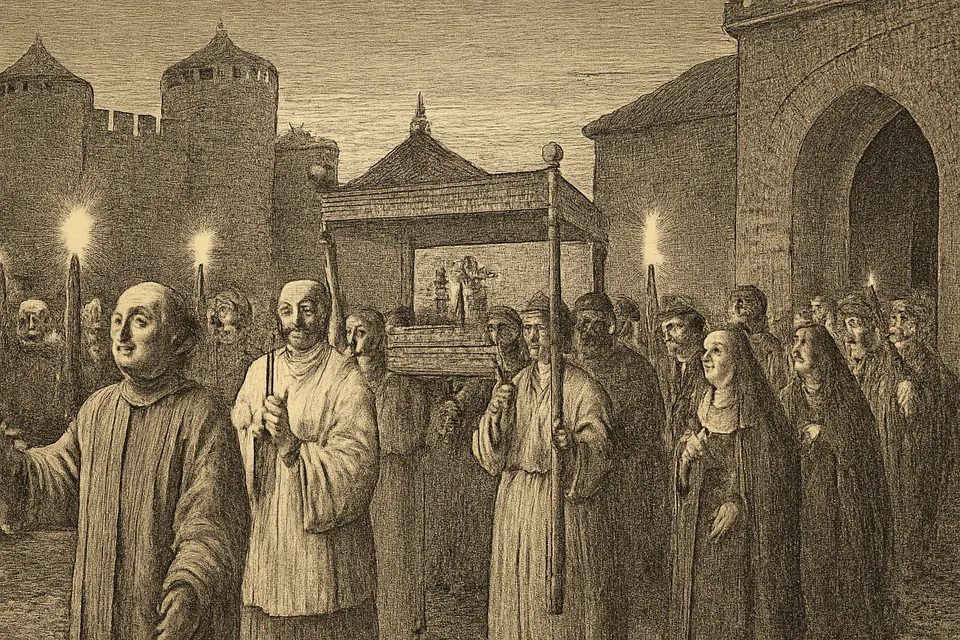
Radegund had asked the Byzantine emperor Justin II for a relic of the True Cross, and it came. The bishop of Poitiers, Maroveus, refused to receive it into his city, so the relic waited until other clergy carried it to the convent. On November 19, 569, as it was borne in procession to Radegund's monastery, the people sang a new hymn by Fortunatus: Vexilla Regis prodeunt. Radegund's convent took the name of the Holy Cross (Sainte-Croix).
Bishop of Poitiers
Fortunatus was ordained a priest at Poitiers. Radegund died on August 13, 587. A few years later, after Bishop Plato, Fortunatus himself became bishop of Poitiers, probably around 600. Baring-Gould notes that he did not live long afterward; the date of his death is not known.
His hymns and writings
Fortunatus left eleven books of poems, a long poem in four books on the life of St. Martin, and prose lives of saints, including St. Hilary of Poitiers, St. Germain of Paris, St. Medard and Radegund herself. His friend St. Gregory of Tours spoke of him with admiration.
Two of his poems on the Cross passed into the Church's liturgy:
- Vexilla Regis prodeunt ("The royal banners forward go"), sung at Vespers in Passiontide and, before the reform of Holy Week, as the Blessed Sacrament was carried in procession on Good Friday. Its first verse reads: Vexilla regis prodeunt, / fulget crucis mysterium, / quo carne carnis conditor / suspensus est patibulo. ("The royal banners go forth; the mystery of the Cross shines out, on which the Maker of flesh hung in the flesh," our translation.)
- Pange lingua gloriosi proelium certaminis ("Sing, my tongue, the glorious battle"), sung during the veneration of the Cross on Good Friday. Centuries later St. Thomas Aquinas modeled his Corpus Christi hymn Pange lingua gloriosi corporis mysterium on its opening.
Miracles connected with St. Venantius Fortunatus
The healing of his eyes is the one miracle in his story. It is traditional: the Catholic Encyclopedia and Baring-Gould both record it. It was not the subject of any formal investigation. He was honored as a saint from early times, long before formal canonization existed.
Symbols of St. Venantius Fortunatus in art
Images of him are rare, and there is no fixed set of attributes.
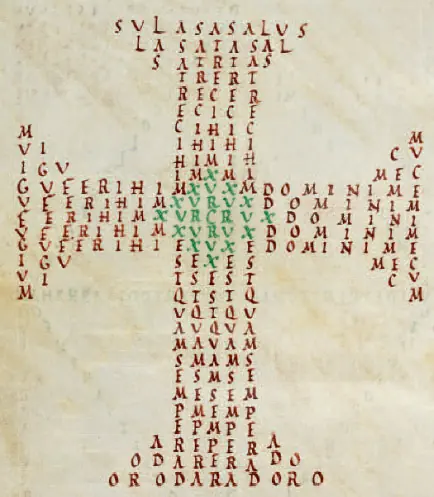
- Pen and book or scroll: the poet. The miniature of about 1100 from Poitiers shows him writing his life of Radegund.
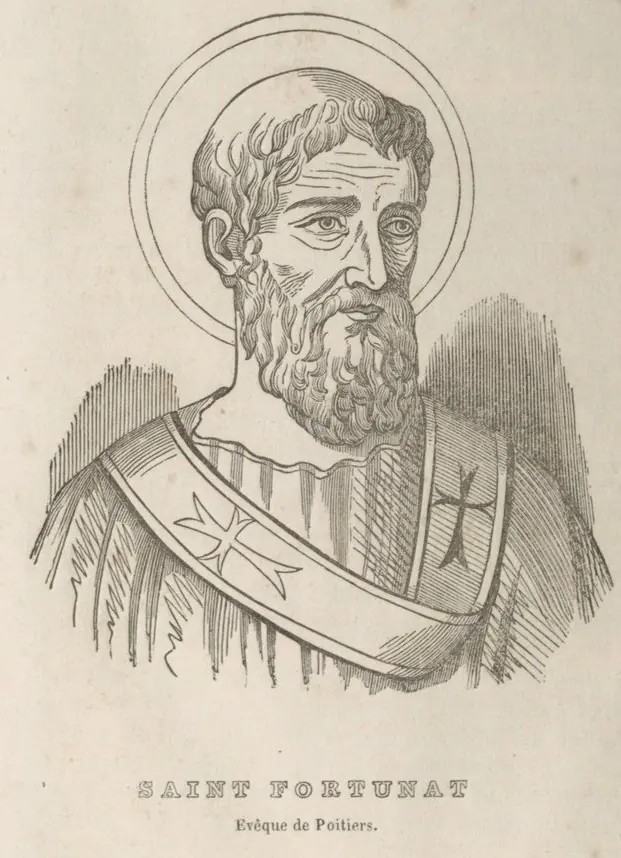
- Bishop's vestments: his office at Poitiers. The 1856 engraving from Poitou shows him as a bishop with a pallium.
- The Cross: for Vexilla Regis and the relic of the Holy Cross.

Feast day and where he is honored
His feast is December 14, when he is remembered at Poitiers and in the Roman Martyrology. The old Gallican calendars also remembered him at Tours on December 17. See more saints of December on our feast days page, and read about the True Cross.
Praying with St. Venantius Fortunatus
We know of no traditional prayer addressed to St. Venantius Fortunatus. The best way to pray with him is to pray his own hymns, especially in Lent and Holy Week: Vexilla Regis at evening prayer, and Pange lingua as we kneel before the Cross on Good Friday.
Let us ask St. Venantius Fortunatus to pray for poets, writers and all who sing in church, that our words may serve the glory of the Cross.
Frequently asked questions
Who was St. Venantius Fortunatus?
A sixth-century poet from near Treviso in Italy, educated at Ravenna, who traveled to Gaul, settled at Poitiers as a friend and chaplain of St. Radegund's convent, and became bishop of Poitiers around 600. He is the last great poet of Latin antiquity and one of the first of the Middle Ages.
What hymns did Venantius Fortunatus write?
Above all Vexilla Regis prodeunt ("The royal banners forward go") and Pange lingua gloriosi proelium certaminis, both written in honor of the relic of the True Cross that Emperor Justin II sent to Radegund. He also wrote lives of saints and a long poem on St. Martin.
When is the feast of St. Venantius Fortunatus?
December 14, the day he is remembered at Poitiers and in the Roman Martyrology.
Why did Venantius Fortunatus go to Gaul?
Out of gratitude to St. Martin of Tours. While a student at Ravenna he was cured of a disease of the eyes through Martin's intercession, and he set out to visit the saint's tomb at Tours.
Keep exploring
Sources
- Fortunatus, Catholic Encyclopedia (1909), New Advent. Birth between Ceneda and Treviso, the eye cure at Ravenna, the route through Mainz, Cologne, Trier and Metz, the epithalamium for Sigebert and Brunhild, Radegund as "mother" and Agnes as "sister", the See of Poitiers after Plato, the eleven books of poems and the prose lives
- Vexilla Regis Prodeunt, Catholic Encyclopedia (1912), New Advent. First sung on November 19, 569, as the relic of the Cross was carried to Radegund's monastery; its use at Vespers in Passiontide and on Good Friday
- S. Baring-Gould, The Lives of the Saints, vol. 15 (December), December 14, archive.org. The Gallican martyrologies (Poitiers December 14, Tours December 17), Bishop Maroveus's refusal to receive the relic, ordination at Poitiers, alive in 600