St. Columba of Sens, Virgin Martyr of Gaul
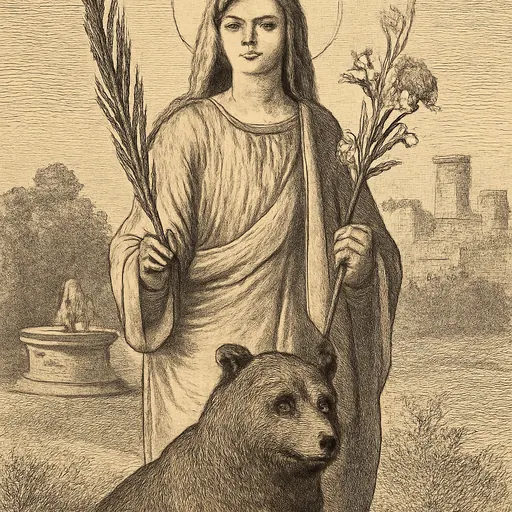
St. Columba of Sens was a young Christian girl from Spain who, according to tradition, was beheaded at Sens in Gaul for her faith at about sixteen, under the emperor Aurelian, in 273 or 274. Legend says a she-bear protected her in prison. Her relics are still honored near Sens, and her feast is December 31.
Who was St. Columba of Sens?
St. Columba of Sens (in French, Sainte Colombe) was a young virgin martyr of the third century. Tradition says she was born in Spain, came to Gaul as a girl, and was beheaded near the city of Sens, in Burgundy, at about sixteen, under the emperor Aurelian. The parish that keeps her shrine dates her death to December 31, 274; the Catholic Encyclopedia places it at the end of the third century and admits that "her whole history is somewhat legendary." Her cult is very old all the same: a monastery stood over her tomb by the seventh century. We keep her feast on December 31.
Do not confuse her with St. Columba of Iona, the Irish abbot, or St. Columba of Córdoba, a nun martyred in Spain in 853.
The story of St. Columba
From Spain to Sens
According to the account kept by her parish, Columba was born in Spain to a royal family that was still pagan. She gave her life to Christ and set out for Gaul with a few other believers; the French bishops' calendar Nominis names them as Béate, Sanctien and Augustin. She was baptized at Vienne, in the Rhône valley, and went on to the region of Sens, where the Church was strong. Nominis says she was fleeing persecution in Spain and came from Saragossa.
Prison, the bear and the fire
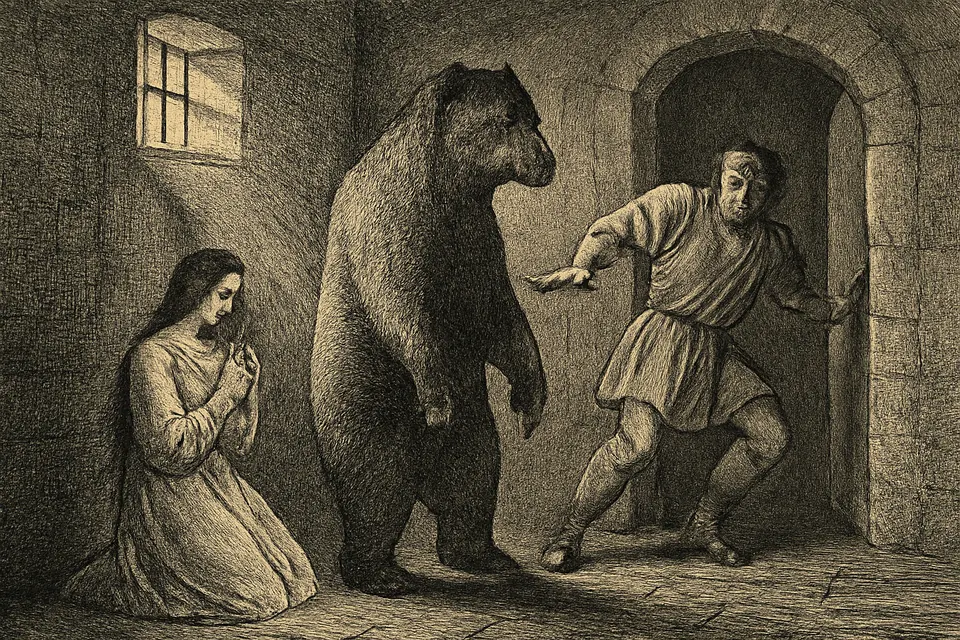
When Aurelian's persecution reached Sens, Columba was arrested. Her companions were martyred first, in the hope that she would give way. Then, the legend says, she was handed over to a debauched man in her cell, and a she-bear came to her defense and drove him off. Her captors set fire to the prison to kill her, but a violent storm broke and put the fire out.
Martyrdom at the fountain of Azon
She was then led out of the city, as was the custom, to a place near a spring called the fountain of Azon. There, the parish account says, she gave her cloak to the executioners in return for time for a last prayer, and a voice from heaven was heard: "Viens, Colombe, les Cieux te sont ouverts" ("Come, Columba, the heavens are open to you"). She was beheaded, and her body was left in the brush beside the spring for wild animals.
All of these wonders are traditional: they come from her legend, not from records we can test.
Aubertus and the first shrine
The legend goes on. A herdsman saw one of his oxen kneel before the body with a light rising from each horn, and he told his master, a Roman named Aubertus who owned a villa nearby. Aubertus was blind. According to the Catholic Encyclopedia, he invoked her, was given back his sight, and in thanksgiving buried her body. A chapel was built over her relics, and later the abbey of Sainte-Colombe, which became a place of pilgrimage.
The abbey of Sainte-Colombe
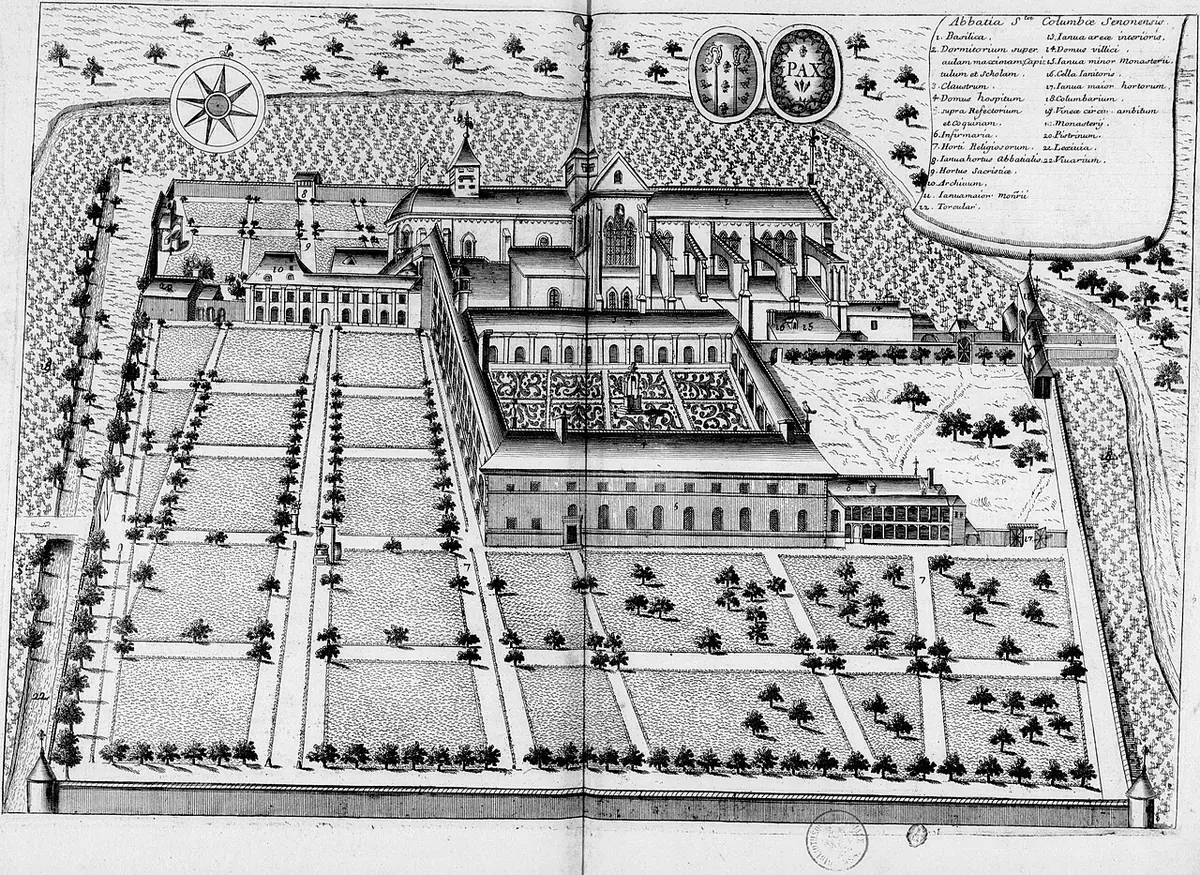
The parish history says King Clotaire II founded a royal abbey over her tomb in 620, and that St. Eligius, the goldsmith bishop, was placed at its head by King Dagobert and made a shrine for her relics. The abbey welcomed famous guests. St. Thomas Becket found refuge there during his exile, from 1166 to 1170, and St. Louis stopped there on May 17, 1234, the eve of his wedding in Sens Cathedral.
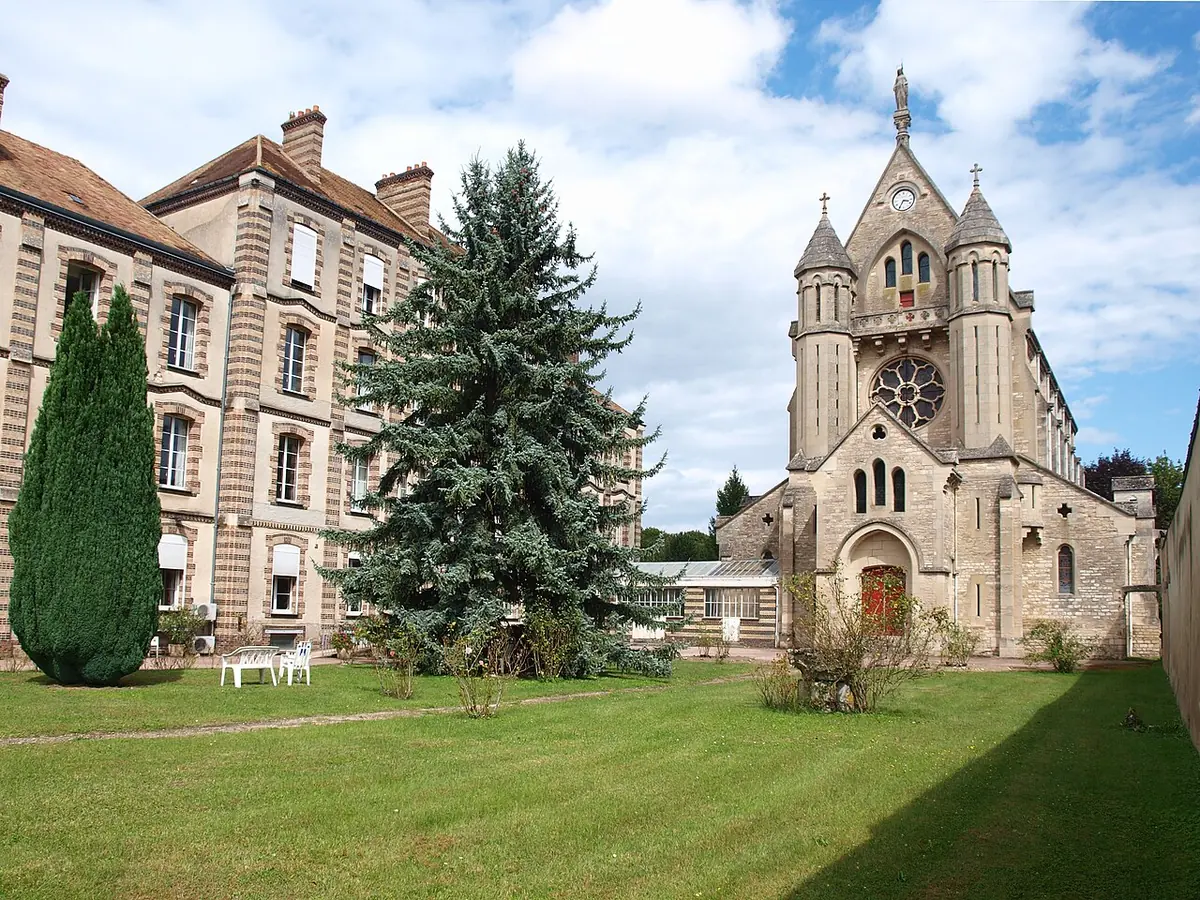
Between 1853 and 1874 the Sisters of the Holy Childhood of Jesus and Mary built the present neo-Gothic chapel on the site, consecrated in 1874, the sixteenth centenary of her martyrdom.
Symbols of St. Columba in art
- A bear: the she-bear that defended her in prison.
- Sword and palm: her beheading and her victory as a martyr.
- Lilies: her virginity.
- Crown: her royal birth in the legend and the martyr's crown.
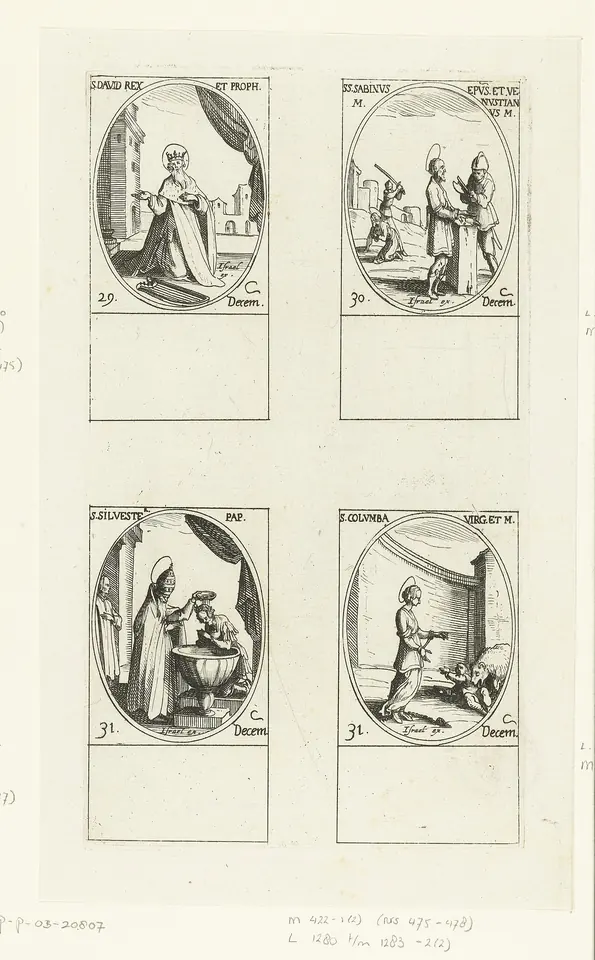
The bear is the easiest way to recognize her. In her chapel's main window she stands crowned, with palm and lilies and the bear at her feet. In Jacques Callot's seventeenth-century calendar of saints she is shown kneeling before the sword.
Feast day, relics and pilgrimage
We keep her feast on December 31, the last day of the year. Most of her relics rest in the crypt of the Chapel of Sainte-Colombe at Saint-Denis-lès-Sens, just outside Sens: an old coffer, dated to the eighth or twelfth century, inside a gilded shrine shaped like a small church, which belongs to the treasury of Sens Cathedral. Nearby lies a wax figure of the saint dressed as a Spanish princess. Columba is the second patroness of the city of Sens, and the parish holds a pilgrimage to her chapel every July. The Catholic Encyclopedia adds that she is said to have been the patroness of the parish church of Chevilly, near Paris. See more saints of late December on our feast days page.

Where the relics of St. Columba of Sens are kept: see them on the relics map →
Praying with St. Columba
We have not found a traditional English prayer to St. Columba of Sens with a source we can cite, so we ask her intercession simply: "St. Columba of Sens, pray for us."
On the last day of the year, let us ask her to pray for young people who are pressured to give up their faith or their purity, for refugees who leave home for the sake of Christ, and for all of us as we close one year and begin another.
Frequently asked questions
Who was St. Columba of Sens?
A virgin martyr of the late third century, born in Spain according to tradition, who was baptized at Vienne and put to death near Sens, in what is now Burgundy, under the emperor Aurelian. The Catholic Encyclopedia notes that her history is 'somewhat legendary,' but her cult is ancient.
Why is St. Columba of Sens shown with a bear?
Because of her legend: when she was imprisoned and handed over to a man who meant to violate her, a she-bear came to her defense. The bear appears with her in the stained glass of her chapel.
When is the feast of St. Columba of Sens?
December 31, the traditional date of her martyrdom in 274.
Where are the relics of St. Columba of Sens?
In the crypt of the Chapel of Sainte-Colombe at Saint-Denis-lès-Sens, near Sens, on the site of the abbey that grew up over her tomb. The parish holds a pilgrimage there every July.
Keep exploring
Sources
- St. Columba of Sens, Catholic Encyclopedia (1908), New Advent. Her martyrdom under Aurelian at the fountain of Azon, Aubertus and his restored sight, the abbey over her relics, and the note that her history is somewhat legendary
- Chapelle Sainte Colombe, Paroisse Sainte-Colombe du Sénonais, Diocese of Sens and Auxerre. The parish account of her legend (the bear, the fire and the storm, the voice from heaven, the ox), Clotaire II's abbey of 620, St. Eligius's shrine, Thomas Becket and St. Louis at the abbey, the chapel of 1853–1874, the shrine in the crypt, and her title as second patroness of Sens (in French)
- Sainte Colombe, vierge et martyre à Sens, Nominis (Conférence des évêques de France). Her companions Béate, Sanctien and Augustin, her honor in medieval Paris, and the July pilgrimage (in French)