Blessed Eugenia Ravasco, Foundress of the Daughters of the Sacred Hearts
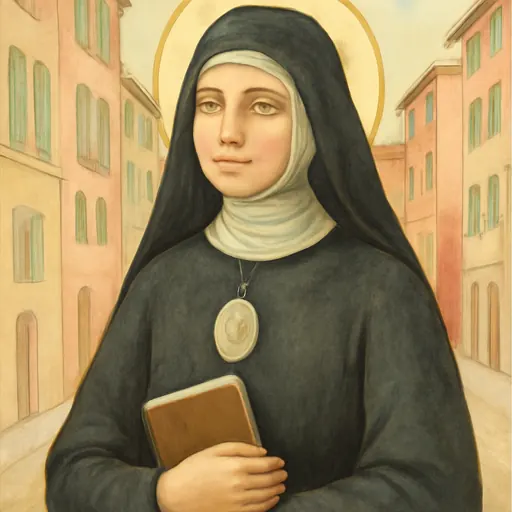
Blessed Eugenia Ravasco (1845–1900) was a Genoese laywoman, orphaned young, who at 23 founded the Daughters of the Sacred Hearts of Jesus and Mary to educate girls and young women and care for the poor. Pope John Paul II beatified her on April 27, 2003. Her feast is December 30.
Who was Blessed Eugenia Ravasco?
Blessed Eugenia Ravasco was a young woman of Genoa who, at twenty-three, founded the Congregation of the Daughters of the Sacred Hearts of Jesus and Mary to educate girls and young women and to bring them, and the poor, to Christ. At her beatification in 2003, Pope John Paul II said she "was wholly concerned with spreading love for the Hearts of Christ and Mary" and "joyfully devoted her whole life to young people and the poor." We keep her feast on December 30.
People sometimes search for "St. Eugenia Ravasco," but the Church has declared her Blessed. She is a different person from the early Roman martyr St. Eugenia.
An orphan in a banking family
Eugenia was born in Milan on January 4, 1845, the third of six children of Francesco Matteo Ravasco, a Genoese banker, and Carolina Mozzoni Frosconi, a noblewoman. Her mother died in 1848, and the family settled for good in Genoa in 1852. In March 1855 her father died too. Her uncle Luigi Ravasco, a banker and a devout Christian, took in the orphans and shaped her upbringing until his own death in December 1862.
She made her First Communion on June 21, 1855, at the age of ten, in the church of Sant'Ambrogio in Genoa, today called the Gesù. She was prepared by Canon Salvatore Magnasco, who later became Archbishop of Genoa.

The call
On May 31, 1863, praying in the church of Santa Sabina in Genoa, she felt God calling her to give herself entirely to doing good for love of the Sacred Heart of Jesus. She was eighteen. Her family and her social class did not understand her, and she met their disapproval for years.

The Daughters of the Sacred Hearts
On December 6, 1868, at twenty-three, she founded the Congregation of the Daughters of the Sacred Hearts of Jesus and Mary, dedicated above all to the education of the young. The works grew quickly: schools, catechism classes, associations and oratories; a training school for women teachers in 1878; a home for young working women in Piazza Carignano in 1892; the Association of St. Zita in 1898; and even a small theater for the young people.

Not everyone welcomed this. The teacher-training school drew hostile attacks in the press. The Archdiocese of Genoa approved her institute in 1882, and in 1909, after her death, it became a congregation of pontifical right.
She handled large sums for her works and never thought of them as hers. The Vatican biography records her saying: "Questi denari ... non sono miei, ma del Signore, io ne sono solo depositaria" ("This money is not mine but the Lord's; I am only its keeper"). To the girls she said: "Siate allegre... divertitevi, ma santamente" ("Be joyful... enjoy yourselves, but in a holy way").

Death and beatification
She died at the motherhouse in Genoa on December 30, 1900, at the age of fifty-five. Cardinal Giuseppe Siri opened her cause in 1948, and she was declared Venerable on July 1, 2000. On July 5, 2002, Pope John Paul II approved, as an approved miracle, the healing of Eilen Jiménez Cardozo of Cochabamba, Bolivia, through her intercession. On April 27, 2003, Divine Mercy Sunday, he beatified her in St. Peter's Square together with five others, among them Blessed James Alberione and Blessed Marco d'Aviano.
In his homily the Pope summed up her charism in her own phrases: "doing good for love of the Heart of Jesus," and "burning with desire for the good of others, especially young people." He added that she paid "special concern for those who had 'fallen away' from the Church."
Why she is a patron of teachers and young people
No formal decree names her patron. Her congregation looks to her as its foundress, and teachers and young people pray to her because she gave her life to forming them. Find her among the patron saints of teachers and of youth.
Symbols of Blessed Eugenia Ravasco in art
She lived in the age of photography, and her images follow her photographs: a woman in the plain black habit and veil of her congregation, with a calm, kind face. The Sacred Hearts of Jesus and Mary, the hearts surrounded by thorns and pierced by a sword, often appear beside her or on her habit, since her whole spirituality grew from them. Artists who paint her as an educator add children or young women around her, or a book.
Praying with Blessed Eugenia
We know of no traditional prayer to Blessed Eugenia in English. Let us ask Blessed Eugenia Ravasco to pray for teachers, for young people, and for all who have drifted from the Church, that they may find their way home to the Heart of Jesus.
Frequently asked questions
Who was Blessed Eugenia Ravasco?
A young woman from a banking family in Genoa who lost both parents as a child and, in 1868, founded the Daughters of the Sacred Hearts of Jesus and Mary. Her sisters ran schools, catechism classes, oratories, a teacher-training school and a home for young working women.
What miracle led to Eugenia Ravasco's beatification?
The healing of Eilen Jiménez Cardozo of Cochabamba, Bolivia, attributed to her intercession. Pope John Paul II approved it on July 5, 2002.
When is the feast of Blessed Eugenia Ravasco?
December 30, the anniversary of her death at the motherhouse in Genoa in 1900.
What did Eugenia Ravasco say about joy?
She told the girls in her care, "Siate allegre... divertitevi, ma santamente" ("Be joyful... enjoy yourselves, but in a holy way").
Keep exploring
- Patron saint pages
- Teachers
- Feast-day calendar
- Saints remembered in DecemberSaint of the dayWhat saint is my birthday?
- More
- Saints A to ZPatron saints A to ZExplore every section
Sources
- Vatican: Eugenia Ravasco (1845-1900), biografia (Italian). Her family, First Communion, her call at Santa Sabina, the foundation and works, approvals, death, the cause and the miracle; her own words
- Pope John Paul II, homily for the beatification of six Servants of God, April 27, 2003. The Pope's words on her charism