St. Fabiola of Rome

St. Fabiola (died 399) was a Roman noblewoman who, after a broken first marriage and a second union, did public penance in Rome and then gave her fortune to the poor. St. Jerome wrote that she was "the first person to found a hospital" in Rome, where she nursed the sick with her own hands. Her feast day is December 27.
Who was St. Fabiola?
St. Fabiola of Rome was a wealthy noblewoman of the fourth century whose life fell apart in marriage, who stood before the whole city as a penitent, and who then spent her fortune and her strength on the sick and the poor. She is not Queen Fabiola of Belgium, and not the heroine of Cardinal Wiseman's novel. We know her through one long letter: the eulogy St. Jerome wrote after her death in 399, which calls her "the praise of the Christians, the marvel of the gentiles, the sorrow of the poor, and the consolation of the monks."
A broken marriage
Fabiola belonged to the Fabii, one of the oldest patrician families of Rome. She married young, and her husband led a life so vicious, Jerome writes, "that not even a prostitute or a common slave could have put up with" him. She divorced him under Roman law. Then, still young and while her first husband was alive, she entered a second union. That was against the law of the Church, and it cut her off from Communion.
Jerome does not hide the fault, but he pleads for her: "I readily admit this to have been a fault, but at the same time declare that it may have been a case of necessity."
Penance before all Rome
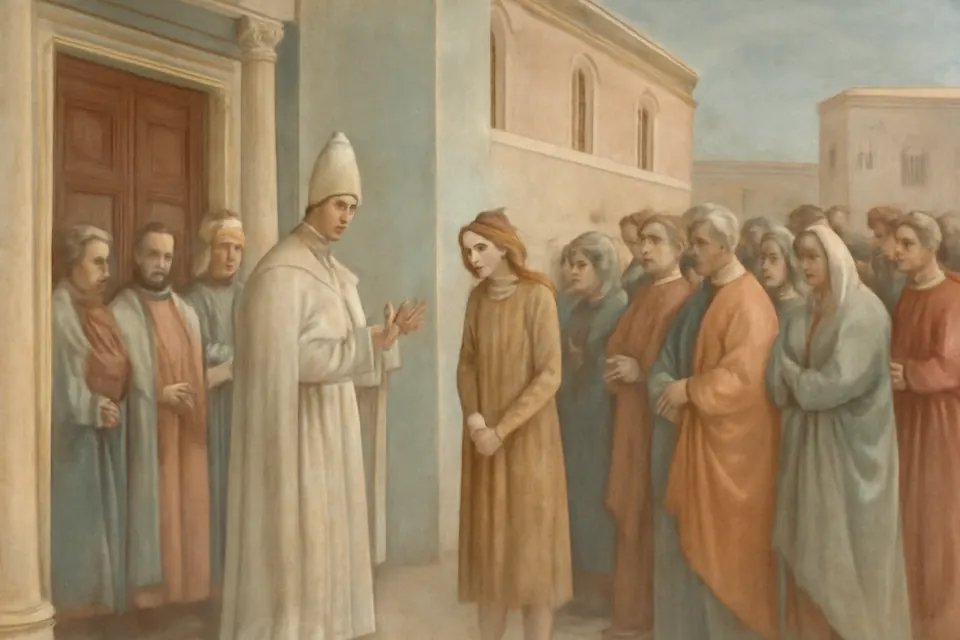
After her second husband died, Fabiola "came to herself." On the day before Easter she appeared at the Lateran basilica in sackcloth and stood among the public penitents. Jerome describes the scene: before "bishop, presbyters, and people, all of whom wept when they saw her weep," she showed "her dishevelled hair, pale features, soiled hands and unwashed neck." The pope received her back into full communion with the Church.
The first hospital in Rome
Restored to the Church, Fabiola sold the great estate that matched her rank and gave the money to the poor. Jerome says plainly: "She was the first person to found a hospital, into which she might gather sufferers out of the streets, and where she might nurse the unfortunate victims of sickness and want."
She did not leave the work to servants. "Often did she carry on her own shoulders persons infected with jaundice or with filth," Jerome writes. "She gave food to her patients with her own hand, and moistened the scarce breathing lips of the dying with sips of liquid." She also supported monasteries, clergy and virgins, and sent help to the communities of monks on the islands and coasts of Italy.

Bethlehem and Jerome
In 395 she sailed to the Holy Land and stayed near Jerome at Bethlehem, in the community of St. Paula. She threw herself into the Scriptures. Jerome remembers how she questioned him about the book of Numbers and the list of the Israelites' resting places in the desert, and pressed him so hard that he promised to write a treatise on it. For her he also wrote on the vestments of the high priest. When the Huns invaded the East and quarrels divided the monks, she returned to Rome.
Portus and her death
Back in Rome, Fabiola joined the former senator St. Pammachius in founding a large hostel for pilgrims and travelers at Portus, the harbor of Rome. "The whole world knows that a home for strangers has been established at Portus," Jerome wrote; "Britain has learned in the summer what Egypt and Parthia knew in the spring." She died on December 27, 399 or 400. All Rome came to her funeral, Jerome says, with psalms and shouts of "Alleluia."
Miracles
No miracles are recorded of St. Fabiola, and Jerome claims none. Her holiness was of another kind: public repentance and a life poured out for the sick. She has been honored as a saint since antiquity on the strength of his testimony, with no formal canonization. Jerome ends his letter with words that are her best epitaph: "Where sin has abounded, grace has much more abounded. To whom more is forgiven the same loves more."
Why St. Fabiola is a patron saint
Fabiola has no patronage assigned by the Church, but Catholics have long turned to her in situations she knew from the inside. People in difficult marriages, the divorced and those who have remarried ask her prayers, because she lived through all of it and found her way back to the sacraments. Penitents see in her the courage to confess in public. Nurses and hospitals honor her as the woman who founded Rome's first hospital and washed the wounds others could not bear to look at.
Symbols of St. Fabiola in art
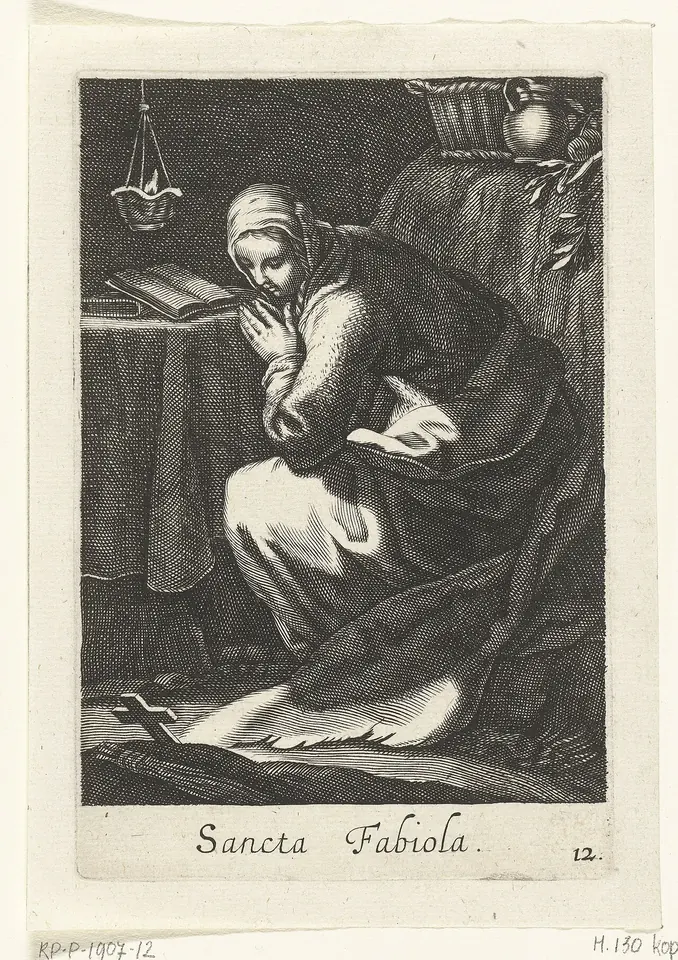
Fabiola has no fixed attribute from early Christian art. Older images show her as a veiled penitent or a woman at prayer with a book of Scripture and a cross, as in the seventeenth-century Netherlandish series of engravings of holy women hermits, the Sacra Eremus Ascetriarum. On the colonnade of St. Peter's Square she stands among the saints of Rome in simple draped robes.

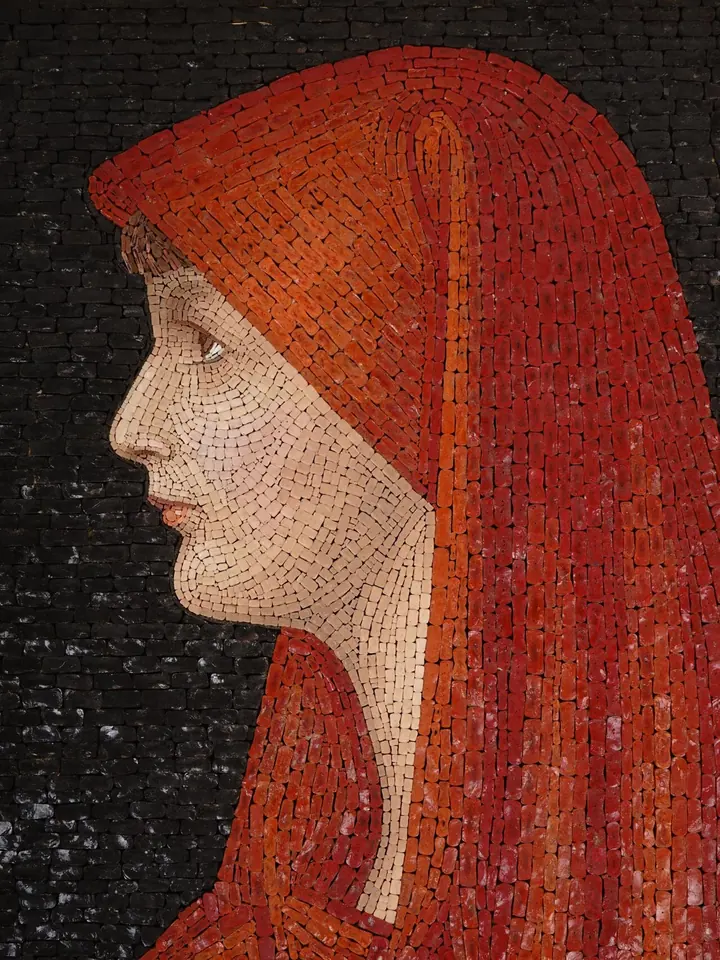
Her best-known image today is modern. The French painter Jean-Jacques Henner painted an imagined profile of a young woman in a bright red veil and called it Fabiola. It was copied many times, as in the Vatican micromosaic above, and many people know her only through that face. The name grew even more famous through Cardinal Wiseman's 1854 novel Fabiola, which painters also illustrated; its heroine is fictional.

Feast day
We keep the memory of St. Fabiola on December 27, the day of her death; see our feast days calendar. Her teacher St. Jerome is honored on September 30.
Prayer to St. Fabiola
No ancient prayer to St. Fabiola has come down to us. We ask her intercession in our own words, and many pray Psalm 51, the great psalm of repentance, with her in mind:
Have mercy on me, O God, according to thy steadfast love; according to thy abundant mercy blot out my transgressions. (Psalm 51:1, Revised Standard Version, Catholic Edition)
St. Fabiola, pray for all whose marriages are broken, for all who are finding their way back to the Church, and for all who care for the sick.
Frequently asked questions
When is the feast of St. Fabiola?
December 27, the day she died in Rome in 399 or 400.
Why is St. Fabiola the patron of divorced people and difficult marriages?
Her first husband's life was so vicious that she left him and, under Roman law, married again while he lived, against the Church's rule. After her second husband died she did public penance and was received back into communion. Catholics in hard or broken marriages ask her prayers because she knew that sorrow and found mercy.
Did St. Fabiola found the first hospital?
St. Jerome says she "was the first person to found a hospital," a house in Rome where she gathered the sick from the streets and nursed them herself. With St. Pammachius she also founded a hostel for pilgrims at Portus, Rome's harbor.
Is the novel "Fabiola" about St. Fabiola?
No. Cardinal Nicholas Wiseman's 1854 novel Fabiola has a fictional heroine set in the age of the martyrs, a century before the real saint. Jean-Jacques Henner's famous painting of a woman in a red veil is also an imagined portrait.