St. Macarius of Alexandria: The Desert Father Who Outdid Every Ascetic

St. Macarius of Alexandria (about 295 to 394) was a Desert Father, a former pastry seller who became priest of the hermits at the Cells, famous for outdoing other ascetics, for healing and for his humor. His feast is January 2 in the Roman Martyrology and January 19 in the Eastern churches, and he is honored by monks and hermits.
Who was St. Macarius of Alexandria?
St. Macarius of Alexandria was one of the Desert Fathers of fourth-century Egypt, a city man who left the bakeries of Alexandria for the silence of the desert and lived there for some sixty years. He became the priest of the Cells, a colony of hermits each living alone in his own cell, between Nitria and Scetis. He was the younger friend of St. Macarius of Egypt, and the two are often confused, but they were different men.
We know him unusually well because a young monk lived near him and wrote down what he saw. Palladius, later a bishop, spent nine years at the Cells and knew Macarius during the last three years of the old man's life. His Lausiac History, written about 420, is our main source. We keep the feast of St. Macarius on January 2; our Orthodox brothers and sisters keep it on January 19.
The life of St. Macarius of Alexandria
From the bakery to the desert
The Monastery of St. Macarius in Egypt keeps the tradition that he was born in Alexandria about 295 to a poor family and made his living baking pastries and sweets to sell. The Orthodox life says he was baptized late and went out to the desert around the age of forty. Palladius says he had kept a remarkable rule from the day of his baptism, sixty years before: he never once spat on the ground.
Priest of the Cells
He trained among the monks of Nitria and was ordained priest for the Cells, the "inner desert," where hermits lived apart, each in his own cell. He had several cells of his own: one in Scetis, one in the Libyan desert, one at the Cells and one on the mountain of Nitria. Some had no windows, and he spent Lent in them in darkness. One was so narrow he could not stretch out his feet.
In 373, during the persecution of the Arian emperor Valens, he and Macarius of Egypt were exiled together to an island in the Nile. According to the tradition kept at the Monastery of St. Macarius, Macarius of Egypt freed the daughter of the island's pagan priest from a demon, and the whole village was converted. Two years later they were allowed home.
The man who could not be outdone
Palladius says that whenever Macarius heard of any ascetic feat, he did the same thing, perfectly. When he heard that the monks of St. Pachomius ate nothing cooked in Lent, he ate nothing cooked for seven years. He once stayed out under the sky for twenty days to conquer sleep, and he said afterward that if he had not gone back under a roof his brain would have dried up. When a mosquito bit him and he killed it, he punished himself by sitting six months in the marshes of Scetis, where the insects could pierce a boar's hide, and came back so swollen that the brothers knew him only by his voice.
The most famous story took him to the great monastery of St. Pachomius at Tabennisi. He went in disguise, dressed as a laborer, and begged to be admitted. All through Lent he stood in a corner plaiting palm leaves, ate a few cabbage leaves on Sundays and never sat down. The monks complained: "Where did you get this fleshless man from, to condemn us?" Pachomius prayed to learn who the stranger was, and when it was revealed to him, he took the old man by the hand and said, "Here, good old man, you are Macarius and you hid it from me."
Old age
He lived to about a hundred. Palladius describes him as short and nearly beardless, and he once listened at the door as the old saint, alone in his cell, scolded himself: "What do you want, bad old man? See, you have had oil and have taken some wine. What do you want more, you white-haired glutton?" He died about 394, at the Cells. The Catholic Encyclopedia gives a later date, about 405, but Palladius's own account points to the earlier one.
The miracles of St. Macarius of Alexandria
Palladius reports several healings he saw himself or heard from the saint's disciples. We label them reported: they come from an eyewitness writer of the fourth century, but they were never examined by a Church tribunal.
- The paralyzed girl from Thessalonica (reported). Palladius saw a young woman, paralyzed for years, whom Macarius anointed with holy oil for twenty days while he prayed. She went home healed.
- The village priest (reported). Macarius refused to see a priest with a terrible ulcer on his head until the man confessed his sin and promised to give up his ministry. Then Macarius laid hands on him and he was healed in a few days.
- The hyena and her cub (reported). His disciple Paphnutius said a hyena brought her blind cub to the saint's door. Macarius prayed over it and it could see. The next day she brought him a sheepskin, which St. Melania the Elder later showed Palladius.
- Communion from an angel (reported vision). Macarius told Palladius that he never gave Communion to the young monk Mark himself: an angel gave it from the altar, and he saw only the knuckle of the hand.
The basket of sand
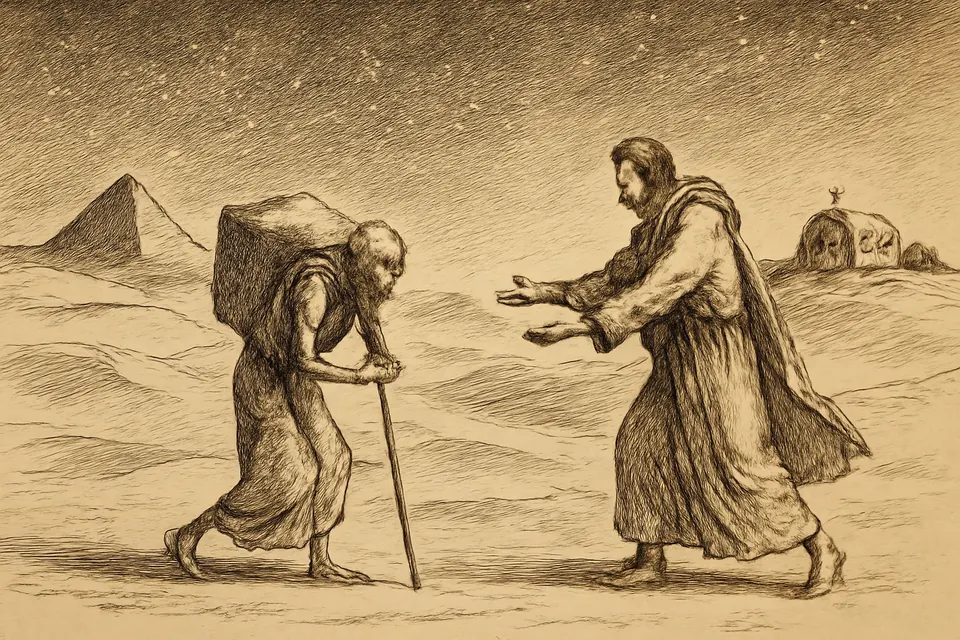
Even Macarius was tempted to pride. One day a thought pressed him to go to Rome and heal the sick, since grace worked so powerfully through him. He lay across his doorway with his feet outside and told the demons to drag him if they could. That night the temptation came again, so he filled a large basket with sand, put it on his shoulders and walked the desert. A traveler offered to carry it for him. Macarius answered, "I trouble my troubler." When Palladius once came to him discouraged, the old man gave him a line for his thoughts: "Tell them, 'For Christ's sake I am guarding the walls.'"
Symbols of St. Macarius of Alexandria in art
- The rough habit of a hermit, often with bare arms and a thin, aged body.
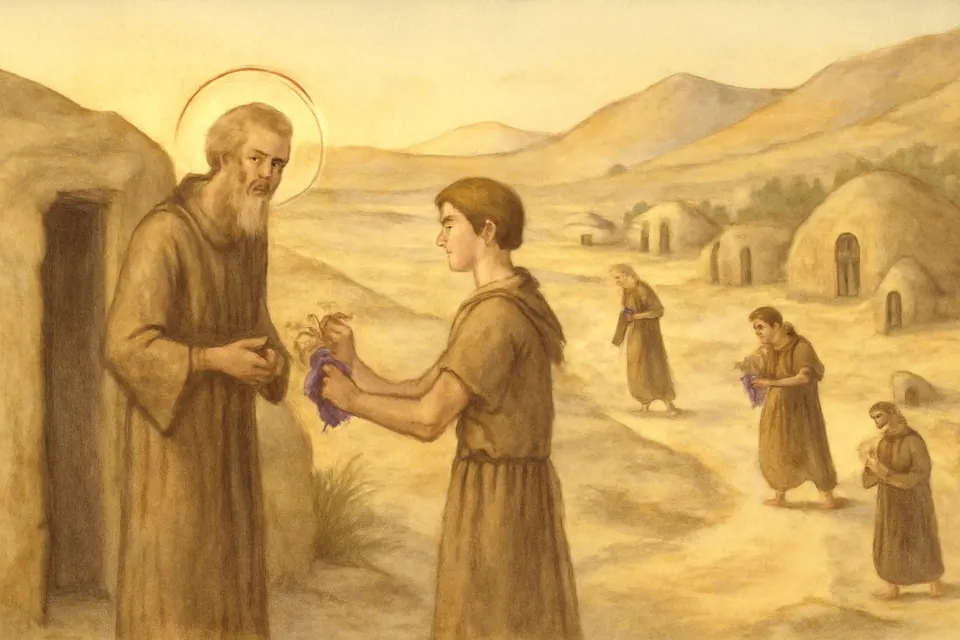
- A bunch of grapes, for the gift he passed on to a sick brother.
- A basket or sack of sand, for his fight against vanity.
- A hyena with her cub, for the healing Paphnutius reported.
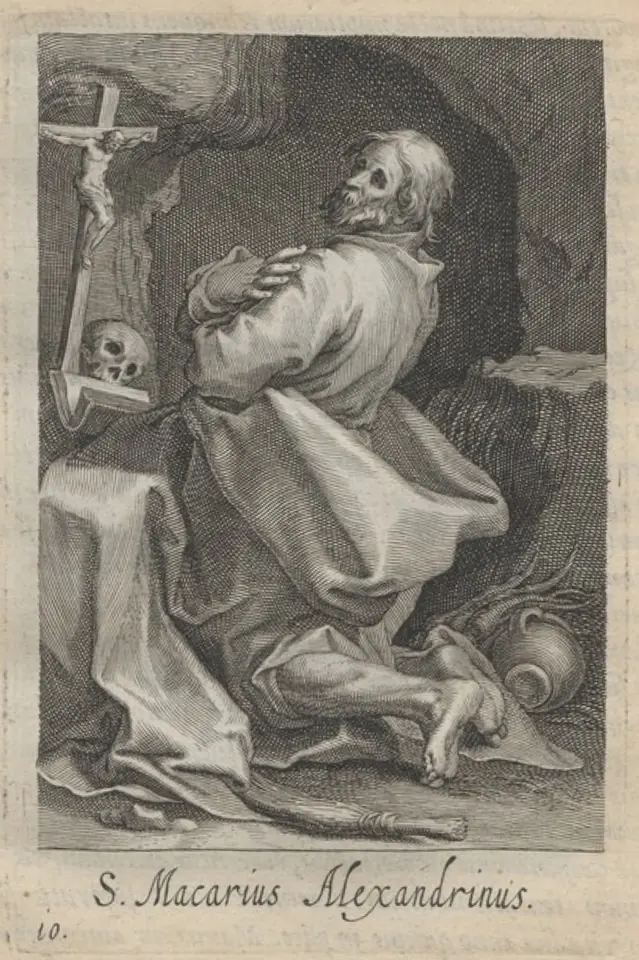
- Skull and crucifix, the Western sign of a hermit's prayer, as in Bloemaert's print.
In Eastern icons he appears among the desert fathers as a lean old monk, sometimes beside Macarius of Egypt, whose long beard sets him apart. Western engravers of the 1600s gave him the grapes.

Feast day and where St. Macarius is honored
The Roman Martyrology names him on January 2; the Byzantine churches keep him with Macarius of Egypt on January 19. See the feast day calendar. In Egypt the monks of Wadi el-Natrun, ancient Scetis, still honor him at the Monastery of St. Macarius the Great, where he kept one of his cells. Monks, hermits and, for his first trade, pastry cooks count him among their patron saints.

Prayer to St. Macarius of Alexandria
We have no prayer from Macarius himself. The Eastern churches sing his troparion on January 19, and anyone may ask his help with a simple invocation: "Holy Father Macarius, pray to God for us." Let us ask him, when our own thoughts tell us to give up and go away, for the grace to answer as he taught: for Christ's sake, I am guarding the walls.
Frequently asked questions
What is the difference between St. Macarius of Alexandria and St. Macarius of Egypt?
They were two different men who lived at the same time and were friends. Macarius of Egypt, the Great, founded the monastic settlement of Scetis. Macarius of Alexandria, sometimes called the Younger, was a city man who became priest of the Cells, a hermit colony nearer Nitria. The Eastern churches keep both on January 19.
When is the feast day of St. Macarius of Alexandria?
January 2 in the Roman Martyrology. The Orthodox and Eastern Catholic churches keep him on January 19, together with St. Macarius of Egypt.
What is the story of St. Macarius and the grapes?
Someone brought Macarius a fresh bunch of grapes. He wanted them but gave them to a sick brother, who passed them on to another, and so on through the cells until the bunch came back to Macarius. He gave thanks to God for the self-denial of his monks.
Why is St. Macarius of Alexandria a patron of pastry chefs?
Before he became a monk he earned his living in Alexandria as a baker of pastries and sweets, according to the Coptic tradition kept at the Monastery of St. Macarius, so cooks and confectioners have claimed him.
Keep exploring
- Patron saint pages
- Cooks
- Feast-day calendar
- Saints remembered in JanuarySaint of the dayWhat saint is my birthday?
- More
- Saints A to ZPatron saints A to ZExplore every section
Sources
- Palladius, The Lausiac History, chapter 18: Macarius of Alexandria (tr. W. K. Lowther Clarke, 1918). eyewitness account; the Tabennisi Lent, the six months in the marsh, the hyena, the basket of sand, the healings, his age and appearance
- Catholic Encyclopedia: Macarius. the two Macarii distinguished; Roman Martyrology January 2, Byzantine January 19
- Orthodox Church in America: Venerable Macarius of Alexandria. the grapes; born 295, died about 394 to 395
- Monastery of St. Macarius the Great: St. Macarius of Alexandria (Arabic). his trade as a pastry baker; priest of the Cells about 355; exile with Macarius the Great
- Monastery of St. Macarius the Great: St. Macarius the Great. the exile of both Macarii to a Nile island in 373