St. Nicasius of Rheims, Bishop and Martyr at the Door of His Cathedral

St. Nicasius of Rheims was the bishop of Reims who built the first cathedral of Our Lady there and was killed at its door, about 407, when barbarian invaders took the city. His sister St. Eutropia, his deacon Florentius and his reader Jucundus died with him. We keep his feast on December 14.
Who was St. Nicasius of Rheims?
St. Nicasius of Rheims was the bishop of Reims, in northern Gaul, at the start of the 5th century, and the founder of its first cathedral of Our Lady. When a barbarian army broke into the city, about the year 407, he was killed at the door of that cathedral. His sister, the virgin St. Eutropia, died beside him, with his deacon Florentius and his reader Jucundus.
The Roman Martyrology remembers them together on December 14: "At Rheims, the holy bishop Nicasius, his sister, the virgin Eutropia, and their companions, martyrs, who were put to death by barbarians hostile to the Church." Reims never forgot him. Eight centuries later the sculptors of its great Gothic cathedral gave him a place of honor on two of its portals.

The life of St. Nicasius
Builder of the cathedral
Very little of his life before the invasion has come down to us. Sabine Baring-Gould, drawing on the 10th-century historian Flodoard, says that Nicasius was bishop of Reims by 400 and that he "built the basilica of Our Lady, now the cathedral," moving the bishop's throne there from the older church of the Apostles. Every cathedral that has stood on that spot since, including the Gothic church where the kings of France were crowned, stands on his foundation.
The fall of Reims
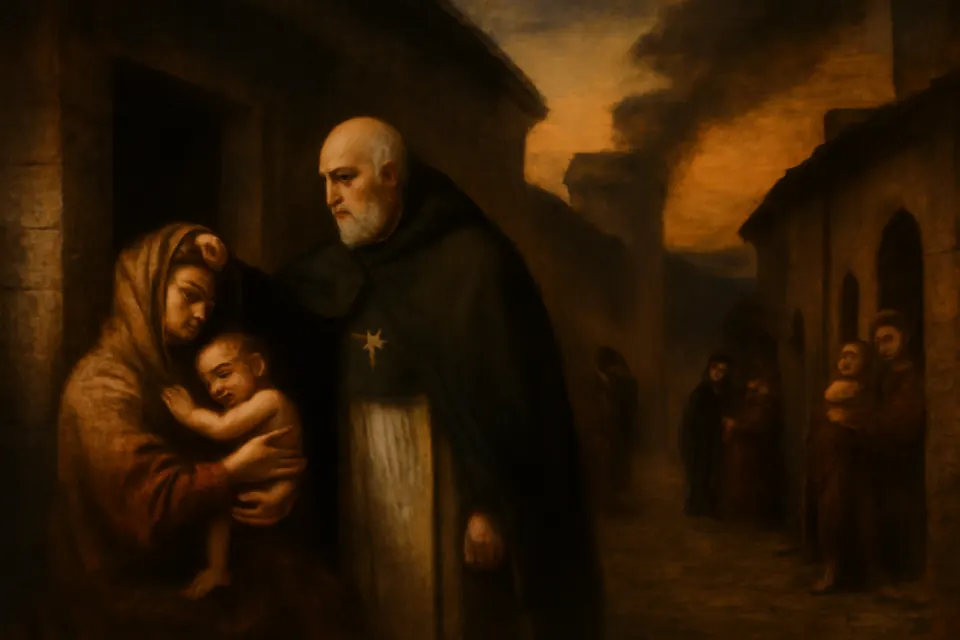
In the winter of 406 to 407, Vandals and Alans crossed the Rhine and swept through Gaul. Alban Butler, writing in the 18th century, says that Nicasius "had foretold this calamity to his flock." When the enemy was in the streets, he forgot himself and "went from door to door encouraging all to patience and constancy," trying to save as many of his people as he could. (Butler notes that Tillemont thought the invaders were Goths; the Bollandist Stilting argued for the Vandals of 407, and most writers since have followed him.)
Death at the cathedral door
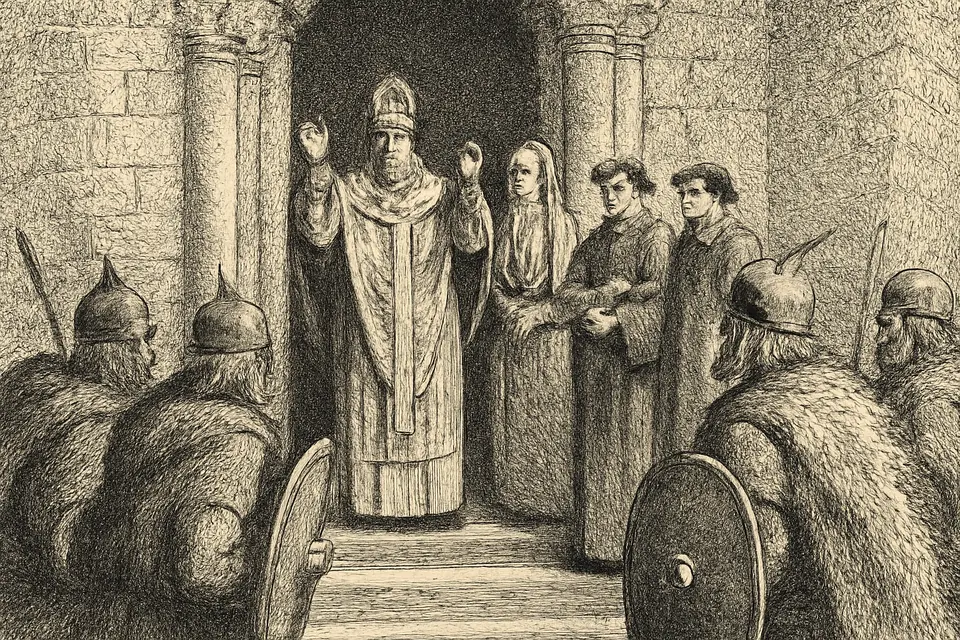
The accounts agree on the place. Nicasius met the invaders at the door of his own cathedral, and there, in Baring-Gould's words, "a Vandal cleft the skull of S. Nicasius." Florentius and Jucundus were killed at his side. Eutropia had been spared for a worse fate. She refused it outright, and Butler says she "boldly cried out to the infidels, that it was her unalterable resolution rather to sacrifice her life, than her faith or her integrity," and they killed her too.
The Catholic Encyclopedia adds that his disciple Oriculus and Oriculus's sisters Oricula and Basilica were killed a short time afterward.
Miracles and relics
- Healings at his tomb: reported. Nicasius and Eutropia were buried in the churchyard of St. Agricola, and Butler writes that "many miracles rendered their tombs illustrious." The church grew into the great Benedictine abbey of Saint-Nicaise.
In 893 Archbishop Fulco moved his body into the cathedral he had founded. Baring-Gould says a marble slab in the nave of Reims Cathedral marks the spot where the old doors stood and where he died, and that only a few fragments of his bones survived the French Revolution. Butler records that his head was kept in the abbey of St. Vaast at Arras in his day.

The abbey church named for him, a masterpiece of 13th-century Gothic, was sold and pulled down after the Revolution. The Monasticon Gallicanum preserves a view of it at its height.

Symbols of St. Nicasius in art
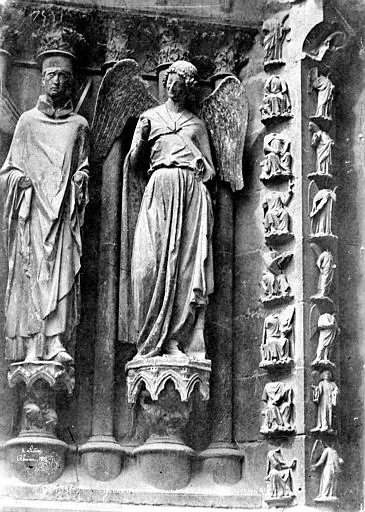
St. Nicasius is dressed as a bishop, in miter and cope, often with a crozier. His particular sign is grim but easy to spot: he holds the top of his own skull in his hands, the part the Vandal's blade cut away. The 13th-century statue on the St. Calixtus portal of the north transept at Reims shows him this way, standing between an angel and his sister Eutropia.

On the west front of the cathedral he stands beside the famous Smiling Angel, one of the best-loved statues of the Middle Ages. Stained glass and paintings show the moment of his death instead: a kneeling bishop, a raised sword, and Eutropia close by. In some images he carries the palm of a martyr.
Feast day
We keep the feast of St. Nicasius, St. Eutropia and their companions on December 14. He is honored above all in Reims, the city he served, and in the churches of northern France and Belgium that bear his name, Saint-Nicaise. See other saints of December on our feast days page.
Prayer to St. Nicasius
There is no well-known traditional prayer to St. Nicasius alone. The faithful of Reims have long asked his help in their own words, as pastor and protector of the city. We can pray simply: St. Nicasius, who stayed with your people when the enemy came and died at the door of God's house, pray for bishops and pastors, and for every city in danger. St. Eutropia, pray for us.
Frequently asked questions
Who was St. Nicasius of Rheims?
A bishop of Reims in the early 5th century. He built the city's first cathedral of Our Lady and was cut down at its door when the Vandals stormed Reims about 407, after spending the last hours going through the city to strengthen his people.
When is the feast of St. Nicasius?
December 14, with his sister St. Eutropia and their companions, as the Roman Martyrology gives it.
Why is St. Nicasius shown holding his head?
The old accounts say a Vandal cleft his skull at the cathedral door. Gothic sculptors at Reims showed him holding the top of his own head, the sign of how he died.
Is St. Nicasius the same as St. Nicasius of Sicily?
No. St. Nicasius of Sicily was a 12th-century Knight Hospitaller. The bishop of Reims lived some 700 years earlier.
Keep exploring
Sources
- Catholic Encyclopedia (1911): Reims. The Vandals beheaded him "on the threshold of his church, in 406 or 407," with Eutropia, Florens, Jucundus and later Oriculus
- Butler, Lives of the Fathers, Martyrs and Other Principal Saints, vol. 12 (1842), December 14. He foretold the attack and went door to door; burial at St. Agricola; translation by Archbishop Fulco in 893; head at St. Vaast, Arras
- S. Baring-Gould, The Lives of the Saints, vol. 15 (1914), December 14. He built the basilica of Our Lady; the slab in the nave; relics lost at the Revolution
- The Roman Martyrology (English edition), December 14