St. Melania the Younger
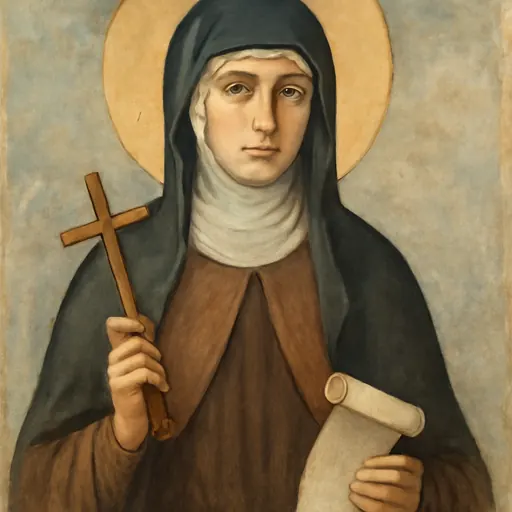
St. Melania the Younger (about 383–439) was a Roman noblewoman, among the richest people of her age, who with her husband Pinian gave away an enormous fortune, freed thousands of slaves and spent her last years as a nun on the Mount of Olives in Jerusalem, where she founded monasteries for women and men. Her feast day is December 31, the day she died.
Who was St. Melania the Younger?
St. Melania the Younger was a Roman noblewoman of the late 4th and early 5th centuries who owned estates across Italy, Sicily, Spain, Gaul and North Africa, and gave nearly all of it away. With her husband, Valerius Pinianus, she left Rome, spent years in North Africa near St. Augustine, and ended her life as a nun on the Mount of Olives in Jerusalem. She died there on December 31, 439, and the Church keeps her feast on that day.
She is called "the Younger" to set her apart from her grandmother, St. Melania the Elder, who had made the same journey from Roman wealth to Jerusalem a generation before. We know her unusually well. Palladius, a monk and bishop who met the family in Rome, wrote about her in his Lausiac History around 420, while she was still alive. Augustine wrote letters to her household. And her chaplain Gerontius, who succeeded her as head of her monasteries, wrote her Life soon after her death.

The life of St. Melania the Younger
A forced marriage
Melania was born in Rome about 383 to Publicola and Albina, Christians of senatorial rank. Her parents married her to Pinian, a young man "of the highest rank in Rome," as Palladius puts it, when she was about thirteen. She had wanted from girlhood to give herself to God. Palladius says her conscience "was always being pricked by the tales she heard about her grandmother."
Two children were born and both died young. After that, Palladius records what she said to her husband: "If you choose to practise asceticism with me according to the fashion of chastity, then I recognise you as master and lord of my life." If not, he could take her property and set her free. Pinian, after a long struggle, agreed. She was twenty and he about twenty-four when they renounced the world together.
Giving away a fortune
Their wealth was immense, and giving it away was a long and difficult task, opposed at first by their relatives. Palladius lists her gifts: her silk dresses went to the altars or were cut up for church hangings, and through a Dalmatian priest named Paul she sent 10,000 pieces of money each to Egypt, to Antioch and to the islands, and 15,000 to Palestine. She freed 8,000 slaves who wished to be free. She sold her lands in Spain and Gaul and kept the income of her estates in Sicily, Campania and Africa to support monasteries.
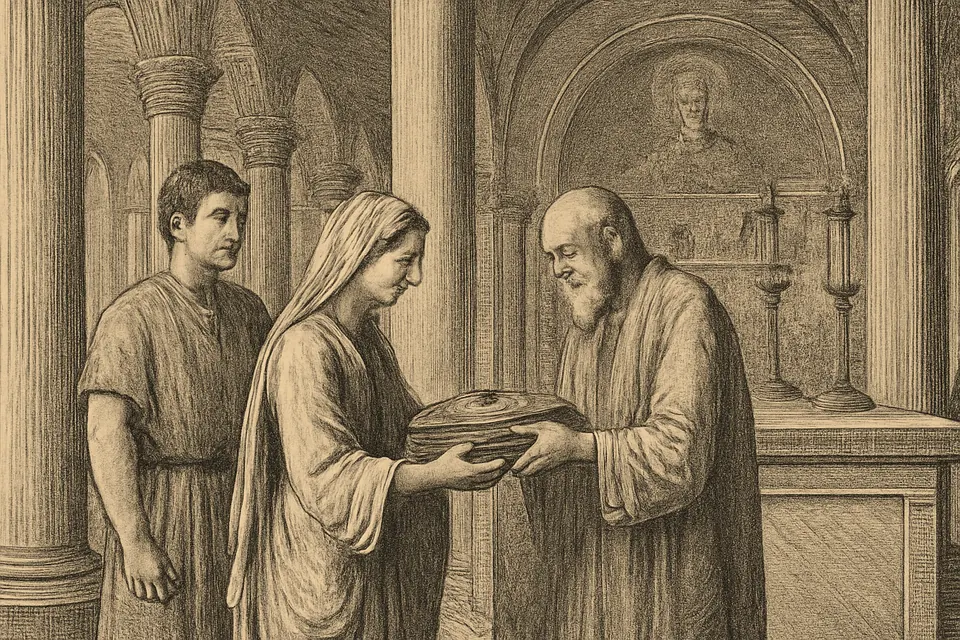
Palladius adds that she snatched all this "out of the mouth of the lion," Alaric, whose Goths besieged Rome and sacked it in 410. The family left Italy before the sack, for Sicily and then North Africa.
With St. Augustine in Africa
In Africa they settled at Thagaste, Augustine's hometown, where they endowed the church; Gerontius adds that they founded two monasteries there. A visit to Hippo in about 411 went badly. The congregation, seeing a rich and holy man in their church, shouted for Pinian to be ordained a priest on the spot. Augustine refused to ordain him against his will. In his Letter 126 to Melania's mother, Albina, he describes the uproar, and "the holy Melania" objecting to the wording of the oath Pinian finally swore to calm the crowd. It is a rare glimpse of a saint seen through the eyes of another saint, on a bad day.

Jerusalem and the Mount of Olives
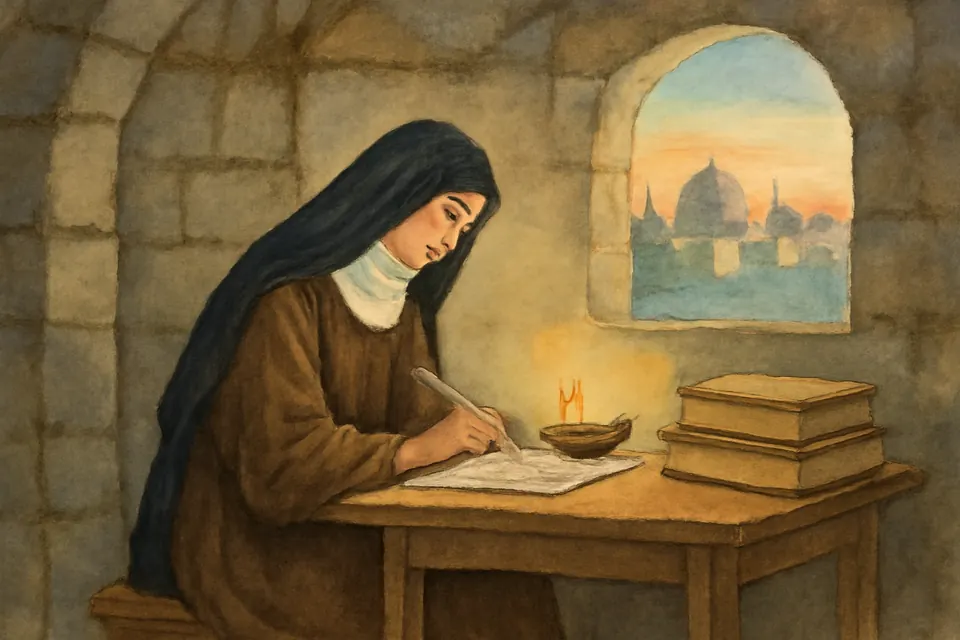
About 417 the family sailed for the Holy Land, by way of Alexandria, where Gerontius says Bishop St. Cyril received them. In Jerusalem they gave away what was left. Melania visited the monks of the Egyptian desert, then shut herself in a small cell on the Mount of Olives, reading Scripture and copying books by hand.
After Albina's death she founded a monastery for women beside her cell. The Orthodox Church's life says about ninety women lived there, and that out of humility Melania refused to be their abbess. In its oratory she placed relics of the Prophet Zechariah, the first martyr St. Stephen and the Forty Martyrs of Sebaste. Pinian died about 431 or 432, and she buried him there. She then built a monastery for men near the Church of the Ascension, where monks kept up unceasing prayer.
Constantinople and her last days
Late in life she traveled to Constantinople to see her uncle Volusian, a pagan and a high official of the Western empire. On the way she prayed at the shrine of St. Lawrence. She found him ill, and he was baptized before he died. She stayed long enough to argue against the teaching of Nestorius, which had divided the city, and then returned to Jerusalem. She died on the Mount of Olives on December 31, 439, at about fifty-six.
Miracles of St. Melania
Gerontius records healings and other wonders through her prayers, and the Orthodox life says that "many miracles were worked through the prayers of the saint" in Constantinople. These are traditional: they come from devoted early biographers and have never been formally examined. What is historical is the giving, attested by Palladius and Augustine while she was alive.
Symbols of St. Melania the Younger in art
Images of St. Melania are uncommon in the West and more frequent in Orthodox churches. To recognize her:
- Nun's dark veil and mantle: in Byzantine and Greek icons she wears the dark maphorion and brown habit of a nun, as in the Meteora fresco below. Her Greek inscription usually calls her "Melania the Roman."
- Hands raised in prayer: the ancient gesture of the orant, seen in the Menologion of Basil II.
- Cross and scroll: later Greek icons put a cross in her hand, the sign of a nun and confessor, and a scroll with words of counsel to her sisters.
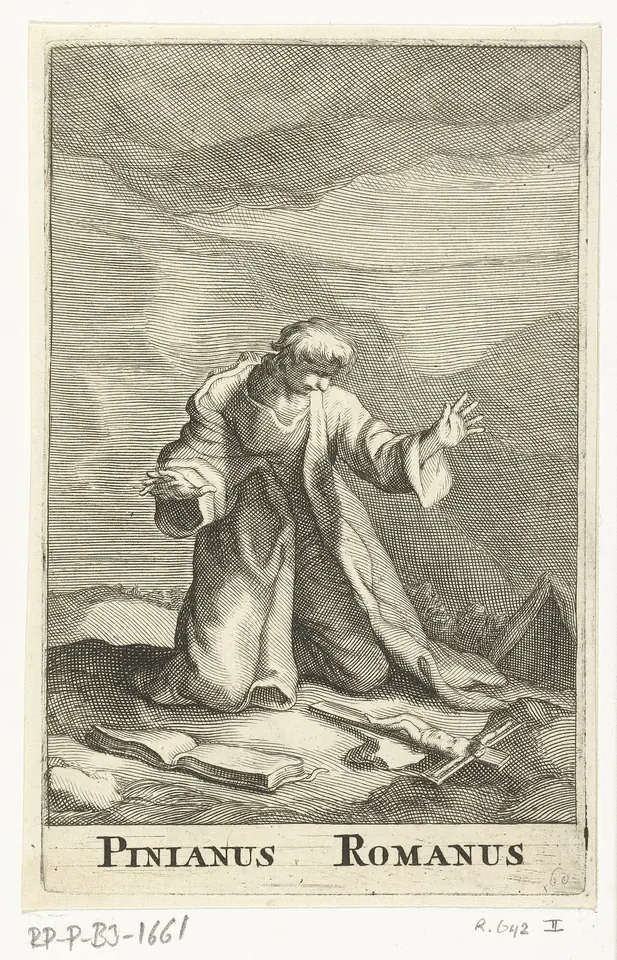
- A hermit in the wilderness: Western engravings of the 1600s, like the Bloemaert series above, show her with long hair kneeling over a book in a desert landscape, among the hermit saints.

Feast day and prayer
We keep St. Melania's feast on December 31, the last day of the civil year. See more saints on our feast days calendar, or other early monastic saints on our Desert Fathers page. Her tomb on the Mount of Olives has not survived, and no relics of hers are known to be venerated today.
The Orthodox Church sings this troparion for her, in the translation published by the Orthodox Church in America:
The image of God was truly preserved in you, O Mother, / for you took up the Cross and followed Christ. / By so doing, you taught us to disregard the flesh, for it passes away; / but to care instead for the soul, since it is immortal. / Therefore your spirit, O holy Mother Melania, rejoices with the angels.
Let us ask St. Melania to pray for all who hold wealth, that they may use it as she did, and for every family that has buried a child.
Frequently asked questions
Who was St. Melania the Younger?
A Roman heiress, born about 383, granddaughter of St. Melania the Elder. Married at thirteen or fourteen to Valerius Pinianus, she persuaded him after the deaths of their children to live in chastity and give their wealth to the poor and the Church. They lived in Sicily and North Africa, then in Jerusalem, where she founded monasteries on the Mount of Olives. She died there on December 31, 439.
When is St. Melania the Younger's feast day?
December 31, the anniversary of her death. The Orthodox Church and the Eastern Catholic churches keep her that day, and she is listed on December 31 in the Roman Martyrology.
What is the difference between Melania the Elder and Melania the Younger?
Melania the Elder (about 350–410) was the grandmother. She was a Roman widow who went to the Holy Land and founded a monastery on the Mount of Olives with Rufinus. Melania the Younger was her granddaughter, who followed the same path a generation later. Palladius says the younger Melania was spurred on by "the tales she heard about her grandmother."
How many slaves did St. Melania free?
Palladius, who knew the family, wrote that she freed 8,000 slaves who wished to be free. Those who did not want freedom she let her brother take for three pieces of money.
Keep exploring
- Appears in
- Female saintsSaint names for girls
- Feast-day calendar
- Saints remembered in DecemberSaint of the day
- More
- Saints A to ZPatron saints A to ZExplore every section
Sources
- Palladius, The Lausiac History, ch. 61: Melania the Younger (trans. W. K. Lowther Clarke, 1918)
- St. Augustine, Letter 126, to Albina (New Advent)
- St. Augustine, Letter 124, to Albina, Pinianus and Melania (New Advent)
- Orthodox Church in America: Venerable Melania the Younger of Rome
- Orthodox Church in America: Troparion of Venerable Melania the Younger