St. Vincent Strambi, Passionist Bishop of Macerata

St. Vincent Strambi (1745–1824) was a Passionist priest, a great preacher of Christ's Passion and the bishop of Macerata and Tolentino. He refused Napoleon's oath and went into exile, and at the end of his life, tradition holds, he offered his life to God for the dying Pope Leo XII. He was canonized by Pius XII in 1950, and his feast is January 1.
Who was St. Vincent Strambi?
St. Vincent Strambi was a Passionist priest and bishop who spent his life preaching the Passion of Christ. He was born and died on the same day of the year, January 1, and in between he preached across Italy, guided some of the holiest souls of his time, governed the diocese of Macerata and Tolentino through the Napoleonic wars, and went into exile rather than swear a forbidden oath. The Passionists remember that he died, at seventy-eight, after offering his life to God for the pope.
The life of St. Vincent Strambi
A pharmacist's son who would not give up
Vincent was born on January 1, 1745, in Civitavecchia, the port of Rome, where his father kept a pharmacy. At fifteen, after winning over his reluctant father, he entered the seminary of Montefiascone on November 4, 1762. He went on to study at the Collegio Nuovo in Rome and with the Dominicans in Viterbo. He was ordained a deacon in Bagnoregio on March 14, 1767, made rector of the seminary there that November, and ordained a priest on December 19 of the same year.
He wanted religious life, but both the Lazarists and the Capuchins turned him away. Then he met the Passionists. St. Paul of the Cross, their founder, received him, and Vincent made his profession on September 24, 1769.
Preacher of the Passion
For three decades he preached missions all over Italy, at times alongside St. Gaspar del Bufalo. At the pope's request he often preached in Rome to the clergy, bishops and cardinals of the Curia. People called him "the holy Passionist preacher." He was a sought-after spiritual director: among those he guided were Blessed Anna Maria Taigi and Venerable Luisa Maurizi. From 1792 until his death he was also the congregation's postulator general, the man who promoted the causes of its holy members in Rome.
Bishop of Macerata and Tolentino
On July 5, 1801, he was named bishop of Macerata and Tolentino. He founded a seminary, reformed his clergy, organized the teaching of the catechism, enlarged an orphanage and opened a home for the elderly. To give the poor work, he set up hemp spinning. His motto for this work has come down to us in his own words: "The poor are my masters, and I am only their steward" (our translation of the Italian the Dicastery quotes). The Passionists add that the city called him "father of the city" for standing up to foreign troops who invaded Macerata.

Exile under Napoleon
When Napoleon's France annexed the Papal States, the clergy were ordered to swear an oath of loyalty to the new regime. Strambi refused. He was sent to Novara for a year and then, in October 1809, to Milan, where the Barnabite Fathers took him in. The Passionists count nearly six years of exile in all. Only after Napoleon's fall did he return to his flock.

The last forty days
Old and tired, he asked many times to be released from his diocese. In 1823 the new pope, Leo XII, finally agreed, but kept him in Rome as his counselor and confessor.
At the end of that year Leo XII fell gravely ill. The Passionists teach that Vincent offered his own life to God in place of the pope's. The pope recovered and lived until 1829. Vincent suffered a stroke, and he died in Rome on January 1, 1824, on his seventy-ninth birthday, after only about forty days as the pope's counselor. He was buried in the Passionist Basilica of Sts. John and Paul on the Caelian Hill.

Beatification, canonization and miracles
Pius XI beatified Vincent Strambi on April 26, 1925, and Pius XII canonized him in St. Peter's Basilica on June 11, 1950. Both steps required healings attributed to his prayers to be examined and approved by the Holy See; the Dicastery's biography doesn't describe them, and we have not found a reliable account to share.
The offering of his life for Leo XII is not a formally investigated miracle. It belongs to tradition, kept by his own congregation: a bishop's sacrifice, followed by the pope's recovery.
Symbols of St. Vincent Strambi in art
- Black Passionist habit with the Passion sign: the white heart-shaped badge with a cross and the words "Jesu XPI Passio" that every Passionist wears.
- Crucifix: the Passion he preached for half a century.
- Pectoral cross: his office as bishop. Some images add a purple skullcap.
- Book: his preaching and his writings on the spiritual life and on the Precious Blood, to which the Passionists say he had special devotion.
Most pictures of him are nineteenth- and twentieth-century devotional portraits of an old, thin bishop in black, holding a crucifix.
Feast day and where he is honored
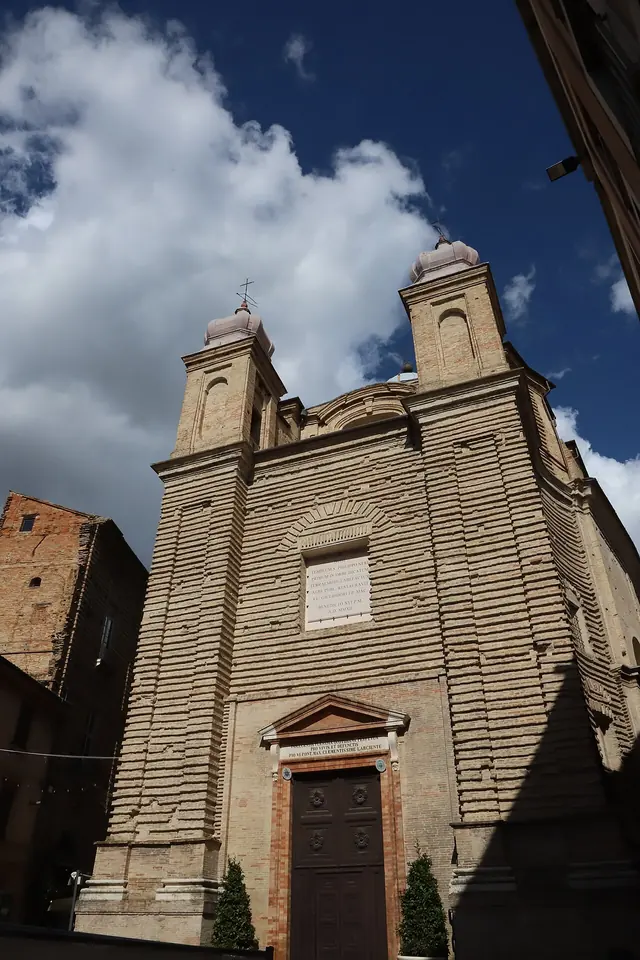
His feast is January 1, which is also the Solemnity of Mary, Mother of God, so in most places he is remembered quietly within that great day. His body was moved on November 12, 1957, from Rome to the Church of San Filippo in Macerata, the city where he served as bishop for over twenty years. Find other saints of the new year on our feast days page.
Praying with St. Vincent Strambi
We have not found a traditional prayer to St. Vincent Strambi with a source we can cite, so we don't print one. His own words to the poor make a fine starting point for prayer.
Let us ask St. Vincent Strambi to pray for bishops and priests, for preachers of the Cross, for those exiled for their conscience, and for the Holy Father.
Frequently asked questions
Who was St. Vincent Strambi?
A priest from Civitavecchia who joined the Passionists under St. Paul of the Cross, became one of the best-known preachers in Italy, and served as bishop of Macerata and Tolentino from 1801. He died in Rome on January 1, 1824.
When is the feast of St. Vincent Strambi?
January 1, the day he was born and the day he died.
Did St. Vincent Strambi give his life for the pope?
The Passionists teach that he offered his life to God in place of the gravely ill Pope Leo XII at the end of 1823. The pope recovered and lived until 1829; Strambi died of a stroke a few days later.
Where is St. Vincent Strambi buried?
In the Church of San Filippo in Macerata, where his body was moved in 1957 from the Passionist Basilica of Sts. John and Paul in Rome.
Keep exploring
Sources
- Vincenzo Maria Strambi, Dicastero delle Cause dei Santi. Seminary, ordination dates, Passionist profession (September 24, 1769), postulator general, appointment as bishop (July 5, 1801), exile to Novara and Milan, beatification, canonization, the 1957 transfer of his body, and his saying about the poor
- St. Vincent Mary Strambi, Passio Christi (Passionist General Curia). His spiritual directees, nearly six years of exile, the offering of his life for Leo XII, and his sayings about the poor