Blessed Mary Frances Schervier, Mother of the Poor of Aachen

Blessed Mary Frances Schervier (1819–1876) was the daughter of an Aachen needle manufacturer who gave her life to the poor and sick and founded the Poor Sisters of St. Francis in 1845. Her sisters nursed cholera patients and ran hospitals in the United States. Pope Paul VI beatified her on April 28, 1974. Her feast is December 14.
Who was Blessed Mary Frances Schervier?
Blessed Mary Frances Schervier was a well-to-do young woman of Aachen who gave her life to the poor. With four companions she founded the Poor Sisters of St. Francis in 1845, and within her lifetime her sisters were nursing the sick in Germany and across the ocean in America. The people of her city called her the "Mother of the Poor," and Pope Paul VI used the same title when he beatified her in 1974.
The life of Blessed Frances
A needle manufacturer's daughter
Franziska Schervier was born in Aachen on January 3, 1819, the daughter of a needle manufacturer in what was then Prussian territory. After her mother's death she ran the family household, and she became known for her generosity to the poor who came to the door. For a time she hoped to become a Trappistine nun, but her road led instead to the streets of her own city.
She saw clearly what the new factories were doing to working families. She worked for decent housing for them, schooling for factory children and soup kitchens for the hungry. Later she wrote of what she had learned among them: "I recognized so plainly in the poor and the suffering my divine Lord" (our translation from the German).

The Poor Sisters of St. Francis
In 1844 she and four friends became members of the Third Order of St. Francis. In 1845, at Pentecost, they began living together as a community devoted to the poor, with Frances as their superior. They cared for the sick in their homes, ran soup kitchens, stood by prisoners and prostitutes, and accompanied men condemned to death.
When epidemics of cholera and smallpox came, the sisters nursed the stricken. In 1850 the constitutions of the new congregation went to the Archbishop of Cologne, who approved them, and on August 12, 1851, Mother Frances and twenty-three companions received the Franciscan habit.
She embraced Franciscan poverty for herself and her sisters, and she did not back away from quarrels with church or state officials when the poor were at stake. Her congregation keeps a sentence she understood as Christ's own charge to her community: "You shall heal my wounds and save souls" (our translation).

Across the ocean
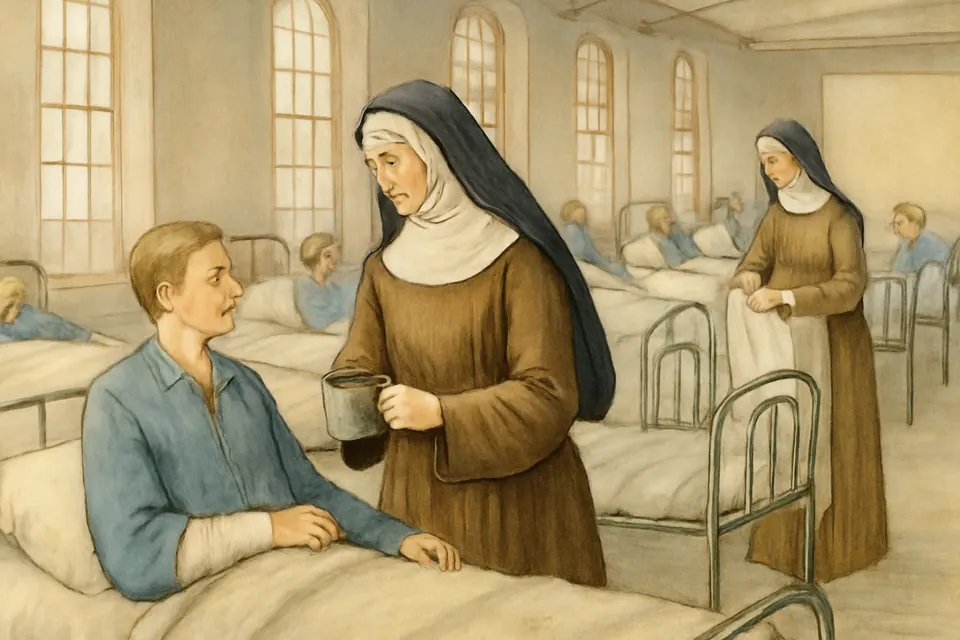
In 1858 Sarah Peter, a convert from Cincinnati, asked for sisters to come to America. Six sisters sailed on August 24, 1858, and opened a hospital in Cincinnati that same year. More followed: Covington, Kentucky, in 1860; Columbus, Ohio, in 1862; Hoboken, New Jersey, in 1863; and soon Jersey City, Brooklyn and New York City.
Mother Frances crossed the Atlantic in 1863 and helped her sisters nurse soldiers wounded in the Civil War. She came again in 1868. In Germany she encouraged Philip Hoever as he founded the Brothers of the Poor of St. Francis.
Death and beatification
Mother Frances died in Aachen on December 14, 1876. About 2,500 sisters belonged to her congregation by then. Paul VI beatified her on April 28, 1974, praising her steady will to do what God asked as the leading trait of her holiness, and the life of prayer she kept up in the middle of her work for the poor. He set her in her time: nineteenth-century Germany, where rapid industrial change left many people in poverty, and where she lived the Franciscan ideal of poverty as a witness to the Gospel. For her beatification the Church recognized an approved miracle, as it does for every non-martyr; we have not found its details in a source we could check, so we do not describe it here.
Symbols of Blessed Frances in art
She lived in the first age of photography, so pictures of her follow her real likeness: a calm, oval face framed by a white wimple and black veil.
- Franciscan habit and cord: the brown habit and knotted cord of the Franciscan family she joined in 1844.
- Crucifix: for her love of Christ crucified, whom she saw in the suffering poor.
- Rosary: for the prayer that ran through her days of work.
- Bowl of soup: for the soup kitchens of Aachen where her work began.
Feast day and where she is honored
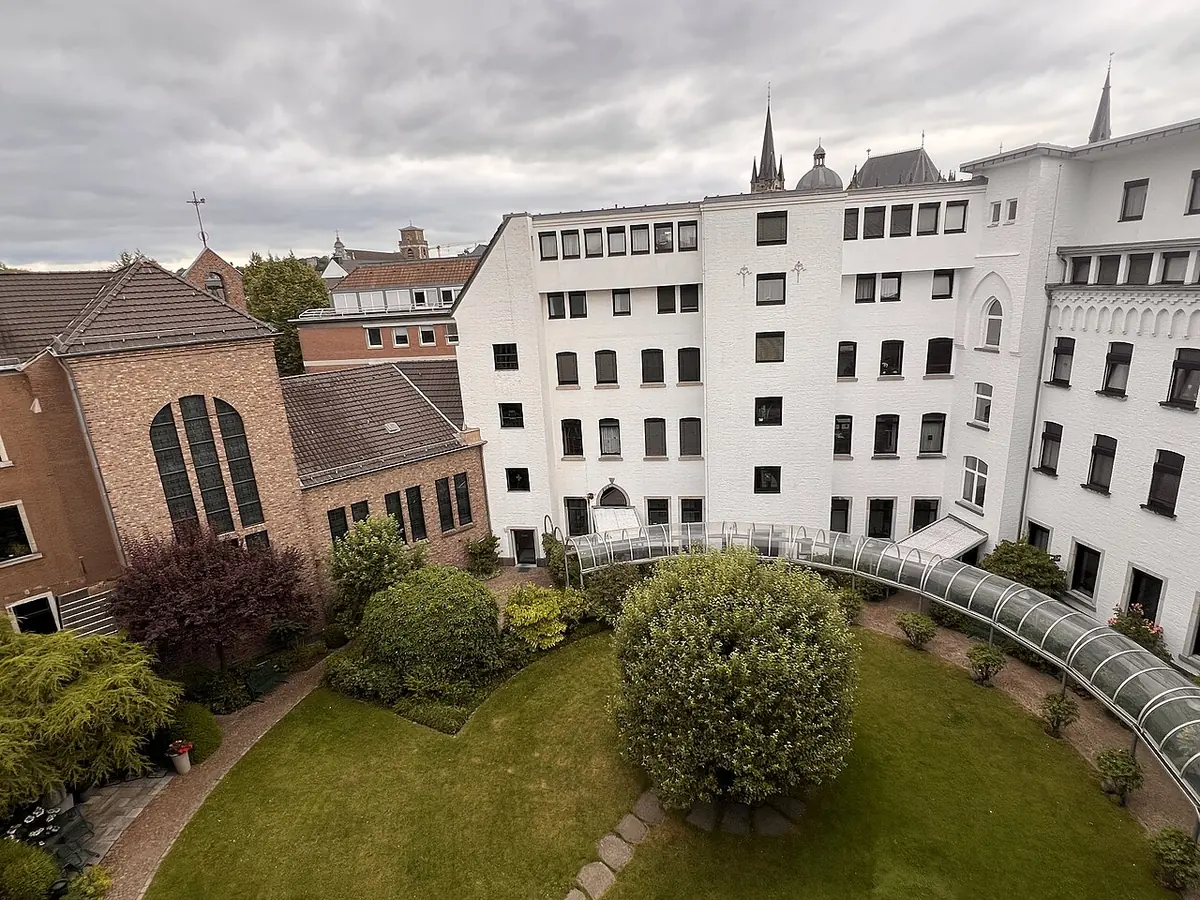
We keep her feast on December 14, the day of her death. Her tomb is in the convent church of the motherhouse of the Poor Sisters of St. Francis in Aachen, near the cathedral, and her sisters still welcome guests there. In America, the Franciscan Sisters of the Poor carry on her work. See more on our feast days page.
Praying with Blessed Frances
We have not found an official English prayer to Blessed Frances Schervier, so we do not print one. Let us ask her to pray for the poor and the homeless, for nurses and hospital workers, for prisoners, and for all who serve Christ in the suffering.
Frequently asked questions
Who was Blessed Mary Frances Schervier?
A German laywoman from a prosperous Aachen family who became a Franciscan tertiary and, in 1845, founded the Poor Sisters of St. Francis to care for the poor and the sick. The people of Aachen called her the 'Mother of the Poor.'
When is the feast of Blessed Mary Frances Schervier?
December 14, the day she died in Aachen in 1876. Some American sources list her on December 15.
What congregation did Frances Schervier found?
The Poor Sisters of St. Francis (Armen-Schwestern vom heiligen Franziskus) in Aachen. Their American branch, today's Franciscan Sisters of the Poor, began with six sisters sent to Cincinnati in 1858.
Where is Blessed Frances Schervier buried?
In the convent church of her congregation's motherhouse in Aachen, Germany, near the cathedral.
Keep exploring
Sources
- Paul VI, Homily at the beatification of Franziska Schervier, 28 April 1974 (German), Vatican. 'Mother of the Poor' and the pope's description of her holiness; quotations translated on this page
- Ordensgründerin, Armen-Schwestern vom heiligen Franziskus (Aachen). Her works for workers, prisoners and the condemned, the Pentecost 1845 founding, her words on the poor, and her grave in the motherhouse church
- Sisters of the Poor of St. Francis, Catholic Encyclopedia (1912). The 1850 constitutions, the clothing of August 12, 1851, Sarah Peter and the six sisters who sailed for Cincinnati on August 24, 1858, and the American hospitals
- Blessed Mary Frances Schervier, Franciscan Media. Her hope of becoming a Trappistine, her Civil War nursing in 1863, Philip Hoever, and about 2,500 sisters at her death