St. Constantine the Jew (Constantine of Synnada)
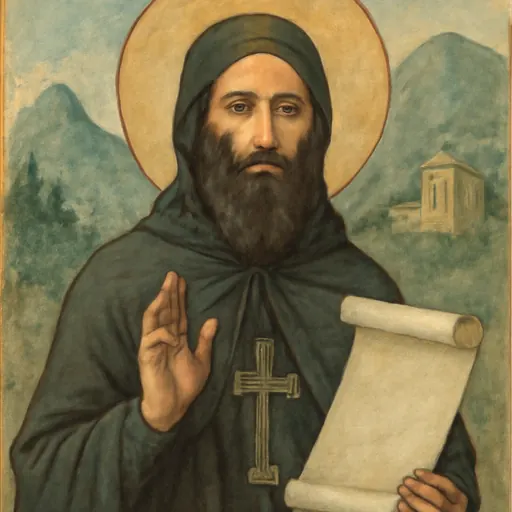
St. Constantine the Jew, also called St. Constantine of Synnada (about 850–after 886), was a Byzantine monk born to a Jewish family in Synnada in Phrygia. Drawn to Christ as a boy, he became a monk near Nicaea, was baptized and ordained a priest, and lived as an ascetic on Mount Olympus in Bithynia. The Orthodox Church keeps his feast on December 26.
Who was St. Constantine the Jew?
St. Constantine the Jew, also known as St. Constantine of Synnada, was a Byzantine monk of the ninth century, born to a Jewish family in the city of Synnada in Phrygia, in central Anatolia, in what is now Turkey. The Greek Church calls him Constantine "who was from the Jews," a name that remembers where his road began. The Catholic Encyclopedia notes that the Greek Church honors him on December 26, and the Orthodox Church keeps his feast on that day as the Venerable Constantine of Synnada.
He was born about 850. As a boy he was a gifted student of Hebrew and the Scriptures of Israel.
Where his story comes from
Almost everything we know about him comes from one Greek Life, written by an unnamed monk of Nicaea early in the tenth century, during the reign of Emperor Leo VI. It survives in a single manuscript and was printed by the Bollandists in the Acta Sanctorum. The author never met Constantine and drew on what was told about him, so we read its wonders as traditional, while its outline (Synnada, Nicaea, Mount Olympus, the court of Basil I) fits what is known of the Byzantine world of his day. The shorter Synaxarion entry read in Orthodox churches on December 26 follows the same Life.
His life
A boy and the sign of the cross
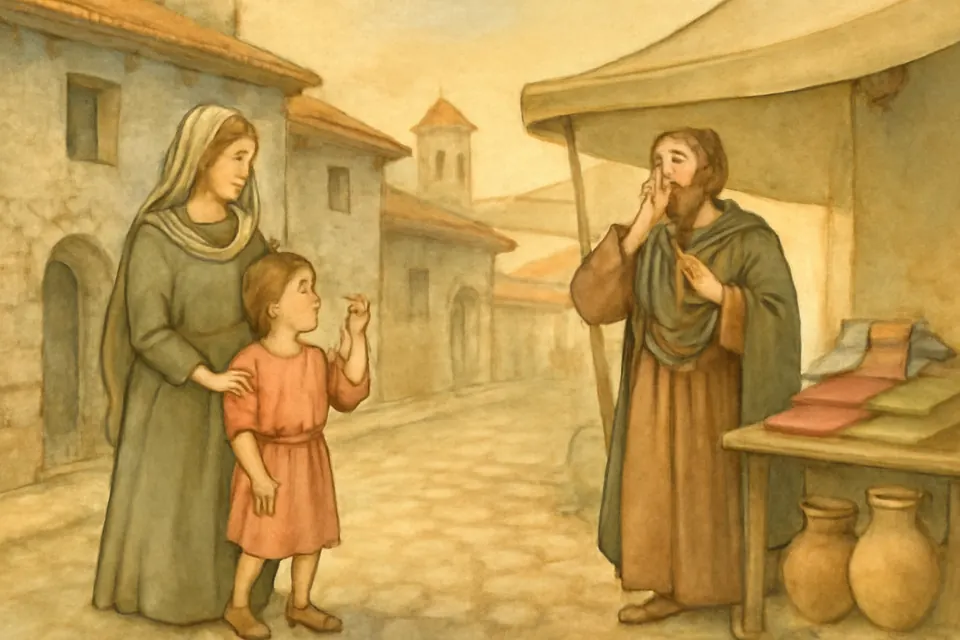
The Synaxarion tells that one day, walking with his mother, the boy saw a Christian yawn and make the sign of the cross over his mouth, as Byzantine Christians did. He began to do the same, and the simple gesture opened his heart. He learned what Christians believe, fasted for days at a time, and, the Life says, his face shone. His full turning to Christ took time.
His family arranged a marriage for him. On the day of the wedding, the Life says, he left home and went to the monastery of Phlouboute near Nicaea, led there by a cloud. There at last he was baptized. He took the name Constantine in honor of the first Christian emperor, who had also come to faith through a sign of the cross.
Twelve years at Phlouboute
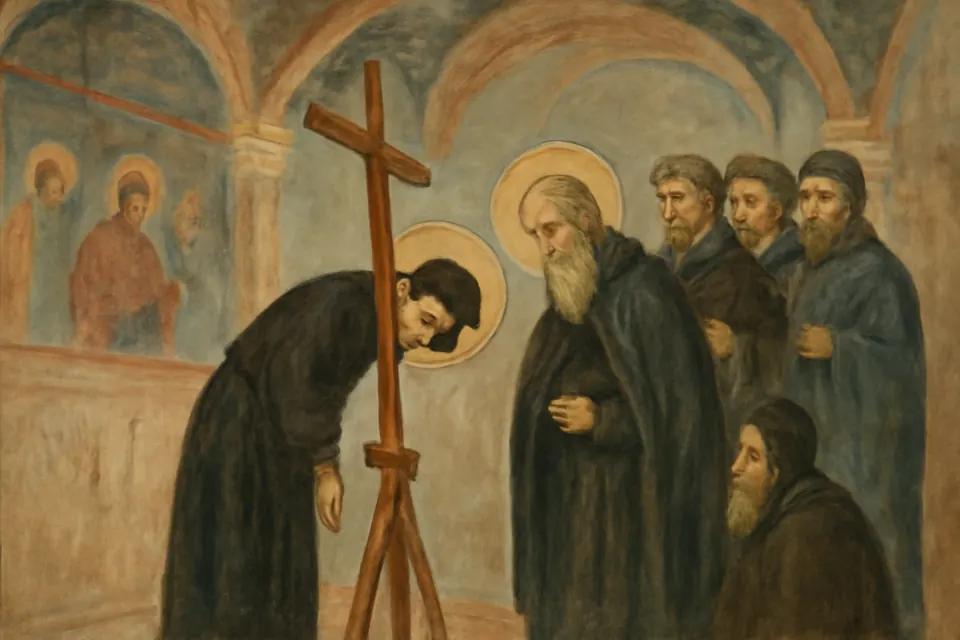
Constantine stayed at Phlouboute about twelve years. When the abbot told him to kiss the foot of a cross, the Life says, the whole cross bowed and rested on his head, leaving a mark in its shape that stayed with him until he died. The OCA's life keeps the same memory: "he was marked by its image for the rest of his life." He worked with his hands, making leather goods and tents like St. Paul, and the brothers came to him for counsel, for he seemed to read their hearts.
He was ordained a priest, against his own wishes, and worked to bring the Jews of the Nicaea region to Christ. That work met strong opposition, and his own relatives tried to have him arrested and brought home as a runaway. He left for the monastic mountain of Bithynian Olympus.
Wanderer and hermit
Constantine traveled widely. The Synaxarion takes him to Mount Olympus, to Myra in Lycia, the city of St. Nicholas, to Attaleia, and to Cyprus, where, the Life says, St. Spyridon had sent him in a vision. There he obtained relics of a martyr named Palamon and brought them back to a monastery in Nicaea. Back on Olympus, he once kept a fast of forty days standing in a pit up to his waist. He finally settled in the monasteries of Atroa and later Balaios.
Between 883 and 886, it is said, he went to Constantinople and met Emperor Basil I, and tried to reconcile the emperor with his son Leo, the future Leo VI, who had been accused of plotting against his father.
He foretold his death years in advance, and he died peacefully on December 26, some time after 886.

The miracles of St. Constantine
The Life gives him many wonders, all traditional:
- The cross on his head: the mark left when the cross bowed to him at Phlouboute.
- Footprints in stone: after his baptism, his footprints remained on the marble slab where he stepped out of the font.
- A woman raised: when a young woman tried to seduce him, she fell lifeless at his sign of the cross, and he raised her up again.
- A river crossed: near Attaleia, he walked across a deep, wide river.
- Fragrance and open doors: the place where he prayed was filled with fragrance, and church doors opened at his word.
Symbols of St. Constantine in art
Images of him are rare. In Orthodox calendar icons he is shown as:
- A monk in a black habit and schema: his life as a Byzantine ascetic.
- A cross: the sign that first drew him to Christ, sometimes shown marked on his forehead.
- A scroll: the Scriptures he loved from childhood.
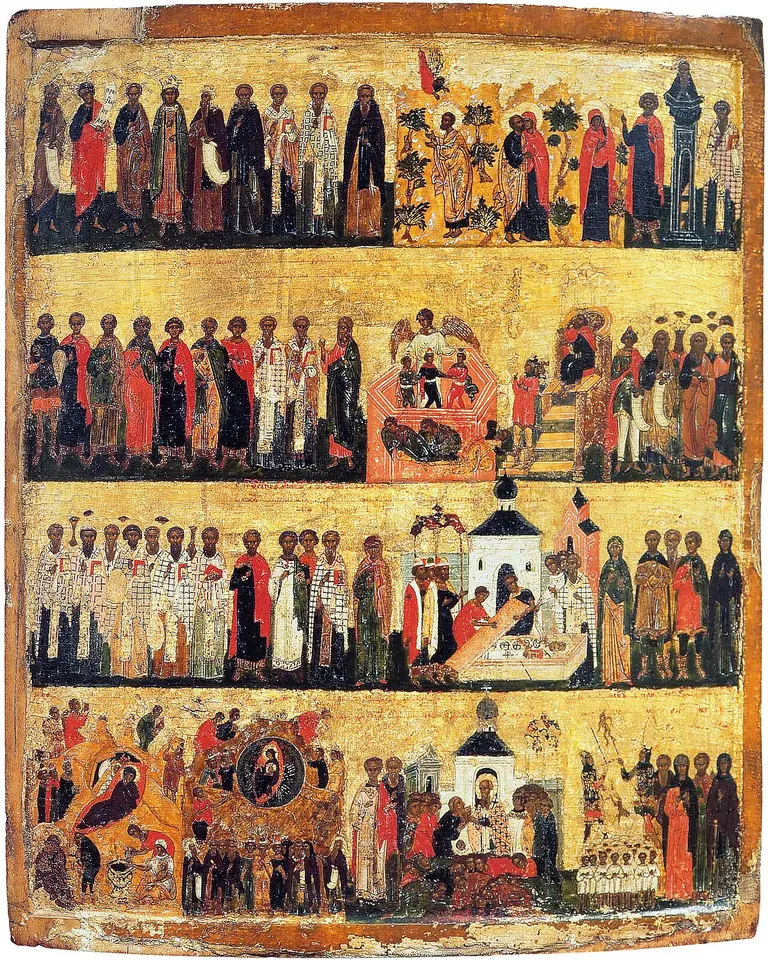
Look for him among the saints of December 26 in Greek and Russian calendar icons and illuminated menologia.
Feast day and prayer
The Orthodox Church keeps his memory on December 26, the second day of Christmas. Around 1200, Archbishop Anthony of Novgorod recorded a church dedicated to him in the Jewish quarter of Constantinople. See the feast day calendar.
The Orthodox Church sings an apolytikion in the fourth tone in his honor, praising the holy father whose tears made the desert fruitful. There is no traditional prayer to him in English. Let us ask his help in our own words: Holy Father Constantine, who loved the Scriptures from your childhood and followed the sign of the cross to Christ, pray for us, that we may never be ashamed of the cross and may seek God with our whole heart.
Frequently asked questions
Who was St. Constantine the Jew?
A ninth-century Byzantine monk born to a Jewish family at Synnada in Phrygia, a scholar of the Hebrew Scriptures as a boy. He came to faith in Christ, took the baptismal name Constantine, lived twelve years in the monastery of Phlouboute near Nicaea, became a priest, and spent his later life as a monk on Mount Olympus in Bithynia. The Greek Church calls him "the former Jew" to honor his journey.
When is the feast of St. Constantine of Synnada?
December 26, the day of his death, in the Orthodox calendar and the Greek Synaxarion.
Why is he called Constantine the Jew?
The Byzantine Synaxarion names him Constantine "who was from the Jews" (ho ex Ioudaion), because he was born and raised in a Jewish family before his baptism. It is a title of origin, not of reproach; he is also known simply as Constantine of Synnada.
Where does his story come from?
From an anonymous Greek Life written in the early tenth century, during the reign of Emperor Leo VI, which survives in a single manuscript and was printed in the Acta Sanctorum. Its author did not know him personally and drew on oral tradition, so many of its wonders are best read as traditional.
Keep exploring
Sources
- Orthodox Church in America: Venerable Constantine of Synnada (December 26). His Jewish family at Synnada, his monastic life, the cross that marked his head, his peaceful death, the December 26 feast
- Catholic Encyclopedia (1912): Synnada. St. Constantine, a converted Jew of Synnada, honored by the Greek Church on December 26
- Synaxarion of St. Constantine the Former Jew (December 26), trans. John Sanidopoulos. The Synaxarion account (sign of the cross, Phlouboute, baptism, travels to Olympus, Myra, Cyprus and Attaleia, ordination, Atroa) and the meeting with Basil I between 883 and 886
- Vita S. Constantini ex Iudaeis (BHG 370), Acta Sanctorum, November, vol. 4 (Brussels, 1925), pp. 628–656. The anonymous tenth-century Greek Life, the main source for all later accounts (not consulted directly)
- Wikipedia: Constantine the Jew. Only source found for the church dedicated to him in Constantinople, recorded by Archbishop Anthony of Novgorod about 1200