St. Richard of Chichester

St. Richard of Chichester (about 1197–1253), also called Richard de Wyche, was a farmer's son from Droitwich who became chancellor of Oxford University, the friend of St. Edmund of Canterbury, and from 1245 the bishop of Chichester, where he lived poorly and gave his income to the poor. He is the patron saint of Sussex. His feast day is April 3.
Who was St. Richard of Chichester?
Richard of Chichester was an English bishop of the thirteenth century who never forgot that he had grown up working the land. Born about 1197 at Droitwich in Worcestershire, the second son of Richard and Alice de Wyche, he became a scholar at Oxford, Paris and Bologna, chancellor of the University of Oxford, the right hand of St. Edmund of Canterbury, and finally bishop of Chichester from 1245 until his death in 1253. Pope Urban IV canonized him in 1262, only nine years after he died. We keep his feast on April 3, and Sussex honors him as its patron.
The farmer and the scholar
His father died while Richard was young, and the family estate fell into ruin. The Catholic Encyclopedia, drawing on the medieval lives, says his elder brother offered to hand the inheritance over to him. Richard refused, though he took on the work of the farm and brought it back into good order. Then he went to Oxford, where he and two friends were so poor that they owned one tunic and one hooded gown among them and took turns going to lectures.
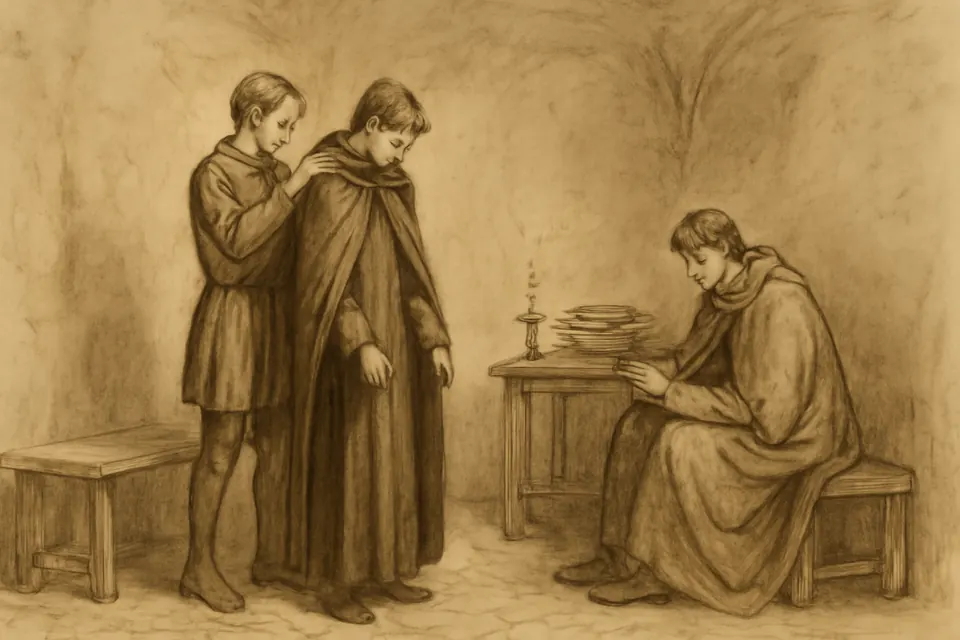
After Oxford he studied in Paris and then canon law at Bologna, and he came home with such a reputation that he was elected chancellor of Oxford University. Two of the greatest churchmen in England, Archbishop Edmund Rich of Canterbury and Bishop Robert Grosseteste of Lincoln, both asked him to be their diocesan chancellor. He chose Edmund.
With St. Edmund in exile
Richard became Edmund's closest friend and follower. He backed the archbishop when he opposed King Henry III over vacant bishoprics, went with him into exile at Pontigny, and was with him when he died at Soisy in 1240. Later he gave material to the chronicler Matthew Paris for Edmund's life. After Edmund's death Richard went to the Dominican house at Orléans to study theology and was ordained a priest. Back in England he served as vicar of Deal and rector of Charing before the new archbishop, Boniface of Savoy, made him chancellor again.
A bishop without a house
In 1244 the chapter of Chichester elected Richard bishop, after Archbishop Boniface had quashed the election of Robert Passelewe, a royal favorite. King Henry III was furious and refused to hand over the lands and income of the diocese. Richard took his case to Pope Innocent IV, who consecrated him himself at Lyons on March 5, 1245, and sent him home.
The king still would not give way. So for about two years the bishop of Chichester had no palace and no income in his own diocese. He lived on the charity of his clergy, and one of them, Simon of Tarring, shared with him the little he had. Only in 1246, under threat from the pope, did Henry release the temporalities.

Bishop of Chichester
Once he had his revenues, he gave most of them away. He lived austerely, wrote detailed statutes on the lives of the clergy, the celebration of Mass and the sacraments, and required every priest to own a copy and bring it to the diocesan synod. He started a yearly collection in every parish for the upkeep of his cathedral and gave special encouragement to the friars, above all the Dominicans.
In 1250 he was named a collector for the crusade, and in 1252 the king appointed him to preach it. On his way to Dover to consecrate a new church in honor of his friend St. Edmund, he fell ill. He consecrated the church on April 2, 1253, and died the next morning at the hospital called the Maison Dieu. His body was carried back to Chichester and buried in the cathedral.
Miracles and canonization
Chichester Cathedral remembers that Pope Urban IV canonized Richard in 1262 "for his holy works and miracles." The miracles reported at his tomb were gathered in the life written by his confessor, the Dominican Ralph Bocking, soon after the canonization. We count those healings as reported: they were accepted in the thirteenth-century cause, but no detailed record of their examination survives in the sources we used.
On June 16, 1276, Archbishop Robert Kilwardby translated his body to a new shrine behind the high altar in the presence of King Edward I. Pilgrims came for more than two centuries, until the shrine was rifled and destroyed in 1538.
Why St. Richard is the patron saint of Sussex
He was Sussex's own bishop, and his shrine made Chichester a place of pilgrimage. The cathedral today calls him the patron saint of Sussex, and the anniversary of his translation, June 16, is kept as Sussex Day.

Symbols of St. Richard of Chichester in art
St. Richard is shown as a bishop, in miter and cope or chasuble, holding a crozier for his pastoral charge and often a book for his learning and his diocesan statutes. His most distinctive attribute is a chalice, which usually stands at his feet or rests in his hand. It marks him as a priest devoted to the Holy Sacrifice of the Mass. Popular lives explain it with a story that he once dropped the chalice at the altar and not a drop was spilled; we have not found that story in the oldest sources, so we pass it on as later tradition.
Almost no medieval images of him survived the Reformation, so most of what we see comes from Victorian and twentieth-century stained glass in English churches, like the Kempe studio window at Whyke. In a Sussex church, a bishop with a chalice at his feet is very likely Richard.

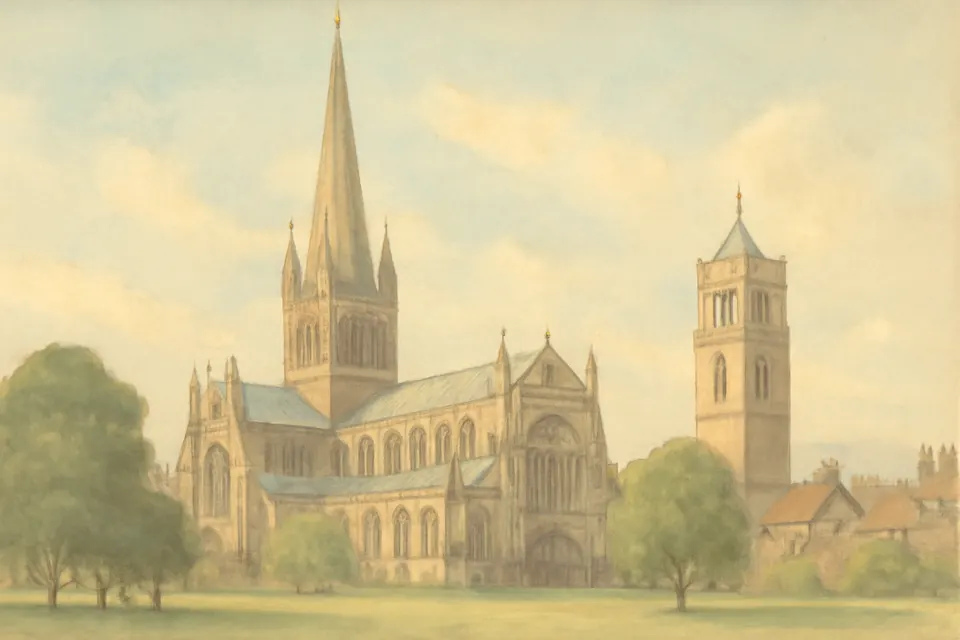
His shrine at Chichester Cathedral
The Catholic Encyclopedia notes that no relics of St. Richard are known to exist, and that the restored tomb in the south transept once claimed for him has no evidence behind it. Pilgrimage has come back all the same. Since the nineteenth century images of St. Richard have returned to the cathedral, and in 1930 an altar was set up again on the site of his shrine in the retroquire.
Prayer of St. Richard of Chichester
Richard's best-known words are the prayer he said on his deathbed, surrounded by his clergy. His confessor Ralph Bocking wrote it down in Latin, and it was later printed in the Acta Sanctorum. Catholic Culture gives it in this English translation:
Lord Jesus Christ, I thank Thee for all the blessings Thou hast given me, and for all the sufferings and shame Thou didst endure for me, on which account that pitiable cry of sorrow was Thine: "Behold and see, if there was any sorrow like unto My sorrow!" Thou knowest, Lord, how willing I should be to bear insult, and pain, and death for Thee; therefore have mercy on me, for to Thee do I commend my spirit. Amen
Many people know a shorter English prayer in his name, which asks to know Christ more clearly, love him more dearly and follow him more nearly, day by day. Catholic Culture notes that the hymn "Day by Day" is attributed to him.
St. Richard of Chichester, faithful bishop and friend of the poor, pray for us, and for all who serve the Church with little to call their own.
Frequently asked questions
When is the feast of St. Richard of Chichester?
April 3, the day he died at Dover in 1253. Sussex also keeps June 16, the anniversary of the translation of his relics to his shrine in 1276; it is celebrated today as Sussex Day.
What is the prayer of St. Richard of Chichester?
His confessor, the Dominican Ralph Bocking, recorded the prayer Richard said on his deathbed, beginning "Lord Jesus Christ, I thank Thee for all the blessings Thou hast given me." A shorter English prayer in his name asks to know Christ more clearly, love him more dearly and follow him more nearly, day by day; the hymn "Day by Day" is attributed to him.
Why is St. Richard of Chichester shown with a chalice?
The chalice marks him as a priest and bishop devoted to the Mass. Popular lives add a story that he once dropped the chalice at the altar without spilling the Precious Blood, but we have not found it in the earliest life.
Where is St. Richard of Chichester buried?
He was buried in Chichester Cathedral and moved to a shrine behind the high altar in 1276. That shrine was destroyed in 1538 and no relics are known to survive. An altar was restored at the shrine site in 1930.