St. Maria Crescentia Höss

St. Maria Crescentia Höss (1682–1744) was a weaver's daughter from Kaufbeuren in Bavaria who entered the town's Franciscan convent without a dowry, was scorned there for years, and became its novice mistress, its abbess and a counselor sought by bishops and princes. Pope John Paul II canonized her in 2001. We keep her feast on April 5.
Who was St. Maria Crescentia Höss?
St. Maria Crescentia Höss was a Franciscan sister of Kaufbeuren, a small town in the Bavarian Swabia of southern Germany. She came from a poor weaver's house, was taken into the convent almost against its will, and spent years as the sister nobody wanted. She ended her life as its abbess, revered by the whole region, and visited by abbots, bishops and a prince-elector who wanted her advice.
Her life has little drama in the usual sense. She never left her town. What makes her a saint is the way she carried an ordinary cross for a long time without bitterness, and how she then led others with the same patience.
We keep her feast on April 5, the day she died in 1744.
A weaver's daughter of Kaufbeuren
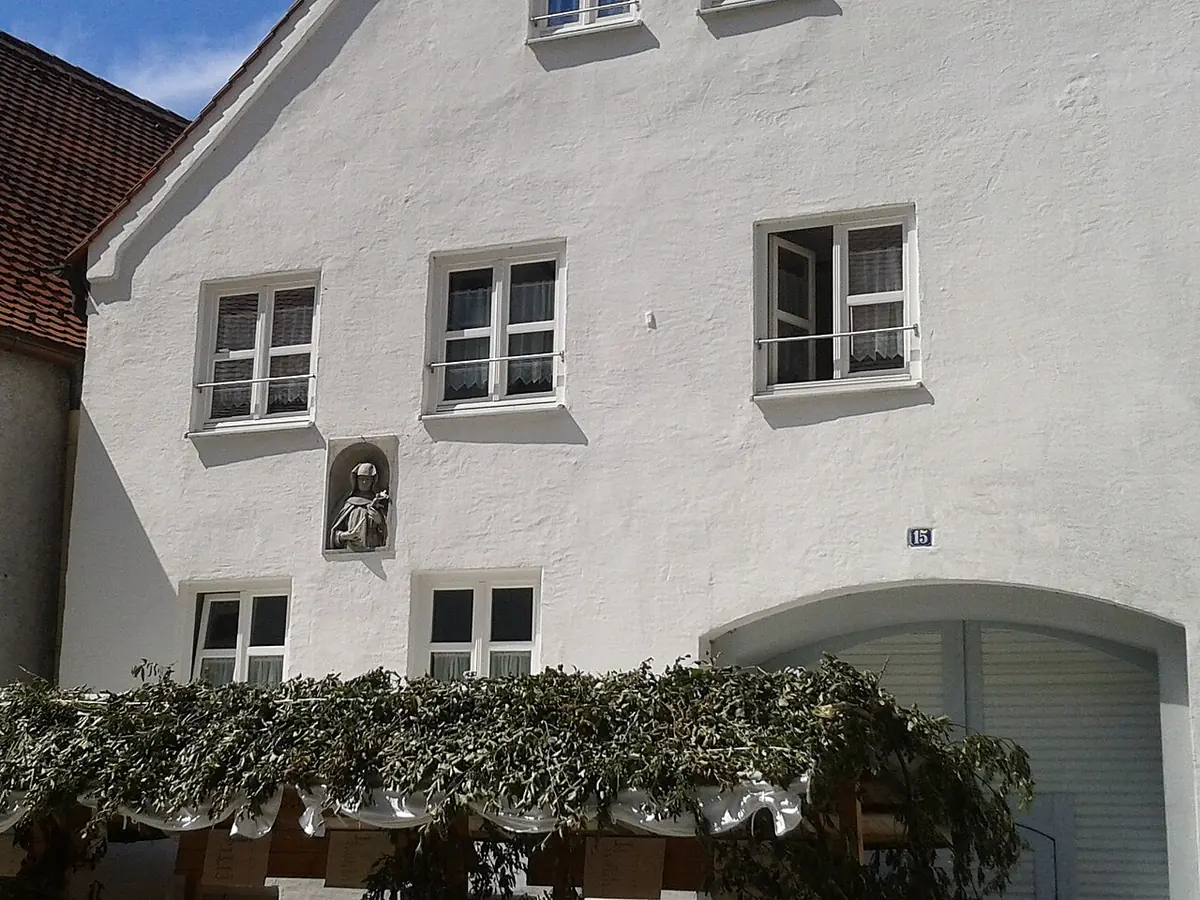
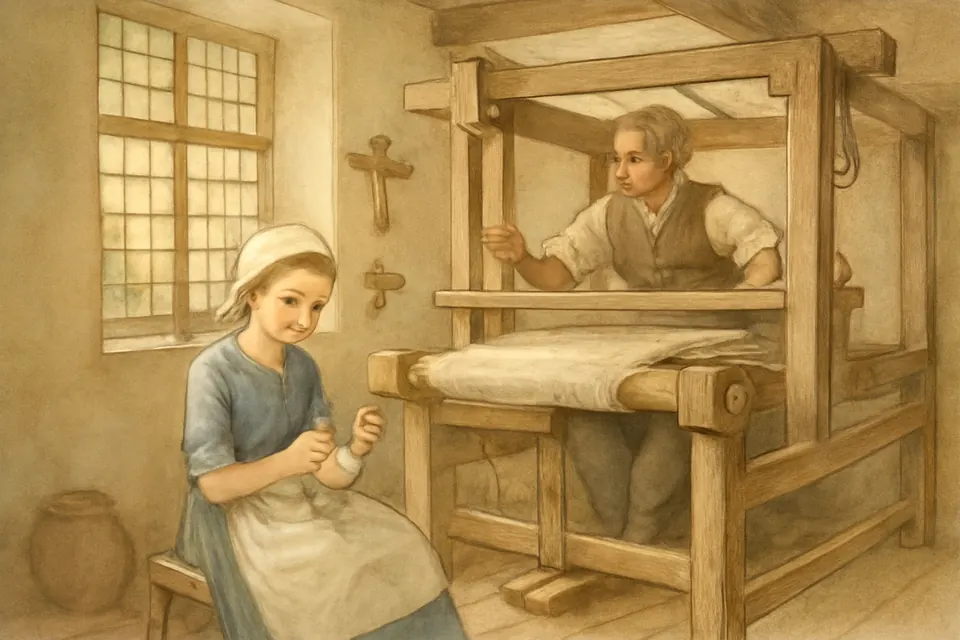
Anna Höss was born on October 20, 1682, in the house at Neue Gasse 15 in Kaufbeuren, one of eight children of the weaver Mathias Höss and his wife Lucia. Five of the children died young. Her convent's own life of her calls her friendly, hard-working and gifted. The Vatican biography adds that she had a beautiful voice. Pope John Paul II, at her canonization, said that as a young girl she could already sing a solo part, "not to display herself but to sing and to play for Christ the King."
From childhood she wanted to give her life to God in the Franciscan convent of her town. Her family had no money for a dowry, and that nearly closed the door.
The sister nobody wanted
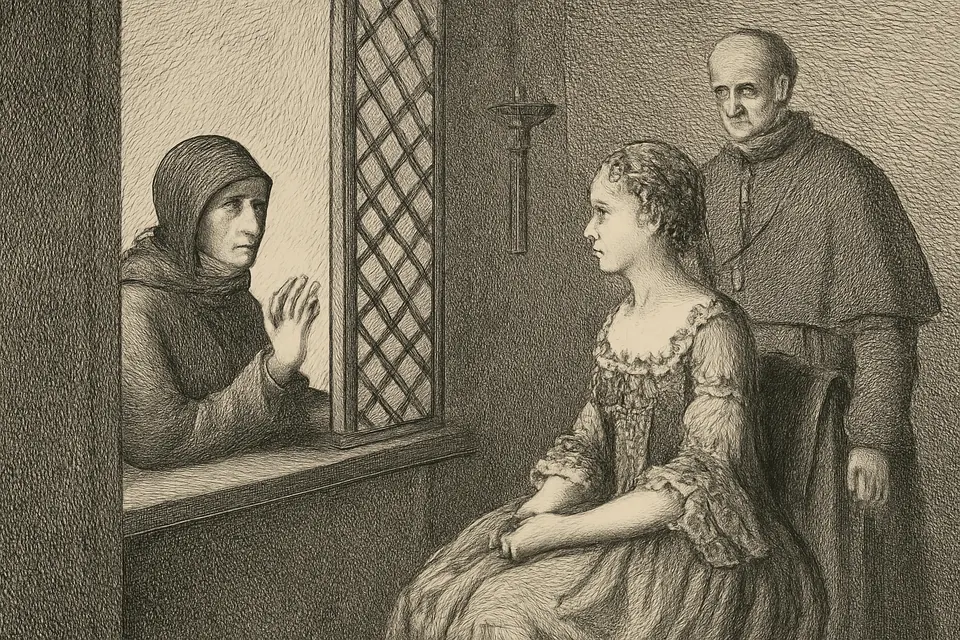
She was admitted in June 1703 and took the name Maria Crescentia, "the growing one." The prioress of the day treated her as a parasite because she had brought no dowry, and the convent's account says she was badly bullied. She professed her vows on June 18, 1704. She was given the kitchen and the loom, and from about 1710 she kept the convent gate and nursed the sick sisters.
John Paul II used a modern word for what she endured. "'Mobbing' took place in her time," he said. "She endured the intrigues of her own community, without ever doubting her own vocation." Her inner life drew further suspicion. She had visions and intuitions, and the convent records that at times she was even suspected of witchcraft and made to undergo humiliating tests of her obedience. Nothing was ever proven against her.
The long suffering, the Pope said, "allowed her to grow in the virtue of patience."
Novice mistress, counselor and abbess
Times changed in the convent, and so did her place in it. She became novice mistress in 1717, by her convent's account, and formed the young sisters for many years. In 1728 a Munich painter, working from her description, painted a vision of the Holy Spirit she had received.
People outside the walls began to come. In 1722 Prince-Abbot Rupert of Kempten asked her advice. In 1731 the Electress Amalia of Bavaria visited her, and later Clemens August, Elector of Cologne. They found her understanding but demanding, and they kept writing to her. John Paul II described the stream of visitors, "both simple men and women, princes and empresses, priests and religious, abbots and bishops," and said she became a kind of "midwife" who helped people "bring forth the truth in their hearts."
In June 1741 the sisters elected her abbess unanimously. She tried to refuse, then accepted. In three years she renewed the house so thoroughly that the Vatican biography calls her its second foundress. She pressed for silence, recollection and the reading of the Gospels, with Christ on the Cross as the teacher of religious life, and she wanted the convent, in her own phrase, "rich in virtue, not in temporal goods." The Pope summed up her rule: "She was generous with the poor, motherly with her sisters, and kind to all who needed a kind word."
She died after a long and painful illness on April 5, 1744. It was Easter Sunday.
Beatification and canonization
Her grave drew pilgrims at once. The beatification process opened in 1775 but stalled for more than a century through the secularization of Bavaria's convents and the wars that followed. Pope Leo XIII beatified her on October 7, 1900. The sources we could open do not describe the approved miracles examined in her cause, so we do not name them here. The favors that pilgrims still write of in the convent's intercession book are reported graces, precious to those who received them but not formally investigated. Pope John Paul II canonized her in St. Peter's Square on November 25, 2001, the Solemnity of Christ the King, with St. Joseph Marello, St. Paula Montal and St. Léonie Aviat. "Give glory to Christ the King," he said: "this wish inspired St Maria Crescenzia Höss from her childhood."
Symbols of St. Maria Crescentia Höss in art
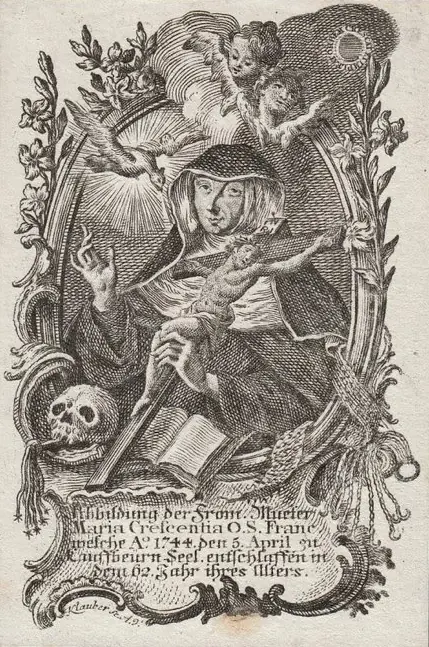
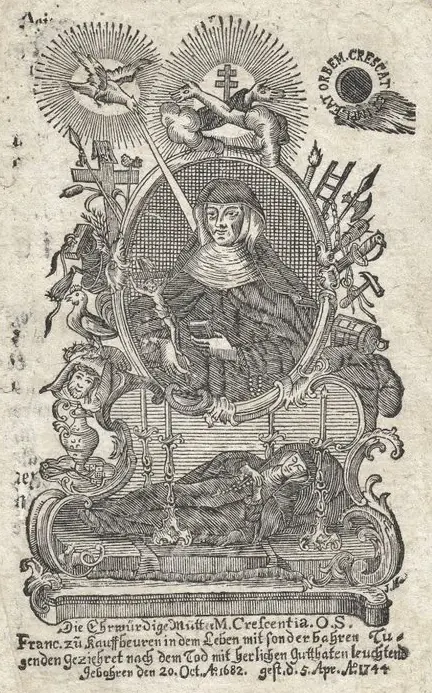
The old devotional prints of Kaufbeuren, made within a few decades of her death, fixed the way she is shown:
- Franciscan habit and white wimple: the dress of the Franciscan sisters of Kaufbeuren, who followed the Third Order Rule of St. Francis.
- Crucifix held to the heart: the crucified Christ she called the teacher of religious life.
- Dove in rays of light: the Holy Spirit, recalling her visions and the painting of 1728.
- Skull and book: the old signs of meditation on death and of prayer.
Bavarian churches often show her in carved figures and painted on glass, usually a thin, kind-faced nun with a crucifix. If you see a brown-habited sister with a dove above her in a church of Swabia or the Allgäu, it is most likely Crescentia.
Feast day, shrine and prayer
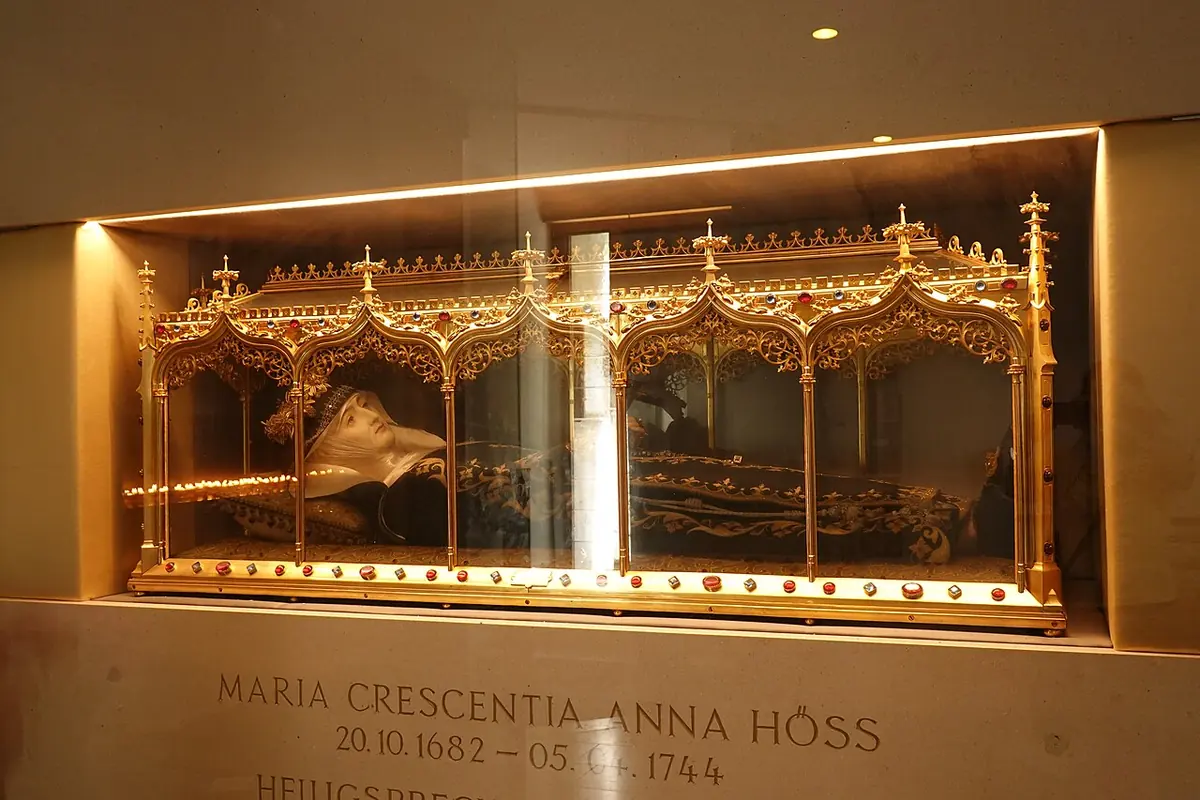
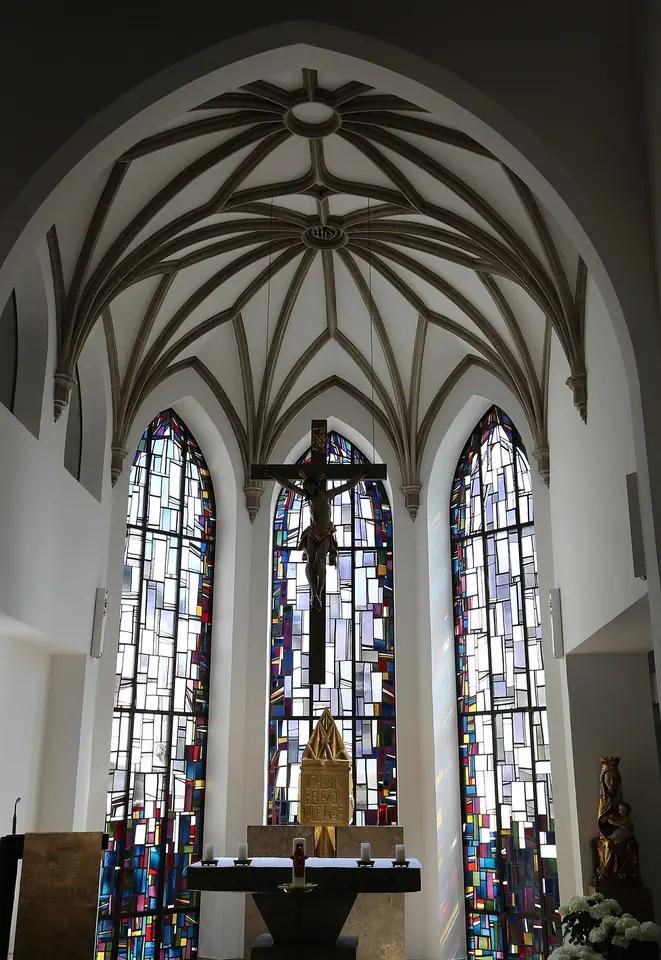
Her remains rest in a reliquary shrine in the church of her convent in Kaufbeuren, and the sisters still keep a book in which visitors write their petitions and thanks. A Crescentia pilgrimage trail also runs through the region.
We keep her feast on April 5. See the feast day calendar.
We found no traditional prayer to St. Crescentia whose text we could verify, so we do not print one. Let us ask her help simply: St. Maria Crescentia, you were mistreated in your own house and never let it make you hard; pray for all who are bullied at work or at home, for those who lead communities, and for everyone who comes to Christ with a heavy heart.
Frequently asked questions
Who was St. Maria Crescentia Höss?
Anna Höss was born in Kaufbeuren, Bavaria, in 1682, the daughter of a weaver. She entered the Franciscan convent of her town in 1703, took the name Maria Crescentia, and lived there until her death in 1744. Ill-treated for years by her own superiors, she later became novice mistress and abbess, and her letters and advice were sought from far beyond the convent walls.
When is the feast of St. Crescentia Höss?
April 5, the day she died in 1744, which was Easter Sunday that year.
When was St. Crescentia canonized?
Pope Leo XIII beatified her on October 7, 1900. Pope John Paul II canonized her in Rome on November 25, 2001, the Solemnity of Christ the King, together with St. Joseph Marello, St. Paula Montal and St. Léonie Aviat.
Where is St. Crescentia buried?
In the church of her own convent in Kaufbeuren, where her remains rest in a reliquary shrine. Pilgrims have come to her grave ever since 1744.
Keep exploring
Sources
- Crescentiakloster Kaufbeuren: Leben der heiligen Maria Crescentia Höß. Her birth house, the bullying over her missing dowry, the suspicion of witchcraft, the 1728 painting of her vision, her visitors, her election in 1741, the beatification of 1900
- Crescentiakloster Kaufbeuren: Die Klosterkirche. The reliquary shrine in the convent church
- Holy See: Maria Crescentia Höss (1682–1744), biography for the canonization. Her offices, her counsel to the sisters, and her saying that God wants the convent rich in virtue
- Pope John Paul II, homily at the canonization of four blesseds, November 25, 2001. The quotations from the canonization homily