Blessed Notker the Stammerer (Notker Balbulus) of St. Gall

Blessed Notker the Stammerer (Notker Balbulus, about 840–912) was a Benedictine monk of St. Gall, a teacher and poet who wrote some fifty sequences, the sung poems of the Mass before the Gospel. He is probably the "monk of St. Gall" who wrote anecdotes about Charlemagne. He was beatified in 1513, and his memory is kept on April 6.
Who was Blessed Notker the Stammerer?
Blessed Notker the Stammerer, called Notker Balbulus in Latin, was a Benedictine monk of the Abbey of St. Gall in Switzerland who gave the Church some of its earliest and most beautiful sung poetry. He spent almost his whole life inside one monastery, teaching boys, keeping the library, welcoming guests and writing. He stammered, and he was physically frail. Yet Ekkehard IV, the abbey's chronicler a century later, remembered him as "delicate of body but not of mind, stuttering of tongue but not of intellect, pushing boldly forward in things Divine, a vessel of the Holy Spirit without equal in his time."
He died at St. Gall on April 6, 912. He was beatified in 1513, and we keep his memory on that April day.
The life of Blessed Notker
A boy of St. Gall
Notker was born about 840 into a family settled near Jonschwil, not far from the abbey founded on the site where the Irish hermit St. Gall had built his cell. The Historisches Lexikon der Schweiz says he entered the monastery around 858. His teachers were Iso and an Irish monk named Moengal, whom the brethren called Marcellus. Among his classmates were Tuotilo, the composer of tropes, and Ratpert, and the three stayed friends for life.
He held several offices. The Catholic Encyclopedia records him as librarian in 890 and guest master in 892–94. Julian's Dictionary of Hymnology adds that he was never abbot and turned down offers of higher posts elsewhere. His true calling was the school. One of his pupils, Salomo, became abbot of St. Gall and bishop of Constance, and Notker compiled for him a book of model letters and a reading list of Christian authors.
The sequences
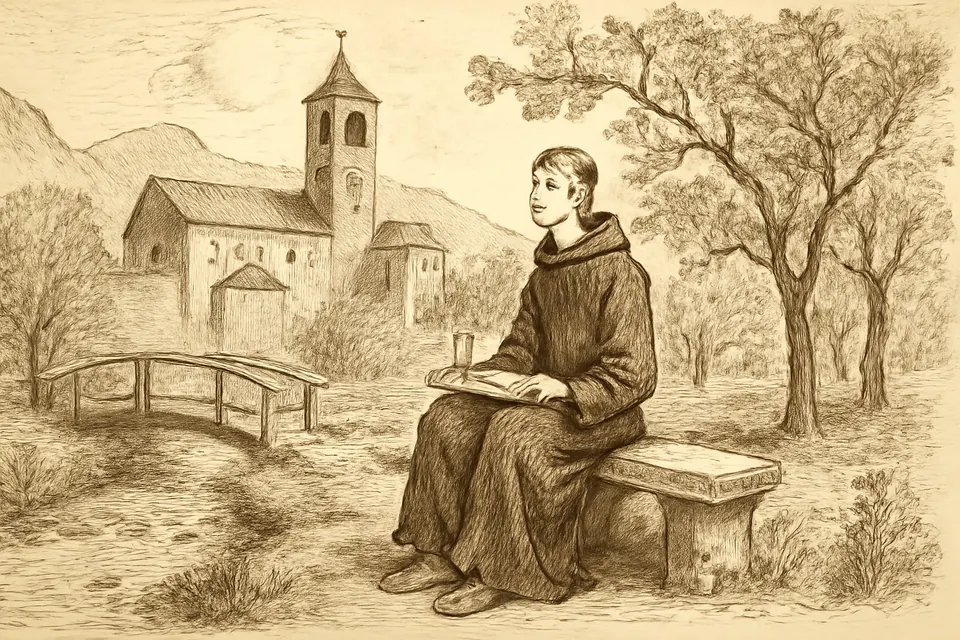
Notker's lasting gift to the Church came from the Mass. In his day, the last syllable of the Alleluia before the Gospel was drawn out over a long, wandering melody that singers struggled to remember. In the preface to his book of sequences, as Julian retells it, Notker says that as a young monk he could not keep these long melodies in his head. Then a priest arrived at St. Gall from the Abbey of Jumièges, which the Northmen had sacked, carrying an antiphonary in which words had been written under the notes. Notker tried the same thing with his own verses. His teacher Iso praised the attempt and gave him one rule: each note should carry a single syllable.
The result was the Liber Hymnorum, which Notker dedicated to Bishop Liutward of Vercelli between 881 and 887. Ekkehard IV credits him with fifty sequences, and the Historisches Lexikon der Schweiz judges that at least forty of those attributed to him are genuine. They follow the Church year, from Christmas through Easter and Pentecost to the feasts of the saints. His Pentecost sequence was sung across Europe for centuries.

One famous chant does not belong to him. The antiphon "Media vita in morte sumus" ("In the midst of life we are in death") was credited to Notker late in the Middle Ages, but the Catholic Encyclopedia calls that attribution an error.
The Deeds of Charlemagne
Notker was also a storyteller. The Emperor Charles the Fat visited St. Gall from December 4 to 6, 883, and Julian notes that he showed Notker special favor. The anonymous "monk of St. Gall" who wrote the Gesta Karoli Magni, a lively book of tales about Charlemagne for that emperor, is almost certainly Notker. It opens with two Irish scholars landing in Gaul among merchants and crying out to the crowds:
"Ho, everyone that desires wisdom, let him draw near and take it at our hands; for it is wisdom that we have for sale."
The book is full of such scenes: proud bishops humbled, poor boys rewarded for study, and an emperor who cared for the Church. Historians read it with caution, but it is a delight.
Other works
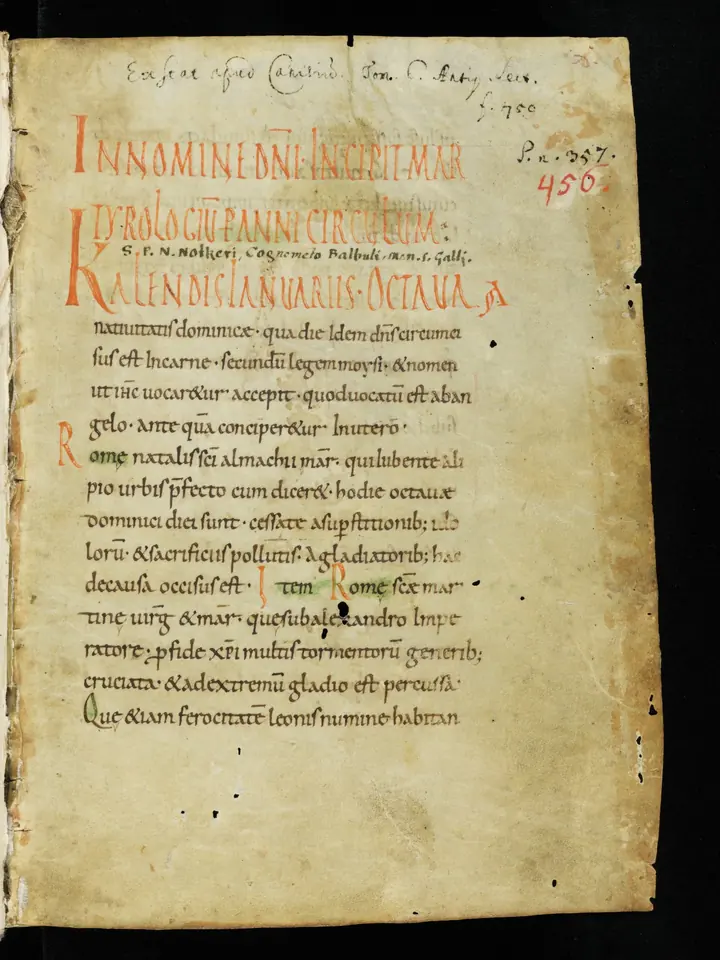
Notker put the life of St. Gall into verse with two younger brothers, wrote poems on St. Stephen, and compiled a long martyrology drawn from those of Rabanus Maurus and Ado of Vienne. He also explained in a letter how letters written above chant melodies told singers how to perform them.
Death and veneration
Notker died at St. Gall on April 6, 912. The brethren honored him as a holy man, and around 1215 an anonymous writer produced a Life of him, partly drawn from Ekkehard and partly, the Historisches Lexikon der Schweiz says, fanciful. It was written to support his canonization. That effort failed, but in 1513 he was beatified under Pope Julius II. The Catholic Encyclopedia gives the year as 1512.
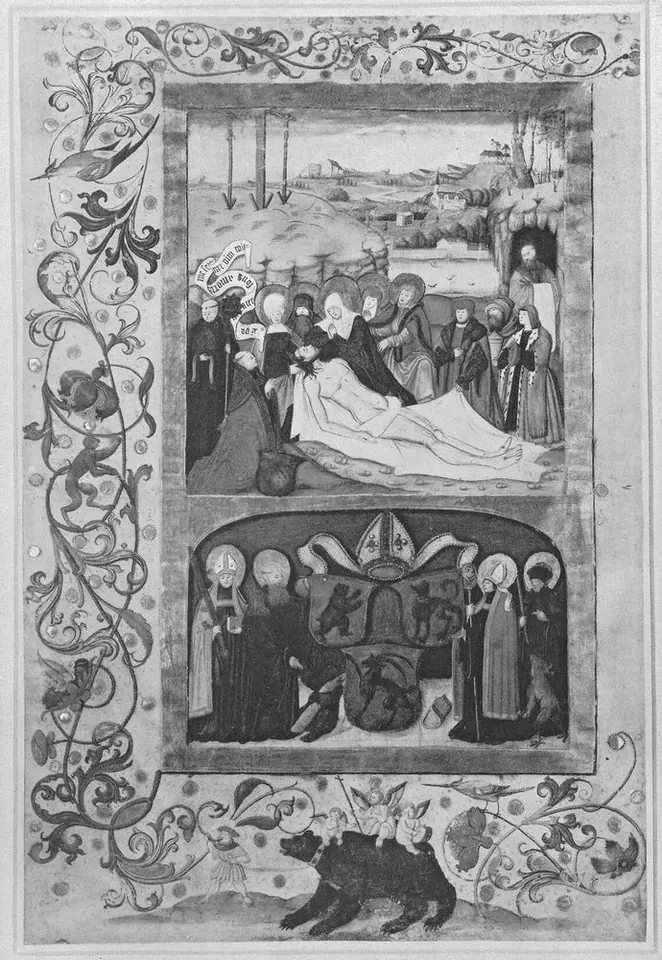
For the six hundredth anniversary of his death, the abbey commissioned a lavishly illuminated sequence book, and the painter Nikolaus Bertschi decorated it around 1510–1511.
We know of no miracles formally approved for Notker. His cult rests on his holy life and on the long, traditional veneration of the monks of St. Gall.
Symbols of Blessed Notker in art
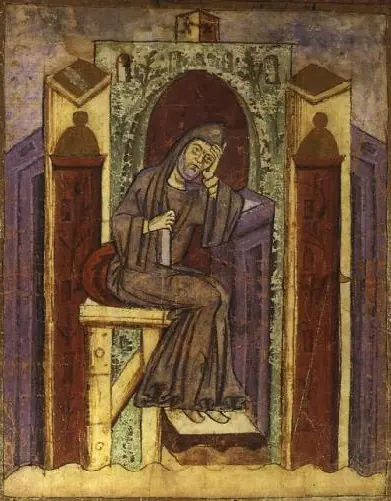
Notker is shown as a Benedictine monk in a black or brown habit and hood. He usually sits at a writing desk or holds a book or scroll, the signs of a teacher and author. A page of music or neumes points to his sequences. In the tenth-century miniature on this page he rests his head on his hand, a pose that fits the monk of his own preface, trying to hold a long melody in memory.
Feast day and prayer
We keep his memory on April 6. He is honored above all at St. Gall, where the abbey library still keeps manuscripts of his work. See the feast day calendar.
We know of no traditional prayer to Blessed Notker. The best way to honor him is to sing what he loved: the Alleluia before the Gospel, and the great sequences the Church still keeps at Easter and Pentecost. Let us ask him to pray for teachers, for church musicians, and for everyone who struggles to speak. Blessed Notker, pray for us.
Frequently asked questions
Who was Blessed Notker the Stammerer?
Notker Balbulus was a monk of the Abbey of St. Gall in what is now Switzerland, born about 840 and died in 912. He was a teacher, librarian and poet, best known for his Liber Hymnorum, a book of about fifty sequences for the feasts of the Church year. He is also usually identified as the anonymous monk of St. Gall who wrote the Deeds of Charlemagne.
Why was Notker called the Stammerer?
"Balbulus" means "the stammerer" in Latin. He had a speech impediment all his life. Ekkehard IV, the St. Gall chronicler, praised him as "stuttering of tongue but not of intellect."
What is a sequence, and did Notker invent it?
A sequence is a sung poem placed before the Gospel at Mass, after the Alleluia. Notker did not invent the form, but he brought it to German lands and gave it its classic early shape by setting one syllable of text to each note of the long Alleluia melodies. The famous "Media vita" was attributed to him in the late Middle Ages, but the Catholic Encyclopedia calls that attribution an error.
When is the feast of Blessed Notker?
April 6, the anniversary of his death at St. Gall in 912. He is not on the General Roman Calendar, and his cult has always been local to St. Gall.
Keep exploring
Sources
- Catholic Encyclopedia (1911): Notker. His teachers, offices, sequences, the dedication to Liutward, Ekkehard IV's praise, the false attribution of Media vita
- Historisches Lexikon der Schweiz: Notker der Stammler (Peter Stotz). Death on April 6, 912; the failed canonization attempt and beatification of 1513; about 40 authentic sequences; his other works
- John Julian, A Dictionary of Hymnology (1892): Notker, at Hymnary.org. The preface story of the Jumièges antiphonary and Iso's advice, Charles the Fat's visit in 883, the office allowed only at St. Gall
- Medieval Sourcebook: The Monk of Saint Gall, The Life of Charlemagne. The quotation from the Deeds of Charlemagne (A. J. Grant translation)