Blessed Didacus Joseph of Cádiz, Capuchin Preacher of Andalusia

Blessed Didacus Joseph of Cádiz (Diego José de Cádiz, 1743–1801) was a Spanish Capuchin friar who preached parish missions across Andalusia and much of Spain for thirty years, drawing crowds that filled town squares. He died in Ronda during an epidemic and was beatified by Pope Leo XIII in 1894. His feast is March 24.
Who was Blessed Didacus Joseph of Cádiz?
Blessed Didacus Joseph of Cádiz, known in Spain as Fray Diego José de Cádiz, was a Capuchin friar who spent thirty years preaching missions in the towns and cities of eighteenth-century Spain. He was a poor student who became the most sought-after preacher of his generation, and people called him the Apostle of Andalusia. He died in Ronda in 1801, and Pope Leo XIII beatified him in 1894.
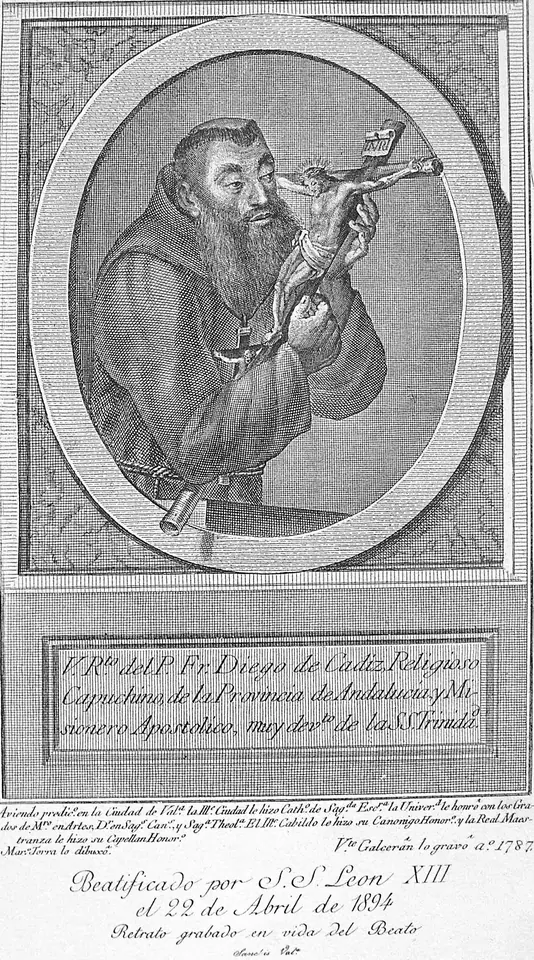
The life of Blessed Didacus Joseph
A boy who could not study
He was born in Cádiz on March 30, 1743, and baptized José Francisco López-Caamaño. His mother died when he was nine. He did badly at his studies; by his own admission, he could not read Spanish as a young man without boring himself and anyone listening.
At thirteen he walked into the Capuchin church at Ubrique while the friars were chanting the Divine Office, and something broke open in him. He later wrote that his soul "was filled with such a great joy" that he nearly came out of himself. The friars lent him a life of St. Fidelis and St. Joseph of Leonessa, both Capuchin missionaries, and then a life of the Capuchin preacher José de Carabantes. "This made my heart burst into flames," he wrote.
He received the habit in Seville in November 1757 and began the novitiate in 1758 under the name Diego José. "From that moment it was my ardent desire to be a Capuchin, a missionary and a saint." He was ordained a priest in 1766.
The missions
He began preaching at Ubrique in 1768 and never really stopped. A mission usually opened with a procession carrying the crucifix and an image of the Divina Pastora, Mary as the Divine Shepherdess, followed by days of sermons, catechism, the evening rosary, guided mental prayer and confession, and closed with a penitential procession. He said he had learned the method from St. Bernardine of Siena.

In 1773 he made peace in Estepona after fifteen years of feuding in the town. In 1778 he told the town council of Écija: "I am staggered at the very costly comedy theatre, while this town has no hospital for the sick, no hospice for orphans, no adequate barracks for the soldiers." That same year his spiritual director, the Minim friar Francisco Javier González, wrote to him: "Yes, God wants to use you, ignorantissimo." The University of Granada gave him degrees in arts, theology and canon law in 1779. He preached before the royal court in the early 1780s, crossed Spain to Barcelona and back on a long preaching journey begun in 1786, and in 1794 preached his way through Portugal, Galicia and Asturias.
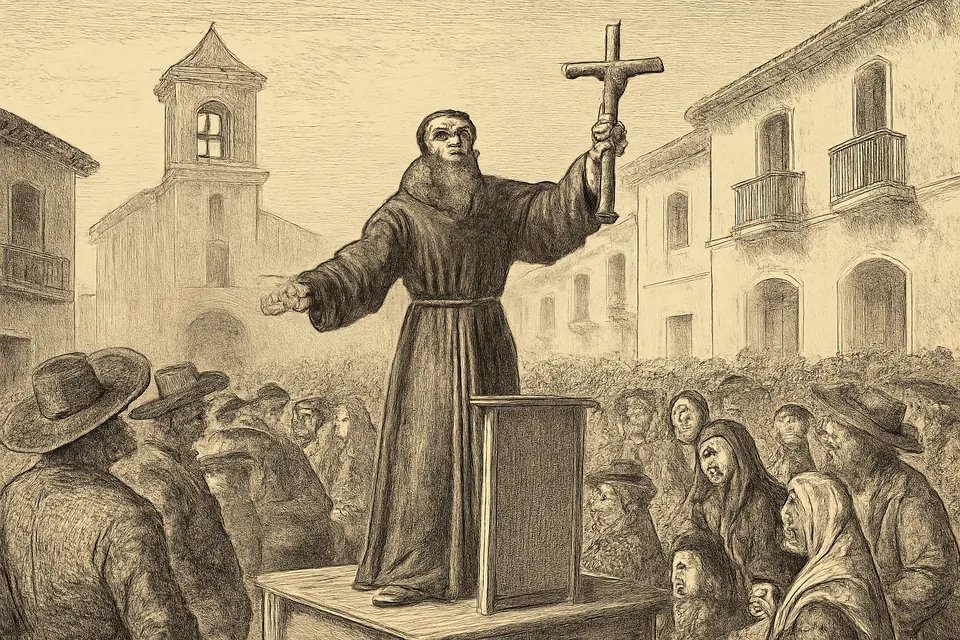
He was not always welcome. He attacked the theater, the fashionable ideas of the Enlightenment and the abuses of officials, and he defended the poor. After a Good Friday sermon in Seville Cathedral in 1784 he was sent away from the city for months, and later he spent time confined to the friary at Casares until 1792.
Death in Ronda
In 1800 an epidemic swept through Andalusia, and he worked among the sick. He spent his last months with a devout family in Ronda, where he had often rested between missions, and died there early on March 24, 1801, at fifty-seven.

Miracles and the cause for beatification
He had a reputation for holiness in his own lifetime. The Capuchins tell how, when he could not manage to write out a sermon, he gave it up to God and found the words came when he stood up to preach; this is a traditional account. Spanish tradition also holds that Our Lady appeared to him as a shepherdess and asked him to spread the devotion to the Divina Pastora, which he did on every mission; this too is traditional. The miracles examined for his beatification are not described in the sources we consulted, so we do not list them. Pope Leo XIII beatified him in St. Peter's Basilica on April 22, 1894.

Symbols of Blessed Didacus Joseph in art
- The Capuchin habit and long beard: the brown hooded habit, cord and beard of the Capuchin reform.
- The crucifix held high: he preached with a crucifix in his hand, and nearly every portrait shows it, often with his eyes fixed on it.
- A crowd of listeners: popular prints show him above a crowd, reaching toward them.
- The Divine Shepherdess: Mary seated as a shepherdess among sheep, the image he carried on his missions.
Look for the crucifix: a bearded Capuchin in a Spanish church holding up a crucifix over a crowd is very likely Fray Diego.
Feast day, tomb and prayer
We keep his feast on March 24. His remains lie in a silver urn, given by the Royal Cavalry Brotherhood of Ronda, whose chaplain he was, at the feet of Our Lady of Peace in her sanctuary in Ronda. The house where he died faces it across the square named for him. See other saints of March on our feast days page.
During the epidemic he urged people to write a short verse on the doors of their houses. A printed broadsheet of it, from 1865, is kept in the Bibliothèque nationale de France:
Aplaca Señor tu enojo,
tu justicia y tu rigor,
dulce Jesus de mi vida,
misericordia Señor.
In English: "Calm your anger, Lord, your justice and your severity; sweet Jesus of my life, mercy, Lord."

Let us ask Blessed Didacus Joseph to pray for preachers and parish missions, for towns divided by old quarrels, and for everyone who thinks they are too slow or too unlearned to be used by God.
Frequently asked questions
Who was Blessed Didacus Joseph of Cádiz?
A Capuchin friar born in Cádiz in 1743, famous as the great missionary preacher of eighteenth-century Spain. Struggling as a student, he became one of the most sought-after preachers of his day, and was called the Apostle of Andalusia.
When is the feast of Blessed Didacus Joseph of Cádiz?
March 24, the day he died in Ronda in 1801. The Capuchins and the dioceses of southern Spain keep it.
Where is Blessed Diego José de Cádiz buried?
In Ronda, Spain. His remains rest in a silver urn at the feet of Our Lady of Peace in her sanctuary on the square that now bears his name.
Is Diego José de Cádiz the same as St. Didacus of Alcalá?
No. St. Didacus (Diego) of Alcalá was a Franciscan lay brother of the 1400s who was canonized in 1588. Blessed Didacus Joseph of Cádiz was a Capuchin priest who lived three centuries later.
Keep exploring
Sources
- Blessed Diego José de Cádiz, Capuchin priest (1743–1801), CapDox, Capuchin Franciscan Friars Australia. His own account of his vocation, the 1778 letter of Fr. Francisco Javier González, the Écija sermon, and his death on March 24, 1801
- María Victoria López-Cordón Cortezo, Fray Diego José de Cádiz, Encrucijada de mundos research project, Universidad de Sevilla. The Granada degrees of 1779, his preaching tours of 1786 and 1794, and his work in the epidemic of 1800
- Ronda y el Beato Fray Diego: Plaza beato Fray Diego José de Cádiz, deronda.es. The house where he died and the silver urn given by the Real Maestranza de Caballería de Ronda
- Cuarteta del P. Fray Diego José de Cádiz (broadsheet, 1865), Bibliothèque nationale de France, Gallica. The text of his four-line prayer for the doors of houses during the epidemic