St. Irenaeus of Sirmium
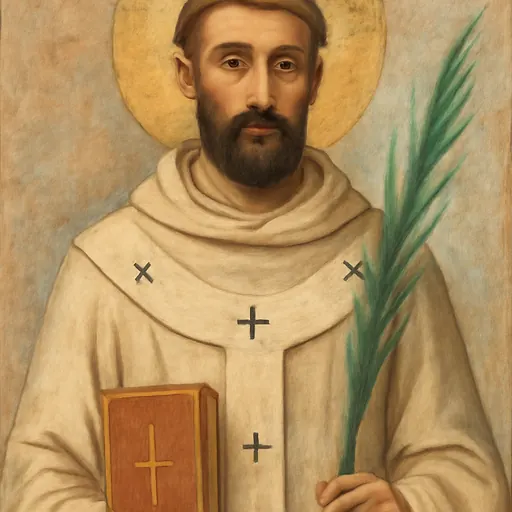
St. Irenaeus of Sirmium was bishop of Sirmium, a great Roman city of Pannonia (today Sremska Mitrovica in Serbia). In the persecution of Diocletian he refused to sacrifice to the gods, though his wife, mother and children begged him to give way, and he was beheaded in 304. We keep his feast on April 6.
Who was St. Irenaeus of Sirmium?
St. Irenaeus of Sirmium was the bishop of Sirmium, one of the great cities of the late Roman Empire, in the province of Pannonia. The ruins of Sirmium lie under the Serbian town of Sremska Mitrovica on the river Sava. In 304, in the persecution of Diocletian, Irenaeus was arrested, tried before the governor Probus, tortured and beheaded, and his body was thrown into the river. The record of his trial has come down to us, and it shows a man who loved his family and loved Christ more. We keep his feast on April 6.
He is not St. Irenaeus of Lyons, the great second-century theologian. The two are often confused because of the name.
The acts of his martyrdom
Most of what we know comes from the Acts of his martyrdom, which Alban Butler called "the original authentic acts of his trial" and took from the collection of the scholar Thierry Ruinart. Butler wrote in the eighteenth century. Baring-Gould, a century later, also called them "the authentic Acts of his martyrdom." Like the best early acts, they read like a court record, question and answer.
Irenaeus had been married before he was ordained bishop, Butler notes, and he had children. Pannonia was a frontier province and Sirmium an imperial capital, where emperors often stayed. Other Christians died at Sirmium in the same persecution, among them St. Anastasia.

The trial before Probus
Probus, governor of Pannonia, opened with the emperor's law: "The divine laws oblige all men to sacrifice to the gods." Irenaeus would not. He was put on the rack, and when the governor asked again whether he would sacrifice, he answered, in Butler's translation:
I sacrifice to my God by confessing his holy name, and so have I always sacrificed to him.
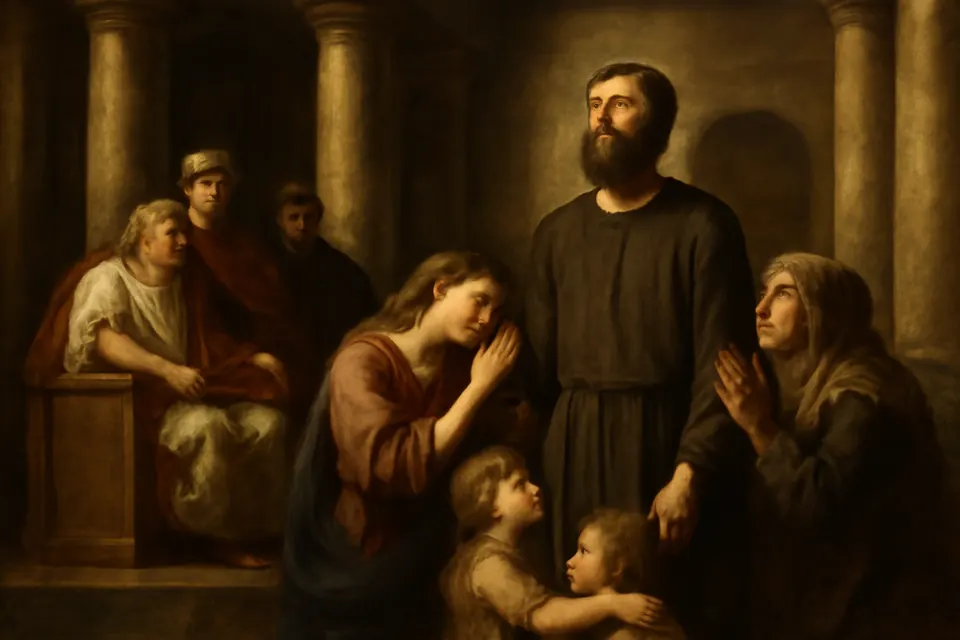
Then came the hardest test. His mother, his wife and his children surrounded him. His children embraced his feet, crying, "Father, dear father, have pity on yourself and on us." His wife threw her arms around his neck and begged him to live for her and for their little ones. His mother wept aloud. Butler says Irenaeus answered them with the words of the Lord: whoever denies Christ before men, Christ will deny before His Father in heaven.
Probus sent him to prison, where he stayed a long time under many torments. At the second hearing the governor asked whether he had a wife, parents or children. Irenaeus said he did not, and explained:
So when I lift up my eyes to contemplate that God whom I adore, and the joys he hath promised to those who faithfully serve him, I forget that I am a father, a husband, a son, a master, a friend.
Pressed to sacrifice for his children's sake, he said, "My children will not lose much by my death; for I leave them for father that same God whom they adore with me."
His death on the bridge
Probus sentenced him to be thrown into the river. Irenaeus protested that this was too little: he wanted to show the world how Christians with a lively faith despise death. The angry governor added that he should be beheaded first. Irenaeus thanked God for a second victory.
At the bridge, he took off his clothes, lifted his hands to heaven and prayed, in the words Butler gives:
Lord Jesus Christ, who condescendest to suffer for the salvation of the world, command the heavens to open, that the angels may receive the soul of thy servant Irenaeus, who suffers for thy name, and for thy people of the catholic church of Sirmium.
He was beheaded and his body thrown into the river. Baring-Gould names the river as the Sava. The year was 304.

No miracles are recorded in his acts. His witness is the miracle: grace strong enough to hold firm against the tears of the people he loved most. Because his body was lost to the river, no relics of him are known.

Symbols of St. Irenaeus of Sirmium in art
Images of him are rare outside Serbia and the Orthodox lands. Look for:
- Bishop's vestments: his office in Sirmium. Orthodox icons show him in the omophorion of an Eastern hierarch.
- A martyr's palm: his victory through death.
- A sword: his beheading.
- A river and a bridge: the place of his death on the Sava.
In Orthodox icons he is labeled as a hieromartyr, a bishop-martyr, which helps tell him from Irenaeus of Lyons.
Feast day and prayer
We keep his feast on April 6. The Roman Martyrology of 1916 placed him on March 25: "At Sirmium, the martyrdom of St. Irenaeus, bishop. In the time of the emperor Maximian, under the governor Probus, after undergoing bitter torments, and a painful imprisonment for many days, he was beheaded." See the feast day calendar for the saints around his day.
Butler closes his account with a thought for the rest of us: "The martyrs most perfectly accomplished the precept of renouncing all things for Christ; but all who desire truly to become his disciples, are bound to do it in spirit."
His own last prayer is the best one we have. Let us make it ours for every Christian who must choose between the faith and the love of family, and for the Church in Serbia and the lands of old Pannonia: St. Irenaeus of Sirmium, pray for us.
Frequently asked questions
Who was St. Irenaeus of Sirmium?
A bishop of Sirmium in the Roman province of Pannonia, martyred in 304 under Diocletian. He had been married before he became bishop. The governor Probus tried him, had him tortured and imprisoned, and finally had him beheaded and his body thrown into the river.
Is Irenaeus of Sirmium the same as St. Irenaeus of Lyons?
No. Irenaeus of Lyons was a second-century bishop in Gaul and the author of Against Heresies. Irenaeus of Sirmium lived about a century later, in what is now Serbia, and is known only from the acts of his martyrdom.
What was St. Irenaeus of Sirmium's last prayer?
In the version Butler gives: "Lord Jesus Christ, who condescendest to suffer for the salvation of the world, command the heavens to open, that the angels may receive the soul of thy servant Irenaeus, who suffers for thy name, and for thy people of the catholic church of Sirmium."
When is the feast of St. Irenaeus of Sirmium?
April 6. Older editions of the Roman Martyrology list him on March 25.
Keep exploring
Sources
- Alban Butler, The Lives of the Fathers, Martyrs, and Other Principal Saints, vol. 3 (March). St. Irenaeus, Bishop of Sirmium, from his acts in Ruinart; the trial and prayer quoted
- S. Baring-Gould, The Lives of the Saints, vol. 3, March (London, 1872). March 25; the river Sava and the Greek date
- The Roman Martyrology (Baltimore, 1916). March 25 (quoted)