St. Alexander of Rome, Soldier Martyr
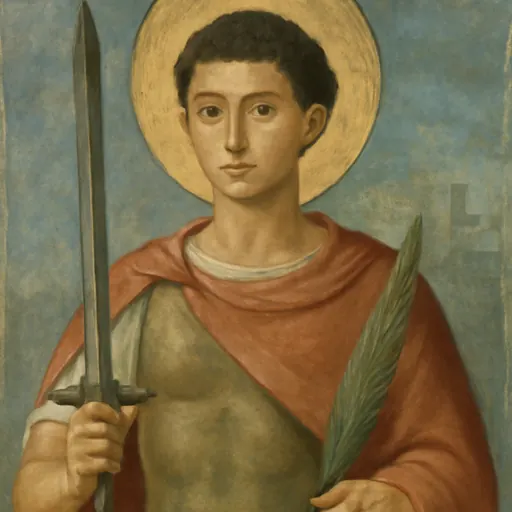
St. Alexander of Rome was a young Christian soldier who, at eighteen, refused the emperor Maximian's order to sacrifice to Jupiter. He was tortured, marched in chains to Thrace, and beheaded at Drizipara, his mother Pimenia following him on the road. The Roman Martyrology remembers him on March 27; the Orthodox Church on May 13.
Who was St. Alexander of Rome?
St. Alexander of Rome was a young Christian soldier who would not offer incense to Jupiter. At eighteen, serving in a regiment at Rome, he refused the emperor's order, endured torture, and was led in chains all the way to Thrace, where he was beheaded at a town called Drizipara. The Roman Martyrology remembers him on March 27:
At Drizipara, in Pannonia, St. Alexander, a soldier, in the time of emperor Maximian. Having overcome many tribulations for Christ, and wrought many miracles, he completed his martyrdom by decapitation.
The old English Martyrology puts Drizipara "in Pannonia," but his life places it in Thrace, on the road toward Byzantium. The Orthodox Church honors him on May 13.
His name causes some confusion. He is not Pope St. Alexander I, the second-century bishop of Rome, and not the son of St. Felicity martyred at Rome. He is "of Rome" because he served there and was raised there in the faith.

History and legend
We should be honest about our sources. What we know of Alexander comes from his Passion, an old account of the kind written long after the persecutions, filled with the wonders such texts love. His martyrdom under Maximian and his grave in Thrace are what the Church's calendars, East and West, have kept. The details of the story are tradition, and we tell them as such.
The story of St. Alexander
As the Orthodox life tells it, Alexander had been raised a Christian from childhood. He served in the regiment of a tribune named Tiberian at Rome. When the emperor Maximian Hercules (286–305) ordered every citizen to go out to the temple of Jupiter on a set day and sacrifice, Tiberian marched his soldiers to the festival. Alexander refused. He would not, he said, offer sacrifice to demons.
Tiberian reported him. That night, the story says, an angel woke Alexander and told him that he would suffer, and that the angel would be with him. When the soldiers came to arrest him, his face shone so brightly that they fell to the ground. He told them to do their duty.
Before Maximian he confessed Christ boldly. The emperor offered honors and then tortures, and Alexander took neither bait nor fear. Maximian handed him back to Tiberian, who was being sent to Thrace to persecute Christians there, and the young man was taken east in chains.
His mother on the road
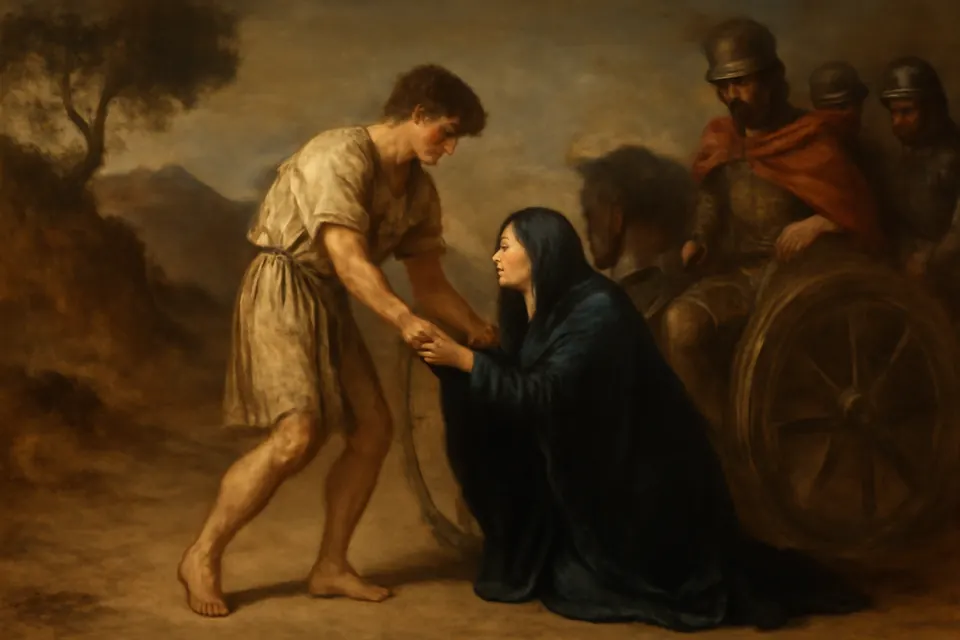
An angel, the life says, told his mother Pimenia what was happening to her son. She went looking for him and found him on trial before Tiberian, and watched him tortured again. As he walked in chains behind the tribune's chariot, she begged the soldiers to let her come to him, and she encouraged him to suffer bravely for Christ. The soldiers began to say to one another, "Great is the God of the Christians!"
At a place called Burtodexion she met him once more and fell weeping at his feet. "Do not weep, my mother," he told her, "for the day after tomorrow, the Lord shall help me finish matters."
Martyrdom at Drizipara
Tiberian tried him again at Philippopolis, today's Plovdiv, and finally sentenced him at Drizipara. The soldier ordered to behead him could not lift his sword, the story says, because he saw angels waiting for the martyr's soul. Alexander prayed for the angels to step back so that he might go to the Lord, and then the blow fell. His body was thrown into a river, but four dogs dragged it out and guarded it until Pimenia came. She buried her son near the River Ergina, and healings began at his grave.
The miracles of St. Alexander of Rome
All of these are traditional, from his Passion as the Orthodox Church still reads it:
- The angel who woke him before his arrest and strengthened him on the road.
- His shining face, before which the soldiers fell.
- A spring of water that rose at his prayer for the soldiers guarding him, who were weak with thirst.
- A tree under which he prayed, whose fruit and leaves afterwards healed the sick.
- The dogs that guarded his body, and the healings at his grave.
The Roman Martyrology sums them up in a phrase: he "wrought many miracles."

Symbols of St. Alexander of Rome in art
No famous Western painting of this St. Alexander is known to us. In Orthodox icons and church frescoes he is painted the way the Byzantine tradition paints its young soldier martyrs:
- A beardless youth in Roman armor and a red cloak, because he was eighteen and a soldier.
- The martyr's cross or palm in one hand, and often a sword.
- An angel beside him in scenes from his life, for the angel of his Passion.
Because many soldier saints look alike in icons, the inscription with his name is the surest way to recognize him.
Feast day and where he is honored
We keep his memory on March 27 with the Roman Martyrology, and Orthodox Christians on May 13. See the feast day calendar.
There is no traditional prayer to St. Alexander of Rome in common English use. Let us ask him, who would not bend before a false god at eighteen, to pray for young people under pressure to deny their faith, for soldiers, and for every mother who watches her child suffer.
Frequently asked questions
Who was St. Alexander of Rome?
A Christian soldier in the regiment of the tribune Tiberian at Rome, who refused to sacrifice to the pagan gods under the emperor Maximian (286–305). He was tortured, sent to Thrace and beheaded at Drizipara. His mother Pimenia buried him.
When is the feast of St. Alexander of Rome?
March 27 in the Roman Martyrology, which places him at Drizipara. The Orthodox Church keeps his memory on May 13.
Is he the same as Pope St. Alexander I?
No. Pope St. Alexander I was bishop of Rome in the early second century, with a feast on May 3. This St. Alexander was a young soldier martyred some two hundred years later.
What miracles are told of St. Alexander of Rome?
His Orthodox life tells of an angel who strengthened him, a spring of water that appeared at his prayer for thirsty soldiers, a tree whose leaves and fruit healed, and healings at his grave. These are traditional accounts from his old Passion.
Keep exploring
Sources
- Orthodox Church in America: Martyr Alexander of Rome (May 13). His Orthodox life, from the regiment of Tiberian to Pimenia's burial of his body near the River Ergina
- Roman Martyrology, March 27 (1916 English edition). His entry as a soldier at Drizipara under Maximian who "wrought many miracles" and was beheaded