St. Catherine of Vadstena (St. Catherine of Sweden)
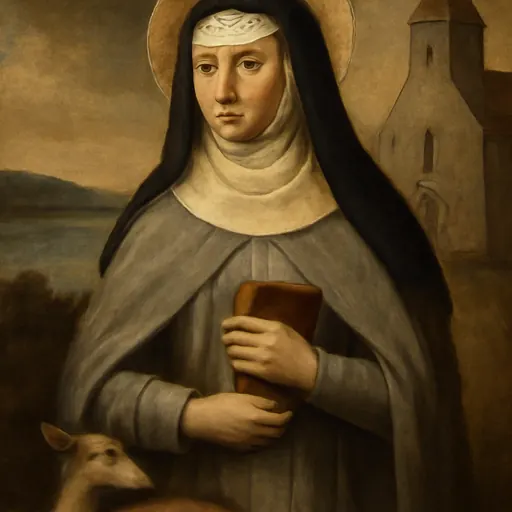
St. Catherine of Vadstena, also called St. Catherine of Sweden (about 1331–1381), was the daughter of St. Bridget of Sweden. Married young, she and her husband lived in chastity; widowed in Rome, she became her mother's constant companion, carried St. Bridget's body home to Sweden and led the new abbey at Vadstena. Her feast is March 24.
Who was St. Catherine of Vadstena?
St. Catherine of Vadstena, often called St. Catherine of Sweden, was the daughter of St. Bridget of Sweden and the first head of the great abbey her mother founded at Vadstena. She was born in 1331 or 1332, spent most of her adult life at her mother's side in Rome, and died at Vadstena on March 24, 1381. We keep her feast on March 24.
Her life was written by Ulf, a Brigittine friar, about thirty years after her death, as Sabine Baring-Gould notes. The 1908 Catholic Encyclopedia gives a careful summary of it, and we follow both here.
A marriage kept in chastity
Catherine was the fourth child of Bridget and her husband Ulf Gudmarsson. At seven she was sent to the convent of Riseberg to be educated, and even as a girl she showed her mother's longing for prayer and penance.
At thirteen or fourteen, at her father's command, she was married to a nobleman of German descent, Eggart von Kürnen. The Catholic Encyclopedia says she "at once persuaded her husband, who was a very religious man, to join her in a vow of chastity." The two lived together as brother and sister and gave themselves to prayer and works of charity.
With her mother in Rome
Bridget went to Rome in 1349. Catherine, though she loved her husband deeply, followed her there. Soon after she arrived, word came from Sweden that Eggart had died.
From then on she lived with her mother. She shared Bridget's labors, copied her strict life, and turned away every suitor. The Catholic Encyclopedia calls her "the distinguished and beautiful young widow," and Roman nobles sought her hand. She would not marry again.
In 1372 Catherine and her brother Birger went with their mother on pilgrimage to the Holy Land. After their return Catherine nursed Bridget through her last illness. Bridget died in Rome on July 23, 1373.
Abbess of Vadstena
In 1374, as her mother had wished, Catherine brought Bridget's body home to Sweden for burial at Vadstena on Lake Vättern. The abbey there was the mother house of the Order of the Most Holy Savior, the Brigittines, and Catherine became its head. She governed it, the Catholic Encyclopedia says, "with great skill" and in the spirit her mother had laid down.

The next year she went back to Rome to seek her mother's canonization and a new confirmation of the order. She won the confirmation from Gregory XI in 1377 and again from Urban VI in 1379. The canonization had to wait: the Great Schism broke out in 1378, and Bridget was not canonized until 1391, ten years after Catherine's death.
When the schism divided the Church, Catherine, like St. Catherine of Siena, stood firmly with Urban VI, the Roman pope, and testified in his favor before a church commission. After five years in Italy she returned to Sweden carrying a letter of commendation from the pope. Not long after she came home she fell ill, and she died at Vadstena on March 24, 1381.
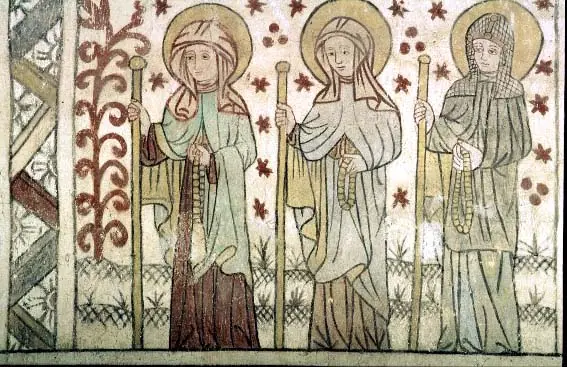
Her writing
Catherine wrote a devotional book, Consolation of the Soul (Sielinna Tröst), made up mostly of passages from Scripture and older spiritual books. The Catholic Encyclopedia reports that no copy of it is known to survive.
Miracles and recognition
We have no list of her miracles that we can verify, and she was never canonized by a formal process. In 1484 Pope Innocent VIII gave permission for her to be honored as a saint, and Baring-Gould notes that her office was sanctioned by the same pope. Her feast entered the Roman Martyrology, and Sweden, Denmark and Norway kept her day in their medieval calendars.
Symbols of St. Catherine of Vadstena in art
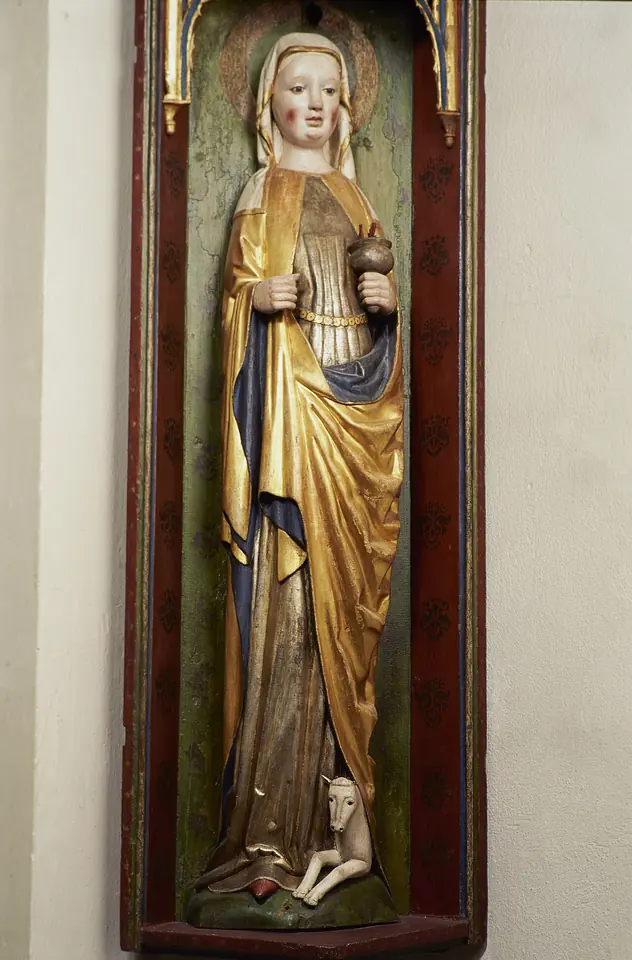
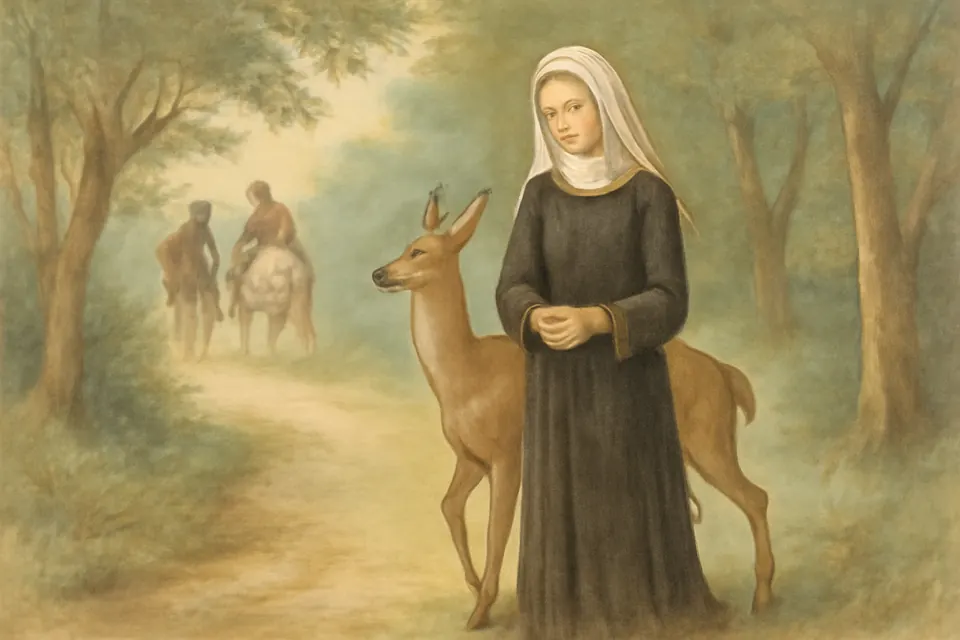
- A hind (female deer): her chief emblem. The Catholic Encyclopedia relates the traditional story that a hind came to her aid when young men tried to trap her, so it stands for God's care for her chastity.
- The Brigittine habit: a gray habit and a black veil with the white linen crown band of the order, as abbess of Vadstena.
- A book: her rule of life and her lost Consolation of the Soul.
Swedish churches are full of late medieval statues of her, often paired with her mother. To recognize her, look for a woman in a veil with a small deer lying at her feet, as in the Bollnäs statue above.
Vadstena today
The abbey church at Vadstena, built for the Brigittines, still stands on the shore of Lake Vättern. Pilgrims come there for St. Bridget and her daughter, and the town remains the heart of Brigittine memory in Sweden.

Feast day and prayer
We keep her feast on March 24; see our feast day calendar. There is no traditional prayer to her in English, so let us pray in our own words. St. Catherine of Vadstena, faithful daughter, chaste wife and wise abbess, pray for all who care for an aging parent, for widows, and for married couples who want to give their lives wholly to God.
Frequently asked questions
Who was St. Catherine of Vadstena?
The fourth child of St. Bridget of Sweden and her husband Ulf Gudmarsson. She shared her mother's life of prayer in Rome for about twenty-five years, brought Bridget's body back to Sweden in 1374, and became the head of Vadstena Abbey, the mother house of the Brigittine Order. She died there on March 24, 1381.
Why is St. Catherine of Sweden shown with a deer?
She is usually painted with a hind, a female deer. The story told of her is that a hind came to her aid when young men tried to ensnare her, so the animal stands for God's protection of her purity.
Is St. Catherine of Vadstena the same as St. Catherine of Siena?
No, though they lived at the same time and both supported Pope Urban VI at the start of the Great Schism. Catherine of Siena was an Italian Dominican tertiary and Doctor of the Church; Catherine of Vadstena was a Swedish noblewoman and abbess.
When is the feast of St. Catherine of Vadstena?
March 24, the day she died in 1381.
Keep exploring
Sources
- Catholic Encyclopedia (1908): St. Catherine of Sweden. Her marriage, Rome, the papal confirmations of 1377 and 1379, her testimony for Urban VI, the permission of 1484, her lost book and the hind
- Sabine Baring-Gould, The Lives of the Saints, vol. 3: March (Project Gutenberg). March 24; her life by Ulf, a Brigittine friar, written thirty years after her death