St. Innocent of Alaska, Enlightener of the Aleuts and Apostle to America
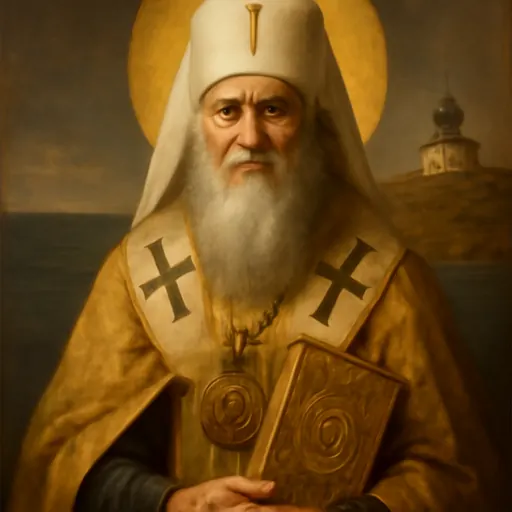
St. Innocent of Alaska (John Veniaminov, 1797–1879) was a Siberian Orthodox priest who volunteered in 1823 to serve the Aleuts of Unalaska, wrote the first book in their language, ministered to the Tlingit at Sitka, became the first resident bishop in Alaska and ended his life as Metropolitan of Moscow. The Russian Orthodox Church glorified him in 1977 as Enlightener of the Aleuts and Apostle to America. His feasts are March 31 and October 6.
Who was St. Innocent of Alaska?
St. Innocent of Alaska was a Siberian Orthodox priest named John Veniaminov who, in 1823, said yes to a mission no one else in his diocese would take: the Aleutian Islands, at the far edge of the Russian Empire. He spent the next fifteen years among the Aleut and Tlingit peoples, learning their languages, building their churches with his own hands and translating the Gospel for them. After his wife died he became a monk, the first resident bishop in Alaska, and finally Metropolitan of Moscow. The Russian Orthodox Church glorified him in 1977 as Enlightener of the Aleuts and Apostle to America, and we keep his feast on March 31 and again on October 6.
In Russia he is usually called St. Innocent of Moscow. In America, where Orthodox Christians count him as one of their founding fathers, he is St. Innocent of Alaska. The Church honors him with the title Equal to the Apostles, given to saints who brought whole peoples to Christ.
The life of St. Innocent
A church server's son from Siberia
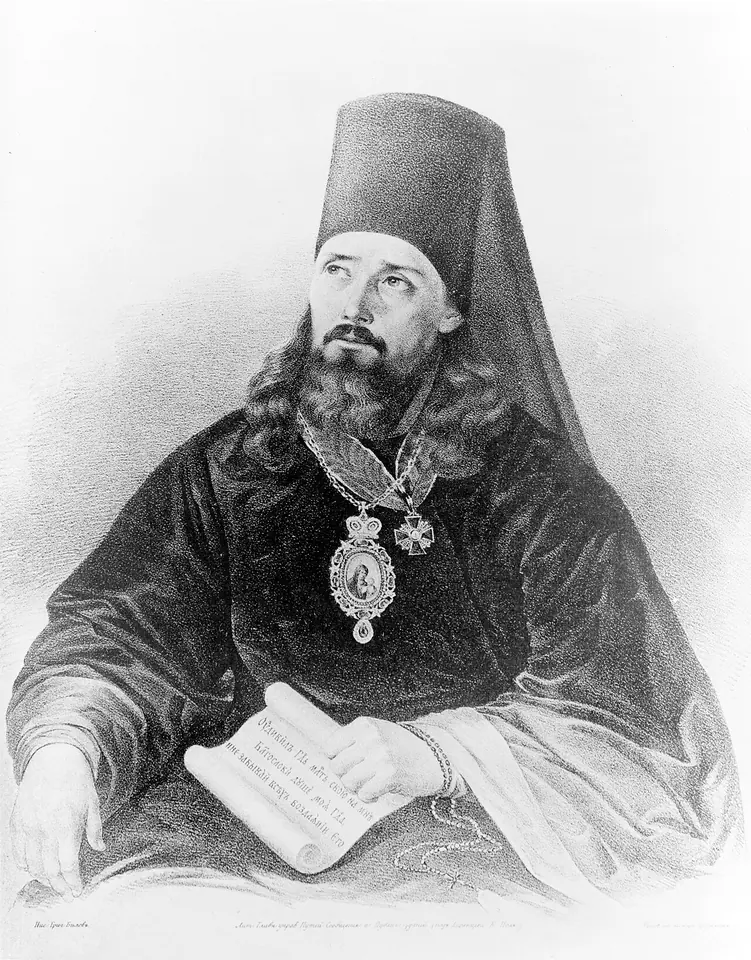
He was born John Popov on August 26, 1797, in the village of Anginskoye in the province of Irkutsk. His father, a church server, taught him to read in his fifth year and died in 1803. John entered the Irkutsk seminary in 1807, living on a small state grant; he later took the surname Veniaminov. In 1817 he married Catherine Sharina and was ordained deacon for the Church of the Annunciation in Irkutsk; he was ordained priest for the same church on May 18, 1821.
"Blessed be the name of the Lord!"
Early in 1823 the Holy Synod asked the bishop of Irkutsk to send a priest to Unalaska in the Aleutians. Nobody volunteered. Father John at first held back too, then, as he later recalled, after an inner struggle he said, "Blessed be the name of the Lord!" and offered himself. On May 7, 1823, he set out with his wife, his infant son Innocent, his aging mother and his brother Stefan. The journey took fourteen months. They reached Unalaska on July 29, 1824, and lived at first in an earthen hut they built themselves.
Ten years on Unalaska
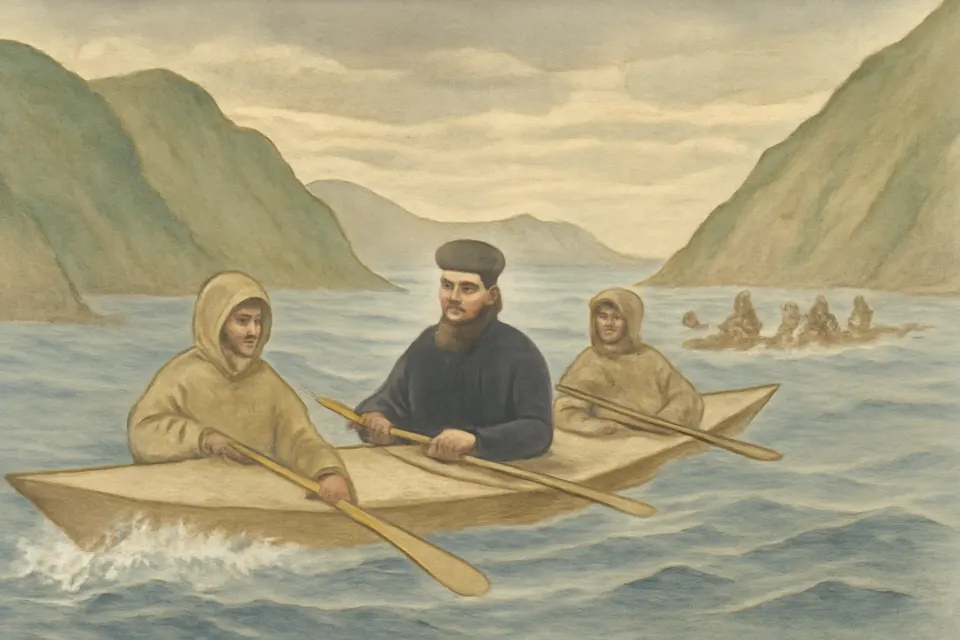
His parish ran from Umnak Island in the west to the Shumagin Islands in the east and included the Pribilofs to the north: twenty-seven villages and 1,484 people, according to his own records. He visited them by sailing ship, by open skin boat and, from 1828, by baidarka, the narrow skin kayak of the Aleuts, through straits where the tides run at six miles an hour.
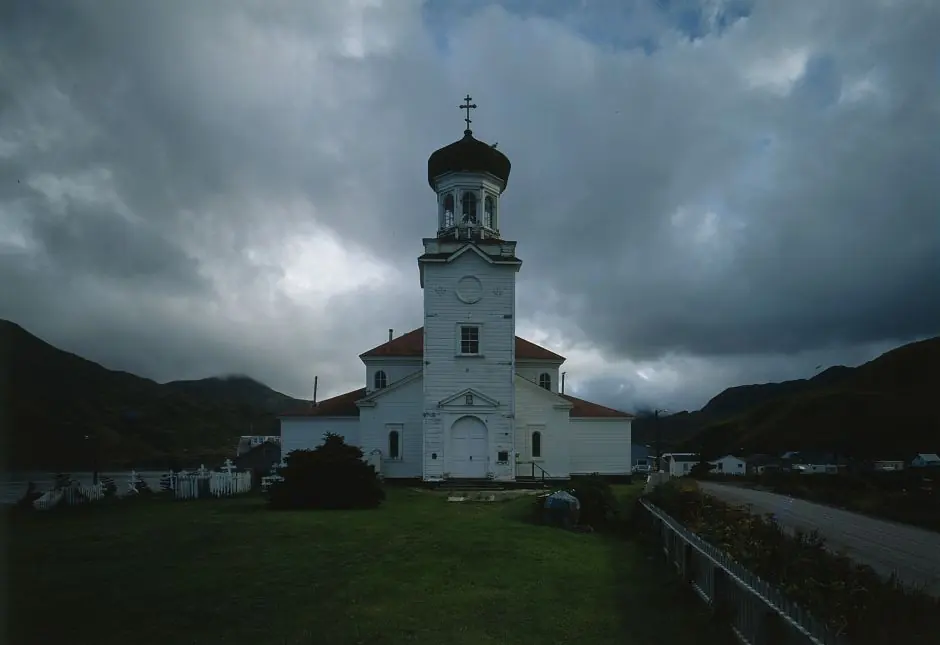
He taught the islanders carpentry, metalwork and masonry, and with them began a church in July 1825. It was consecrated in honor of the Ascension the following year. He built his own furniture and a clock, and kept weather records for the whole decade. His Notes on the Islands of the Unalaska District is still the main record of traditional Aleut life; a Russian anthropologist of the twentieth century wrote that to study Aleut ethnography, "we must use the work of Veniaminov."

He mastered the Unangan language and, with the Aleut leader Ivan Pan'kov, worked out an alphabet in Cyrillic letters. The Catechism and the Gospel of St. Matthew appeared in Aleut in 1828. His own short book, Indication of the Way into the Kingdom of Heaven, written in Aleut, was the first book in the language.
Sitka and the Tlingit
In November 1834 he was transferred to New Archangel, today's Sitka, to serve the Tlingit, who had so far refused Christianity. He studied their language and customs, wrote notes and a glossary, and, the OCA records, even taught them to vaccinate. He would not baptize anyone who did not ask for it, and waited patiently until they did. In 1836 his travels took him south to Fort Ross on the California coast and to the Spanish missions of northern California.
Bishop of Kamchatka, the Kuriles and the Aleutians
In 1838 he went back to Russia to report on the mission and to press for more churches and clergy. While he was there his wife, Catherine, died. After much prayer he accepted monastic tonsure, taking the name Innocent in honor of the missionary St. Innocent of Irkutsk, and in 1840 he was consecrated in St. Petersburg as bishop of Kamchatka, the Kurile Islands and the Aleutian Islands: the first bishop to live in Alaska. He came home to Sitka, kept traveling and in 1848 consecrated St. Michael's Cathedral, which he designed himself. He had already sent the Aleut priest St. Jacob Netsvetov to found the mission on the Yukon in 1844, and in 1850 he was raised to archbishop.

From 1853 he worked mostly in Siberia, at Yakutsk and along the Amur. The Yakut people first heard the Liturgy in their own language in 1859. In 1860 and 1861 he met the young St. Nicholas of Japan and shared his experience of mission with him.
Metropolitan of Moscow
On January 5, 1868, the old missionary was named Metropolitan of Moscow and Kolomna, the highest see in the Russian Church. He used it to found the Orthodox Missionary Society and to improve the life of the clergy. He died on March 31, 1879, which that year was Holy Saturday. He had left the text for his own funeral sermon: "The steps of a man are rightly ordered by the Lord" (Psalm 36/37:23). He was buried at the Trinity-St. Sergius Lavra, the monastery of St. Sergius of Radonezh.

Wonders and signs
The Church glorified St. Innocent for his apostolic life rather than for a list of miracles, and no formally investigated miracle is attached to his glorification. The OCA's life for children records one reported event: in rough seas off Kodiak, Bishop Innocent turned toward Spruce Island, where the monk St. Herman of Alaska had lived and was buried, and asked his prayers; within minutes the waters grew calm. He himself saw the wonder of his life in God's providence, and the kontakion sung at his feast says the same: "In hardships and dangers you toiled for the Gospel's sake / and God delivered and preserved you unharmed."
Why St. Innocent is a patron of missionaries
Orthodox Christians ask his prayers for every work of mission, because his whole method is still taught: learn the people's language, give them the Scriptures and the services in it, teach them useful skills, baptize no one by force. He is also beloved by the Native Orthodox peoples of Alaska, the Aleut (Unangan), Yup'ik and Tlingit, whose churches still use the alphabets and translations he began. See our patron saints page for other patrons of missionaries.
Symbols of St. Innocent in art
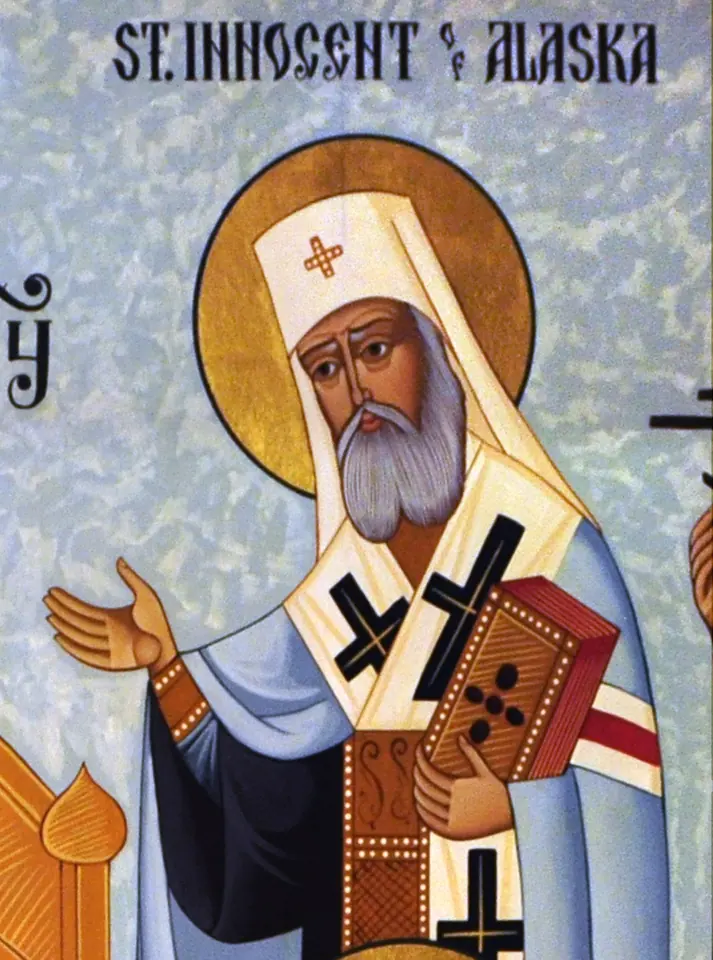
Icons show St. Innocent as an elderly hierarch with a long white beard. Look for:
- The white klobuk: the white headdress with a small cross on top, worn by a Metropolitan of Moscow. Earlier portraits, from his years as bishop in Alaska, show the black klobuk of an ordinary bishop.
- Bishop's vestments and omophorion: the wide stole marked with crosses, the sign of a bishop.
- A Gospel book or a scroll: for his translations and his Indication of the Way.
- A blessing hand: raised toward the viewer or toward a church.
- Alaskan scenes: life icons, painted with small scenes around the central figure, show him in a baidarka, building the church at Unalaska and preaching to the Aleuts and Tlingit.
He is often painted in group icons of the saints of North America beside St. Herman, St. Peter the Aleut and St. Jacob Netsvetov.
Feast, glorification and relics
The Russian Orthodox Church glorified Metropolitan Innocent on October 6, 1977, at the official request of the Orthodox Church in America. We keep two feasts: March 31, the day of his repose, and October 6, the day of his glorification. He is also remembered on October 5 with the Synaxis of the Moscow Hierarchs. Find his neighbors on the calendar on our feast days page. The Orthodox cathedral in Anchorage, Alaska, is dedicated to him.
He was buried in the Church of the Holy Spirit at the Trinity-St. Sergius Lavra in Sergiev Posad, near Moscow. Today his relics rest in a shrine in the Lavra's Dormition (Assumption) Cathedral, where pilgrims from Alaska still come to pray before them.

Prayer to St. Innocent of Alaska
The Orthodox Church sings this troparion to him (Tone 4), in the translation of the Orthodox Church in America:
O holy father Innocent / in obedience to the will of God / you accepted dangers and tribulations / bringing many peoples to the knowledge of truth. / You showed us the way, / now by your prayers help lead us into the Kingdom of Heaven.
A second troparion (Tone 2) calls him "enlightener of Alaska and all America, whose ways were ordered by the Lord." St. Innocent himself said, in words the OCA preserves: "Whoever abounds in faith and love, can have mouth and wisdom, and the heart cannot resist their serving it."
Let us ask St. Innocent, who said yes when everyone else said no, to pray for all who carry the Gospel to faraway places and for the peoples of Alaska he loved.
Frequently asked questions
Who was St. Innocent of Alaska?
A married parish priest from Irkutsk, John Veniaminov, who went to the Aleutian Islands in 1823 when no other priest would go. He served Unalaska for ten years and Sitka for five, translated the Gospel into Aleut, became a monk and bishop after his wife's death, and later served as Metropolitan of Moscow from 1868 until his death in 1879.
When is the feast of St. Innocent of Alaska?
March 31, the day he died in 1879 (April 13 on the civil calendar for churches using the Julian calendar), and October 6, the day of his glorification in 1977. The Russian Church also remembers him on October 5 with the other Moscow hierarchs.
Why is he called St. Innocent of Moscow?
Because he ended his life as Metropolitan of Moscow and Kolomna, the senior see of the Russian Church, from 1868 to 1879. Orthodox Christians in Russia often call him St. Innocent of Moscow, and those in America St. Innocent of Alaska. It is the same saint.
Where are the relics of St. Innocent?
In the Dormition (Assumption) Cathedral of the Trinity-St. Sergius Lavra at Sergiev Posad, near Moscow. He was first buried in the Lavra's Church of the Holy Spirit.
What did St. Innocent write?
His best-known work is the Indication of the Way into the Kingdom of Heaven, written in Aleut and the first book published in that language. He also wrote a grammar of Aleut, studies of the Tlingit language and the Notes on the Islands of the Unalaska District, still a standard source on traditional Aleut life.
Keep exploring
Sources
- Orthodox Church in America: Past Primates, Bishop Innocent (Veniaminov) of Alaska. His family, ordination dates, volunteering in 1823, the journey and arrival on July 29, 1824, the Ascension church and his work among the Tlingit
- Orthodox Church in America: Repose of Saint Innocent, Metropolitan of Moscow, Enlightener of the Aleuts, Apostle to the Americas. Glorification on October 6, 1977, meetings with St. Nicholas of Japan, his quotation and funeral text
- Orthodox Church in America: Troparion and Kontakion of St. Innocent
- Orthodox Church in America, Department of Christian Education: North American Saints, St. Innocent Veniaminov (PDF). The storm off Kodiak, the visit to Fort Ross and the California missions, burial in the Church of the Holy Spirit
- Wolfgang Brinck, The Kayak Voyages of Father Ivan Veniaminov (Sea Kayaker, 2006; Fort Ross Conservancy Library). His parish of 27 villages and 1,484 people, his clock, furniture and weather records, and his first baidarka journey in 1828
- OrthoChristian: Birth and canonization of St. Innocent of Alaska celebrated at Trinity-St. Sergius Lavra. His relics kept in the Dormition Cathedral of the Lavra