St. Finnian of Clonard, Teacher of the Saints of Ireland
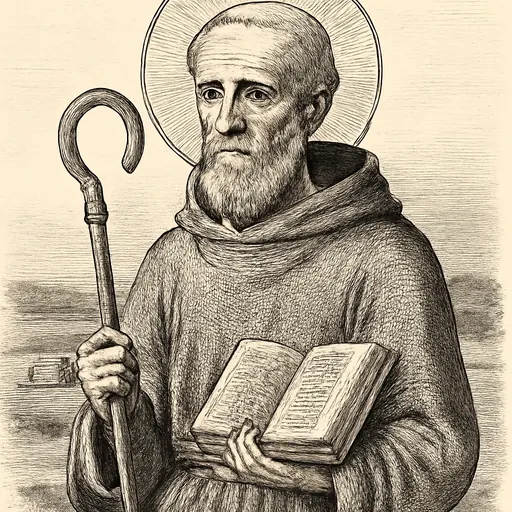
St. Finnian of Clonard (died about 549–552) was an Irish abbot who founded the monastery and school of Clonard on the River Boyne in County Meath. So many of Ireland's great founders studied under him, among them St. Columba and St. Ciarán, that he is called the Teacher of the Saints of Ireland. His feast is December 12, and he is patron of the Diocese of Meath.
Who was St. Finnian of Clonard?
St. Finnian of Clonard was a sixth-century Irish abbot whose monastery on the River Boyne became the most famous school in Ireland. Butler says that among the early teachers of the Irish Church his name ranks next to St. Patrick's. Out of Clonard came the men later called the Twelve Apostles of Ireland, founders like St. Columba of Iona and St. Ciarán of Clonmacnoise, which is why Finnian is remembered as the Teacher of the Saints of Ireland. We keep his feast on December 12.
He is not the same man as St. Finnian of Movilla, another great teacher of the same century in the north. Columba studied under both.
The life of St. Finnian of Clonard
A Leinster boy
The Catholic Encyclopedia gives his birthplace as Myshall in County Carlow, about 470. His medieval Irish Life, preserved in the Book of Lismore, says his father was Finntan and his mother Telach, and that before his birth she dreamed of a flame that became a bright bird, with all the birds of Ireland gathering to it. He was baptized by St. Abban and taught the Psalms by Bishop Fortchern of Trim.
Wales and the British saints
As a young man he crossed the sea. The Irish Life says he met the British saints David, Gildas and Cathmael (that is, St. Cadoc) and studied with them for thirty years. Baring-Gould, writing in the nineteenth century, thought thirty years far too long, and the Catholic Encyclopedia gives the figure only as the Salamanca manuscript's. What is clear is that Finnian brought home the monastic learning of Wales.
Founding Clonard
Back in Ireland he preached and founded churches in Leinster. The Life says he stayed for a time with St. Brigid at Kildare, reading and teaching. At last, the Catholic Encyclopedia relates, an angel led him to Cluain Eraird, "Erard's meadow," on the Boyne, telling him it would be the place of his resurrection. There he built a small cell and a church of clay and wattle and gave himself to study, penance and prayer.

The school
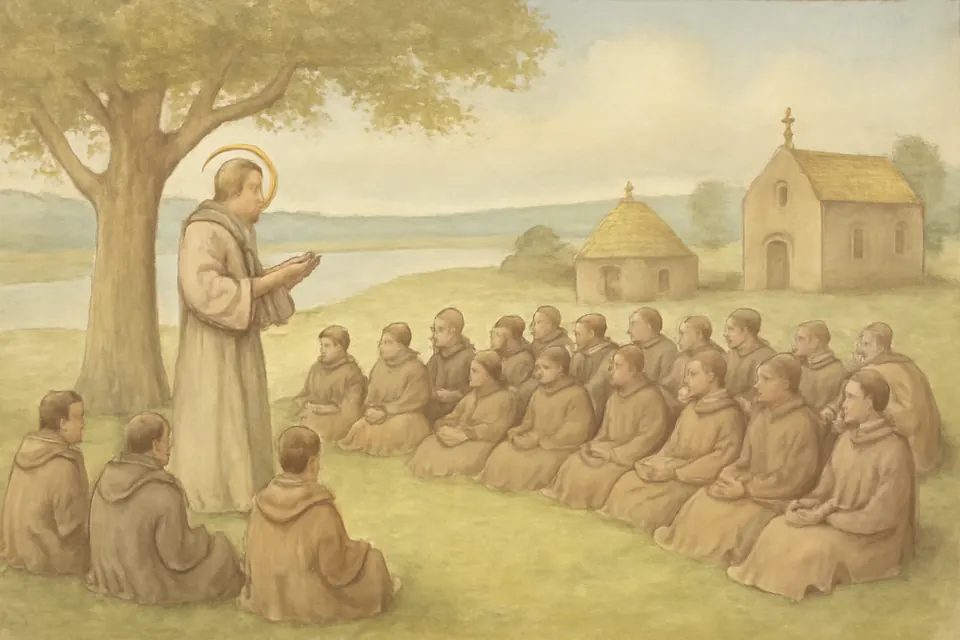
Students came from all over Ireland. The Office of St. Finnian claims that 3,000 pupils were taught at one time "in the green fields of Clonard." The Catholic Encyclopedia says he excelled above all in explaining the Scriptures. The Irish Life adds that none of the 3,000 left without "a crozier, or a gospel, or some well-known sign," and that they built their own churches around those keepsakes.
He lived hard. Butler says he ate bread and herbs, drank water, slept on the ground and used a stone for a pillow. The Life says that on Sundays and feasts he took a little wheaten bread, a piece of salmon and a cup of ale or mead.
His death
Finnian died at Clonard, probably in 549 or 552. The Irish Life says he died for the people of Ireland during the Yellow Plague, offering himself so that they would not all perish. It adds that St. Columba of Terryglass brought him his last Communion. He was buried in his own church.
Miracles and legends of St. Finnian
The Irish Life of Finnian is full of wonders, and they are best read as traditional. In Wales, it says, he made the sign of the cross over his mouth and spoke British as if it were his native tongue. He dipped a torch into a lake and the lake fled into the sea to make room for a church. He found in a stream the gold ring St. Brigid had tried to give him, and used it to buy a man's freedom. The Life also tells of a well whose place an angel showed him, a sick nun made well at his blessing and a king's son raised from the dead.
Butler, more soberly, says "he healed the souls, and often also the bodies of those who applied to him."
Why St. Finnian is the patron of the Diocese of Meath
Clonard was the seat of a bishop for centuries after Finnian. In the early thirteenth century the Norman bishop Simon Rochfort moved the see to Trim, and it became the Diocese of Meath. The Irish bishops still list St. Finnian as patron of the diocese, with his feast on December 12.
Symbols of St. Finnian in art
There are no early portraits of him. Modern Irish art shows him with:
- An abbot's crozier and sometimes a bishop's miter.
- A book of the Scriptures, for his teaching.
- Students gathered around him, often twelve.
- An angel, pointing him to the site of Clonard.
The Church of St. Finian at Clonard has a series of windows from 1957 telling his life, and its medieval font has a worn figure that local tradition says is Finnian.
Where St. Finnian is honored today
Nothing remains of his monastery. The Catholic Encyclopedia tells how Clonard suffered from Viking raids and later wars, and nothing of his shrine survives. A Church of Ireland church stands on the old monastic site, and the Catholic parish church nearby is dedicated to him.

See our feast days calendar for other saints of December, and our page on Irish saints.
Prayer to St. Finnian of Clonard
We know of no traditional prayer to St. Finnian in common use. We may ask him, in our own words, to bless teachers and students, to give us a love for the Scriptures, and to raise up holy founders in the Church again. St. Finnian of Clonard, pray for us.
Frequently asked questions
When is the feast of St. Finnian of Clonard?
December 12. The Irish Catholic bishops list him as patron of the Diocese of Meath with his feast on that day.
Who were the Twelve Apostles of Ireland?
They were twelve founders of Irish monasteries said to have studied under Finnian at Clonard. Butler names among his pupils Ciarán the Younger of Clonmacnoise, Columba (Columcille), Columba of Terryglass, the two Brendans, Laserian, Canice and Ruadhan.
Is St. Finnian of Clonard the same as St. Finnian of Movilla?
No. St. Finnian of Movilla, in County Down, was another sixth-century teacher, honored on September 10. St. Columba studied under both, which is part of why they get confused.
Was St. Finnian a bishop?
Butler calls him bishop of Clonard. Baring-Gould points out that the Irish calendars and his own Life call him abbot, not bishop.
Keep exploring
Sources
- Catholic Encyclopedia (1908): School of Clonard. His birth at Myshall about 470, the angel's direction to Cluain Eraird, the 3,000 pupils in the Office of St. Finnian, and his burial at Clonard
- Alban Butler, Lives of the Saints, vol. XII (1866): Saint Finian, or Finan, Bishop of Cluain-Irard, or Clonard. His pupils, his diet of bread and herbs, and the dates 552 or 564
- Whitley Stokes, Lives of Saints from the Book of Lismore (Oxford, 1890): Life of Findian of Clonard. The medieval Irish Life, with its miracles, the iron girdle, the Yellow Plague and his last communion from Columba of Terryglass
- Sabine Baring-Gould, The Lives of the Saints, vol. 15 (December): S. Finnian, B. of Clonard. Doubts about the thirty years in Wales, and the remark that the Irish calendars call him abbot, not bishop
- Irish Catholic Bishops' Conference: Diocese of Meath. Patrons of the diocese: St Finian, 12 December