St. Herman of Alaska

St. Herman of Alaska (about 1756 to 1837) was a Russian monk of Valaam Monastery who came to Kodiak with the first Orthodox mission to Alaska in 1794. For more than forty years he lived as a hermit on Spruce Island, teaching orphans, nursing the sick and defending the Alaska Natives. In 1970 the Orthodox Church in America glorified him as its first saint; his feast day is December 13, and his glorification is kept on August 9.
Who was St. Herman of Alaska?
St. Herman of Alaska was a Russian monk who crossed Siberia and the North Pacific with the first Orthodox mission to Alaska and spent the rest of his life there, most of it as a hermit on Spruce Island, a forested island a mile and a quarter off Kodiak. He was never ordained a priest. He refused the offer of priesthood and of higher rank, and stayed what he called himself to the end, a simple monk. The Native people of Kodiak called him Apa, "grandfather."
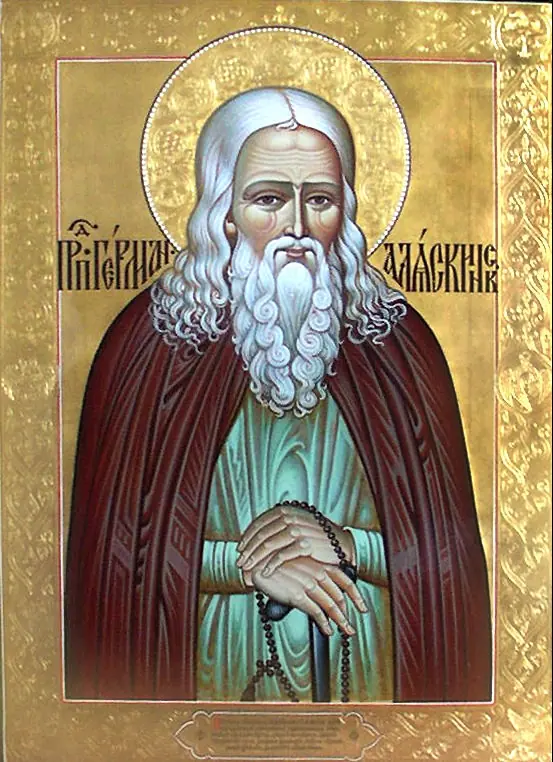
He came to Kodiak in 1794 with nine other monks from Valaam Monastery. One by one his companions were martyred, drowned, died or went home, and Herman stayed. For more than forty years he prayed, fed and taught orphans, nursed the sick through an epidemic, and stood up to the Russian traders who mistreated the Aleuts and Alutiiq people of the islands. He died on Spruce Island in December 1837. In 1970 the Orthodox Church in America, in the first year of its independence, glorified him as its first saint. The Orthodox honor him as the Wonderworker of All America, and his feast is December 13.
Most of what we know comes from his disciples and from people who knew him, gathered by Bishop Peter of Sitka in an inquiry of 1867 and published in the first life of Herman by Valaam Monastery in 1894. The Orthodox Church in America's life of the saint, quoted below, draws on those accounts.
The life of St. Herman of Alaska
Serpukhov, the Trinity-St. Sergius Hermitage and Valaam
Herman came from a merchant family of Serpukhov, south of Moscow. His baptismal and family names are unknown, though the OCA life suggests his name in baptism may have been Gerasim. He was born about 1756; the bishops who canonized him gave 1760. At sixteen he entered the Trinity-St. Sergius Hermitage on the Peterhof Road, about ten miles from St. Petersburg. He also spent time at Sarov, the monastery later made famous by St. Seraphim, and there met Father Nazarius, who became his elder.
At the hermitage, a painful abscess swelled on the right side of his throat until he could hardly swallow and expected to die. He locked his cell and prayed all night before an icon of the Mother of God, wiped the icon's face with a wet towel and bound the towel over the swelling. He fell asleep on the floor and dreamed that the Virgin healed him. In the morning the swelling was gone, though the abscess had never broken, leaving only a small mark.
After five or six years he moved to Valaam, the great monastery on the islands of Lake Ladoga, where Nazarius had become abbot. He carried out the usual obediences, oversaw a marble quarry for a time, and was then allowed to live alone in the forest about a mile from the monastery, in a place the monks still called "Herman's." On feast days he came back to sing in the choir. The life quotes Father Barlaam, later abbot of Valaam: as he sang "O Sweetest Jesus, save us sinners," "tears would fall like hail from his eyes."

He loved Valaam all his life. From America he wrote to Nazarius that his "fatherly goodness" would be erased from his heart "neither by the terrible, unpassable Siberian lands, nor by the dark forests," nor by "the awful ocean."
The mission to Kodiak
Russian traders had reached the Aleutian Islands and Kodiak in the second half of the 1700s. With the blessing of the Holy Synod, Metropolitan Gabriel asked Nazarius to choose monks for a mission to the new territories. Ten were sent, under Archimandrite Joasaph: hieromonks, hierodeacons, and two simple monks, the monk Joasaph and Herman. They left Valaam in 1793 and, after crossing Siberia and the sea from Okhotsk, reached Kodiak in 1794. The OCA chronology calls it the longest missionary journey in the history of the Orthodox Church. The church of the Holy Resurrection was founded on Kodiak that November.
Thousands were baptized in the first years, and a school was opened. Then the mission came apart. In 1795 Hieromonk Juvenaly was killed on Lake Iliamna, the first Orthodox martyr in America. In 1799 Joasaph, newly consecrated in Irkutsk as the first bishop of Kodiak, drowned with his party when their ship, the Phoenix, went down in the North Pacific. Others died or returned to Russia. In the end only Herman remained.
The monks also clashed with Alexander Baranov, the manager of the Russian-American Company, who blamed them for unrest among the Natives. In 1800 he wrote to "the monk steward Herman" forbidding the missionaries contact with the Native people, and in 1801, after a violent scene in which Herman tried to intervene, he confined them to their house for more than a year. Herman never stopped speaking for the people the traders exploited.
New Valaam
At some point between 1808 and 1818 Herman moved to Spruce Island and named it New Valaam. He dug a cave and lived in it his first summer; a cell was built for him nearby for the winters, and he kept the cave for his grave. A chapel, a schoolhouse and a guest house were put up near the cell, and he laid out a garden.

He worked hard and ate little. He dug the garden himself, salted mushrooms with salt boiled from seawater, and hauled baskets of seaweed for fertilizer that one man could hardly lift. His disciple Gerasim saw him one winter night carrying, barefoot, a log that would normally take four men. He wore the same deerskin smock and patched cassock winter and summer, slept on a bench covered with a worn deerskin with two bricks for a pillow, and covered himself with a wooden board he called his blanket. Under his clothes he wore iron chains of about sixteen pounds. Everything he earned went to feed and clothe orphans and to buy books for his pupils.

Asked whether he wasn't lonely in the forest, he answered: "No I am not there alone! God is here, as God is everywhere. The Holy Angels are there. With whom is it better to talk, with people, or with Angels? Most certainly with Angels."
Father of the Aleuts
Herman settled quarrels, reconciled husbands and wives, and pleaded with Russian officials for those who had been wronged. He baked biscuits and little pretzels for the children, who loved him. In a letter to Simeon Yanovsky, the colony's manager, he called himself "the most humble servant of these people, and their nurse," and begged him: "Be our Father and our Protector... Wipe away the tears of the defenseless orphans."
In 1819 a ship brought a deadly fever to Kodiak. It killed in three days, and so many died that for a time there was no one to dig graves. There was no doctor and no medicine. For the whole month the epidemic lasted, Herman went from house to house, nursing the sick, praying with them and preparing the dying, and, the life says, "He never spared himself."
He built a school for Aleut orphans and taught them the Law of God and church singing. In 1820 a young Aleut woman, Sophia Vlasova, came to him asking to stay, having "become so inflamed with love for Jesus Christ." He took her in, against his love of solitude, and she looked after the children of the school until his death.

"Do you love God?"
Yanovsky came to Herman a freethinker, educated in the naval corps and well read in atheist books. He wrote that they talked every day until midnight and later, and that "the Lord returned me completely to the way of Truth, and I became a real Christian." He also recorded the conversation for which Herman is best remembered.
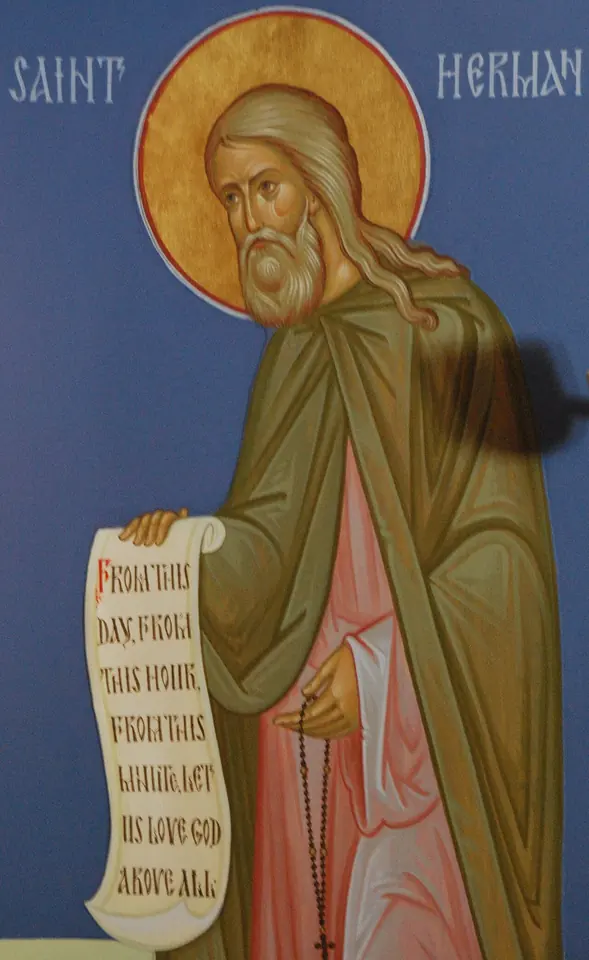
Invited aboard a frigate from St. Petersburg, Herman sat among the captain and some twenty-five officers and asked them what each loved most. One wanted wealth, another glory, another a beautiful wife. Didn't they all, he asked, want what seemed best to them, and wasn't the best of all the Lord Jesus Christ? They agreed. Did they love God, then? Certainly, they said. "And I a sinner have been trying for more than forty years to love God," he answered, "I cannot say that I love Him completely." He ended: "For our own good, and for our own fortune, let us at least promise ourselves that from this very minute we will try to love God more than anything and to fulfill His Holy Will!"
Yanovsky also told him of an Aleut named Peter, tortured to death in California in the 1810s for refusing to give up his Orthodox faith. Herman stood up before an icon, made the sign of the cross and said, "Holy newly-martyred Peter, pray to God for us!" That Aleut is venerated today as St. Peter the Aleut.

Not everyone welcomed him. Once an inspector and company men searched his cell for treasure, and one of them began tearing up the floor with an axe. "My friend, you have lifted the axe in vain," Herman told him; "this weapon shall deprive you of your life." Some time later the man was killed at Fort Nicholas. The persecution eased when Baron Ferdinand von Wrangel took charge of the colony and met Herman in 1831.
His death
Herman foretold that he would be buried by his disciples alone, without a priest. One day he had a candle lit and the Acts of the Apostles read, then stopped the reading and said the Lord had given him another week. A week later the candles were lit and the Acts read again. He laid his head on Gerasim's chest, the cell filled with a sweet scent, and he died. The date was December 13, 1837, by the Julian calendar, December 25 by ours.
A storm kept anyone from crossing from Kodiak for a month. The body lay all that time in the warm schoolhouse without any change. The islanders finally buried him themselves, and the sea went calm. On Afognak Island that night, people saw a pillar of light rising over Spruce Island and said, "It seems that Father Herman has left us."

The miracles of St. Herman of Alaska
None of these was investigated in the way the Catholic Church examines miracles today. The Orthodox Church glorifies a saint on the evidence of a holy life, the people's veneration and the signs reported by witnesses. In our terms:
- The healing of his throat abscess (traditional). Told in his life as Herman himself described it.
- The flood (traditional). When the sea rose over Spruce Island, Herman set an icon of the Mother of God on a sandbank and said, "Have no fear, the water will not go any higher than the place where this holy icon stands." It didn't. He gave the icon to Sophia for future floods, and the OCA life says it is kept on the island still.
- The forest fire (traditional). With his disciple Ignaty he turned over a strip of moss a yard wide and said the fire would not pass it. Ignaty testified that it stopped there.
- Prophecies (traditional). He foretold that America would have its own bishop, an epidemic after his death (smallpox struck about half a year later), and that a monk would one day live on Spruce Island again.
- The incorrupt body and the pillar of light (reported). Witnessed by the islanders in 1837 and 1838.
- The storm of 1842 (reported). St. Innocent of Alaska, then Archbishop of Kamchatka, was on a ship in distress off Kodiak. He looked toward Spruce Island and said, "If you have found favor in God's presence, Father Herman then may the wind change." About fifteen minutes later the wind turned. He landed and served a memorial service at Herman's grave.

Why St. Herman is the patron of Orthodoxy in America
At his glorification the Orthodox Church in America took him as its heavenly patron. The OCA's prayer calls him "Holy Father and Patron of the Church in America," and the troparion calls him the "adornment of the Orthodox Church in America." Bishop Dmitri, preaching at the canonization, said the Church had been given "a saint, as both example and protector."
He is honored for the Alaska Native Christians he served and defended, for missionaries as one of the first Orthodox missionaries in America, and for orphans, whom he fed, clothed and taught. Find more on our patron saints page.
Symbols of St. Herman of Alaska in art
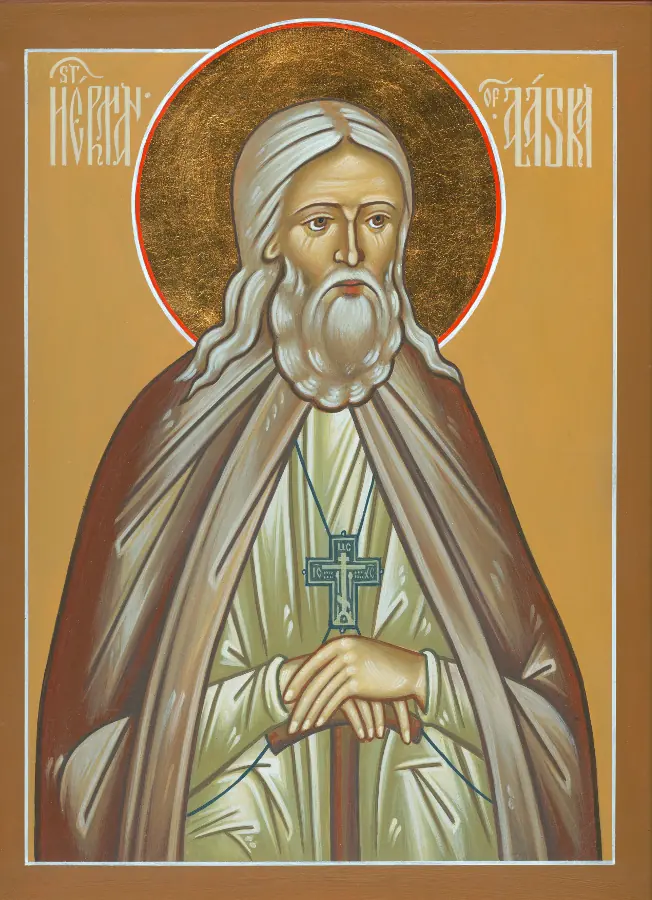
St. Herman's icons follow a description by Yanovsky, who knew him: short, with a pale, wrinkled face, grayish-blue eyes and a pleasant voice. Look for:
- An old monk with long white hair and beard, often bareheaded or in a black klobuk, the monastic headdress.
- A worn, plain monastic mantle, for the patched clothes he wore summer and winter.
- A prayer rope in his hand, for the unceasing prayer of the Valaam monks.
- A scroll, often reading "From this day, from this hour, from this minute let us love God above all," a short form of his words to the naval officers.
- Spruce Island, a rocky shore, or the sea behind him, and sometimes a small wooden chapel.
- St. Peter the Aleut beside him, a young man in a fur parka, in icons of the Alaskan saints.
The icons on this page show the range: a Russian icon with a prayer rope, an American icon with his hands on a staff, the Dayton icon with the scroll, and the mosaic with his fellow saints of Alaska.
Feast day, relics and the Spruce Island pilgrimage
We keep St. Herman's feast on December 13, the day of his repose, and the feast of his glorification on August 9. In March 1969 the Great Council of Bishops of the American Metropolia announced its decision to canonize "the Venerable Spiritual Father the monk Herman of Alaska," calling him "the first in America" among its saints. The glorification took place at Holy Resurrection Church in Kodiak on August 9, 1970. You can find his neighbors on the calendar on our feast days page.

His relics rest in Holy Resurrection Cathedral in Kodiak. On Spruce Island, the Chapel of Sts. Sergius and Herman of Valaam stands at Monk's Lagoon over the place of his first grave.
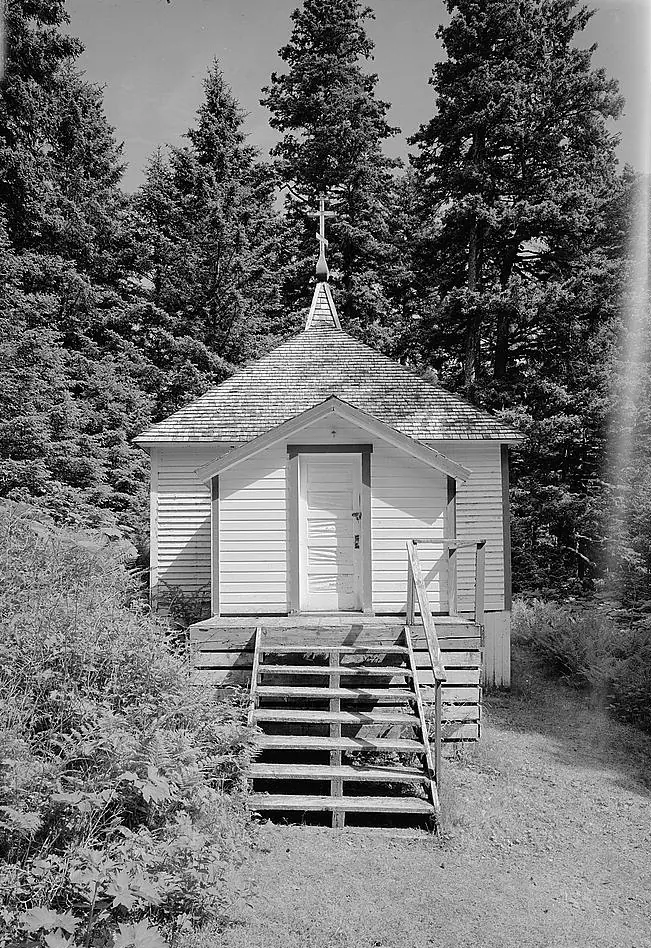
Every August, pilgrims from across North America gather in Kodiak, venerate his relics in the cathedral, and cross by boat to Spruce Island for the Divine Liturgy at the chapel. As he foretold, Spruce Island did not stay empty: the monk Gerasim lived there for many years and died on October 13, 1969, less than a year before the glorification.

Prayer to St. Herman of Alaska
The Orthodox Church in America sings this troparion on his feast:
O joyful north star of the Church of Christ, / guiding all men to the Heavenly Kingdom; / teacher and apostle of the true faith; / intercessor and defender of the oppressed. / Adornment of the Orthodox Church in America, / blessed Father Herman of Alaska, / pray to our Lord Jesus Christ / for the salvation of our souls!
The OCA also publishes a longer prayer to St. Herman, written for his glorification. It closes:
O Holy Father and Patron of the Church in America: Be a physician to the weak in faith; be a support to the fallen; be a defender to the defenseless; be a bulwark of strength to the weary in spirit; be a guide to the travelers by sea, by land and by air; be our heavenly intercessor.
Herman's own words make a good prayer for any day: from this very minute, let us try to love God more than anything and to do His holy will. Let us ask St. Herman to pray for missionaries, for orphans, and for all the people of Alaska. Holy Father Herman of Alaska, pray to God for us.
Frequently asked questions
Who was St. Herman of Alaska?
A Russian monk from Serpukhov who trained at the Trinity-St. Sergius Hermitage near St. Petersburg and at Valaam Monastery on Lake Ladoga. In 1793 he left with nine other monks on the first Orthodox mission to Alaska, reaching Kodiak in 1794. He outlived all his companions, settled on Spruce Island, which he called New Valaam, and spent more than forty years there praying, teaching orphans and defending the Native people. He died there in 1837.
When is St. Herman of Alaska's feast day?
December 13, the anniversary of his repose in 1837 by the Julian calendar. The Orthodox Church in America keeps it on December 13; churches that follow the Julian calendar keep it on December 13 Old Style, which is December 26 on the civil calendar. His glorification is kept on August 9.
Why is St. Herman of Alaska important?
He is the first saint glorified by the Orthodox Church in America, which canonized him at Kodiak on August 9, 1970, and he is honored as the patron of Orthodoxy in America. In its 1969 decision, the Great Council of Bishops called him "the first in America" among its saints.
Where are the relics of St. Herman of Alaska?
In Holy Resurrection Cathedral in Kodiak, Alaska, where they were enshrined at his glorification in 1970. His first grave, on Spruce Island, lies under the Chapel of Sts. Sergius and Herman of Valaam at Monk's Lagoon. Pilgrims visit both every August during the annual St. Herman pilgrimage.
What miracles did St. Herman of Alaska work?
His Orthodox life tells of his healing from a throat abscess as a young monk, a flood on Spruce Island that stopped at the icon he set on the shore, a forest fire that halted at a line he marked, and prophecies that came true. After his death, St. Innocent of Alaska prayed to him in a storm in 1842, and the wind turned. These are traditional accounts preserved by his disciples and the Church.
What did St. Herman of Alaska say?
His best-known words come from a conversation with naval officers. After asking them whether they loved God, he said, "For our own good, and for our own fortune, let us at least promise ourselves that from this very minute we will try to love God more than anything and to fulfill His Holy Will!" Icons often show a shorter form on his scroll.
Is St. Herman of Alaska a Catholic saint?
He is a saint of the Orthodox Church, glorified by the Orthodox Church in America in 1970, and he is not on the Roman calendar. Many Catholics, especially in Alaska, admire him as a holy missionary and monk, and we can all learn from his love of God and of the poor.
Keep exploring
Sources
- Orthodox Church in America: Repose of Venerable Herman of Alaska, Wonderworker of All America
- Orthodox Church in America: Chronology of the Life of Saint Herman of Alaska
- Orthodox Church in America: Address of the Great Council of Bishops Concerning the Canonization of the Spiritual Father Herman of Alaska (March 1969)
- Orthodox Church in America: On the occasion of the Canonization of Saint Herman of Alaska, by Bishop Dmitri
- Orthodox Church in America: Prayer to Saint Herman of Alaska
- Orthodox Church in America: Troparion and Kontakion of St. Herman of Alaska
- Orthodox Church in America: Pilgrims from North America, Russia celebrate 40th Anniversary of Saint Herman's glorification on Spruce Island (2010)