St. Swithun Wells, Martyr of Gray's Inn Fields

St. Swithun Wells (about 1536–1591) was a Hampshire gentleman and schoolmaster who returned to the Catholic faith and opened his London house to priests. When a Mass was discovered there in November 1591, he was condemned and hanged outside his own door on December 10, 1591. He is one of the Forty Martyrs of England and Wales, canonized in 1970.
Who was St. Swithun Wells?
St. Swithun Wells was an English gentleman from Hampshire who was hanged in London on December 10, 1591, because a Catholic priest had said Mass in his house. He was about fifty-five. He had been a country sportsman and a schoolmaster, a cheerful man who loved hawking and hunting, and he went to his death still joking, still praying for the man who hunted him down. The Church honors him among the Forty Martyrs of England and Wales, canonized by Pope Paul VI in 1970.
He was named for St. Swithun, the Anglo-Saxon bishop of nearby Winchester, and his feast falls on the day he died.

The life of St. Swithun Wells
A gentleman of Hampshire
Swithun was born around 1536 at Brambridge, near Winchester, the youngest of five or six sons of Thomas Wells. His family held firmly to the old faith. His eldest brother Gilbert, Bishop Challoner writes, was "renowned for his immovable constancy, and great persecutions which he suffered under Queen Elizabeth for the Catholic religion."
Challoner's sources describe Swithun as good-natured, pleasant in conversation, courteous, generous and courageous, "every way a gentleman." He loved hawking and hunting but held his pleasures in check. He married a devout woman whose name is not given in the accounts we have, who would one day stand condemned beside him.
Years of conforming, and a return
Here the Catholic Encyclopedia is honest with us. For many years Swithun conformed: he went to the Protestant services and received the Protestant communion, as the law demanded. For about six years, probably from 1576 to 1582, he kept a school for young gentlemen at Monkton Farleigh in Wiltshire. Challoner's source calls that school "a fruitful seminary" for the Church, and one of its pupils became a martyr.
On May 25, 1582, the Privy Council ordered a search for him. In that year or the next he was reconciled to the Catholic Church. It is a story many of us know: a man who went along for years, and then came home.
Gray's Inn Lane
In 1585 he moved to London and took a house in Gray's Inn Lane. He was in and out of prison: discharged on bail in July 1586, questioned about the Babington plot in August, released from the Fleet in November, examined again in March 1587. His house was a place where priests could find shelter and Catholics could hear Mass.
The Mass of November 8, 1591
On the morning of November 8, 1591, the octave day of All Saints (the Catholic Encyclopedia gives November 1), the young priest Edmund Gennings was saying Mass in Wells's house. Swithun was out. His wife was there, with the priest Polydore Plasden and several laymen. In the middle of the Mass the priest-hunter Richard Topcliffe and his officers broke down the door. The men held the door until Mass was finished, and then all were taken.

When Swithun came home and found his house ransacked and his wife in prison, he went straight to Justice Young to demand her release. The justice sent him to Newgate in irons. Questioned the next day, he said he had not been at the Mass, but wished he had been, "thinking his house highly honoured by having so divine a sacrifice offered therein." The justice replied that though he had missed the feast, "he should taste of the sauce."
A letter from prison
On December 4 they were tried, and the next day all were condemned. Before his trial Swithun wrote to his brother-in-law, Gerard Morin, a letter Challoner printed in full. Part of it reads:
When I pray, I talk with God; when I read, He talketh to me; so that I am never alone. He is my chiefest companion and only comfort.
And further on:
I am bound and charged with gyves; yet am I loose and unbound towards God; and far better I account it to have the body bound, than the soul to be in bondage.
December 10, 1591
On the morning of the execution his wife was brought out with him, but the sheriff sent her back to prison under reprieve. She grieved to be left behind. She lived ten more years in Newgate in prayer and fasting and died there in 1602.
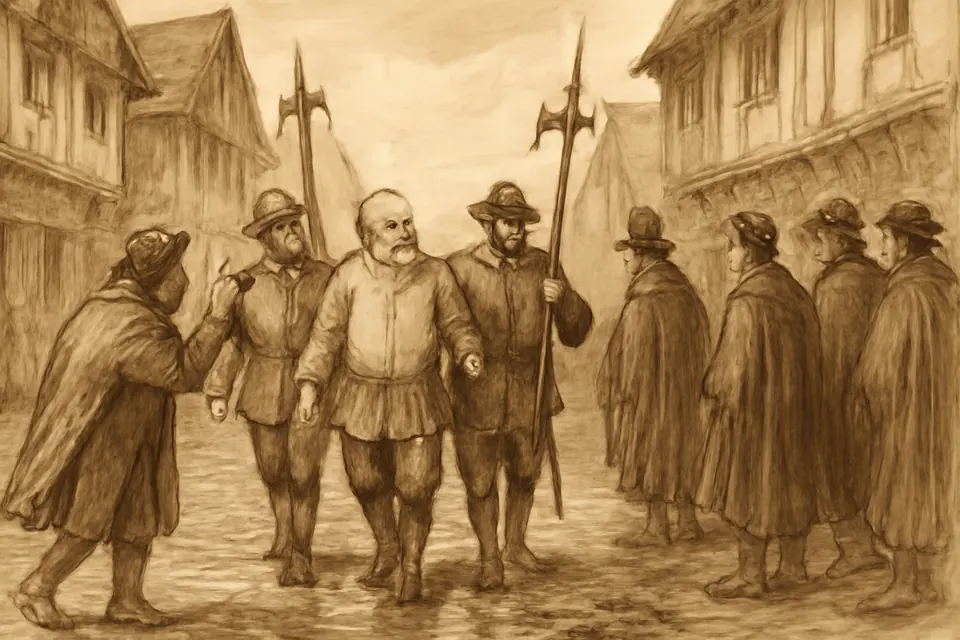
Swithun and Edmund Gennings were taken to Gray's Inn Fields, opposite his own door. On the way he saw an old friend and called out: "Farewell, dear friend! farewell all hawking, hunting, and old pastimes; I am now going a better way!" He watched Gennings die first. Then, standing in his shirt in the cold, he told Topcliffe to be quick, and prayed for him:
I pray God make you of a Saul a Paul, of a persecutor a Catholic professor.
Martyrdom and canonization
Swithun Wells was not a priest and was not accused of plotting. He was put to death for helping priests, under the statute 27 Elizabeth, c. 2. The Church recognized his martyrdom: he was beatified in 1929 and canonized on October 25, 1970, with thirty-nine other martyrs of England and Wales. No miracles are needed for the canonization of martyrs, and none are claimed for him; his witness is his death.
Symbols of St. Swithun Wells in art
Swithun has no old artistic tradition; images of him are modern.
- Martyr's palm: the victory of a martyr.
- Gentleman's dress: doublet, ruff and cloak, the layman and householder.
- Rope: the manner of his death.
- Letter: the letter he wrote from prison.
He is sometimes shown with St. Edmund Gennings, the priest who died with him.
Feast day and where he is honored
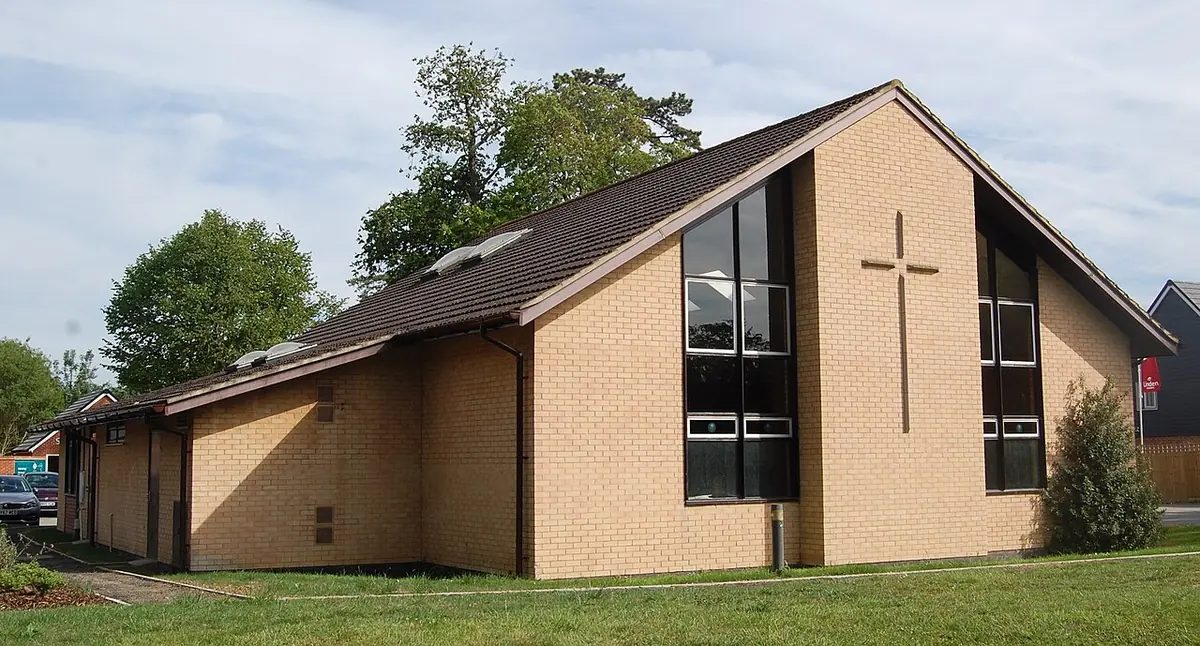
We keep St. Swithun Wells's feast on December 10, the day of his martyrdom, and honor him with the Forty Martyrs of England and Wales and, in England, with all the English martyrs on May 4. A parish in Fair Oak, Hampshire, not far from his birthplace, bears his name. See more saints of the season on our feast days page.
Prayer to St. Swithun Wells
There is no traditional prayer to St. Swithun Wells in common use. His own last words are a prayer we can make ours, for anyone who has wronged us: "I pray God make you of a Saul a Paul." Let us ask St. Swithun to pray for families who open their homes to the Church, for teachers, for people coming back to the faith after years away, and for the grace to forgive.
Frequently asked questions
Who was St. Swithun Wells?
A Catholic gentleman from Brambridge, near Winchester, who ran a school for young gentlemen and later lived in Gray's Inn Lane in London. He was hanged in 1591 because a priest, St. Edmund Gennings, had said Mass in his house.
What were St. Swithun Wells's last words?
According to the account Bishop Challoner preserved, he urged the priest-hunter Richard Topcliffe to be quick and prayed for him: 'I pray God make you of a Saul a Paul, of a persecutor a Catholic professor.'
When is St. Swithun Wells's feast day?
December 10, the day of his martyrdom. He is also honored with the Forty Martyrs of England and Wales on October 25, and in England with all the English martyrs on May 4.
Was St. Swithun Wells's wife a martyr too?
She was condemned with him, but she was reprieved on the morning of the execution. She stayed in Newgate prison for about ten years, living in prayer and fasting, and died there in 1602.
Keep exploring
Sources
- Catholic Encyclopedia (1912): Ven. Swithin Wells. His family, his years of outward conformity, the school at Monkton Farleigh, the search order of May 25, 1582, his arrests of 1586 and 1587, and his last words to Topcliffe
- Richard Challoner, Memoirs of Missionary Priests (1924 edition), pp. 173–181: Edmund Genings and Swithin Wells. The raid on the Mass of November 8, 1591, his words to Justice Young, his letter from prison, his wife's reprieve and his words on the way to and at the gallows
- Pope Paul VI, homily at the canonization of the Forty Martyrs of England and Wales, October 25, 1970