St. Damasus I, Pope of the Martyrs and the Vulgate

St. Damasus I was pope from 366 to 384. He defended the faith of Nicaea, asked his secretary St. Jerome to revise the Latin Gospels, the start of the Vulgate, and restored the tombs of the Roman martyrs in the catacombs, marking them with verses he wrote himself. His feast day is December 11.
Who was St. Damasus I?
St. Damasus I was the pope from 366 to 384, a Roman priest of Spanish descent who set St. Jerome to work on the Latin Bible and who spent much of his reign caring for the graves of the martyrs. If you have walked through the catacombs of Rome and seen a marble slab cut in tall, graceful letters, you have likely seen his handiwork.
He was not a gentle figure in every respect. His election was violent, his enemies accused him of terrible things, and he fought hard for the authority of the Roman see. The Church honors him for his faithfulness to the creed of Nicaea and his love for those who died for Christ.
The life of St. Damasus
A son of St. Lawrence's church
Damasus was born about 305. The Book of the Popes calls him "by nationality a Spaniard, son of Antonius." The Catholic Encyclopedia thinks he was probably born in Rome, where he "grew up there in the service of the church of the martyr St. Laurence." His mother's name, Laurentia, was unknown until 1902 and 1903, when archaeologists found her epitaph. It says she lived the sixty years of her widowhood in the service of God and died at eighty-nine.
A contested election
When Pope Liberius died in 366, a large majority elected the deacon Damasus. A faction chose the deacon Ursinus and had him consecrated irregularly, and the quarrel turned to rioting and bloodshed in the churches of Rome. The emperor Valentinian recognized Damasus and banished Ursinus in 367, but the antipope's party kept up its attacks. In 378 they accused Damasus of adultery. Emperor Gratian cleared him, and a Roman synod of forty-four bishops excommunicated his accusers. The encyclopedia warns that much of what we read about the violence comes from a "highly prejudiced" petition by his opponents.
Guardian of the faith of Nicaea
Damasus led the Western Church in the last great struggle with Arianism. In Roman synods of 368 and 369 he condemned the errors of Apollinaris and of the Macedonians, who denied the divinity of the Holy Spirit, and he sent legates to the Council of Constantinople in 381. He lived to see the edict of Theodosius in 380, which made the faith "which St. Peter had preached to the Romans" the religion of the empire. He held that the primacy of the Roman Church rested not on the decrees of councils but on Christ's words to Peter in Matthew 16:18.

Damasus and St. Jerome
St. Jerome served for a time as Damasus's confidential secretary, and it was Damasus who urged him to revise the old Latin translations of the Gospels, the first step toward the Vulgate, the Latin Bible of the Western Church for more than a thousand years.
Jerome's earlier letter to the pope, written from the desert of Syria, shows how the Church looked to Damasus:
My words are spoken to the successor of the fisherman, to the disciple of the cross. As I follow no leader save Christ, so I communicate with none but your blessedness, that is with the chair of Peter. For this, I know, is the rock on which the church is built!
The pope of the martyrs
Damasus loved the martyrs of Rome. He drained and restored the catacombs, widened their stairways and opened shafts for light so that pilgrims could reach the tombs. He wrote short Latin poems for the martyrs' graves, and his friend Furius Dionysius Filocalus carved them in a lettering so distinctive that scholars still call it "Damasan." Many survive. Our knowledge of St. Tarcisius, the boy who died protecting the Eucharist, comes almost entirely from one of these epitaphs, and Damasus wrote verses for St. Agnes and many others.
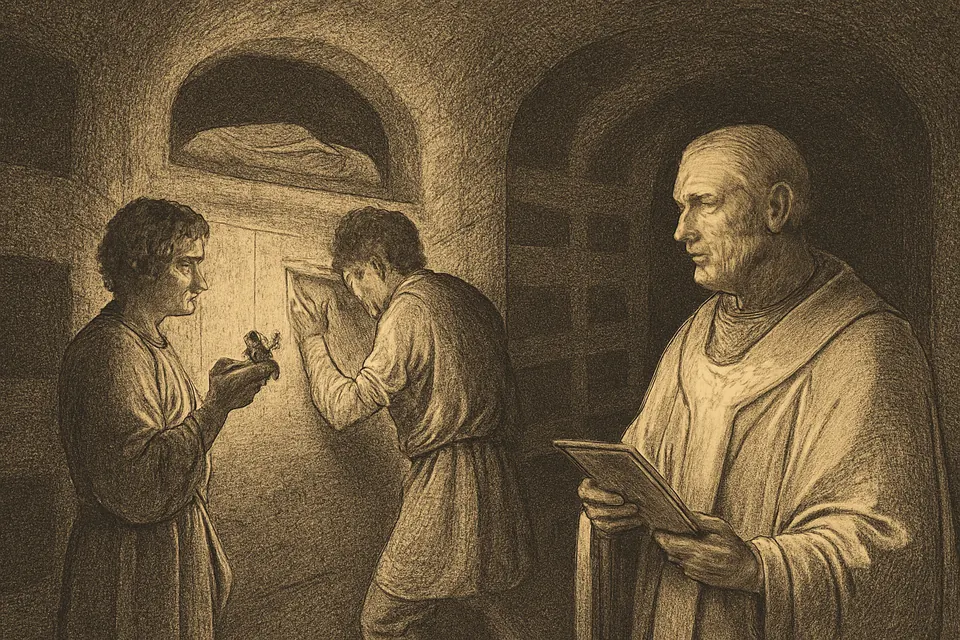
In the Crypt of the Popes in the Catacombs of St. Callixtus, where nine popes of the third century lie, he placed a poem. The basilica of San Lorenzo in Damaso quotes it: Damasus confesses that he had wanted to lay his own body there, among the saints, but feared to disturb the holy ashes of the faithful. So he built a small basilica nearby on the Via Ardeatina and was buried there with his mother and sister. Its ruins were found in 1902 and 1903.

He also built a basilica in honor of St. Lawrence near the theater, on the site that tradition says was his own family home. Rebuilt in the Renaissance inside the Palazzo della Cancelleria, it is still called San Lorenzo in Damaso.
Symbols of St. Damasus in art
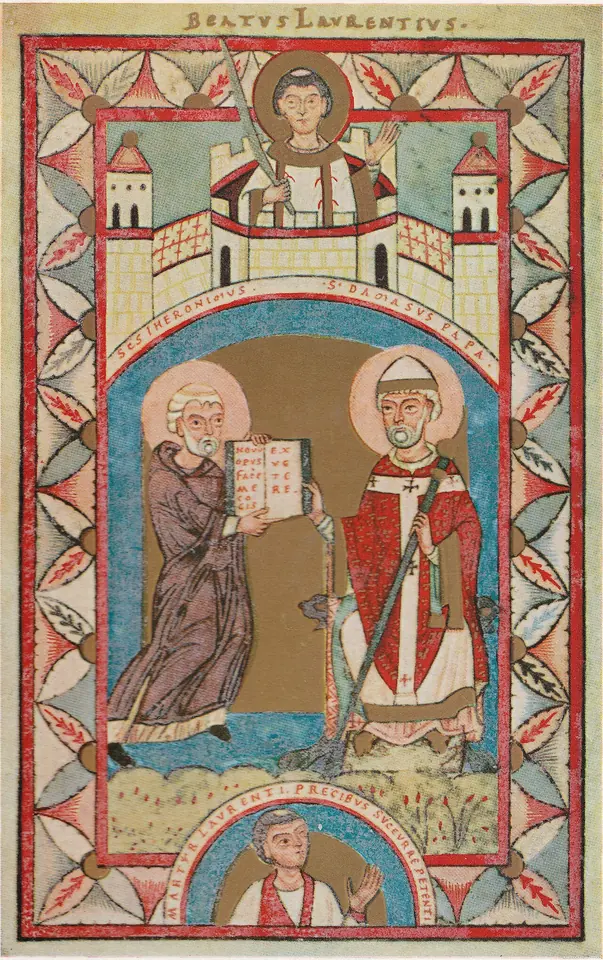
Damasus appears in papal vestments with the pallium, often holding a book. In medieval Bibles he is paired with St. Jerome: the scholar hands the pope his translation, or the two flank the opening words of Jerome's preface, as in the Limoges Bible on this page. Later art sometimes adds a marble tablet with an inscription, for his catacomb verses. When you see a pope receiving a book from a man in a cardinal's red or a monk's habit, you are probably looking at Damasus and Jerome.

Feast day, relics and prayer
We keep the feast of St. Damasus on December 11, the day of his death in 384, an optional memorial on the General Roman Calendar. Find his neighbors on our feast days page. His original tomb is lost; his relics are honored at San Lorenzo in Damaso, under an altar medallion that reads "Corpus S. Damasi." No miracles of Damasus are recorded, not even traditional ones. The Church remembers him for his labors, not for wonders.
The Church's own prayer for his day, the Collect of the Roman Missal, asks:
Grant, we pray, O Lord, that we may constantly exalt the merits of your Martyrs, whom Pope Saint Damasus so venerated and loved. Through our Lord Jesus Christ, your Son, who lives and reigns with you in the unity of the Holy Spirit, God, for ever and ever.
Let us ask St. Damasus to pray for all who study and translate the Scriptures, for those who keep the memory of the martyrs, and for the unity of the Church around the chair of Peter.
Frequently asked questions
Who was Pope St. Damasus I?
The bishop of Rome from 366 to 384, born about 305, whose father served the church of St. Lawrence in Rome. His election was contested by the followers of Ursinus, and he spent his reign defending the faith of the Council of Nicaea, strengthening the Roman see and honoring the martyrs.
What is St. Damasus known for?
Three things above all. He asked St. Jerome to revise the old Latin Gospels, which led to the Vulgate. He restored the martyrs' tombs in the catacombs and wrote verse inscriptions for them, carved in beautiful lettering by his friend Furius Dionysius Filocalus. And he held synods against the Arian and Apollinarian heresies.
When is the feast of St. Damasus?
December 11, the day he died in 384. It is an optional memorial on the General Roman Calendar. The Collect asks that "we may constantly exalt the merits of your Martyrs, whom Pope Saint Damasus so venerated and loved."
Where is St. Damasus buried?
He was first buried with his mother and sister in a small basilica he built between the Via Appia and Via Ardeatina, whose exact location is now lost. His relics are honored today at the Basilica of San Lorenzo in Damaso in Rome, the church that grew from his family home.
Keep exploring
Sources
- Thomas Shahan, Pope St. Damasus I (Catholic Encyclopedia, 1908). The Ursinus conflict, his synods, the request to Jerome, the inscriptions of Filocalus, the 1902–1903 discovery of his mother Laurentia's epitaph
- Roman Catacombs (Catholic Encyclopedia, 1908). Damasus enlarged the burial chambers, opened light shafts and built broader stairways for pilgrims
- St. Jerome, Letter 15, to Pope Damasus
- Basilica of San Lorenzo in Damaso: Il Papa San Damaso. His verse confessing he wished to be buried among the martyrs but feared to disturb their ashes
- Optional Memorial of St. Damasus I, Collect (Catholic Culture)
- Louise Ropes Loomis, The Book of the Popes (Liber Pontificalis), New York: Columbia University Press, 1916