St. Elizabeth Rose: The Benedictine Nun of Chelles Who Founded the Abbey of Rozoy

St. Elizabeth Rose (died 1130) was a Benedictine nun of the royal abbey of Chelles who became a hermit in a marshy wood at Rozoy and then founder and first abbess of a monastery there. A local saint of France, she is honored on December 13. Only a little of her story has come down to us.
Who was St. Elizabeth Rose?
St. Elizabeth Rose was a French Benedictine nun of the early twelfth century who left a great royal abbey to live alone in the woods, and ended as the founder and first abbess of a new monastery. She began religious life at Chelles, east of Paris, and finished it at Rozoy in the Gâtinais, about two leagues from the town of Courtenay. She died there in 1130.
We keep her feast on December 13. She is a local saint, honored in France, and we should say plainly at the start that very little about her survives: a handful of facts in the old French collections of saints' lives, repeated in later dictionaries. What follows is that little, told as faithfully as we can.
The life of St. Elizabeth Rose
A noble daughter
Our sources do not agree on where she was born. The French calendar Nominis says Burgundy; Agnes Dunbar's Dictionary of Saintly Women (1904) says the diocese of Troyes, in Champagne. Dunbar gives her a noble family: her father was Raoul (Radulph) de Crépy, and her mother Adèle, countess of Bar-sur-Aube. If that is right, she belonged to one of the great families of northern France, and Dunbar records that her sister married into the comital houses of Champagne and Vermandois.
A nun of Chelles
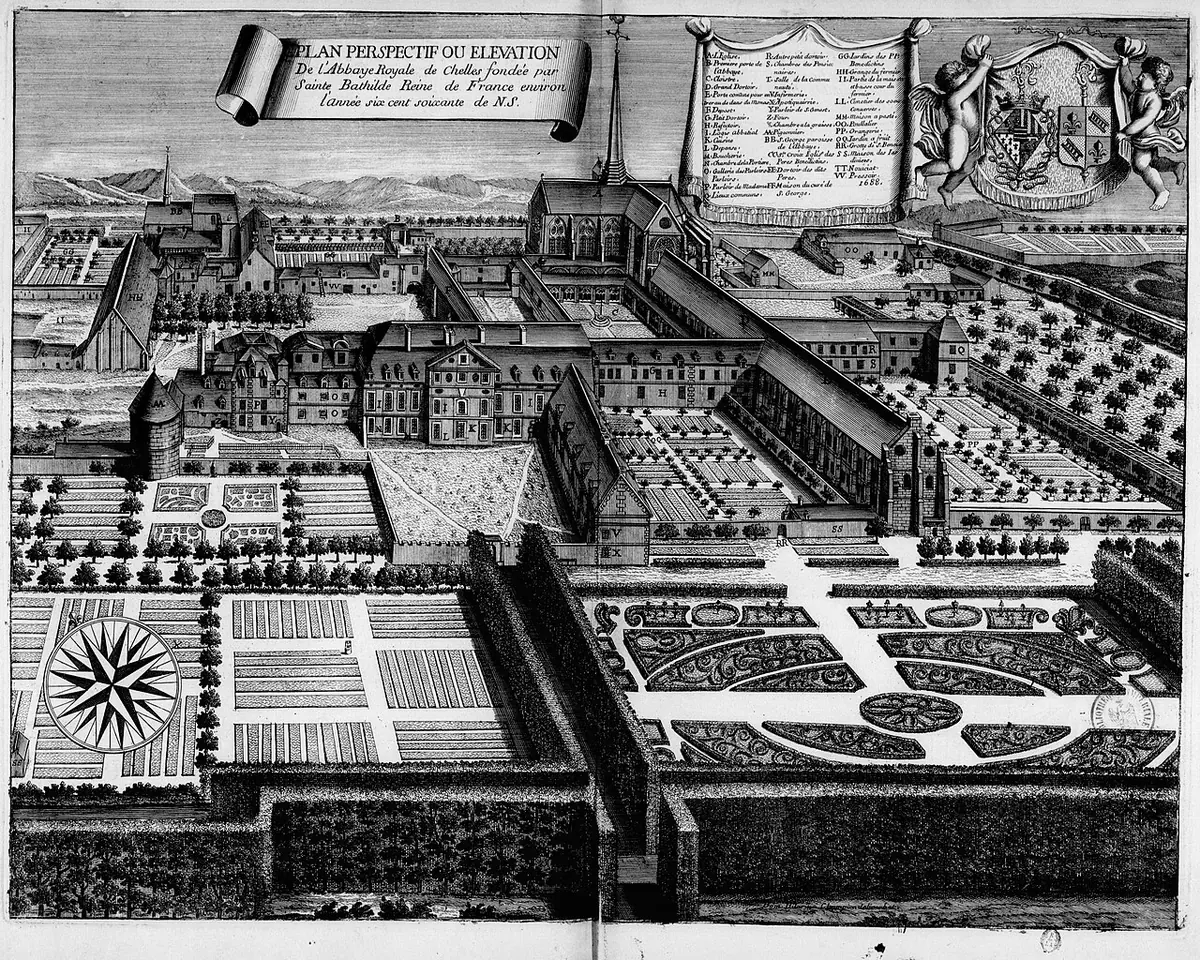
She entered the abbey of Chelles very young. Chelles was one of the oldest and wealthiest convents in France, founded in the seventh century by Queen Bathilde. Dunbar says Elizabeth used her family's connections for the good of her community, winning protection and privileges for the abbey through her kinsman Raoul of Vermandois, seneschal of France under King Louis VI.
Into the wilderness
Comfort was not what she wanted. Nominis speaks of her strong desire for solitude and a harder life. With two nuns she left Chelles for the country around Château-Landon, south of Paris. The three of them put up poor huts in a damp, marshy, unhealthy place at Rozoy. It was too much for her companions. Both lost heart and went back to Chelles.
Elizabeth stayed. Dunbar records that she made her home in a hollow oak and lived on roots and wild fruit. The shepherds and peasants of the district laughed at her at first.

From huts to an abbey
Her neighbors slowly changed their minds. They saw her goodness, and when other women came to join her, the same shepherds who had mocked her helped them build a house. Nominis adds that a gift from the Count of Nevers turned the cluster of huts into a real monastery. It took the name of Sainte-Marie du Rozoy, and Elizabeth was its first abbess. She governed it until her death in 1130.

Miracles of St. Elizabeth Rose
- Miracles in life and after death (reported). Dunbar writes that she was "distinguished for miracles, both in her life and after her death." No particular miracle is described in the sources we have, and none was ever examined by the Church.
- The hermit in the oak (traditional). The picture of the noble nun living in a hollow tree, fed on roots, is the one detail every account keeps.
Symbols of St. Elizabeth Rose in art
We have not found any old painting, statue or icon of St. Elizabeth Rose. Her cult stayed local, and her abbey was later destroyed. If she is shown, the signs to look for are:
- The black Benedictine habit and veil: she lived under the Rule of St. Benedict from Chelles to Rozoy.
- An abbess's crosier: she was the founder and first abbess of Rozoy.
- A hollow oak: her hermitage in the woods.
Where St. Elizabeth Rose is honored
Some years after her death, Dunbar records, the abbey at Rozoy was destroyed in the wars with England, and the nuns moved to Villechasson, in the Gâtinais. There they kept her memory and called her Ste. Rose de Villechasson. Paul Guérin, the nineteenth-century French hagiographer, noted that she appears among the saints in the martyrology of France and in Gallia Christiana, the great history of the French dioceses and abbeys.

The village of Rozoy-le-Vieil, in the Loiret near Courtenay, still has its old parish church. Nothing we have found says where her body rests today.

Her feast is December 13; see the feast day calendar.
Prayer to St. Elizabeth Rose
There is no traditional prayer to St. Elizabeth Rose in the standard prayer books, and we will not invent one. Her story speaks to anyone who has started something good and watched the others walk away. We can ask her help simply: "St. Elizabeth Rose, pray for us."
Let us ask her for the courage to stay where God has put us, even when it is lonely, and for the patience to win over those who laugh.
Frequently asked questions
When is the feast day of St. Elizabeth Rose?
December 13, kept as a local feast in France. It is the same day as the much better-known feast of St. Lucy.
Why is she called Elizabeth Rose?
She is remembered by the place where she founded her monastery, Rozoy (also spelled Rosoy) in the Gâtinais, and the "Rose" in her name seems to come from it. Her nuns later called her Ste. Rose de Villechasson, after the place they moved to.
Where did St. Elizabeth Rose live?
She was first a nun at the abbey of Chelles, east of Paris. With two companions she left for the country near Château-Landon and settled in a marshy place at Rozoy, about two leagues from Courtenay, where she founded the abbey of Sainte-Marie du Rozoy and died in 1130.
Keep exploring
Sources
- Agnes Dunbar, A Dictionary of Saintly Women, vol. 1 (1904), St. Elisabeth Rose (archive.org). her family, Chelles, the hollow oak, the shepherds, the move to Villechasson, Guérin and Gallia Christiana
- Nominis: Sainte Elisabeth Rose. born in Burgundy, entered Chelles very young, the gift of the Count of Nevers, local feast December 13