Blessed Thomas Percy, Earl of Northumberland and Martyr

Blessed Thomas Percy (1528–1572), 7th Earl of Northumberland, was a Catholic nobleman who led the failed Rising of the North in 1569, was handed over to Elizabeth I's government, and was beheaded at York on August 22, 1572 after refusing an offer of his life if he would give up the Catholic faith. Pope Leo XIII beatified him in 1895. We keep his feast on August 22.
Who was Blessed Thomas Percy?
Blessed Thomas Percy was the Earl of Northumberland who gave his life rather than give up the Catholic faith. Born in 1528 into the most powerful family of the English North, he lost his father to the executioner when he was eight, won back the family's titles under Queen Mary, led the failed Northern Rising of 1569 against Elizabeth I, and was beheaded on the Pavement at York on August 22, 1572.
The Church honors him as a martyr because, in the last hours of his life, he was offered his life if he would abandon his religion, and he refused. Pope Leo XIII beatified him on May 13, 1895.
A son of the Pilgrimage of Grace
His father, Sir Thomas Percy, was hanged at Tyburn on June 2, 1537, for a leading part in the Pilgrimage of Grace, the northern rising against Henry VIII's attack on the monasteries. Many Catholics count him a martyr too. Young Thomas and his brother Henry were taken from their mother and placed with Sir Thomas Tempest.
In 1549 an Act of Parliament restored him "in blood," and he was knighted soon after. Under Queen Mary he took back Scarborough Castle from rebels in 1557, and the earldom of Northumberland was restored to him. As Warden General of the Marches he fought and defeated the Scots. In 1558 he married Anne Somerset, daughter of the Earl of Worcester, whom the Catholic Encyclopedia calls "a valiant woman who subsequently suffered much for the Faith."
The Rising of the North
When Elizabeth came to the throne, the Earl's loyalty to the old faith was well known. She kept him in the North while her first Parliament passed its laws against Catholic worship, yet she still gave him the Order of the Garter in 1563. As the persecution tightened, the Catholic gentry of the North began in 1569 to plan the release of Mary, Queen of Scots, and freedom to worship. Percy and the Earl of Westmorland wrote to the Pope for advice, but events overtook them before an answer came. In November 1569 they entered Durham, and Mass was sung again in the cathedral.
The rising collapsed within weeks. Percy fled to Scotland, was captured, and was held for nearly three years at Lochleven Castle. His wife, in exile in Flanders, tried in vain to win his release. In 1572 the Scots sold him to the English government.
At Lochleven, his early biographer Nicholas Sander says, he spent whole days on his knees, and when he grew too weak to kneel he copied prayers into a book in his own hand. Sander saw that book, "elegantly written and illuminated," and wrote that when the Earl could pray no longer, "his handwriting still continued ever pleading for him."

His last night and martyrdom at York
He reached York on August 21, 1572. There, according to Sander and Cardinal Allen, his life was offered to him if he would give up his religion. He refused, and was told he would die the next afternoon. A Protestant dean and a minister came to argue with him that night; even his jailer, Sir John Forster, admitted afterward that he had never seen in the Earl "such wisdom, eloquence, and modest firmness." When his servant John Clerk begged him to rest, he answered: "If Christ chid His disciples for not watching one hour with Him, do you wish me, who have so little of life left, to sleep for an hour?"

On the scaffold on the Pavement he made the sign of the cross on the steps and spoke to the crowd. Sander records his words:
Know, therefore, that, from my earliest years down to this present day, I have held the Faith of that Church which, throughout the whole Christian world, is knit and bound together; and that in this same Faith I am about to end this unhappy life. But, as for this new Church of England, I do not acknowledge it.
He grieved aloud for the poor men who had died after the rising, forgave everyone, kissed a cross he traced on the ladder, and laid his head on the block with the words, "Lord, receive my soul!" He was forty-four. A dispatch to Lord Burghley put the hour at three in the afternoon, and it was a Friday, the octave day of the Assumption.
Relics, burial and his daughter's convent
- Reported: Sander writes that the people soaked up his blood with handkerchiefs and linen so carefully "that not even a straw stained with it was suffered to remain," to keep as relics.
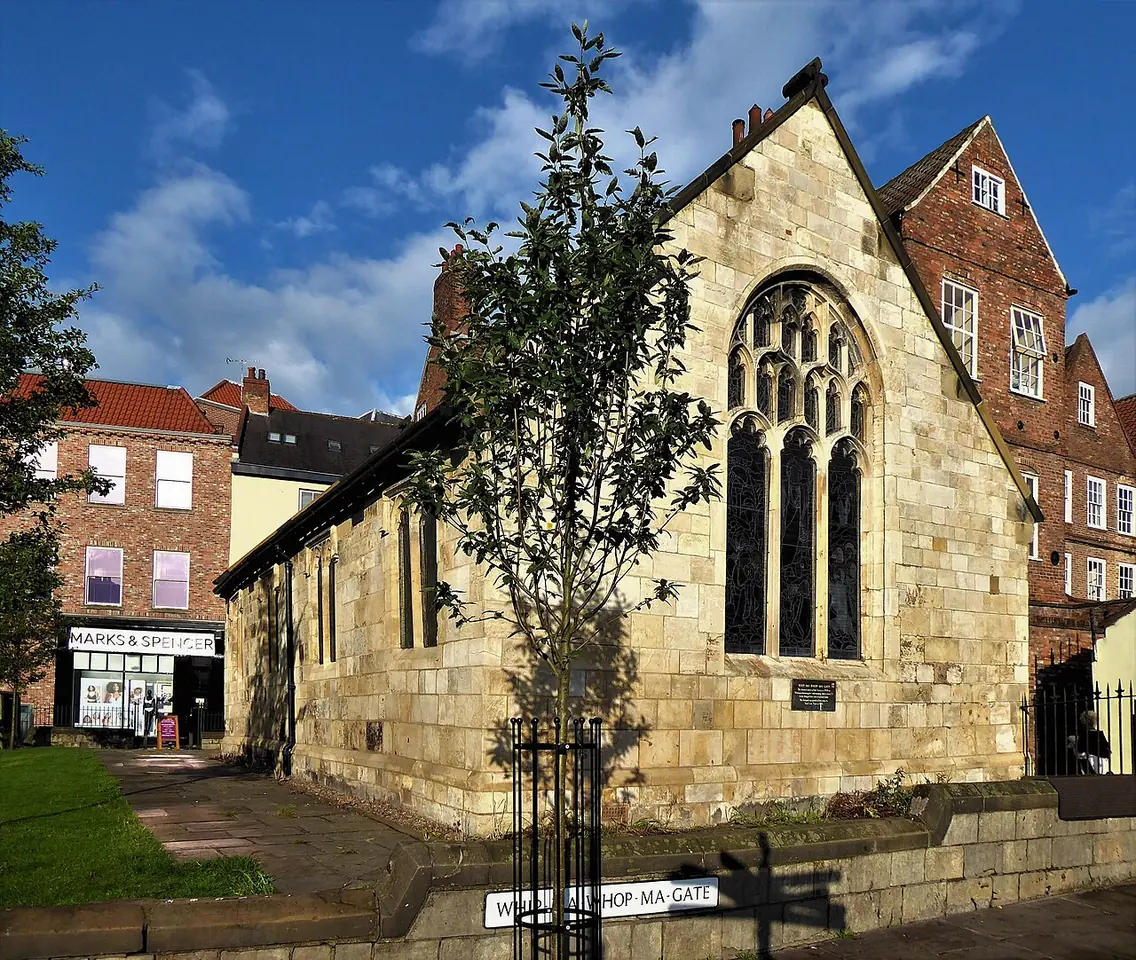
His head was set on Micklegate Bar for two years and then stolen. Two of his servants buried the body in St Crux church at the end of the Pavement. St Crux was pulled down in 1887, and his grave is lost; only a small parish room built from its remains stands there today.
He also wore a thorn said to be from the Crown of Thorns, given to him by Mary, Queen of Scots. He left it to his eldest daughter, Elizabeth, who gave it to the Jesuits, and Camm's Lives of the English Martyrs records it at Stonyhurst College. His youngest daughter, Mary Percy, founded a convent of Benedictine nuns at Brussels in 1598, and the Catholic Encyclopedia says nearly all the houses of English Benedictine nuns descend from it.
Symbols of Blessed Thomas Percy in art
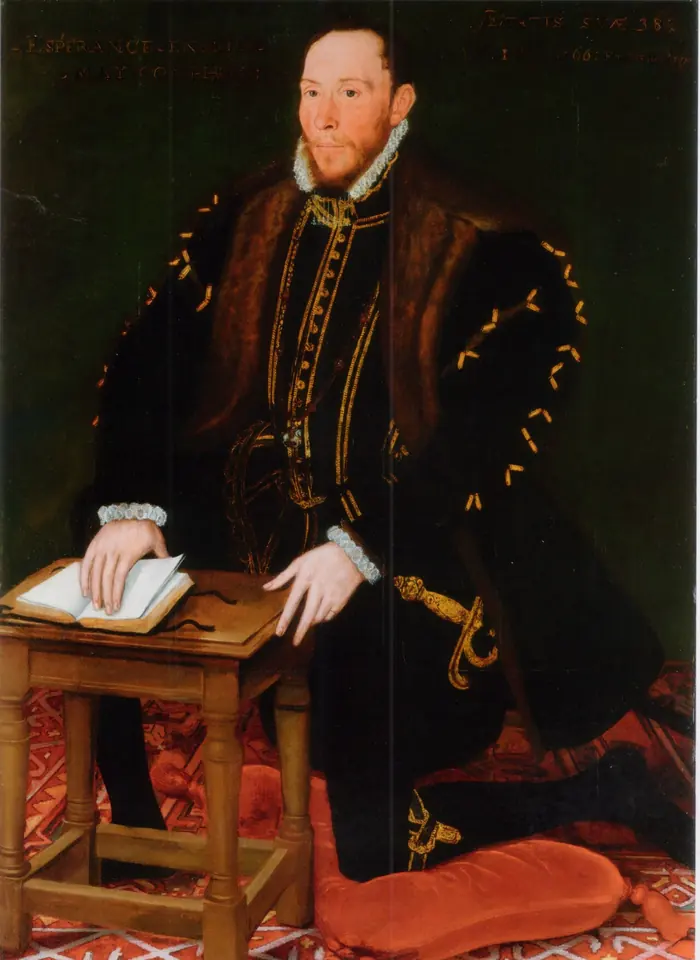
No old cult image of him survives, but the portraits painted in his lifetime show how he wished to be seen:
- The Garter collar and earl's dress, the honors he held and was willing to lose;
- The prayer book open before him in the 1566 portrait, a fitting sign for the man who wrote out his own prayers in prison;
- The kneeling posture on a cushion, the pose of a man at prayer.
In devotional pictures of the English martyrs he may be shown with the martyr's palm and the axe and block of a beheaded nobleman. You can recognize him by the beard, the black Tudor clothes and the Garter.
Feast day and prayer
We keep the feast of Blessed Thomas Percy on August 22. See the feast day calendar.
We know of no traditional prayer to him. His own last words make a good one to borrow: "Lord, receive my soul." Let us ask Blessed Thomas to pray for families divided by faith, for those tempted to buy safety with a lie, and for the Church in England.
Frequently asked questions
Who was Blessed Thomas Percy?
The 7th Earl of Northumberland, head of the great Percy family of the North of England. His father had been executed for the Pilgrimage of Grace. Thomas was restored to the family titles under Queen Mary, joined the Northern Rising of 1569 against Elizabeth I, and was beheaded at York in 1572, dying as a professed Catholic.
Why is Thomas Percy considered a martyr if he led a rebellion?
He was condemned for the rising, but the Catholic Encyclopedia and his early biographers record that at York his life was offered to him if he would abandon his religion, and he refused. On the scaffold he declared that he died in the faith of the Catholic Church. Leo XIII beatified him as a martyr on May 13, 1895.
When is the feast of Blessed Thomas Percy?
August 22, the day he was beheaded at York in 1572. At his beatification his feast was first assigned to the Diocese of Hexham and Newcastle on November 14.
Where is Blessed Thomas Percy buried?
Two of his servants buried his body in the church of St Crux at the end of the Pavement in York. The church was pulled down in 1887, and the exact place of his grave is lost. His head was set on Micklegate Bar for two years and then stolen.
Keep exploring
Sources
- Catholic Encyclopedia (1912): Bl. Thomas Percy. His family, career, the rising, his capture and sale, the offer of his life, his beatification on May 13, 1895, and his daughter Mary's Brussels convent
- Lives of the English Martyrs, vol. 2 (ed. Bede Camm, 1905; 1914 printing), chapter on BB. Thomas Percy and Thomas Plumtree. Nicholas Sander's account of his last night and scaffold speech, the burial in St Crux, the Holy Thorn at Stonyhurst and his prayer book written at Lochleven
- Catholic Encyclopedia (1909): English Confessors and Martyrs (1534-1729). His place among the Elizabethan martyrs and the laymen who suffered after the Northern Rising