St. Tamar, Right-Believing Queen of Georgia
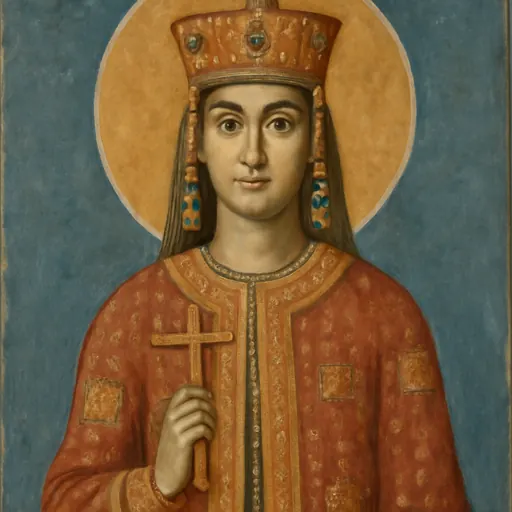
St. Tamar of Georgia (1166–1213) was the queen who ruled Georgia in its golden age, the first woman to reign over the country in her own right, called "king" in Georgian. She defended the Christian kingdom in battle, built churches and the cave monastery of Vardzia, and lived in prayer and fasting. The Orthodox Church honors her as a right-believing queen on May 1.
Who was St. Tamar of Georgia?
St. Tamar was the queen of Georgia from 1184 to 1213, and the Orthodox Church honors her as a saint, a "right-believing" ruler who governed by day and prayed through the night. She was the first woman to rule Georgia in her own right. In Georgian she is called mepe, "king," because she reigned as a monarch and not as a consort.
Her reign is remembered as Georgia's golden age. Her armies won victories that made the small Christian kingdom the leading power of the Caucasus, and she built and endowed churches and monasteries at home and across the Christian East. The Church remembers her above all for her faith.
The life of St. Tamar
A daughter crowned
Tamar was born in 1166, the daughter of King George III and Queen Burdukhan. Her father had no son, and he proclaimed that his daughter would share his throne from the age of twelve. The court swore allegiance to her, and father and daughter ruled together for five years. When George died in 1184, the nobles recognized the eighteen-year-old Tamar as sole ruler of all Georgia.
At the start of her reign she called a council of the Church. The Orthodox Church in America preserves her words to the bishops:
Judge according to righteousness, affirming good and condemning evil. ... Begin with me -- if I sin I should be censured, for the royal crown is sent down from above as a sign of divine service.
Two marriages
The Church and the court chose her first husband, Yuri, son of Prince Andrei Bogoliubsky of Vladimir-Suzdal, known in Georgia as George the Russian. He was a brave soldier but often drunk and given to immoral behavior, and the court finally sent him away to Constantinople with a generous settlement. Under pressure to secure the dynasty, Tamar married a second time. She asked her aunt Rusudan to choose, and the choice was Davit Soslan, a prince of Ossetian descent from the Bagrationi line.
Prayer before battle
In 1195 a Muslim coalition under the Atabeg Abu Bakr marched against Georgia. Tamar ordered vigils, Liturgies and generous alms so the poor could rest from work and pray. Then, the account says, she took off her shoes, climbed barefoot to the Metekhi Church of the Theotokos in Tbilisi, and prayed before the icon of the Mother of God until news came of victory at Shamkor.

Around 1203 Sultan Rukn al-Din came with an enormous army and demanded her surrender, offering marriage if she became a Muslim and threatening her with his harem if she refused. She answered:
I place my trust not in any army or worldly thing but in the right hand of the Almighty God and the infinite aid of the Cross, which you curse.
The Georgian army routed the sultan at Basiani. The Orthodox Church in America calls it a victory not only for Georgia but for the whole Christian world.
A queen at prayer
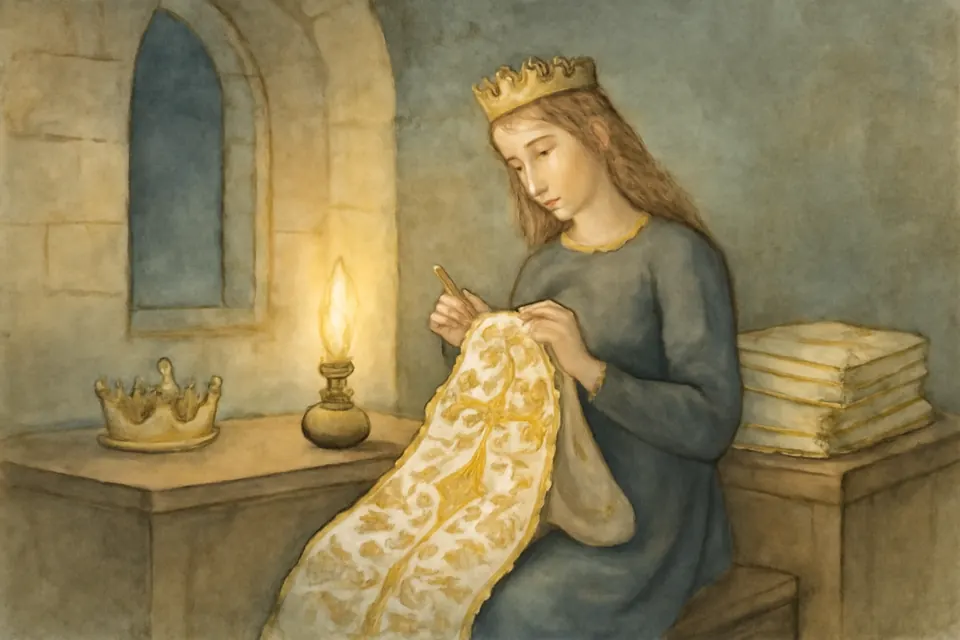
Tamar's holiness was hidden in plain sight. By day she governed in royal splendor; by night, the life says, she prayed on her knees for the Georgian Church. She embroidered with her own hands and gave her work to the poor. Once she dreamed of a jeweled throne in heaven and was told it belonged to a servant girl who had sewn vestments for twelve priests. When she woke, she sewed vestments for twelve priests herself.
Another time, dressing for a feast at Gelati, she kept a beggar waiting while she fastened a belt of rubies. When she came out he was gone. Grieved that she had turned Christ away in the poor, she took off the belt and gave it to the Gelati icon of the Mother of God.
Builder of churches
In her reign the cave monastery of Vardzia was carved into a cliff above the Mtkvari River, a whole city of churches and cells, and she would go there to labor during Great Lent. The churches of Pitareti, Kvabtakhevi, Betania and others were built in her time. She gave gifts to monasteries far beyond Georgia: in Palestine, Cyprus, Sinai, Mount Athos, Bulgaria, Greece, Constantinople and elsewhere. According to the life, she also abolished the death penalty and bodily torture.

Her death
Years of secret fasting, sleeping on stone and praying barefoot wore down her health. When she knew her time had come, she prayed before an icon of Christ and the Cross:
Lord Jesus Christ! Omnipotent Master of heaven and earth! To Thee I deliver the nation and people that were entrusted to my care and purchased by Thy Precious Blood, the children whom Thou didst bestow upon me, and to Thee I surrender my soul, O Lord!
She died in 1213. Where she was buried is still a mystery. Some sources place her tomb at Gelati among the Bagrationi kings; others say her relics rest in the Monastery of the Holy Cross in Jerusalem.
Miracles and holiness
The lives of St. Tamar do not center on miracles. Her holiness is told through her prayer, fasting, charity and faith in war. The victories at Shamkor and Basiani are historical events; that they came through her prayers is the traditional faith of the Georgian Church. The dream of the twelve vestments and the story of the ruby belt are traditional accounts from her life.
Symbols of St. Tamar in art
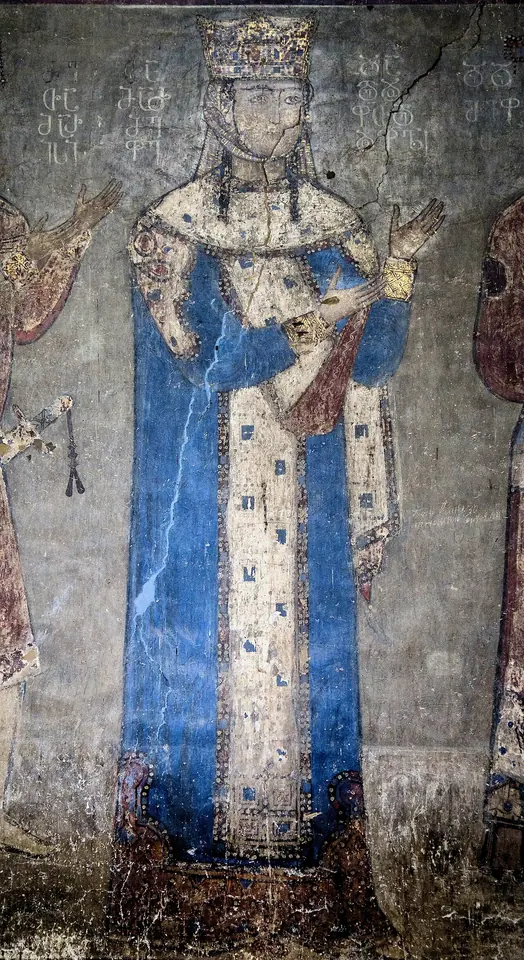
St. Tamar is one of the few saints whose portraits were painted in her lifetime or soon after, on church walls at Vardzia, Betania, Kintsvisi and Bertubani.
- Tall crown with hanging pendants: the Georgian royal crown.
- Long royal robe with jeweled bands: her rule as king.
- Cross in her hand: the faith she defended.
- Model of a church: her foundations, in later icons.
- Icon of the Mother of God: the prayer before battle.
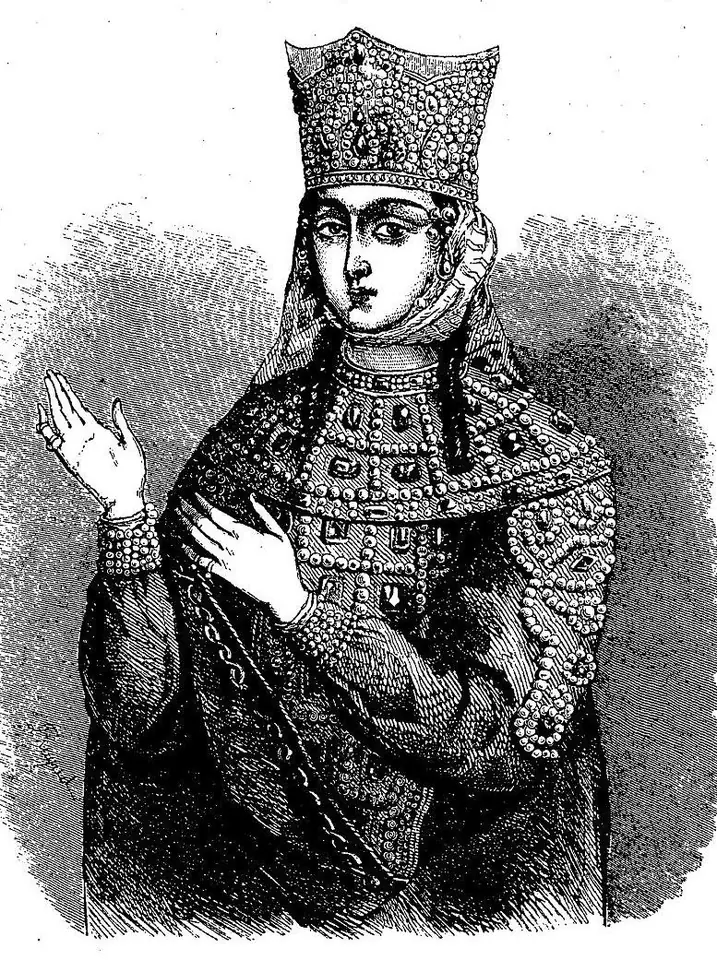
The medieval portraits show her as a donor, standing in full royal dress beside her family. Later Georgian and Russian prints, like the 1884 engraving below, follow the same crown and robes.
Feast day and where she is honored
We remember St. Tamar on May 1 (May 14 on the civil calendar where the Julian calendar is kept) and on the Sunday of the Myrrh-bearing Women. She is honored throughout Georgia, where churches, schools and streets bear her name. She is a saint of the Orthodox Church. See more saints of the season on our feast days page.
Prayer to St. Tamar
The Orthodox Church sings a troparion (Tone 1) in her honor that praises the queen for choosing heavenly sweetness over earthly pleasure and living like an angel during her reign; the OCA prints the full text on its website.
Let us ask St. Tamar to pray for Georgia, for all who govern, for women who carry heavy responsibility, and for the persecuted Christians of the East.
Frequently asked questions
Who was St. Tamar of Georgia?
The daughter of King George III, crowned co-ruler at about twelve and sole ruler at eighteen, in 1184. She reigned until 1213, won great victories at Shamkor and Basiani, endowed monasteries from Georgia to Sinai and Mount Athos, and is venerated by the Orthodox Church as a saint.
Why was Queen Tamar called King Tamar?
Because she reigned as a monarch in her own right, not as a king's wife. The Orthodox Church in America notes that in Georgian she is called 'King' (mepe) for this reason.
When is St. Tamar's feast day?
May 1 (May 14 on the civil calendar, for the Georgian Church, which keeps the Julian calendar). She is also remembered on the Sunday of the Myrrh-bearing Women.
Where is Queen Tamar buried?
No one knows for certain. Some sources place her tomb at Gelati Monastery, among the Bagrationi kings, and others in the Monastery of the Holy Cross in Jerusalem.
Keep exploring
Sources
- Right-believing Tamara, Queen of Georgia, Orthodox Church in America. Her life, her words to the Church council, her two marriages, the battles of Shamkor and Basiani, her letter to the sultan, the vision of the twelve vestments, the ruby belt at Gelati, her foundations, her dying prayer and the two claimed burial places
- Right-believing Tamara, Queen of Georgia: Troparion and Kontakion, Orthodox Church in America. Full text of the troparion