St. Syncletica of Alexandria, Mother of the Desert
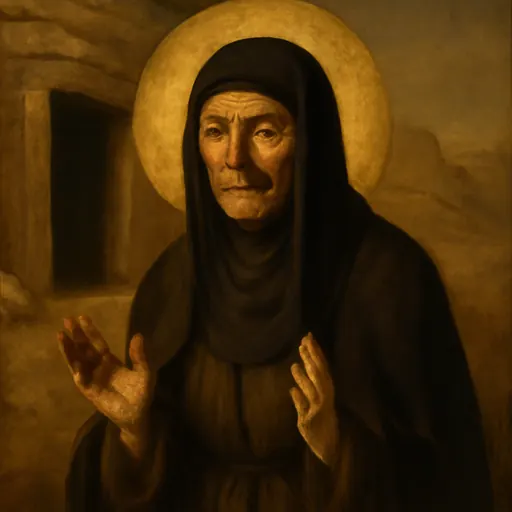
St. Syncletica of Alexandria was a woman of fourth-century Egypt who gave her fortune to the poor and withdrew with her blind sister to a family tomb. Her teachings were kept among the Sayings of the Desert Fathers. We keep her feast on January 5, and she is honored as one of the first mothers of women's monastic life.
Who was St. Syncletica of Alexandria?
St. Syncletica of Alexandria was one of the first great women of Christian monastic life. Born in fourth-century Alexandria to a wealthy family, she turned down every offer of marriage, gave away her inheritance, and spent the rest of her long life in prayer in an empty tomb outside the city. Women came to her for guidance, and the words she spoke to them were remembered. The Greek collections of the Sayings of the Desert Fathers place them beside those of the great abbas, and so she is often called Amma Syncletica, "Mother" Syncletica. You can read more about her world on our Desert Fathers page.
Almost everything we know comes from one ancient Life. Butler says its author seems to have known her personally. It was long attributed to St. Athanasius, but Butler already judged that attribution unproven.

The life of St. Syncletica
A wealthy daughter of Alexandria
Butler, following the ancient Life, says her parents were wealthy Macedonians who had settled in Alexandria. She was beautiful and rich, and young noblemen sought her hand. From childhood, though, she had set her heart on God, and she made a vow of virginity while still young. Butler writes that, "regarding herself as her own most dangerous enemy," she began early to tame her body with fasting.
Her two brothers died young. When her parents died, Syncletica inherited the family estate and the care of a sister who was blind.
The tomb outside the city
She gave her fortune to the poor. Then she took her sister and moved into an empty tomb on a relative's land outside Alexandria. There she sent for a priest and cut off her hair in his presence, renouncing the world. The Orthodox life calls her home simply a crypt, where she stayed for the rest of her life.
Mother to the women who came
Word of her life spread, and women began to come to her. At first, Butler says, her humility made her unwilling to teach, but charity won out. Women came to live near her under her direction, and her words were written down.

The sayings of St. Syncletica
Her teaching is plain and practical. In Butler's English rendering of the Life, she told the women:
Oh, how happy should we be, did we but take as much pains to gain heaven and please God, as worldlings do to heap up riches and perishable goods!
She warned them that the spiritual life is never safe from attack, and used the image of a ship:
A ship sometimes passes safe through hurricanes and tempests, yet, if the pilot, even in a calm, has not a great care of it, a single wave, raised by a sudden gust, may sink her.
She went on to say that "we have a most intelligent and experienced pilot at the helm of our vessel, even Jesus Christ himself." And on humility:
A treasure is secure so long as it remains concealed; but when once disclosed, and laid open to every bold invader, it is presently rifled; so virtue is safe as long as secret.

Her last illness
In her eightieth year she fell gravely ill. Butler describes a burning fever, a disease of the lungs and a spreading sore that ate away her mouth and took her speech. For three months she found no rest, and yet, he writes, her patience "served to preach to others more movingly than words could have done." The Orthodox life says the day of her death was revealed to her in a vision. Three days before the end she knew her release was near, and she died, Butler writes, "surrounded by a heavenly light," in her eighty-fourth year. The OCA places her death around 350.
Miracles and signs
No healings or wonders are attributed to her in the sources we have. The signs at her death, the vision and the light, are traditional, from the ancient Life. Her legacy is her teaching, read for sixteen centuries by monks and nuns.
Symbols of St. Syncletica in art
- Dark veil and mantle: the dress of a consecrated woman and of a nun in Byzantine icons.
- Hands raised in prayer: in the Menologion of Basil II she stands in the ancient orans posture.
- Cave, hut or tomb: Western prints set her in a rough hermit's cell, recalling the tomb she lived in.
- Skull and book: in the 1619 engraving by Bolswert, a skull lies at her feet, the hermit's reminder of death. The rosary in her hands there is an anachronism of the seventeenth-century artist.
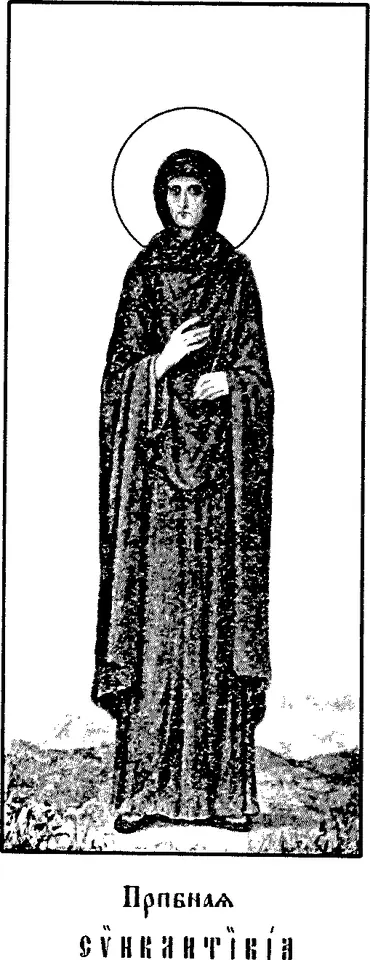
Russian icons, like the one from the Lives of the Saints below, show her standing in dark monastic robes. Look for the caption with her name, since many nuns are painted in the same way.
Her feast day
We keep her feast on January 5, the eve of the Epiphany, the day the Roman Martyrology gives her and the day the Orthodox Church in America keeps. See more saints of the season on our feast days page.
Prayer to St. Syncletica
The Orthodox Church in America gives this troparion (tone 8) for her feast:
The image of God was truly preserved in you, O Mother; / for you took up your cross and followed Christ; / by so doing, you taught us to disregard the flesh, for it passes away; / but to care instead for the soul, since it is immortal. / Therefore, O Venerable Synklētikḗ, your spirit rejoices with the Angels.
Let us ask St. Syncletica to pray for women in religious life, for all who care for a sick or disabled family member, and for anyone carrying a long illness with patience.
Frequently asked questions
Who was St. Syncletica of Alexandria?
A fourth-century woman of Alexandria, from a wealthy family of Macedonian origin, who refused marriage, gave away her inheritance and lived a life of prayer in a tomb outside the city. Women gathered around her as disciples, and she is remembered as Amma (Mother) Syncletica, one of the desert mothers.
When is the feast of St. Syncletica?
January 5 in the Roman Martyrology and the Orthodox calendar. Butler notes that some Greek calendars kept her on January 4.
What did St. Syncletica teach?
Watchfulness, humility and perseverance. She compared the soul to a ship that must be steered with care even in calm weather, and said virtue is safest when it is kept hidden, like a treasure.
Who wrote the Life of St. Syncletica?
An ancient Greek Life, written by someone who seems to have known her, was long attributed to St. Athanasius. Butler, writing in the eighteenth century, already judged that attribution unproven.
Keep exploring
Sources
- Venerable Synkletika of Alexandria, Orthodox Church in America. The Orthodox life: her refusal of marriage, the crypt, her disciples, her illness in her eightieth year and death about 350
- Venerable Synkletika of Alexandria, Troparion and Kontakion, Orthodox Church in America. Text of the troparion quoted on this page
- Alban Butler, The Lives of the Fathers, Martyrs, and Other Principal Saints, vol. 1 (January), 1842 edition. January 5: her Macedonian family, her blind sister, the tomb on a relative's estate, the sayings quoted here, her last illness and the authorship of the ancient Life