St. Manuel González García: The Bishop of the Abandoned Tabernacle

St. Manuel González García (1877 to 1940) was a Spanish priest and bishop of Málaga and Palencia, called the Bishop of the Abandoned Tabernacle. After praying before a neglected tabernacle in a village church in 1902, he gave his life to bringing people back to Jesus in the Eucharist and founded the Eucharistic Missionaries of Nazareth. His feast day is January 4, and he is honored by Eucharistic associations around the world.
Who was St. Manuel González García?
St. Manuel González García was a Spanish priest and bishop who spent his life for Jesus in the Blessed Sacrament, especially in the tabernacles that people had forgotten. As a young priest he knelt before a neglected tabernacle in a village near Seville and never got over it. He became archpriest of Huelva, bishop of Málaga and then of Palencia, founded a whole family of Eucharistic associations and a congregation of sisters, and wrote books that priests still read. Spain calls him the Bishop of the Abandoned Tabernacle.
We keep his feast on January 4, the day he died in 1940.
The life of St. Manuel González
A carpenter's son in Seville
Manuel was born in Seville on February 25, 1877, the fourth of five children. His father, Martín González Lara, was a carpenter, and his mother, Antonia, kept the home. As a boy he won a place among the seises of Seville Cathedral, the choirboys who dance before the Blessed Sacrament on Corpus Christi and on the feast of the Immaculate Conception. He took the seminary entrance exam without telling his parents, and he paid his way through his studies by working as a servant. Blessed Marcelo Spínola ordained him a priest on September 21, 1901.
Before the tabernacle of Palomares
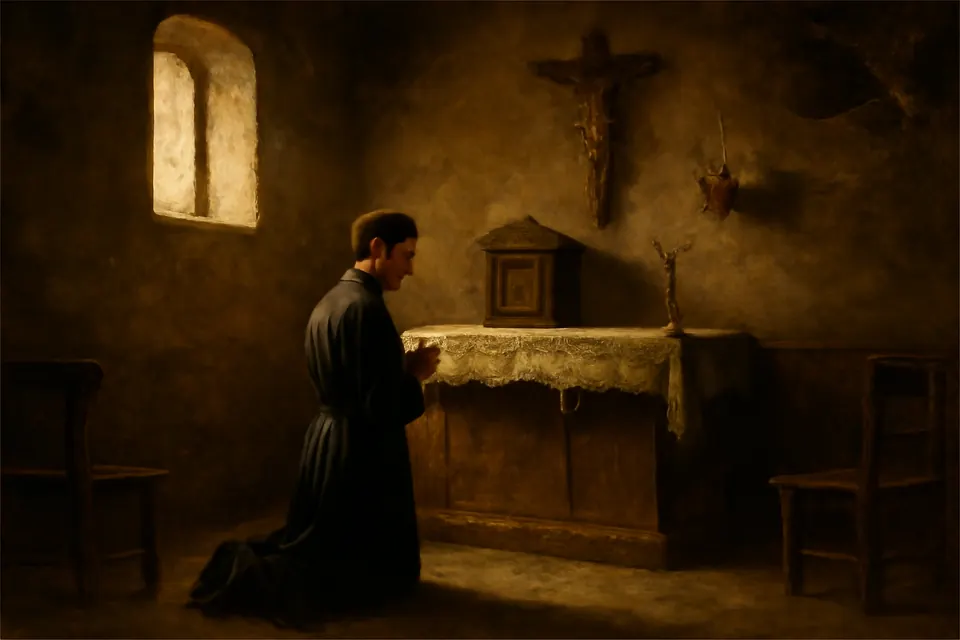
In 1902 he was sent to preach a mission in Palomares del Río, a village near Seville. The sacristan gave him a gloomy picture, and he went straight to the tabernacle. Years later he wrote about it (our translation from his Spanish):
I went straight to the tabernacle... and what a tabernacle, my God! What efforts my faith and my courage had to make there not to run off home! But I did not run. There on my knees... my faith saw a Jesus so silent, so patient, so good, looking at me... a gaze that said much to me and asked more of me, a gaze in which all the sadness of the Gospel was reflected.
That gaze, he said, became the starting point for everything in his priesthood.
Huelva and the Marys of the Tabernacles
In 1905 he went to Huelva as parish priest of San Pedro and soon archpriest of the city. He found widespread religious indifference and answered it with schools for poor children, catechism and a magazine, El Granito de Arena. On March 4, 1910, he spoke to a group of women who helped him in his work:
Allow me, who so often ask your charity for poor children and all the abandoned poor, to ask today your attention and your help for the most abandoned of all the poor: the Most Blessed Sacrament.
So began the Marys of the Tabernacles, women who would keep Jesus company in neglected churches. The work spread fast, with branches for men, children, priests and young people. In 1921, with his sister María Antonia, he founded a religious congregation, the Eucharistic Missionaries of Nazareth. When he met Pope St. Pius X on November 28, 1912, he was introduced as "the apostle of the Eucharist."
Bishop of Málaga
Pope Benedict XV made him auxiliary bishop of Málaga, and he was consecrated on January 16, 1916. When he became bishop of the diocese in 1920, he celebrated by giving a banquet, not for the authorities, but for 3,000 poor children, and had the officials, priests and seminarians wait on them. His great project was a new seminary that would be, in his words, "substantially Eucharistic," with the Eucharist as its first teacher and its cornerstone.

Fire, exile and Palencia
When the Second Republic came in 1931, he was a target. On May 11, 1931, his episcopal palace in Málaga was set on fire, and he went to Gibraltar so as not to endanger those who sheltered him. From 1932 he governed the diocese from Madrid. On August 5, 1935, Pius XI named him bishop of Palencia, where he spent his last years. His health failed, and he died on January 4, 1940.

The miracles of St. Manuel González
- Sara Ruiz Ortega (approved). The healing of an eighteen-year-old woman from tuberculosis in Palencia province in December 1953 was approved in 1999 and opened the way to his beatification by John Paul II on April 29, 2001.
- María del Carmen Feijóo Varela (approved). The healing of a woman in Madrid in 2008, whose cancer regressed in a way doctors could not explain, was approved by Pope Francis in March 2016. He was canonized on October 16, 2016.
At the beatification, John Paul II called him "a model of Eucharistic faith whose example continues to speak to the Church today."
Why St. Manuel González is honored by Eucharistic associations
His whole life turned on one idea, which he called eucaristizar: to bring everyone close to the Eucharist. The family he founded, the Eucharistic Reparation Union, with the Eucharistic Missionaries of Nazareth, still keeps company with Jesus in forgotten tabernacles in Spain and the Americas, and they honor him as founder and father. See more patron saints.
Symbols of St. Manuel González in art
- The black cassock and red cape of a bishop, as in his photographs.
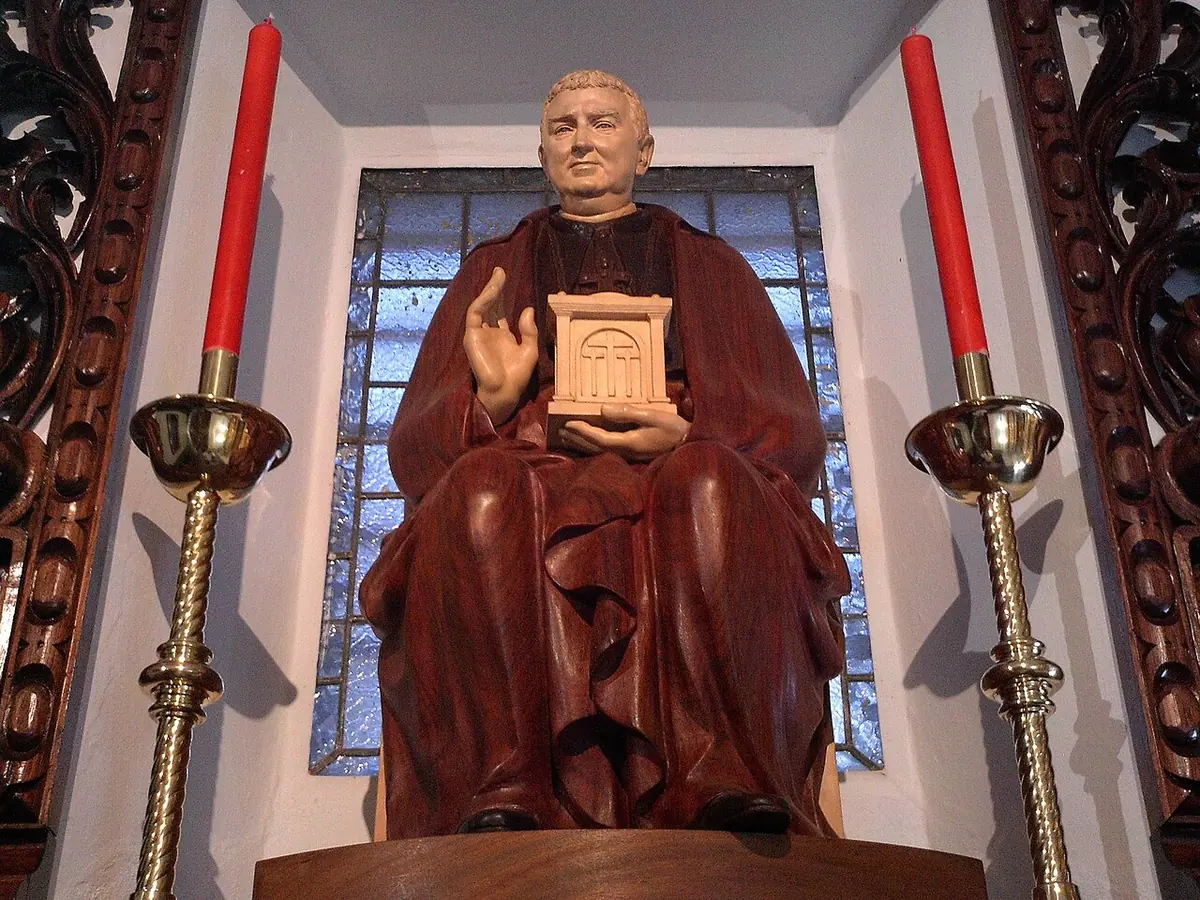
- A tabernacle in his hands, the sign of his whole mission, as in his statue at Palomares del Río.
- A monstrance, for his love of Eucharistic adoration.
Monuments to him stand in Huelva, where he was archpriest, and at the seminary of Málaga.

Feast day, tomb and his epitaph
His feast is January 4. See the feast day calendar. He is buried in Palencia Cathedral, beside the tabernacle, under the epitaph he wrote himself:
Pido ser enterrado junto a un Sagrario, para que mis huesos, después de muerto, como mi lengua y mi pluma en vida, estén siempre diciendo a los que pasen: ¡Ahí está Jesús! ¡Ahí está! ¡No lo dejéis abandonado!
In English: "I ask to be buried next to a tabernacle, so that my bones, after death, like my tongue and my pen in life, may always be saying to those who pass: Here is Jesus! He is here! Do not leave him abandoned!"

Prayer of St. Manuel González
His family keeps his own prayer to the Blessed Virgin, a cry for perseverance that fits every tired apostle:
¡Madre Inmaculada! ¡Que no nos cansemos! ¡Madre nuestra! ¡Una petición! ¡Que no nos cansemos!
"Immaculate Mother! May we not grow weary! Our Mother! One request! May we not grow weary!" Let us ask St. Manuel González to teach us to visit Jesus in the tabernacle and never leave him alone: "St. Manuel González, pray for us."
Frequently asked questions
When is the feast day of St. Manuel González García?
January 4, the day he died in 1940.
Why is he called the Bishop of the Abandoned Tabernacle?
In 1902, as a young priest sent to preach a mission in Palomares del Río, near Seville, he found the village tabernacle neglected and the church nearly empty. Kneeling there, he felt the gaze of Jesus left alone in the Blessed Sacrament, and he spent the rest of his life trying to bring people back to him.
What is written on the tomb of St. Manuel González?
He wrote his own epitaph, asking to be buried next to a tabernacle so that his bones would keep saying to all who pass: "Here is Jesus! He is here! Do not leave him abandoned!" He rests in the Chapel of the Blessed Sacrament of Palencia Cathedral.
When was Manuel González García canonized?
Pope Francis canonized him in St. Peter's Square on October 16, 2016, together with St. José Sánchez del Río and St. Elizabeth of the Trinity. John Paul II had beatified him on April 29, 2001.
Keep exploring
Sources
- Vatican: Manuel González García (1877-1940), biography (Spanish). the Palomares account in his own words, the 1912 audience with Pius X, the banquet for 3,000 children, the fire of May 11, 1931
- John Paul II, homily for the beatification of April 29, 2001. calls him a model of Eucharistic faith; the epitaph in English
- Unión Eucarística Reparadora: San Manuel González. the full epitaph; his prayer to Mary, "Que no nos cansemos"
- Catholic-Hierarchy: Bishop St. Manuel González y García. episcopal dates
- Wikipedia (Spanish): Manuel González García. only source found for the two approved miracles and his death in Madrid