St. Pulcheria, Empress and Virgin

St. Pulcheria (399–453) was the Byzantine princess and empress who ruled for her young brother Theodosius II, vowed her life to God as a virgin, and defended the faith at the Councils of Ephesus (431) and Chalcedon (451). Pope St. Leo the Great called her the "handmaid and pupil of the Truth." Her feast day is September 10.
Who was St. Pulcheria?
St. Pulcheria was a fifth-century Byzantine empress, the granddaughter of Theodosius the Great, who ruled the Eastern Roman Empire for her younger brother and spent her power and her fortune defending the faith. She vowed her virginity to God as a teenager, raised her brother to be a pious emperor, and stood behind the two great councils that taught the Church how to speak of Christ: Ephesus in 431 and Chalcedon in 451. The Orthodox call her "right-believing." We keep her feast on September 10.
Unlike many early saints, Pulcheria is well documented. The church historian Sozomen dedicated his history to her brother and wrote about her while she was alive, and her letters with Pope Leo the Great survive.
The princess who ruled for her brother
Her father, the emperor Arcadius, died in 408, leaving a son, Theodosius II, who was a small child, and three young daughters: Pulcheria, Arcadia and Marina. Pulcheria was not yet fifteen when, as Sozomen tells it, she took charge of her brother's upbringing and of the government in his name. In 414 she was proclaimed Augusta.
Sozomen describes her as "most wise and divine above her years." She spoke and wrote Greek and Latin with perfect accuracy. She had her brother trained in riding, arms and letters, and she taught him herself how to carry himself as an emperor: how to sit, how to walk, how to restrain laughter, and how to hear petitions kindly. Above all she taught him to pray and to honor the Church.
A vow made in public
Pulcheria vowed her virginity to God and led her sisters to do the same. To avoid scheming suitors, she let no man into her palace. Sozomen says she took "God, the priests, and all the subjects of the Roman empire" as witnesses, and gave the great church of Constantinople an altar of gold and precious stones inscribed with her vow and her brother's rule.
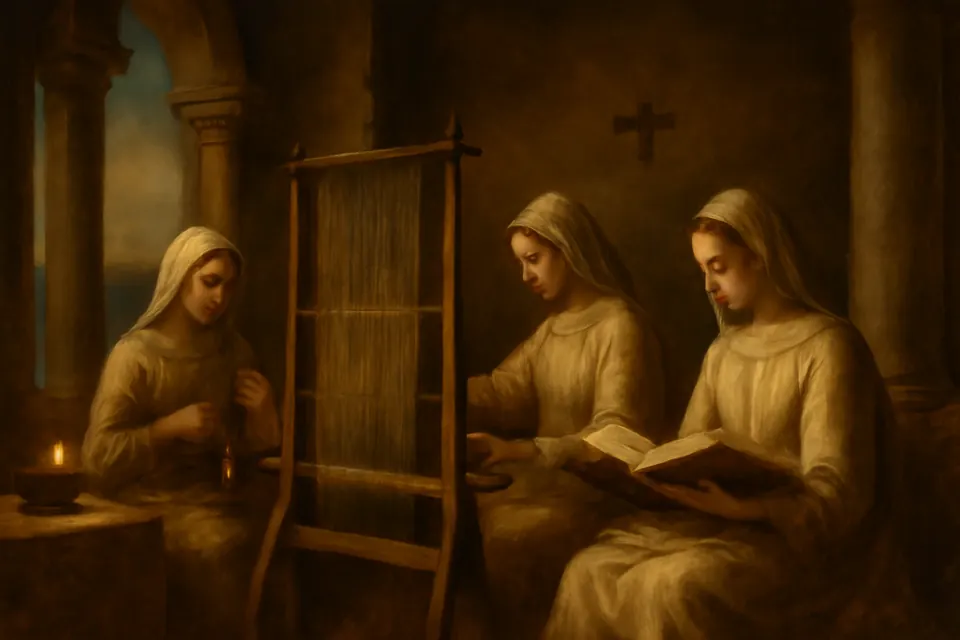
The sisters lived almost like nuns inside the palace. They ate and walked together, sang God's praises by day and night, and worked at the loom, giving generously to the poor and to strangers. Pulcheria built churches, hostels for travelers and monasteries, and endowed them.
Defender of the faith at Ephesus and Chalcedon
Two controversies about Christ divided the Church in her lifetime. In the 420s, Nestorius, the archbishop of Constantinople, refused to call Mary the Theotokos, the Mother of God. Pulcheria opposed him, and the Council of Ephesus condemned his teaching in 431. Pope Leo later praised her for this, saying the heresy of Nestorius had not escaped "you the handmaid and pupil of the Truth."
In the 440s her influence at court faded. The OCA's life of her says that intrigue, including the hostility of her brother's wife Eudokia, pushed her from power, and she lived in retirement. Meanwhile the monk Eutyches taught that Christ had only one nature after the Incarnation, and the "Robber Council" of Ephesus in 449 upheld him. Leo wrote to Pulcheria asking for her help.
Empress in her own right
Theodosius II died in 450. Pulcheria was proclaimed empress, the first woman to hold the Roman throne in her own name, and she married the respected senator Marcian so he could rule as emperor beside her. The marriage was in name only: she agreed on the condition that her vow be kept. Together they called the Council of Chalcedon, which met in October 451 and taught that Christ is one person in two natures, true God and true man. Pulcheria and Marcian attended its sixth session in person.
She died in 453 and was mourned as a mother of the Church. The Catholic Encyclopedia notes that she "is canonized by both Catholics and Orthodox."
The miracles of St. Pulcheria
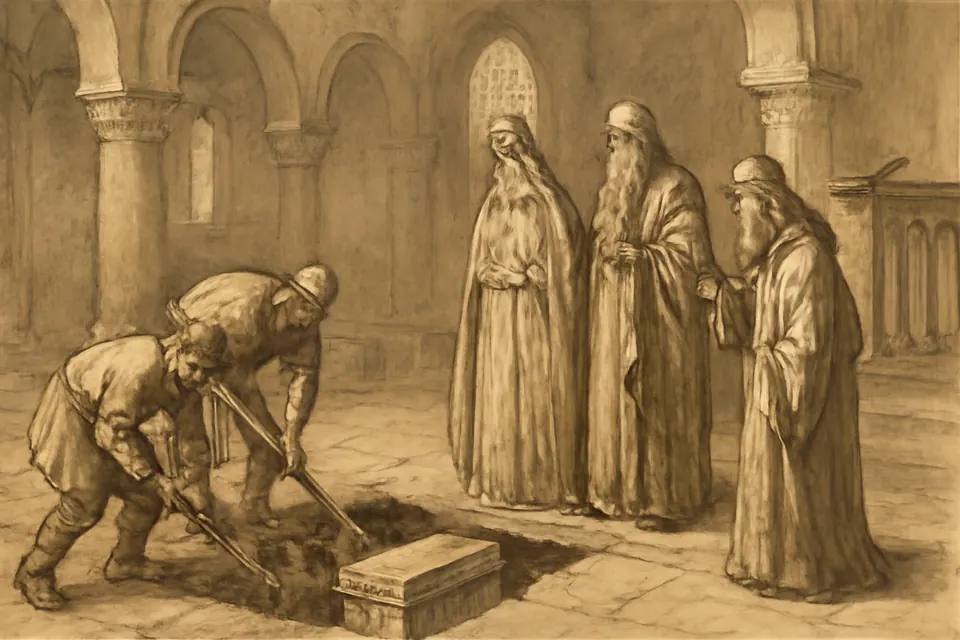
Sozomen tells of one wonder at length, and it is traditional: it was never examined by any later process, but it comes from a historian who wrote within her lifetime and attended the celebration that followed. The relics of the Forty Martyrs of Sebaste had been hidden under a church outside the city and forgotten. The martyr Thyrsus, Sozomen says, appeared to Pulcheria three times and told her where they lay, and the forty martyrs appeared to her "arrayed in shining robes." An old monk and a priest named Polychronius pieced together the location, the workers dug by the reading platform, and the relics were found exactly there, in two silver caskets packed with perfumes. Pulcheria gave thanks, placed the martyrs in "the costliest casket," and honored them with a public festival and a procession with psalms. Sozomen says he was there himself.
Sozomen adds that God often showed her what was going to happen. He gives no further details, and we leave them where he left them.
Patronages of St. Pulcheria
No formal patronage is attached to St. Pulcheria. She is remembered above all as a defender of the true faith about Christ and as a model of a consecrated virgin who lived in the world. For our list of causes and their saints, see patron saints.
Symbols of St. Pulcheria in art
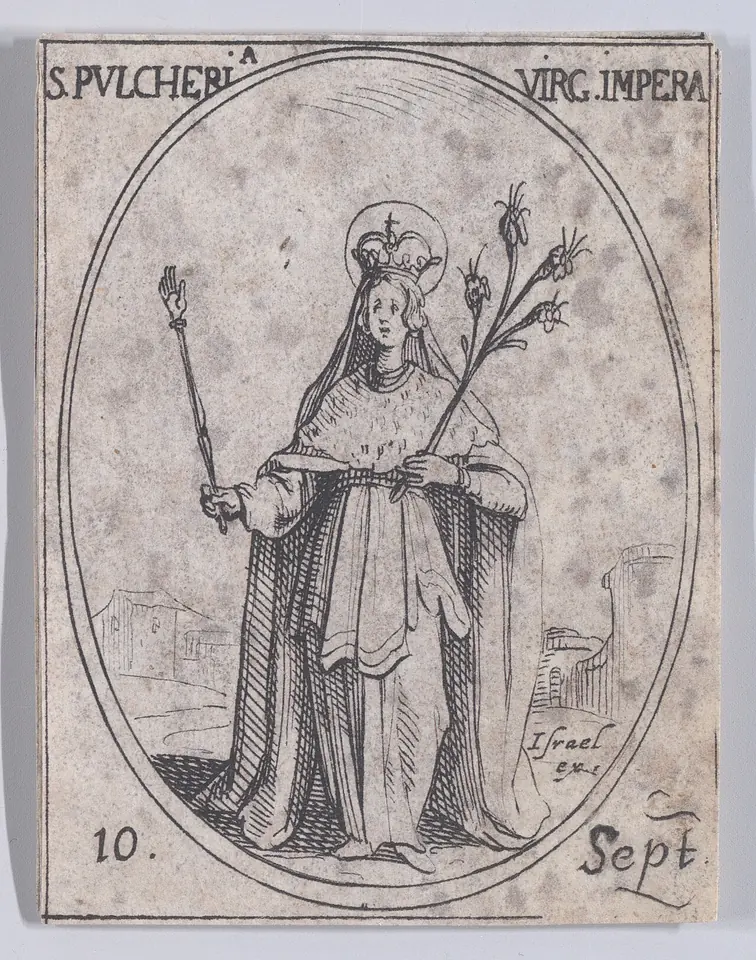
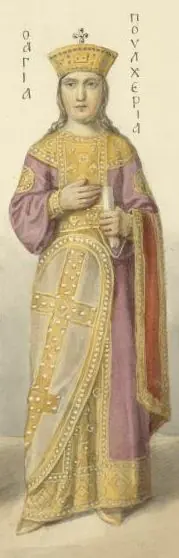
In Western prints like Callot's, St. Pulcheria wears a crown and holds a scepter, for her rule, and lilies, for her vow of virginity. In Byzantine and Russian icons she stands in the jeweled purple and gold robes of an empress, with a pearl-hung diadem, often holding a cross, and sometimes beside Marcian. Her own coins show her in profile with the diadem and, on the reverse, Victory holding a long cross. In a church, look for a crowned woman with lilies and a scepter, or for a Greek inscription naming her.
Where St. Pulcheria is honored
The OCA's life credits her with building the church of the Mother of God at Blachernae in Constantinople. A small church of St. Mary still stands on the site in the Ayvansaray district of Istanbul, over the ancient holy spring.
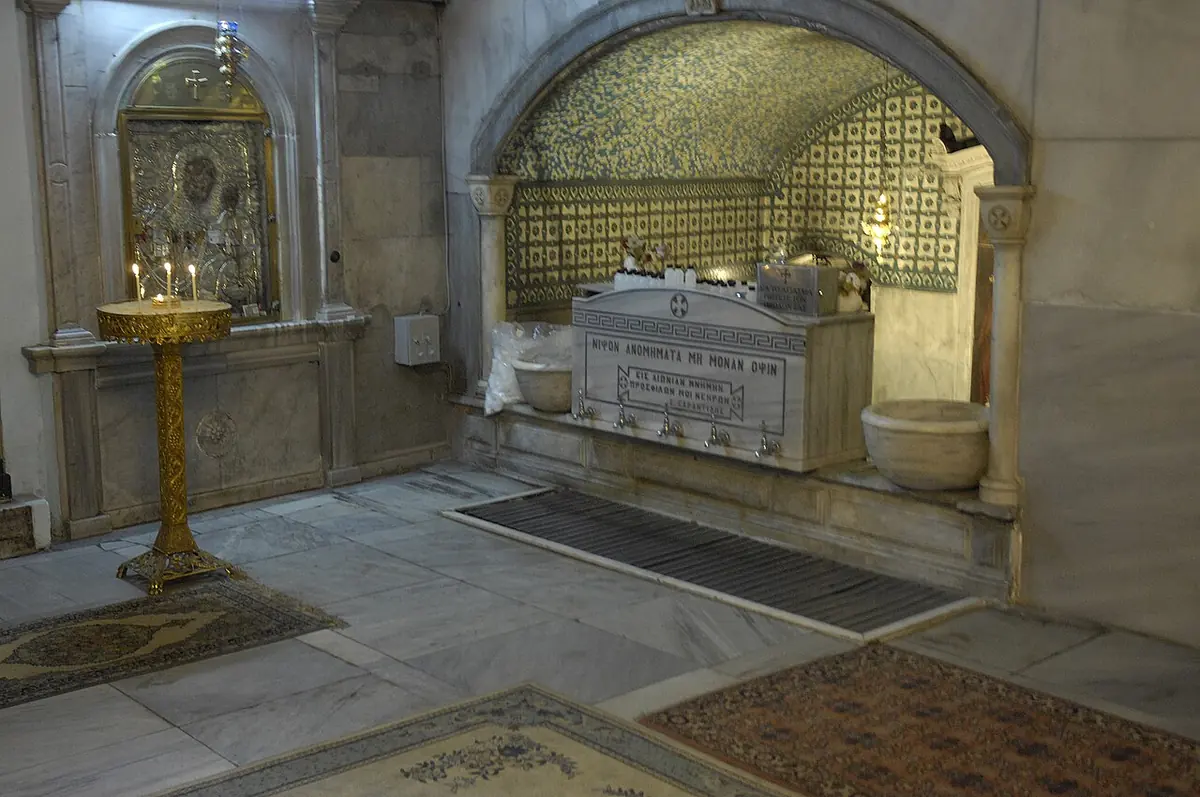
Her grave in Constantinople has not survived. She is remembered on September 10 throughout the Orthodox world and in the Roman Martyrology. See our feast days page for the saints around her date.
Prayer to St. Pulcheria
The Orthodox Church sings a troparion and kontakion for her feast, but we have found no traditional English prayer to her in the Catholic prayer books. We ask her help simply, for those who hold power and for the integrity of the faith:
St. Pulcheria, faithful empress and defender of the truth about Christ, pray for us.
Frequently asked questions
When is St. Pulcheria's feast day?
September 10, in both the Roman Martyrology and the Orthodox calendar. The Orthodox Church also remembers her with her husband, the emperor St. Marcian, on February 17.
Why is St. Pulcheria a saint?
For her consecrated virginity, her generosity to the poor and to churches, and above all for defending the Church's teaching about Christ against Nestorius and Eutyches. She helped bring about the Council of Chalcedon in 451.
Did St. Pulcheria marry?
Yes, but in name only. When her brother died in 450, she married the senator Marcian so he could rule as emperor, on the condition that her vow of virginity be kept. They lived as brother and sister.
What did St. Pulcheria find?
The relics of the Forty Martyrs of Sebaste, hidden for years under a church outside Constantinople. The historian Sozomen, her contemporary, tells the story.