St. Peter Yu Tae-chol, the Youngest Korean Martyr
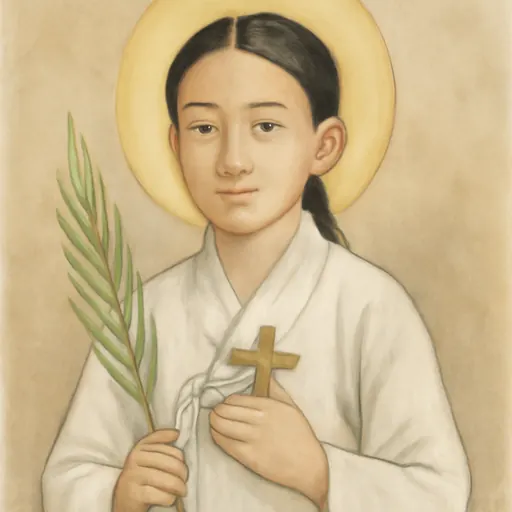
St. Peter Yu Tae-chol (1826–1839) was a Korean boy who gave himself up to the authorities during the persecution of 1839 and, after months of interrogation and beatings that never broke his faith, was strangled in prison in Seoul on October 31, 1839, at the age of thirteen. He is the youngest of the 103 Korean martyrs canonized by Pope John Paul II in 1984. We keep his feast with them on September 20.
Who was St. Peter Yu Tae-chol?
St. Peter Yu Tae-chol was a Korean boy martyred for Christ in 1839, at the age of thirteen. He was the son of St. Augustine Yu Chin-gil, a government interpreter who was himself martyred, and he gave himself up to the authorities of his own accord while his father was in prison. For months he was questioned and beaten, and for months he answered with a cheerful face that he would not deny God. He was strangled in prison in Seoul on October 31, 1839.
He is the youngest of the 103 martyrs of Korea whom Pope John Paul II canonized in Seoul on May 6, 1984. We keep his feast with them on September 20.

A son between his father and his mother
Peter was born in 1826 into a divided home. His father, Augustine, was a fervent Catholic. His mother would not become a Catholic, and according to the Catholic Bishops' Conference of Korea she "tried very hard to hinder her son from practicing his faith and to force him to offer sacrifices to the ancestors." His mother and his sister pressed him to explain why he would not obey her. He gently replied, in the bishops' account, that it was not proper to obey his mother and disobey the Heavenly King and the Father of all creatures.
The same account says that in everything except the faith, Peter obeyed his mother faithfully and tried not to hurt his family. He did not despise the people who opposed him; he simply would not give up God.

The persecution of 1839
In 1839 the Joseon government launched the persecution that Korean Catholics remember as the Gihae persecution. The bishop and the two French priests in the country were taken and beheaded, and Korean lay leaders such as St. Paul Chong Hasang died with them. Augustine Yu was among those arrested.
Peter was moved by the example of his father and the other prisoners. In July 1839 he went to the authorities and gave himself up. When the judge learned that he came from a Catholic family, he sent him to prison.
Thirteen years old and unafraid
The judge tried everything: persuasion, threats, beatings. The bishops' account records that Peter was interrogated fourteen times and tortured on fourteen occasions, and that at least ten witnesses later testified to what he suffered. Once a guard struck him and asked, "Do you still believe in God?" Peter answered, "Yes, I certainly do. I am not afraid of being hit." When the guard threatened to put a burning coal in his mouth, Peter opened his mouth, and the guard could not bring himself to do it. After one beating left him unconscious, he told his fellow prisoners, "Don't worry. I will not die because of this pain."
What struck everyone was his face. Through it all, the bishops write, "young Peter always had a happy, smiling face." The officials meant to beat him to death, but he lived, and so on October 31, 1839, he was strangled in prison. He was thirteen.

The witness of St. Peter Yu
Peter Yu worked no miracles that history records. The Church honors him as a martyr, and his canonization rests on his death for Christ, not on approved miracles. The wonder in his story is the one the Korean bishops name: a child who suffered more than most grown men could bear and kept smiling. Pope Pius XI beatified him with the other martyrs of 1839 and 1846 on July 5, 1925, and Pope John Paul II canonized him in Seoul. In his homily the Pope began his roll of the martyrs with this boy: "From the thirteen-year-old Peter Yu to the seventy-two-year-old Mark Chong, men and women, clergy and laity, rich and poor, ordinary people and nobles... they all gladly died for the sake of Christ."
He was not the only child in those prisons. St. Barbara Yi, a girl of fifteen, died of fever in a Seoul prison the same year.
Symbols of St. Peter Yu Tae-chol in art
There are no portraits of Peter Yu from his lifetime. Korean Catholic art shows him as a boy in a white hanbok, often with his hair in the long braid worn by unmarried boys of the Joseon era. He carries the martyr's palm, the ancient sign of victory through death, and sometimes a cross or rosary. In group paintings of the 103 Korean martyrs he is easy to find: he is the smallest figure, usually near the front. Artists rarely show his torments; he is painted, as the witnesses remembered him, with a peaceful face.
Feast day and where he is honored
We celebrate St. Peter Yu with all the Korean martyrs on September 20, the memorial of Sts. Andrew Kim Taegon, Paul Chong Hasang and Companions. Korean Catholics honor the martyrs at the shrines of Seoul: Seosomun, outside the old Little West Gate, where many of the martyrs of 1839 were executed, and Jeoldusan and Saenamteo by the Han River. The Korean bishops call him "a model for all Korean children." See our feast days calendar for other saints.

Prayer to St. Peter Yu Tae-chol
The Church prays for St. Peter Yu with all the Korean martyrs in the Mass and Office of September 20. We have not found a traditional prayer to him alone. Let us ask his prayers for children and teenagers who are mocked for their faith, for families divided over religion, and for young people facing persecution today. St. Peter Yu Tae-chol, pray for us.
Frequently asked questions
Who was St. Peter Yu Tae-chol?
The thirteen-year-old son of the martyr Augustine Yu Chin-gil. During the persecution of 1839 he turned himself in, refused under torture to deny God and was strangled in prison in Seoul on October 31, 1839. He is the youngest of the 103 Korean martyr saints.
When is the feast of St. Peter Yu Tae-chol?
September 20, the memorial of Sts. Andrew Kim Taegon, Paul Chong Hasang and Companions, the martyrs of Korea. He died on October 31.
How old was St. Peter Yu Tae-chol when he died?
Thirteen. Pope John Paul II named him first among the Korean martyrs when he canonized them in Seoul: 'From the thirteen-year-old Peter Yu to the seventy-two-year-old Mark Chong.'
Was St. Peter Yu's family Catholic?
His father, Augustine Yu Chin-gil, was a Catholic and a martyr, now also a saint. His mother refused to become a Catholic and tried hard to make her son give up his faith and offer sacrifices to the ancestors.
Keep exploring
Sources
- Catholic Bishops' Conference of Korea Newsletter No. 53 (Winter 2005): The Lives of the 103 Martyr Saints of Korea 33, Saint Yu Tae-chol Peter (archived copy). His family, his surrender in July 1839, the 14 interrogations and tortures, the testimony of witnesses, and his death on October 31, 1839
- Pope John Paul II, Homily at the Canonization of 103 Korean Martyrs, Seoul, May 6, 1984