St. Symeon of Thessalonica, Archbishop and Teacher of the Liturgy

St. Symeon of Thessalonica was archbishop of Thessalonica from about 1416 until his death in September 1429, a monk of Constantinople who wrote the great Byzantine commentary on the Divine Liturgy and the sacraments and shepherded his city through siege and Venetian rule. The Ecumenical Patriarchate numbered him among the saints in 1981. His feast is September 15.
Who was St. Symeon of Thessalonica?
St. Symeon of Thessalonica was the last great archbishop of Byzantine Thessalonica, a gentle, often sickly monk who led his people through siege and foreign rule and who left the Orthodox Church its fullest explanation of the Divine Liturgy. He was archbishop from about 1416 until his death in September 1429, six months before the city fell to the Ottomans. The Church keeps his feast on September 15.
He was not formally numbered among the saints until April 14, 1981, when the Ecumenical Patriarchate proclaimed him. By then, priests and teachers had been learning the meaning of the services from his books for more than five hundred years.
The life of St. Symeon
A monk of Constantinople
We know little of his early years. He was born in Constantinople in the second half of the fourteenth century, and his name in the world is lost; Symeon is his monastic name. He became a hieromonk in a monastery of the capital, probably the community founded by the Xanthopoulos brothers. George Zaravelas, writing for Pemptousia, describes his learning as theological and churchly rather than philosophical: he knew the writings on worship deeply.
Archbishop of a city under siege
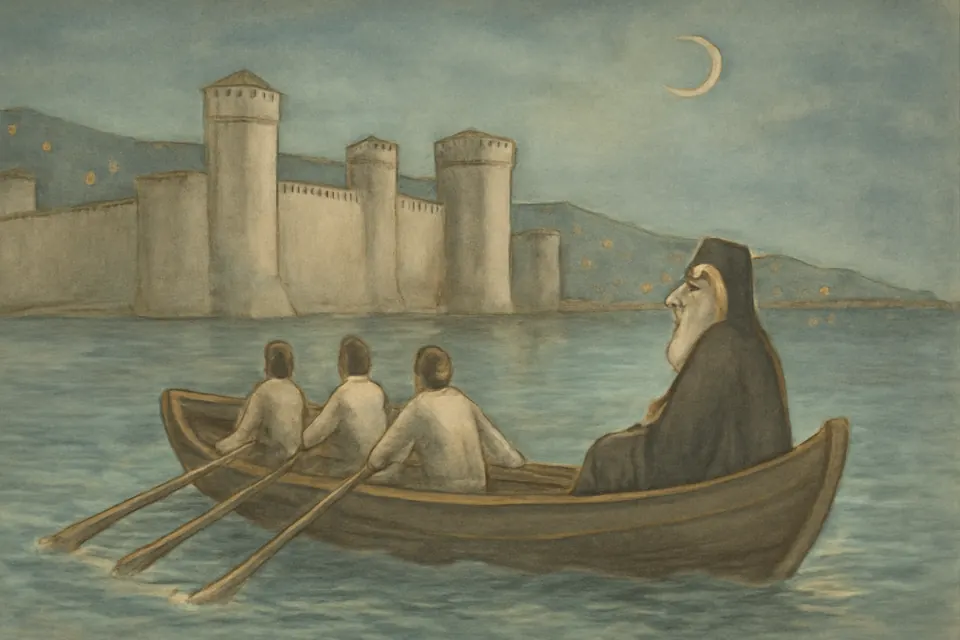
Symeon was consecrated in Constantinople and took up the see of Thessalonica around 1416 or 1417, as Ottoman forces were closing in. In June 1422, as the siege tightened, he slipped out of the city to beg the emperor in Constantinople for soldiers. He barely escaped capture, got only as far as Mount Athos, and was persuaded to go back to his flock. He later wrote an account of these years, the Logos Historikos.
In 1423 the city's governor handed Thessalonica to Venice, hoping the republic could hold it. Symeon accepted Venetian rule as the lesser evil, since he feared that Ottoman rule would endanger the faith of his people. Through those years he preached and wrote, cared for the poor, and urged his flock to place all their hope in God and to trust in St. Demetrius, the city's patron.
His death
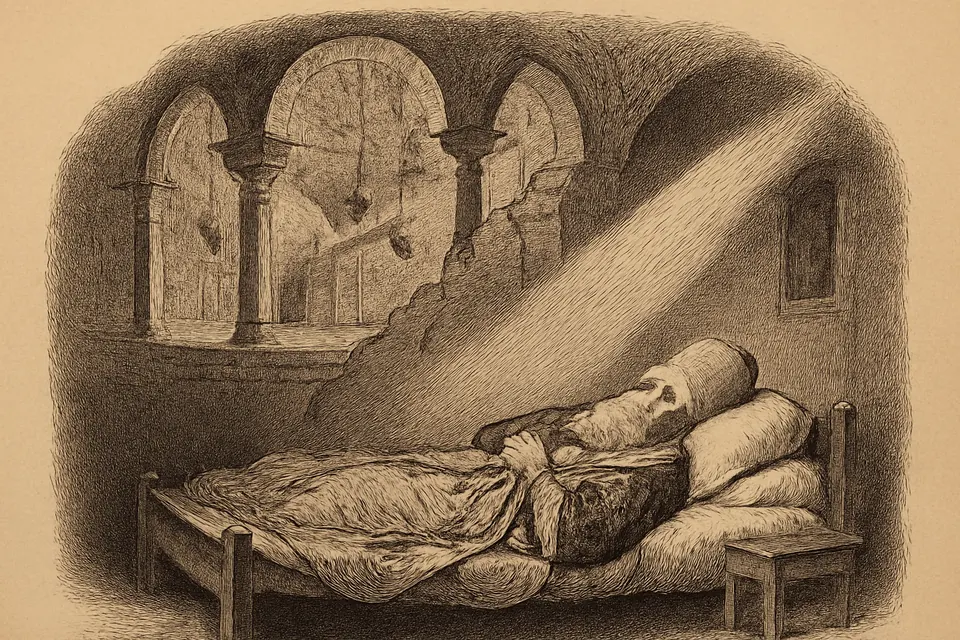
Tradition holds that six months before the city fell, Symeon dreamed he was in a richly decorated house and heard a voice telling him not to linger there admiring its beauty but to leave quickly, before it fell to the ground. He died in the middle of September 1429. The account of his death says the whole city mourned him, "not only Orthodox but also Latins and Jews, for he was a father and shepherd to all." On March 29, 1430, Sultan Murad II took Thessalonica.
The writings of St. Symeon
Symeon is best known as a teacher of the liturgy. Most of what he wrote explains the services of the Church: the Divine Liturgy, the holy mysteries (sacraments) and the other rites and prayers of the Orthodox year. He wanted these treasures understood and kept even if the empire around them was passing away. He also wrote a dialogue against the heresies of his day, pastoral letters (some to Christians in Crete), a rule for prayer, hymns and prayers.
He stood firmly with the hesychast teaching of St. Gregory Palamas, an earlier archbishop of Thessalonica, on prayer and the uncreated light of God. With St. Nicholas Cabasilas, another son of Thessalonica, he is one of the great Byzantine guides to the meaning of the Liturgy.
His liturgical works were first printed by Patriarch Dositheos of Jerusalem at Iași, in Moldavia, in 1683, and later reprinted in Migne's Patrologia Graeca, volume 155. English translations of some of his treatises exist today.

Miracles
No miracles are told of St. Symeon in the accounts we have, and we will not invent any. His dream of the falling house is the one wonder handed down, and we hold it as traditional. The Church honors him above all for his faithful shepherding and his teaching.
Symbols of St. Symeon of Thessalonica in art
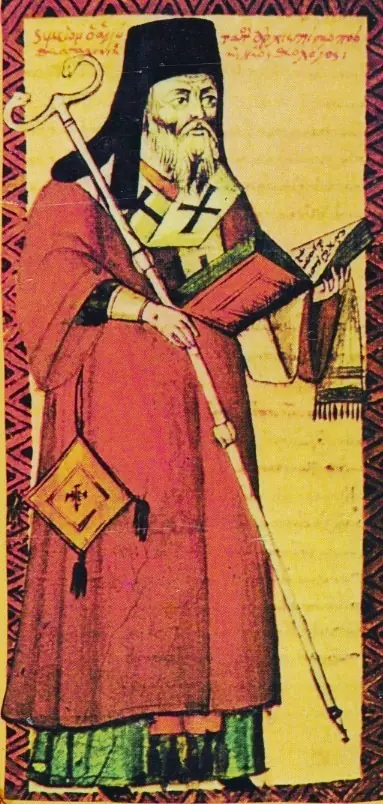
- Archbishop's vestments: the sakkos and the omophorion with crosses, the dress of a Byzantine hierarch.
- A book: his writings on the liturgy and sacraments.
- A pastoral staff: the shepherd of Thessalonica.
- A gray beard and a thoughtful face: he died in his later years, worn by illness and labor.
The 1763 painting in a Vatopedi manuscript on this page shows him this way, with his name written beside his head.
Feast day and where he is honored
We keep his feast on September 15. He is honored above all in Thessaloniki, and wherever Orthodox clergy study the services he explained. See more saints of September on our feast days page.
Prayer to St. Symeon of Thessalonica
The Greek Church sings an apolytikion on his feast (First Tone) that praises him as a shepherd of Thessaloniki and a teacher of divine wisdom; John Sanidopoulos publishes an English translation online.
Let us ask St. Symeon to pray for bishops and priests who must lead their people through hard times, for all who serve at the altar, and for every Christian who wants to understand the worship of the Church more deeply.
Frequently asked questions
Who was St. Symeon of Thessalonica?
A monk of Constantinople who became archbishop of Thessalonica around 1416 or 1417. He led the city through the Ottoman siege and the Venetian years from 1423, wrote widely on the services of the Church, and died in September 1429, shortly before Thessalonica fell to Sultan Murad II on March 29, 1430.
When is the feast of St. Symeon of Thessalonica?
September 15, the day of his death in 1429.
When was St. Symeon of Thessalonica canonized?
The Ecumenical Patriarchate formally numbered him among the saints on April 14, 1981, though his writings had been honored in the Church for centuries.
What did St. Symeon of Thessalonica write?
Mostly explanations of worship: the Divine Liturgy, the sacraments and the rites of the Church, along with a dialogue against heresies, pastoral letters, prayers, hymns and an account of the siege of his city. His liturgical works were first printed by Patriarch Dositheos of Jerusalem in 1683.
Keep exploring
Sources
- Saint Symeon, Archbishop of Thessaloniki (+1429), George Zaravelas, Pemptousia. His birth in Constantinople, the two periods of his episcopate, his care for the poor, his death in mid-September 1429, his canonization on April 14, 1981, and the scope of his writings
- Saint Symeon, Archbishop of Thessaloniki (+ 1429), Orthodox Christianity Then and Now. The dream of the falling house, the mourning of Orthodox, Latins and Jews, and the text of the apolytikion quoted here
- Symeon of Thessalonica, OrthodoxWiki. His attempt to reach Constantinople in 1422 and his return from Athos, and the printed editions of his works