St. Magnus of Füssen, St. Mang, Apostle of the Allgäu

St. Magnus of Füssen, called St. Mang, was an eighth-century monk who preached the Gospel in the Allgäu, the hill country of southern Bavaria and Swabia. He died about 750 at Füssen, where his cell grew into the Benedictine abbey of St. Mang. Legend makes him a dragon-slayer. His feast is September 6.
Who was St. Magnus of Füssen?
St. Magnus of Füssen, known in Germany as St. Mang, was a monk of the eighth century who carried the Gospel into the Allgäu, the green hill country below the Alps in southern Bavaria and Swabia. He worked from the Lech River, built a little cell at Füssen, and died there about the middle of the century. The great Benedictine abbey of St. Mang grew up over his grave. We keep his feast on September 6.
Honesty matters with St. Magnus. The 1910 Catholic Encyclopedia begins its article: "The history of St. Magnus is shrouded in obscurity." Almost everything we know comes from one old Life, and it mixes history with legend.

His life
The old Life of St. Magnus
The Vita S. Magni claims to have been written by his companion Theodore and buried with him under his head. Scholars have long doubted that. The view the Catholic Encyclopedia follows holds that the Life was written about 851 by a monk of Ellwangen, when the saint's relics were moved, and that its first part, which makes Magnus a companion of St. Gall in the early 600s, was added later by the monks of St. Gall, who blended the memory of an older Magnus with the Füssen saint. A manuscript of it survives at St. Gall as Codex 565.
Missionary on the Lech
What can be said with some confidence is this. Magnus, a monk from the region of St. Gall, came east with companions around the 740s. A priest of the Diocese of Augsburg named Tozzo invited him to the eastern Allgäu, and the bishop of Augsburg sent him to preach there. His companion Theodore stayed at Kempten, while Magnus went up the Lech. He built a house of prayer at Waltenhofen in 746 and a cell at Füssen, which King Pippin the Younger endowed with lands.
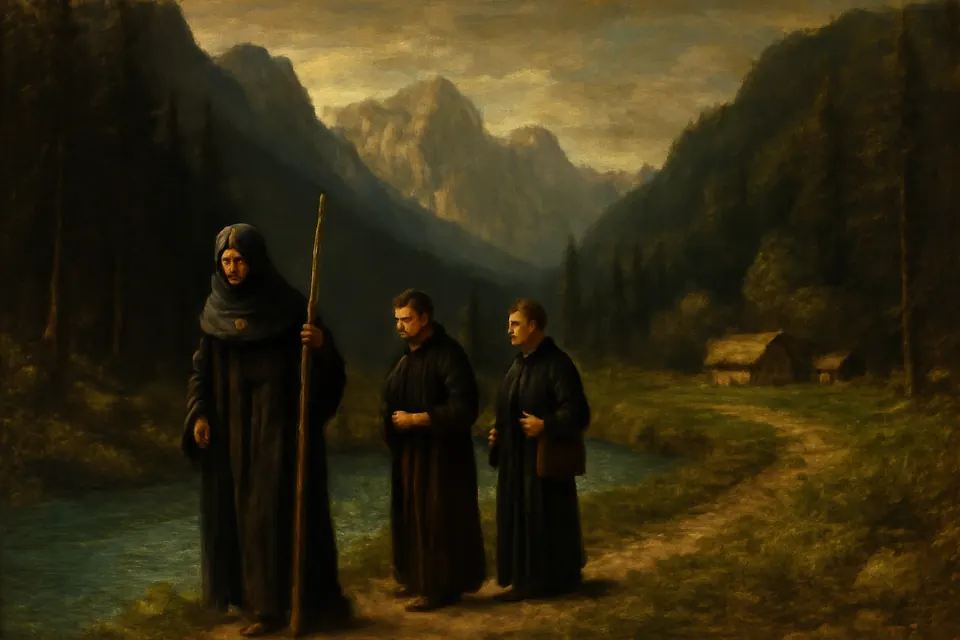
He died at Füssen about 750. In 851 Bishop Lanto of Augsburg moved his relics into a new church there.
The miracles and legends of St. Magnus
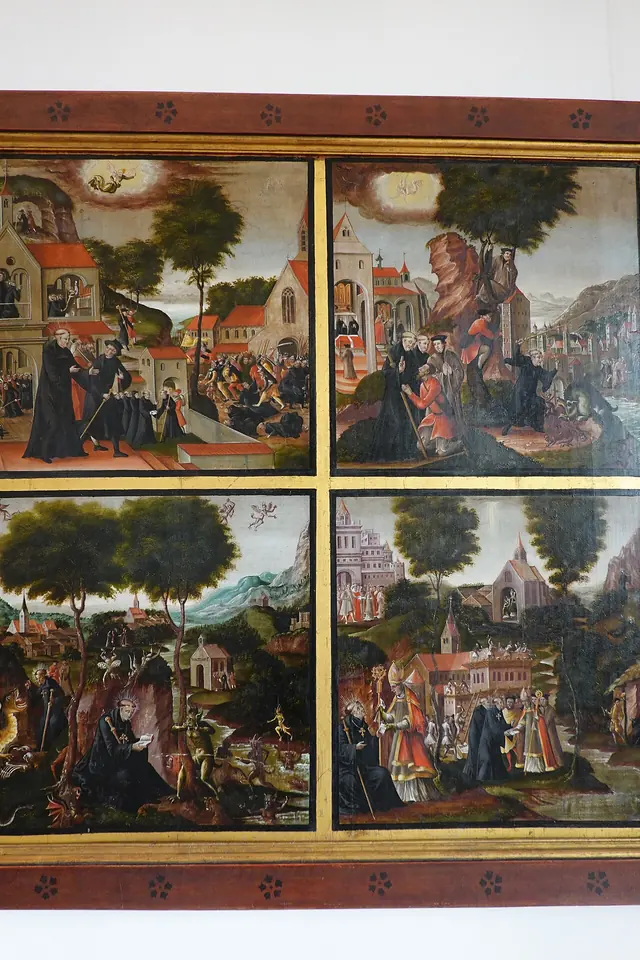
The stories told of him are traditional legends, many of them carried in the Life or in the paintings of his abbey:
- The serpents of Kempten. Arriving at Kempten, he is said to have met serpents and demons and driven them off with his staff, killing their leader, a great serpent.
- The dragon. He is said to have slain a dragon that blocked his road; the story is told at several places, among them Roßhaupten.
- The bears. He drove off bears that threatened the people, made one leave his apples alone, and, the story goes, was shown a vein of iron ore by a bear, which the people of Füssen then mined.
- The staff of Columbanus. The legend says he brought back from the grave of St. Columbanus at Bobbio the abbot's staff of that great Irish missionary. The Heiligenlexikon points out that Magnus lived about a century after Columbanus.
Why St. Magnus is the patron saint of the Allgäu
He is patron of the Allgäu, of Füssen and of Kempten, because he first preached there. Because the legends show him driving away serpents and beasts, farmers took him as protector of cattle and of the fields against mice, rats, worms, cockchafers and grubs; he is also invoked against snakebite and eye ailments. His staff, kept in a silver reliquary at Schussenried, was carried in rogation processions against damage to the fields, and another St. Mang staff of about 1500 is kept at Wangen im Allgäu.
Symbols of St. Magnus in art
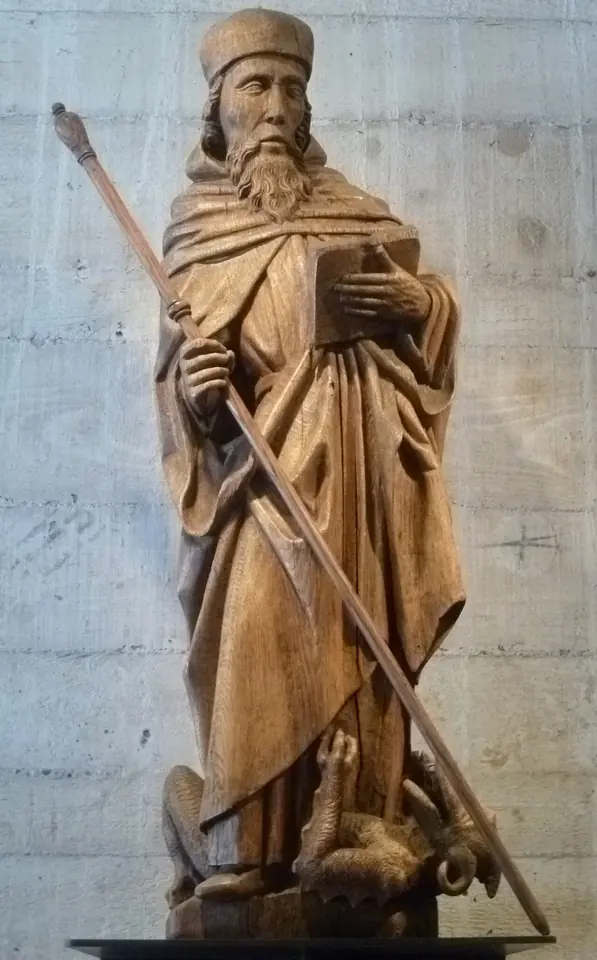
St. Magnus is easy to spot once you know his attributes:
- A Benedictine monk's habit, sometimes with a cap or hood.
- A long staff or crozier, the staff of Columbanus, often driven into a dragon.
- A dragon or serpent at his feet, for the legends of Kempten and Roßhaupten.
- A bear, for the bear stories of Füssen.
In Swabian and Bavarian churches he looks much like other dragon-slaying saints, but a monk, not a knight, with a staff, not a lance, is Magnus.
Where St. Magnus is honored
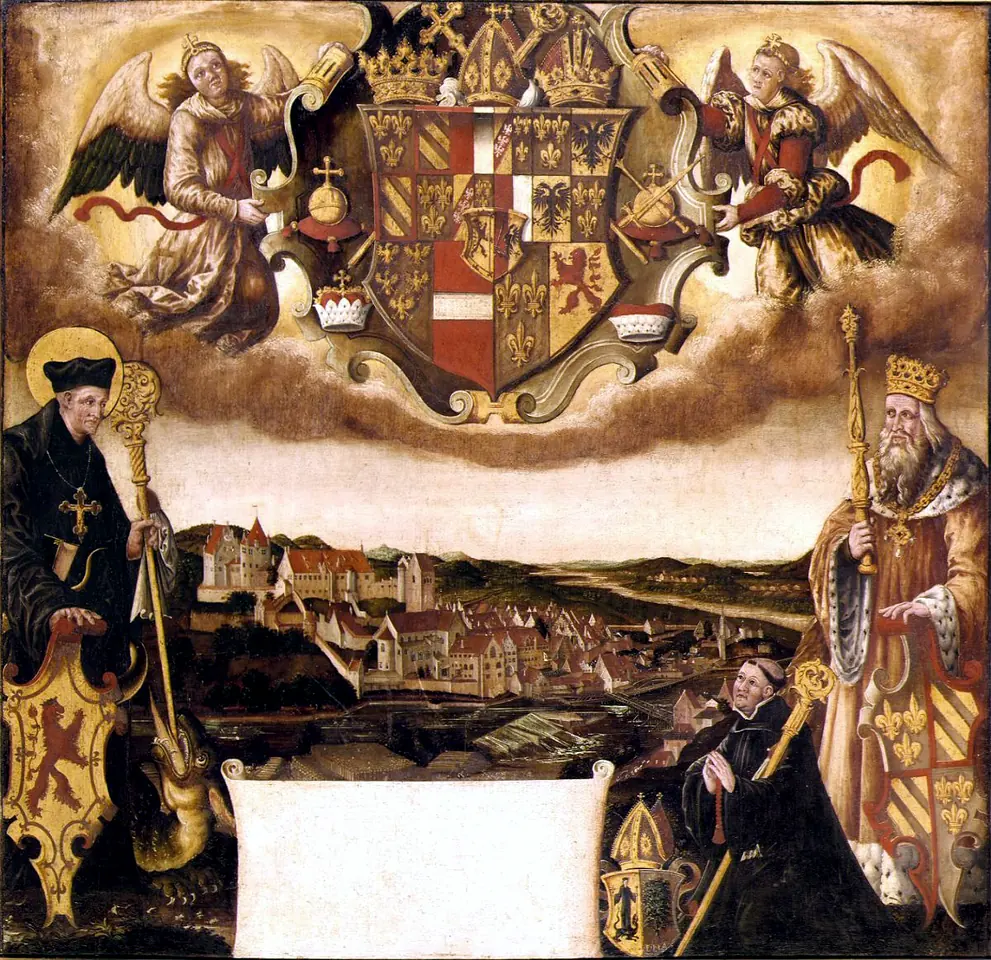
The former Benedictine abbey of St. Mang dominates Füssen. Excavations in the 1960s showed that the St. Anne's Chapel was the first abbey church and that his grave lies there. The abbey was secularized in 1802 and its buildings now house the town hall and museum. In St. Gallen, Switzerland, the church of St. Mangen bears his name. See the feast day calendar for other September saints and the patron saints index.
Prayer to St. Magnus
We don't have a traditional English prayer to him that we can quote here. In the Allgäu his feast was long tied to the harvest and the autumn sowing. Let us ask his intercession for farmers and their fields, for the sick, and for all who bring the Gospel to new places: St. Magnus, pray for us.
Frequently asked questions
Who was St. Magnus of Füssen?
An eighth-century monk, also called St. Mang, who preached in the Allgäu in southern Germany. With his companions Theodore and the priest Tozzo he worked under the bishops of Augsburg, built a cell at Füssen on the Lech River, and died there about 750.
When is the feast of St. Magnus of Füssen?
September 6. It is kept in the dioceses of Augsburg and Feldkirch, among others, and by the Benedictines.
Why is St. Magnus invoked against pests?
Legend says he drove serpents, a dragon and bears out of the country with his staff, and tradition adds that he banished field pests like cockchafers and grubs. For centuries his staff, believed to be the staff of St. Columbanus, was carried in processions to bless the fields.
Is St. Magnus of Füssen the same as St. Magnus of Orkney?
No. Magnus of Orkney was a Norse earl martyred in the twelfth century. Magnus of Füssen was a monk in southern Germany some four hundred years earlier.
Keep exploring
- Patron saint pages
- Eyes
- Feast-day calendar
- Saints remembered in SeptemberSaint of the dayWhat saint is my birthday?
- Relics
- Where the relics are kept (map)
- More
- Saints A to ZPatron saints A to ZExplore every section
Sources
- Catholic Encyclopedia (1910): St. Magnus. The Vita S. Magni and its problems, the St. Gall manuscript, Tozzo and Bishop Wichbert, the translation of his relics to Füssen by Bishop Lanto in 851, and the quotation "shrouded in obscurity"
- Ökumenisches Heiligenlexikon: Magnus von Füssen (German). The legends of the serpents, dragon and bears, the staff in Schussenried and Wangen, the excavation that located his grave under the St. Anne's Chapel, his patronages and the dioceses that keep his feast