St. Marcellinus of Carthage, Martyr

St. Marcellinus of Carthage was a Roman tribune whom the emperor Honorius sent to Africa to preside over the Conference of Carthage between Catholic and Donatist bishops in 411. A close friend of St. Augustine, who dedicated The City of God to him, he was falsely accused after a revolt and beheaded at Carthage on September 13, 413.
Who was St. Marcellinus of Carthage?
St. Marcellinus of Carthage was a Roman imperial official, a tribune and notary, sent to Africa by the emperor Honorius about 410. He was a devout Catholic layman, a married man and a close friend of St. Augustine. He presided over the great Conference of Carthage in 411, which ended the long Donatist schism in law. Two years later, caught up in the aftermath of a failed revolt, he was arrested on false charges and beheaded at Carthage.
We know him best through Augustine, who loved him, wrote books at his request, visited him in prison and described his death in a letter. The Roman Martyrology now honors him on September 13 as a martyr who, "as tribune and close friend of Saint Augustine and Saint Jerome," and "although innocent, was killed by the Donatist heretics for defending the Catholic faith."
The life of St. Marcellinus
Judge of the Conference of Carthage
For a century the Church in Africa had been split. The Donatists, who claimed to be the only pure Church, had their own bishops in almost every town, and their violent fringe, the Circumcellions, attacked Catholic clergy. At the Catholic bishops' request, Honorius ordered a public conference to settle the matter, and he sent Marcellinus, whom the Catholic Encyclopedia calls "an excellent Christian," to preside as judge.
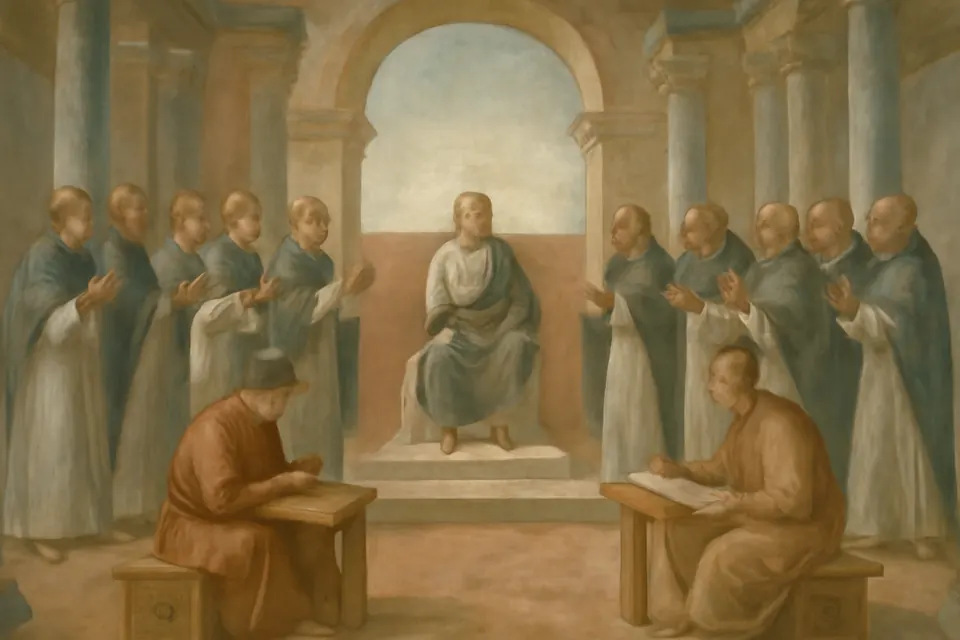
Marcellinus promised in a proclamation to be completely impartial. Some 286 Catholic bishops came to Carthage, and the Donatists nearly matched them. He ruled that each side should choose seven speakers, seven advisers and four secretaries, and the sessions met on June 1, 3 and 8, 411. Augustine was the leading Catholic speaker. At the end Marcellinus judged in favor of the Catholics, and he had headings written for every speech in the minutes so that the record could be consulted easily.
Friend of St. Augustine
Marcellinus did not stay a distant official. He asked Augustine questions about Scripture and the faith, and Augustine answered him with whole books. On the Merits and Forgiveness of Sins and On the Spirit and the Letter, two of Augustine's first writings against the errors of Pelagius, were written for him. When pagans blamed the Christians for the sack of Rome in 410, Marcellinus urged Augustine to answer them, and the result was The City of God. Its opening lines are addressed to him:
The glorious city of God is my theme in this work, which you, my dearest son Marcellinus, suggested, and which is due to you by my promise.
The friendship had its hard moments. When Marcellinus was trying Donatist clergy and Circumcellions who had killed one Catholic priest and maimed another, Augustine wrote to beg him "by the mercy of Christ the Lord Himself" not to sentence them to death or mutilation. A bishop's plea for his enemies' lives is part of this story too.
The martyrdom of St. Marcellinus
In 413 Heraclian, the count of Africa, rebelled against Honorius and was defeated. In the purge that followed, the general Marinus had Marcellinus and his elder brother arrested. The Catholic Encyclopedia says he "fell a victim (it is supposed) to the rancour of the Donatists," who used the moment to take revenge on the judge who had ruled against them.
Augustine and the bishops worked to save him. A bishop was sent to the imperial court to plead for the prisoners, and the church was promised that nothing would be done until he was heard. Then, on the day before the anniversary of St. Cyprian, the brothers were suddenly taken from prison and beheaded on a public promenade near by. It was September 13, 413. The Catholic Encyclopedia adds that the emperor himself did not believe Marcellinus guilty.
Augustine described the scene in a letter to the official Caecilianus, and he left us a portrait of his friend:
In his conduct, what innocence! In his friendship, what constancy! In his study of Christian truth, what zeal! In his religion, what sincerity! In his domestic life, what purity! In his official duties, what integrity!
He also told of a visit to the prison. Afraid that his friend might carry some hidden sin to his death, Augustine asked him whether there was anything he should confess. Marcellinus blushed, thanked him, and "with a grave, modest smile he seized with both hands my right hand, and said: I swear by the sacraments which are dispensed to me by this hand, that I have neither before nor since my marriage been guilty of immoral self-indulgence."

When his brother asked why he, who had lived so well, should suffer with him, Marcellinus answered that God was doing him a great favor if his sins were punished in this life rather than kept for the judgment to come.
Why the Church honors him
No miracles are told of Marcellinus. The Church's reason for honoring him is his life and his death: a just judge, a faithful husband, a humble student of the faith, killed as an innocent man by those who hated the Catholic cause he had served. Augustine believed death was for him "not the night of darkness in which a good life ends, but the dawn in which a better life begins."
He is a fitting saint for Catholics in public life, for judges and civil servants, and for anyone who loses position or life because they did their duty honestly.
Symbols of St. Marcellinus in art
St. Marcellinus is rarely painted, and he has no fixed attributes. When he appears, look for:
- A Roman official's tunic and cloak, the dress of a tribune and imperial notary.
- A scroll or book, for the acts of the Conference of Carthage and the books Augustine wrote for him.
- The martyr's palm and a sword, for his beheading.
He is most often found in the company of St. Augustine. Do not confuse him with St. Marcellinus the priest of Rome, honored with St. Peter the Exorcist on June 2, or with Pope St. Marcellinus.
Feast day and prayer
We keep the memory of St. Marcellinus on September 13, the date added in the revised Roman Martyrology, the day before the feast of St. Cyprian he died so near to.
There is no traditional prayer to St. Marcellinus. Let us ask him to pray for all who hold public office, that they may judge justly and stay faithful when it costs them, and for friendships that lead one another to God, like his with St. Augustine.
St. Marcellinus, pray for us.
Frequently asked questions
Who was St. Marcellinus of Carthage?
Flavius Marcellinus, a Christian Roman official sent to Africa by the emperor Honorius. He judged the conference between Catholic and Donatist bishops in 411, became a close friend of St. Augustine, and was executed at Carthage in 413 on false charges.
What did St. Augustine write for Marcellinus?
He dedicated The City of God to him, addressing him in its first lines as "my dearest son Marcellinus," and wrote for him the treatises On the Merits and Forgiveness of Sins and On the Spirit and the Letter, as well as several letters.
When is the feast of St. Marcellinus of Carthage?
September 13 in the current Roman Martyrology, the day he was beheaded in 413.
Why is Marcellinus called a martyr?
The Roman Martyrology says that, though innocent, he was killed by the Donatist heretics, through the hostility of the usurper Heraclian, for defending the Catholic faith. St. Augustine believed the Donatists' enemies had used the revolt to take revenge on him.
Keep exploring
Sources
- Catholic Encyclopedia (1909): Donatists. Marcellinus as cognitor at the Conference of Carthage in 411, its procedure and verdict, and his death in 413
- St. Augustine, Letter 151, to Caecilianus (New Advent). Augustine's account of the arrest and execution and his testimony to Marcellinus's life, quoted on this page
- St. Augustine, Letter 133, to Marcellinus (New Advent)
- St. Augustine, The City of God, Book I (New Advent)
- Roman Martyrology 2004, September (GCatholic). September 13 entry