St. Adrian of Nicomedia
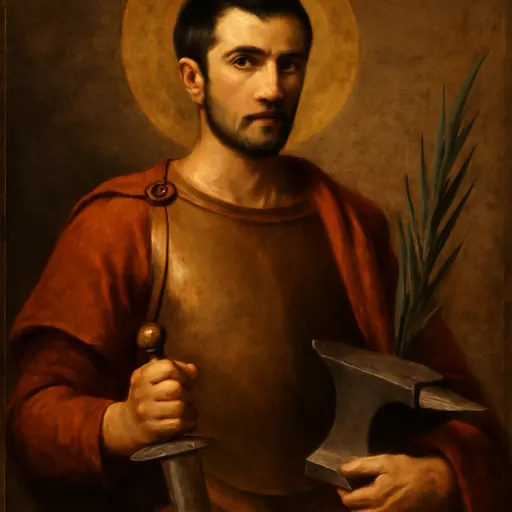
St. Adrian of Nicomedia was a young Roman officer who, overseeing the trial of tortured Christians in Nicomedia, declared himself a Christian and was martyred with them around 306. His wife, St. Natalia, strengthened him in prison. His traditional Western feast is September 8; the East keeps both spouses on August 26. He is a patron of soldiers and guards.
Who was St. Adrian of Nicomedia?
St. Adrian of Nicomedia was a Roman officer who stood guard over the trial of Christians and ended by dying with them. He served at Nicomedia, the city on the Sea of Marmara (now İzmit in Turkey) where the emperors of the East kept their court, during the last and fiercest persecution of the Church, in the first years of the fourth century. He was about twenty-eight and had been married to a young woman named Natalia for little more than a year.
What we know of him comes from his Acts, a martyr's story preserved in Greek and Latin and retold in the medieval Golden Legend. The Catholic Encyclopedia is frank about them: the Acts are "embellished with a number of legendary and, in part, very poetical details." What stands firm is the cult. The Christians of Constantinople venerated his grave, his relics were carried to Rome, and for centuries he was one of the best-loved soldier-saints of northern Europe.

Let us look at his story, history and legend each in its place, and ask him to pray for all who serve and guard others.
The story of St. Adrian and St. Natalia
"Write my name down also"
The Acts tell that the emperor (Galerius in some versions, Maximian in others) offered rewards to anyone who would denounce Christians. A group of twenty-three believers was found hiding in a cave near Nicomedia, tortured and brought before the court so their names and answers could be written down. Adrian, the head of the guard, watched them suffer without giving way. He asked what reward they expected from their God.
They answered with the words of St. Paul: eye has not seen, nor ear heard, nor has it entered into the heart of man, what God has prepared for those who love him (1 Corinthians 2:9). The Orthodox life gives Adrian's reply to the scribes in one line: "Write my name down also, for I am a Christian and I die gladly for Christ God." He had not yet been baptized. When the emperor asked whether he had lost his mind, Adrian answered, "I have not lost my mind, but rather have I found it."
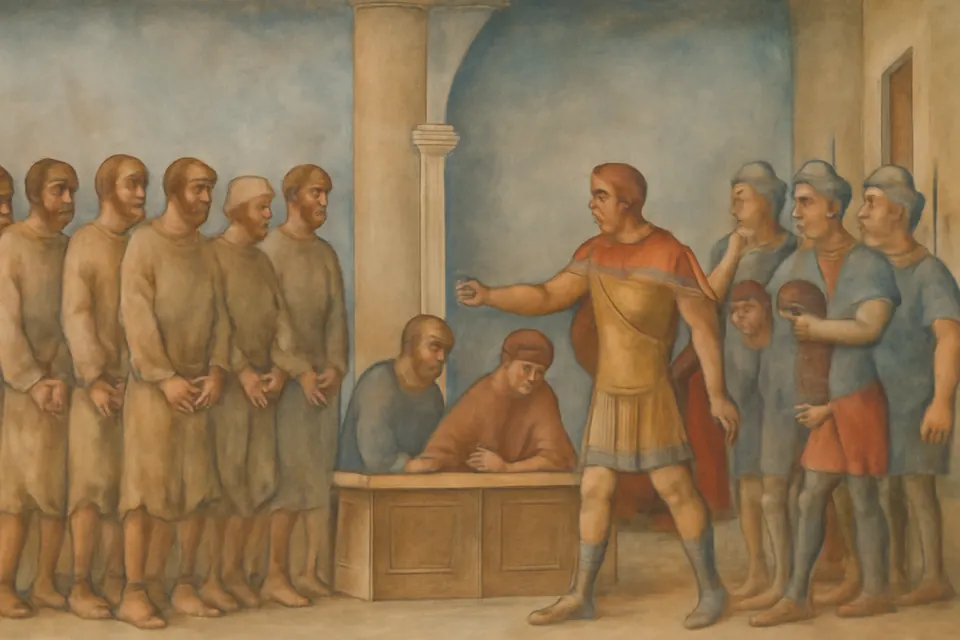
Natalia at the prison door
Natalia was already a Christian in secret. When she heard her husband was in prison for Christ, the Golden Legend says, she ran to the jail and kissed his chains. Then comes the scene medieval readers loved best. Adrian bribed the jailers to let him go home and fetch Natalia, as he had promised, leaving the other prisoners as his pledge. A servant ran ahead shouting that the master had been set free. Natalia assumed he had denied Christ and shut the door in his face, crying that she would rather be the wife of a martyr for a little while than of a renegade for a long time. Only when he swore that he had come to bring her to his martyrdom did she open the door.
For seven days, the legend says, she washed the prisoners' wounds with fine cloths. When the emperor forbade women to visit, she cut her hair, put on men's clothes, and went on serving them, and other women followed her example.

The anvil
At the end the emperor ordered the martyrs' limbs broken on a blacksmith's anvil so that they would die faster. Natalia, afraid that Adrian might lose heart watching the others suffer, asked the executioners to begin with him. He died in the torment, and his companions held out their own limbs freely after him. Natalia hid one of his hands in her cloak.
These details belong to the legend, and they are hard to read. They were told, and painted, to show courage and a wife's love stronger than fear, not to linger on cruelty.
The miracles and legends of St. Adrian
No miracle of St. Adrian has ever been formally investigated; he lived long before the modern process of canonization. The wonders in his story are traditional.
- The storm and the fire (traditional). The emperor ordered the bodies burned, and Natalia tried to throw herself into the flames with them. A sudden storm put the fire out, the Golden Legend says, and the Christians carried the bodies safely to Byzantium. The Orthodox life adds that lightning struck many of the executioners.
- The guide at sea (traditional). A commander sought to marry the wealthy young widow, so Natalia fled by ship to Byzantium with Adrian's hand. The Golden Legend tells that a false pilot tried to steer them onto the rocks, and Adrian himself appeared in a boat and led them safely into port before dawn.
- Natalia's death (traditional). She laid the hand beside the martyrs' bodies, fell asleep in prayer, saw Adrian in a dream inviting her to join him, and died soon after. The Christians buried her with the martyrs.
Why St. Adrian is the patron saint of soldiers
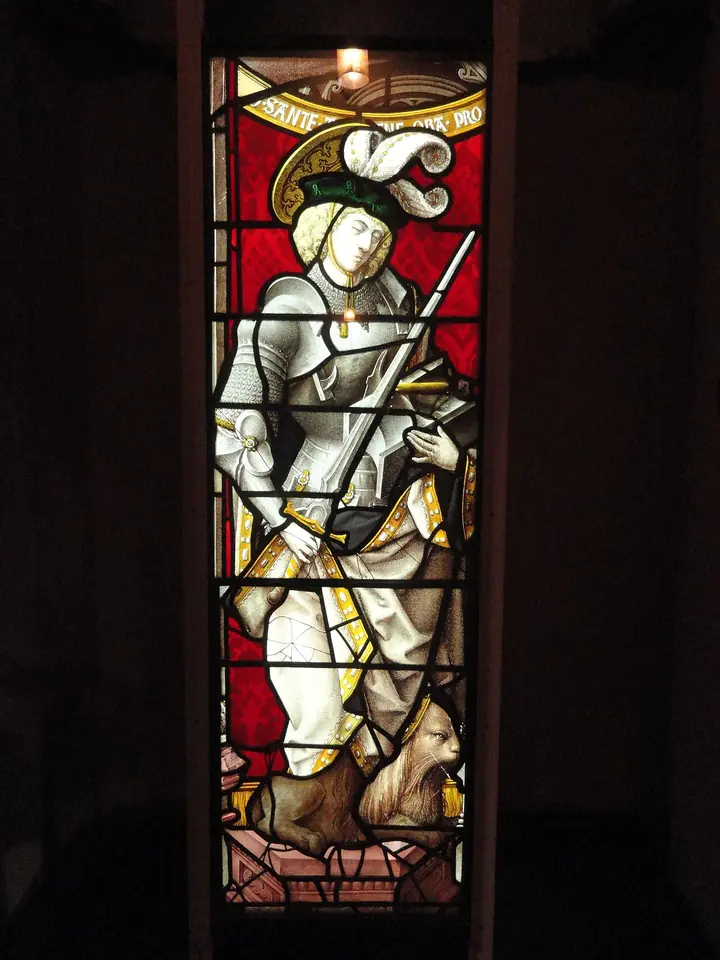
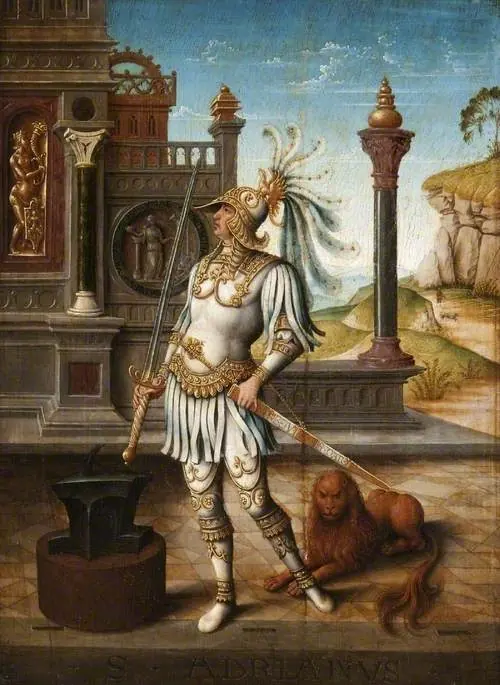
Adrian was a soldier who met Christ while on duty, and that made him a natural patron for men under arms. In the Middle Ages his cult spread through Flanders, Germany and northern France, where knights and city militias honored him second only to St. George. Painters gave him the armor and weapons of their own day, as you can see in the panels on this page, and guards of every kind took him as their protector.
The Orthodox Church honors him together with Natalia as a patron of married couples, alongside Sts. Timothy and Maura. It is a fitting patronage. Their story is about a marriage in which each spouse helped the other toward heaven: she strengthened his faith, and he promised to bring her to see his crown.
The Flemish town of Geraardsbergen also claims him. Its Benedictine abbey received relics of St. Adrian in 1110 and became a pilgrimage shrine, so famous that from 1175 the monastery took his name: the Sint-Adriaansabdij. Pilgrim badges of St. Adrian from Geraardsbergen survive from the fifteenth and sixteenth centuries. The abbey was ravaged in 1794 during the French Revolution and its church pulled down, but Adrian is still, with St. Bartholomew, a patron of the town, and its parish church keeps a St. Adrian chapel.
Symbols of St. Adrian in art
St. Adrian is one of the easier saints to spot once you know his attributes.
- The anvil is his own sign. It recalls the anvil on which, according to his Acts, his limbs were broken. Artists show it calmly, held in his arm like a book or resting at his feet, never as an instrument of horror.
- Armor and a sword mark him as a soldier of the imperial guard. Flemish and German painters dressed him as a knight of their own time, sometimes in fanciful plumed helmets.
- A lion at his feet appears in many northern images, including Holbein's drawing and the Beighem panel. Later retellings say a lion was set on him in the arena and would not attack. The animal also stands for strength and courage.
- A severed hand sometimes appears in the hand of St. Natalia, who kept her husband's hand as a relic.
- The martyr's palm and, in Eastern icons, a small cross held before the chest.
In Eastern icons Adrian is a young man in the red cloak of a martyr, usually standing beside Natalia, who wears a mantle and holds a cross. Western painters more often show him alone and armed. In a Flemish church or museum, a young armored saint with an anvil is almost certainly Adrian. A soldier slaying a dragon is George, and a soldier shown as an African, often with a banner, is usually St. Maurice.
Feast day, relics and shrines
The feast days of St. Adrian can be confusing, so here they are plainly. In the Roman tradition his main feast was September 8, the anniversary of the translation of his relics to Rome, kept as a commemoration on the feast of the Nativity of Mary. The Roman Martyrology also remembers him on March 4. The Eastern churches celebrate Sts. Adrian and Natalia together on August 26, which falls on September 8 of the civil calendar for churches that follow the Julian calendar. So in Russia, Serbia and on Mount Athos the two feasts land on the same day.
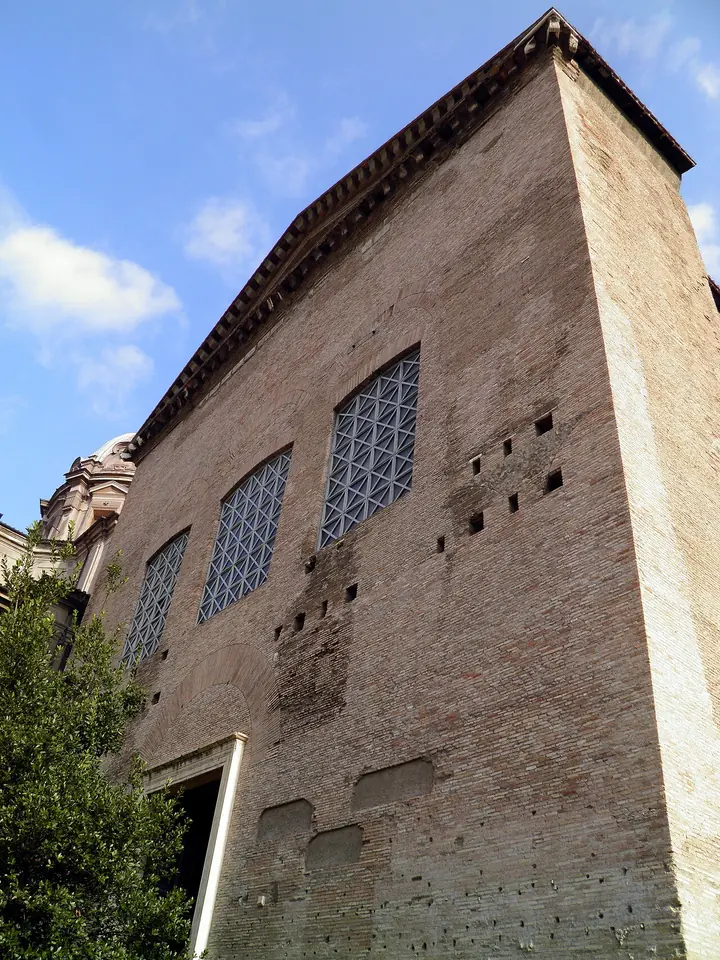
His relics were first kept in Constantinople. They were later brought to Rome and laid in a church in the Roman Forum: the old Senate House, the Curia Julia, which in the seventh century became the church of Sant'Adriano al Foro. It stood for some 1,300 years. In the 1930s the building was stripped back to its ancient form and the church closed, and the title of Sant'Adriano passed in 1958 to a new parish church in Rome. Where the Forum relics rest today is unclear. Geraardsbergen in Belgium received relics in 1110, and portions of St. Natalia's relics are kept at the Kykkos Monastery in Cyprus.
Where the relics of St. Adrian of Nicomedia are kept: see them on the relics map →
Prayer to St. Adrian of Nicomedia
There is no long traditional prayer to St. Adrian in the Western prayer books. The Byzantine Church sings his praises in its own liturgical texts, and we can pray with them. His troparion honors him as a man who treasured the Faith above the ungodliness of his family and asks him to pray for our souls, and his kontakion remembers how he held to the words of his wife, St. Natalia, through torment and shared her crown; the OCA prints both texts on its website.
Let us ask St. Adrian to pray for soldiers, police officers and all who guard others, that they may be brave and just, and for husbands and wives, that like Adrian and Natalia they may help each other toward heaven.
Frequently asked questions
Who was St. Adrian of Nicomedia?
He was an officer in the imperial guard at Nicomedia, the eastern capital of the Roman Empire, in the persecution under Galerius around 306. Watching Christians endure torture for their faith, he asked what reward they hoped for, then told the scribes to write his name down with theirs. He was imprisoned, tortured and put to death with them. The Catholic Encyclopedia notes that his Acts contain many legendary details, but his grave was honored by the Christians of Constantinople from early times.
When is the feast of St. Adrian of Nicomedia?
In the traditional Western calendar he is remembered on September 8, the anniversary of the translation of his relics to Rome; the Roman Martyrology also names him on March 4. Eastern Orthodox and Eastern Catholic churches celebrate Sts. Adrian and Natalia together on August 26.
Why is St. Adrian shown with an anvil?
His Acts say the emperor had the martyrs' limbs broken on a blacksmith's anvil, and that Adrian died in this torment. Painters and sculptors gave him the anvil as his sign, usually held calmly in his hand or set at his feet, together with the sword and armor of a soldier.
What is St. Adrian the patron saint of?
Because he was a soldier of the imperial guard, he became a patron of soldiers and guards, and in the Middle Ages he was among the most popular soldier-saints of Flanders, Germany and northern France. The Orthodox Church honors Adrian and Natalia together as patrons of married couples. The Flemish town of Geraardsbergen took him as one of its patrons after his relics arrived there in 1110.
Who was St. Natalia, the wife of St. Adrian?
Natalia was Adrian's young wife, secretly a Christian before he was. His Acts say she encouraged him in prison, nursed the wounded prisoners, dressed as a man to get past the guards when women were banned, stood beside him at his death and kept his severed hand. She fled to Byzantium to escape a forced marriage and died there soon after. The Orthodox remember her with Adrian on August 26; some Western calendars list her on December 1.
Keep exploring
- Patron saint pages
- SoldiersMarriage
- Feast-day calendar
- Saints remembered in SeptemberSaint of the dayWhat saint is my birthday?
- Relics
- Where the relics are kept (map)
- More
- Saints A to ZPatron saints A to ZExplore every section
Sources
- Catholic Encyclopedia (1910): Hadrian. The Acts called legendary; the Rome church of S. Adriano; the feasts of September 8, March 4 and August 26
- The Golden Legend: Of S. Adrian, Martyr (Caxton translation, 1483), Internet Medieval Sourcebook. Natalia at the prison door, the shaved head, the anvil, the hand kept at her bedside
- Orthodox Church in America: Martyrs Adrian and Natalia and 23 companions, of Nicomedia. The words "Write my name down also"; patrons of married couples; Natalia's relics at Kykkos
- Orthodox Church in America: Troparion and Kontakion of Sts. Adrian and Natalia
- Inventaris Onroerend Erfgoed: Sint-Adriaansabdij met aansluitend park (Geraardsbergen). The translation of the relics in 1110, the name of the abbey from 1175, its destruction in 1794