St. Cornelius, Pope and Martyr
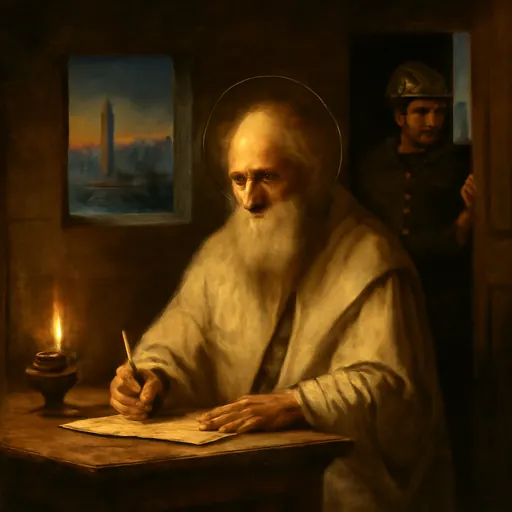
St. Cornelius (Pope Cornelius) was bishop of Rome from 251 to 253. Elected against his will after a year-long vacancy, he defended mercy for Christians who had denied the faith under persecution, against the rigorist antipope Novatian, with the support of his friend St. Cyprian of Carthage. He died in exile in 253. His feast day is September 16.
St. Cornelius was pope for barely two years, from March 251 to June 253, and he did not want the job. He took the chair of Peter at a moment when the emperor was hunting down bishops, when thousands of Christians had just denied their faith to save their lives, and when a brilliant Roman priest was about to set himself up as a rival pope. Cornelius held to one simple conviction through all of it: that sinners who repent can come home.
We keep his feast on September 16 together with his friend St. Cyprian, the bishop of Carthage, who stood by him in every trial. (He is a different man from Cornelius the centurion, the Roman officer baptized by St. Peter in Acts 10.) Let us walk through his short, brave pontificate and ask him to pray for us.
Who was St. Cornelius?
Pope St. Cornelius was the bishop of Rome who succeeded the martyr St. Fabian. We know nothing certain about his family or his early life. Cyprian, who knew him by letter, says he was not someone who reached high office suddenly. He had served in every rank of the Roman clergy and "ascended by all the grades of religious service to the lofty summit of the Priesthood."
For once we can hear a 3rd-century pope in his own words. Two of his letters to Cyprian survive, along with nine of Cyprian's letters to him, and Eusebius copied out long passages from a letter Cornelius sent to Fabius, bishop of Antioch. Scholars have noticed that Cornelius wrote in the everyday spoken Latin of his time, not in the polished style of Cyprian, a former teacher of rhetoric.
The life of St. Cornelius
A pope chosen against his will
When Emperor Decius began his persecution in 250, Pope Fabian was among the first to die, and the Roman church could not safely choose a successor for more than a year. In early 251, with Decius away fighting the Goths, sixteen bishops gathered in Rome and elected Cornelius.
Cyprian defended that election in a letter to a wavering African bishop named Antonianus. He wrote that Cornelius "was made bishop by the judgment of God and of His Christ, by the testimony of almost all the clergy, by the suffrage of the people who were then present, and by the assembly of ancient priests and good men, when no one had been made so before him, when the place of Fabian, that is, when the place of Peter and the degree of the sacerdotal throne was vacant." Cornelius had not sought the office, Cyprian added; "he himself suffered compulsion, so as to be forced to receive the episcopal office."
It took courage to accept. Cyprian marveled that Cornelius "intrepidly sate at Rome in the sacerdotal chair at that time when a tyrant, odious to God's priests, was threatening" the bishops with death.
Novatian and the lapsed
The great question of the day was what to do with the lapsed, the Christians who had offered sacrifice to the gods or bought false certificates saying they had, to escape the persecution. Many now wanted to return to the Church.
Novatian, a gifted Roman priest and theologian, held that the Church had no power to forgive them; they could repent, but only God could pardon them at the judgment. Within weeks of Cornelius's election, Novatian had himself consecrated bishop of Rome by three bishops from the countryside. It was the first serious schism in the Roman church, and it shook Christians from Africa to Syria.
Cornelius's letter to Fabius of Antioch, preserved by Eusebius, tells the story with some heat. He describes Novatian's supporters bringing three "rustic and very simple" bishops to Rome, shutting them in with "certain selected men," and by the tenth hour, "when they had become drunk and sick," having them lay hands on Novatian. One of those bishops soon came back "lamenting and confessing his transgression."

Cornelius answered the schism with councils, not force. A synod of sixty bishops met in Rome and decreed, in Eusebius's words, that Novatian and those who shared "his brother-hating and inhuman opinion" should be separated from the Church, but that the bishops "should heal such of the brethren as had fallen into misfortune, and should minister to them with the medicines of repentance." Cornelius accepted the plan Cyprian's council at Carthage had approved that spring: the lapsed could be readmitted after a period of penance suited to what each had done. The bishops of Africa followed Cyprian in supporting Cornelius, and Dionysius the Great, bishop of Alexandria, brought the churches of the East around within months.
A portrait of the Roman church
In the same letter to Fabius, Cornelius gave us a snapshot of his church that historians still quote. Rome, he wrote, had "forty-six presbyters, seven deacons, seven sub-deacons, forty-two acolyths, fifty-two exorcists, readers, and janitors, and over fifteen hundred widows and persons in distress, all of whom the grace and kindness of the Master nourish." Few documents of the 3rd century give numbers like these, and they show a church that fed fifteen hundred poor people even in a time of persecution.

Confession, exile and death
The peace did not last. In 252 a new persecution broke out under Emperor Trebonianus Gallus, and Cornelius was arrested and sent into exile at Centumcellae, the port of Rome, today's Civitavecchia. Not one Roman Christian fell away this time. Cyprian wrote to him in exile with open joy:
As with you there is one mind and one voice, the whole Roman Church has confessed.

Cornelius died at Centumcellae in June 253. The Liberian Catalog, a list of popes compiled in 354, says he "fell asleep with glory" there, which may mean he died from the hardships of exile; later accounts say he was beheaded. Cyprian repeatedly calls him a martyr, and so has the Church ever since.
The miracles and legends of St. Cornelius
No miracles are recorded in the early sources, and the old Acts of St. Cornelius are late and unreliable. The Catholic Encyclopedia calls them "valueless." Legends grew up later, mostly in Germany and the Low Countries, where his relics drew pilgrims.
The best known comes from Neuss on the Rhine. A young artist was painting a chapel of St. Cornelius and fell in love with the daughter of a local man, who refused the marriage and said he would consent only if the pope did. The statue of Cornelius, the story goes, leaned forward from the altar and blessed the couple. It is a traditional tale, and it made Cornelius a patron of sweethearts in that region. No miracle has ever been approved through a formal process in his case, since he was honored as a martyr long before canonizations began.
Why St. Cornelius is the patron saint of cattle and of people with epilepsy
These patronages come from the Middle Ages, not from his life. The Latin for horn is cornu, and artists in the North gave Cornelius a horn as a play on his name. From the horn it was a short step to horned animals: farmers in the Rhineland, Belgium and the Netherlands asked his protection for their cattle. Pilgrims at Kornelimünster drank blessed water from a horn in his honor.
He was also invoked against epilepsy, which in some places was even named after him. Tradition holds that the connection began with the cures sought at his shrine. Along with St. Quirinus of Neuss, St. Hubert and St. Anthony the Great, Cornelius was counted among the Four Holy Marshals, a group of helper saints honored in the late medieval Rhineland, each with a famous shrine.
Symbols of St. Cornelius in art
You will meet St. Cornelius most often in churches of Germany, Belgium and the Netherlands, and he is one of the easier popes to recognize.
- The horn is his own attribute: a drinking horn or a hunting horn, held in his hand. A pope with a horn is Cornelius.
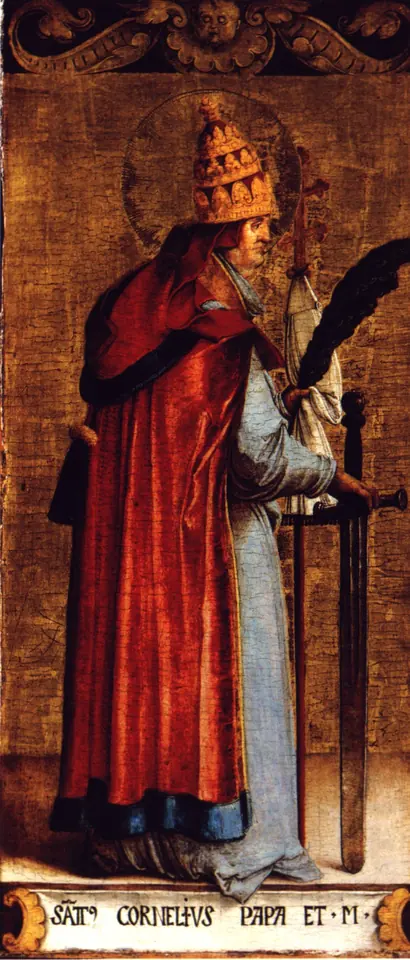
- The papal tiara and the papal cross (with two or three crossbars) mark him as pope. Both are anachronisms: neither existed in his day.
- A martyr's palm and sometimes a sword recall his death for the faith, following the later tradition of beheading.
- A cow or ox at his feet appears in rural images, showing his care for cattle.

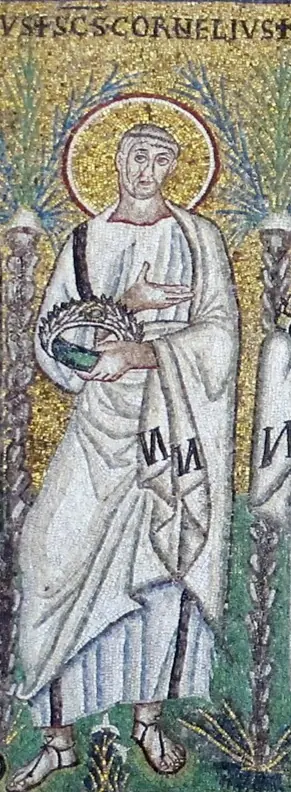
Older art shows him differently. In the 6th-century mosaics of Sant'Apollinare Nuovo in Ravenna, he walks in the long procession of martyrs in a white robe, carrying his crown to Christ, with no papal insignia at all. In the 12th-century apse mosaic of Santa Maria in Trastevere in Rome, he stands among the saints near Christ and Mary, a gray-bearded bishop in dark vestments and a white pallium.
In the North, prints and statues put the horn front and center. A 19th-century engraving by Friedrich August Ludy shows him with tiara, cross staff and horn under a carved arch, and old Flemish devotional prints pair him with other healing saints of the region.

Kornelimünster and the feast of St. Cornelius
Cornelius was buried in the Catacomb of Callixtus on the Appian Way, not in the Crypt of the Popes itself but in a neighboring area, the crypts of Lucina. His epitaph is in Latin, "Cornelius, martyr," while those of his predecessor Fabian and his successor Lucius are in Greek. The Roman calendar of 354 notes that Cyprian's feast was kept in Rome "in Callisti," at the tomb of his friend.
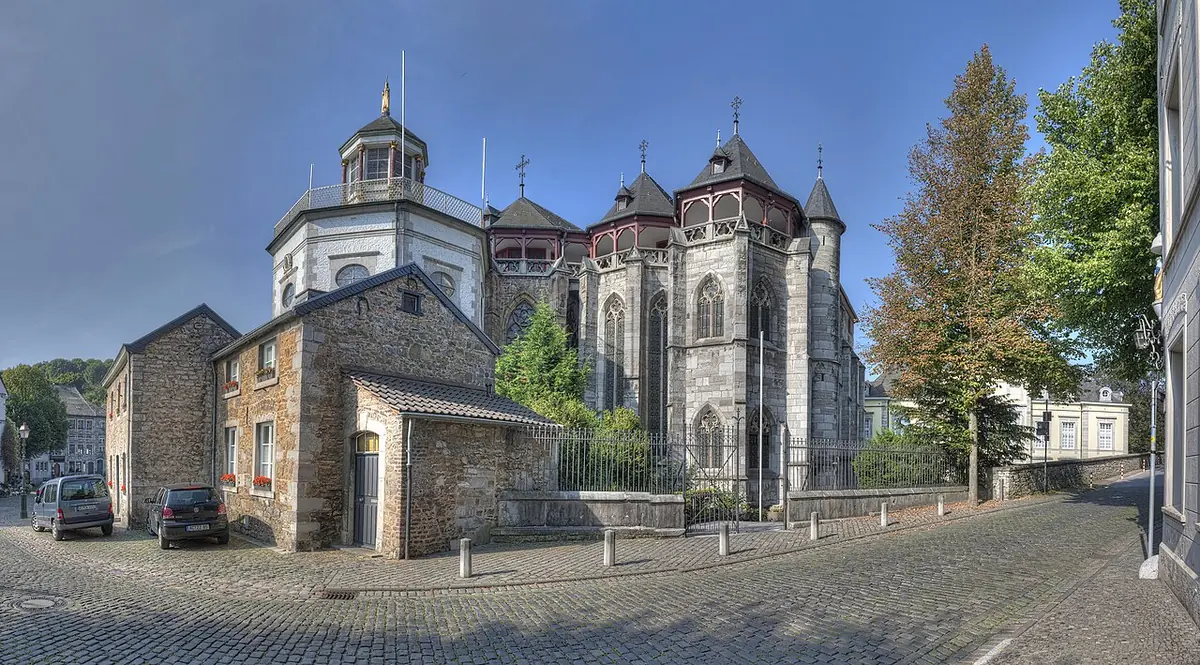
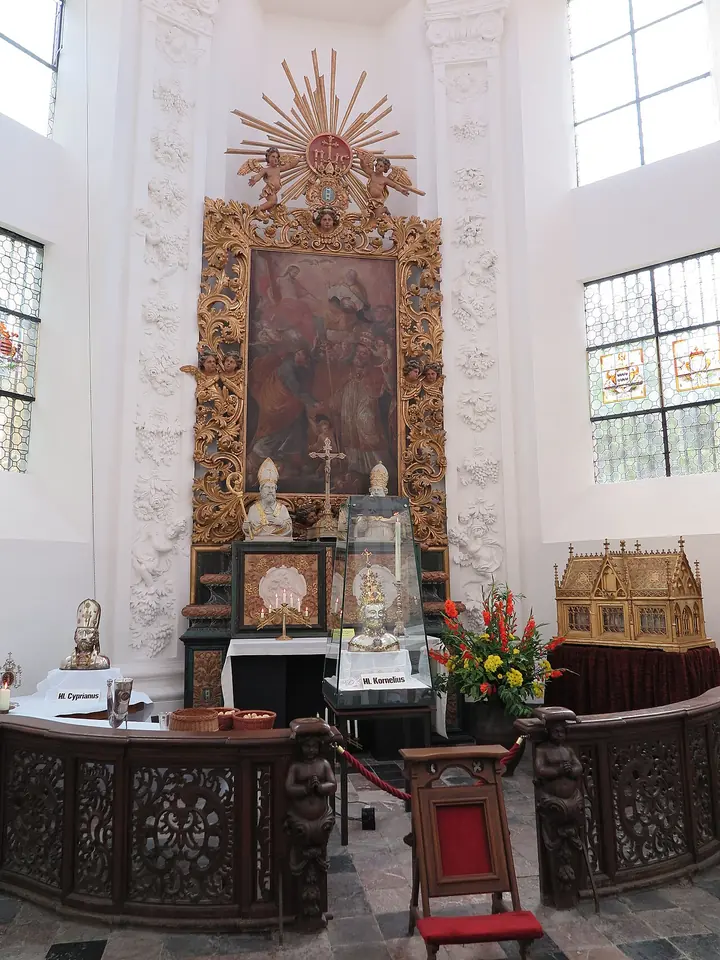
In the 9th century, shortly before the Viking raids, the Carolingian abbey of Inden near Aachen obtained the head of St. Cornelius. From the 11th century it drew an annual pilgrimage, and by the 13th century Cornelius had become the abbey's main patron. The town took his name: Kornelimünster, "Cornelius minster." The abbey church, today the Propsteikirche St. Kornelius, added an octagonal Cornelius chapel in 1706, and pilgrims still come, above all during the Korneliusoktav, the octave of his feast.
His feast is September 16, a memorial in the General Roman Calendar shared with St. Cyprian. Both men are named in the Roman Canon, Eucharistic Prayer I, in the list of saints that begins with Mary and the apostles: "Cornelius, Cyprian, Lawrence, Chrysogonus..." See the feast days calendar for the saints around them.

Prayer to St. Cornelius
The Church's prayer on his feast is the collect of the Roman Missal for Sts. Cornelius and Cyprian:
O God, who gave Saints Cornelius and Cyprian to your people as diligent shepherds and valiant Martyrs, grant that through their intercession we may be strengthened in faith and constancy and spend ourselves without reserve for the unity of the Church.
Cyprian's letter to Cornelius in exile ends with words that are themselves a prayer for friends in hard times, and we can make them ours:
Let us remember one another in concord and unanimity. Let us on both sides always pray for one another. Let us relieve burdens and afflictions by mutual love, that if any one of us, by the swiftness of divine condescension, shall go hence the first, our love may continue in the presence of the Lord, and our prayers for our brethren and sisters not cease in the presence of the Father's mercy.
There is no other traditional private prayer to St. Cornelius in the standard prayer books. In the Rhineland, people simply ask, "St. Cornelius, pray for us," for their animals and for those who suffer seizures. Let us ask him also for the grace he lived by: to welcome home those who have fallen, and to hold fast to the unity of the Church.
Frequently asked questions
Is St. Cornelius the pope the same as Cornelius the centurion?
No. Cornelius the centurion was the Roman officer in Caesarea whom St. Peter baptized with his household in Acts 10, the first Gentile convert named in Scripture. Pope St. Cornelius lived about two centuries later and led the church of Rome from 251 to 253. They have different feast days; the pope's is September 16.
Why is St. Cornelius shown with a horn?
The Latin word for horn is cornu, so medieval artists gave him a horn as a play on his name. In the Rhineland and the Low Countries the horn led people to call on him for horned cattle, and pilgrims at Kornelimünster near Aachen drank blessed water from a horn in his honor. Tradition also made him a helper against epilepsy.
Why do St. Cornelius and St. Cyprian share a feast day?
They were friends and allies. Cyprian, bishop of Carthage, backed Cornelius against Novatian and wrote him some of the warmest letters of the early Church. St. Jerome said they died on the same day in different years, and in the 4th century Rome kept Cyprian's feast at Cornelius's tomb. The Church still honors them together on September 16, and both are named in the Roman Canon of the Mass.
How did Pope Cornelius die?
When a new persecution began under Emperor Gallus, Cornelius was banished to Centumcellae, today's Civitavecchia, the port of Rome. He died there in June 253. The oldest list of popes says he "fell asleep with glory" there, which may mean he died of the hardships of exile; later accounts say he was beheaded. Cyprian and the Roman church honored him as a martyr either way.
Where are the relics of St. Cornelius?
He was buried in the Catacomb of Callixtus on the Appian Way, near the Crypt of the Popes, under a Latin inscription naming him "Cornelius, martyr." In the 9th century his head was brought to the abbey of Inden near Aachen, which took his name and became Kornelimünster. A silver bust reliquary there still holds it.
Keep exploring
- Appears in
- Saint names for boys
- Feast-day calendar
- Saints remembered in SeptemberSaint of the day
- More
- Saints A to ZPatron saints A to ZExplore every section
Sources
- Catholic Encyclopedia (1908): Pope Cornelius. His election, the letters, his exile to Centumcellae and death in June, his Latin epitaph and burial near the Crypt of the Popes
- Eusebius, Church History, Book VI (chapter 43). Cornelius's letter to Fabius of Antioch, with the numbers of the Roman clergy and the 1,500 widows and poor
- Cyprian of Carthage, Epistle 51, to Antonianus, about Cornelius and Novatian. Cornelius made bishop "by the judgment of God and of His Christ"
- Cyprian of Carthage, Epistle 56, to Cornelius in exile. "The whole Roman Church has confessed"; "Let us remember one another in concord and unanimity"
- The Chronography of 354, Part 12: Commemorations of the Martyrs. Cyprian's feast kept at Rome in the Catacomb of Callixtus
- KuLaDig (LVR): Reichsabtei Kornelimünster. The head relic acquired before the Norman raids, the pilgrimage from the 11th century, Cornelius as main patron from the 13th century, the Four Marshals
- Catholic Culture, Liturgical Year: Memorial of Sts. Cornelius and Cyprian (collect)